Encounter

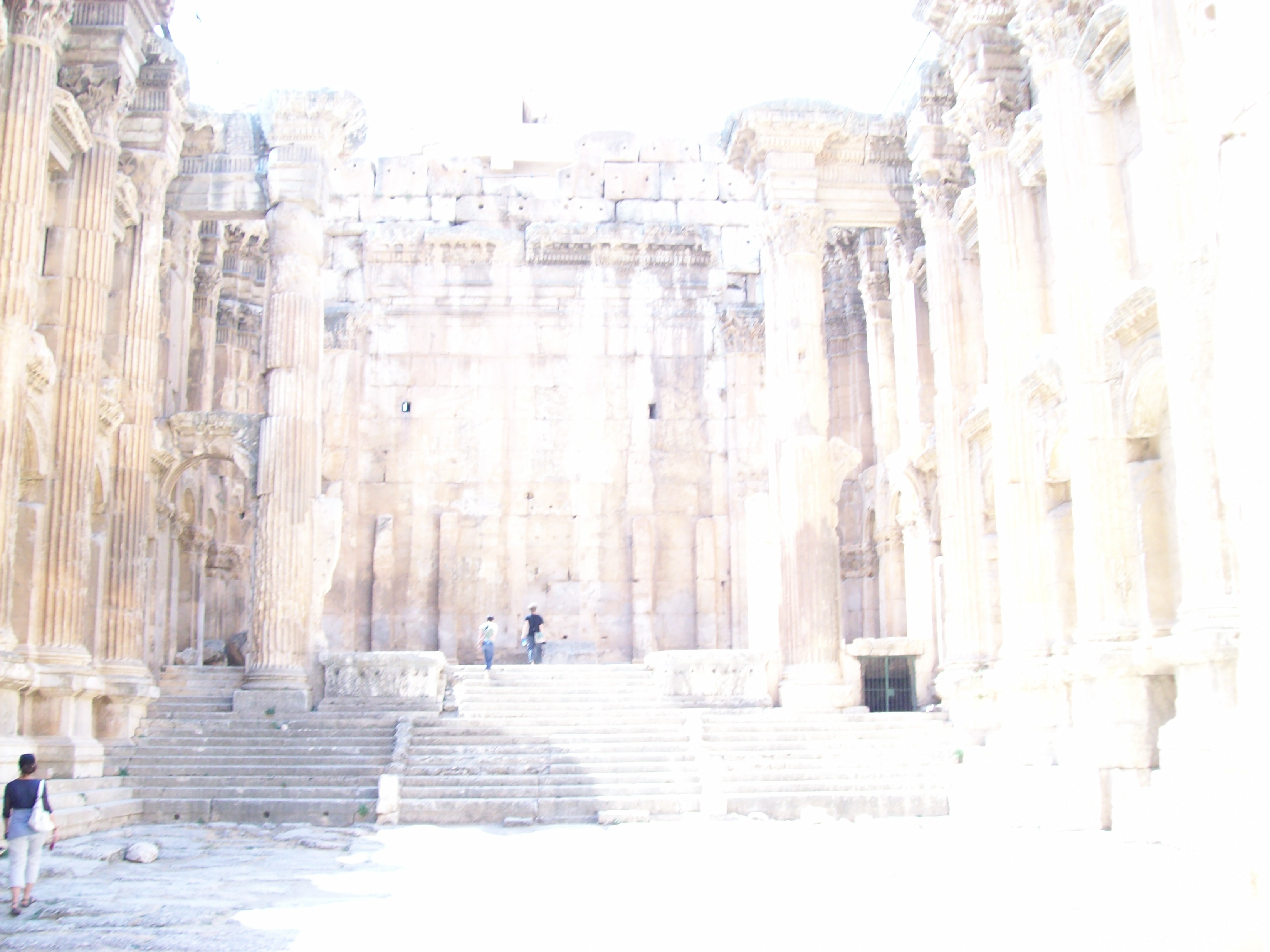
Baalbek, Temple of the Sun, 2010

Beirut, Lebanon, is a fascinating city. There are places we have found to visit once that draw us back again and again. One of those is the Sursock Museum. It was once the home of the Sursock family (funny how they named it after them…) and is a grand old three-story Lebanese home, now filled with modern art. Mr. Sursock and his family were great patrons of encouraging and collecting modern art and every time we come there is a new display. This trip was no different. I have encountered two rooms that are my favorites. One usually has a great collection of old photos, much older than the rest of the art in the place. On Friday, there were late 19th and early 20th century sepia photos of Baalbek, a place I visited in 2010. The color quality of the old photos seemed to match my 2010 versions; the sun was so bright the day I was there that any color simply washed away in its brightness, sacrificed as it were in the Temple to the Sun. The other room is a beautiful old salon with benches that curve around a small fountain. You can just imagine sitting there with a good book and wiling away the hours escaping that same sun on a hot summer day.
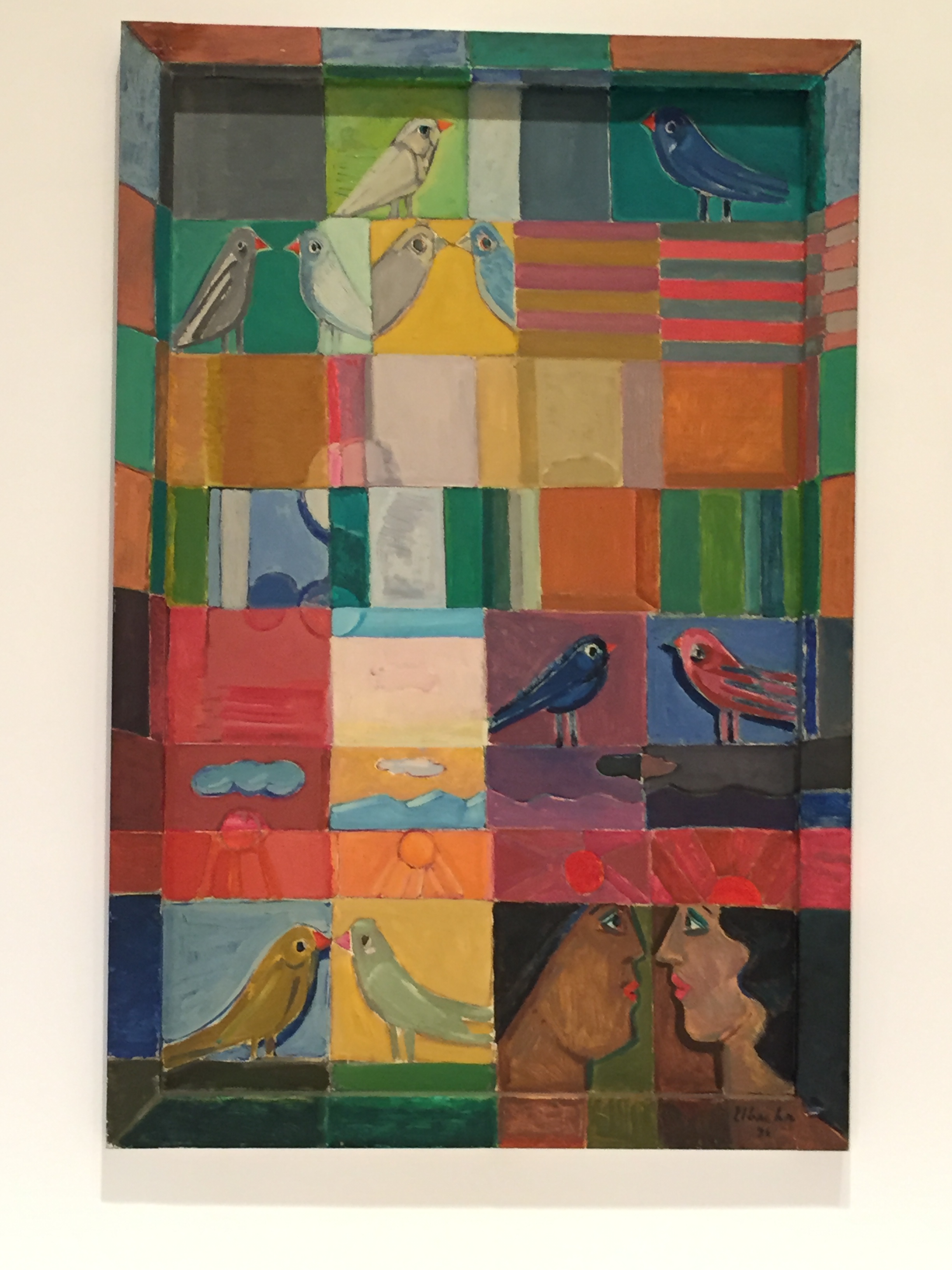
After I scanned the Baalbek photos and poked my head into the salon, I walked a bit farther down the corridor and came across this painting. It is called Encounter and it is by Amine al Bacha, the artist whose work was the feature display of the Sursock. I was entranced by the face-to-face encounters he depicted. Except for the one pair of humans, they are all birds, which I found to be kind of whimsical, as I don’t think I have ever seen birds gaze into each other’s eyes. I noticed that in some of the blocks of the painting they were farther apart and some closer together. They are even touching beaks in one block. They are encountering each other, maybe for the first time, or maybe for the second or third. And I love how the distance closes.

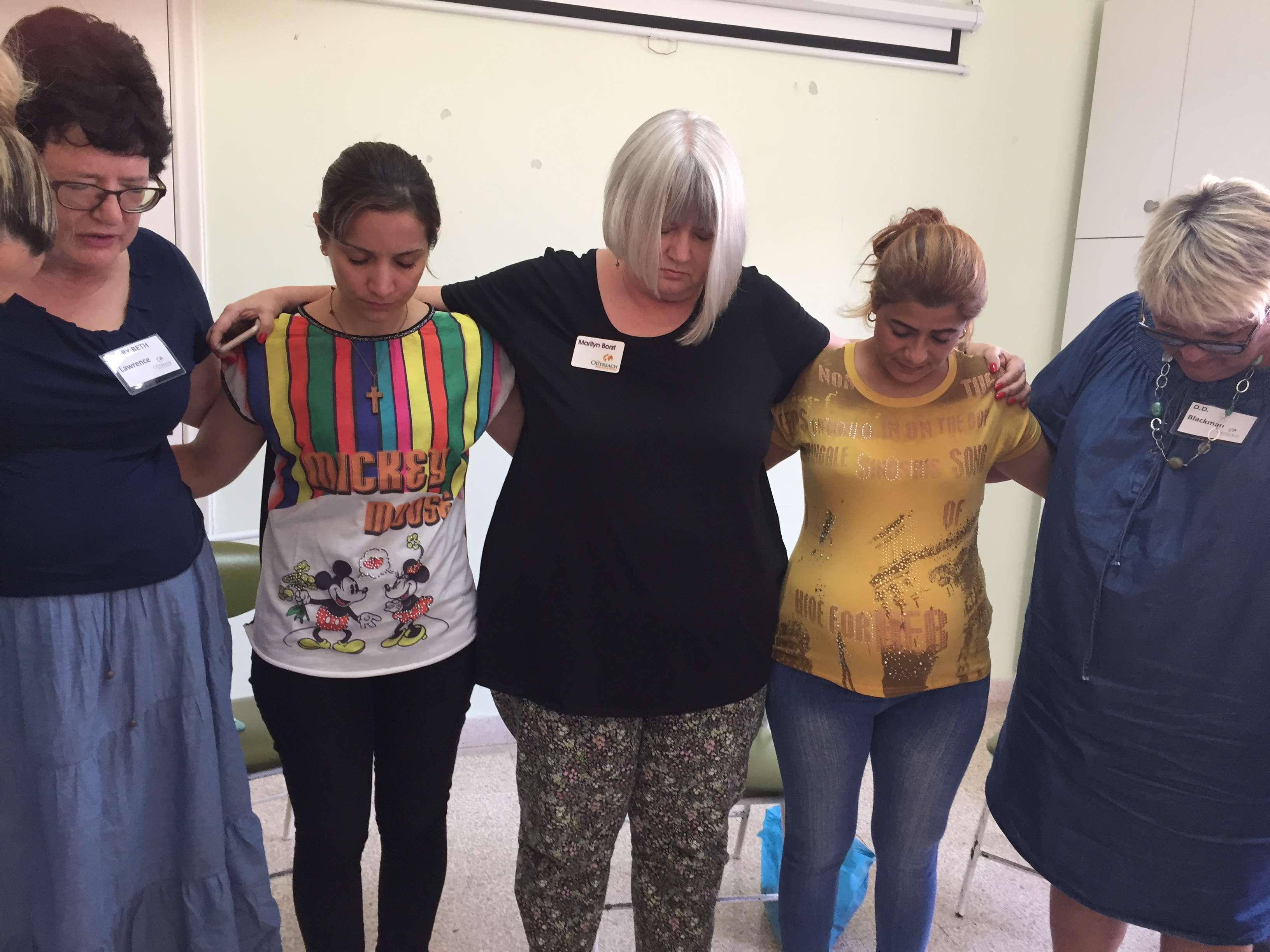
This is how I have experienced my own encounters as I have traveled in these places. The first time in 2010, I encountered new people from a distance. I encountered my roommate, my team members, the church people we met, first in shy conversations and then near the end in nose-to-nose embraces. We encountered each other in those spaces and drew closer to one another in deep relationships. That first roommate is now my dear friend and sister, Barbara Exley. Those team members are faithful women who have gathered me in by Facetime to pray with me over my continued travels. Our faithful leader and my now mentor and friend Marilyn Borst, along with The Outreach Foundation, have enabled me to encounter the churches in Lebanon, Syria and Iraq in ways that help me understand that the body of Christ is much bigger than my church in Omaha, Nebraska. In their midst, I have encountered Emmanuel – God-with-us – who closes the gap between us that our sin and failings create.

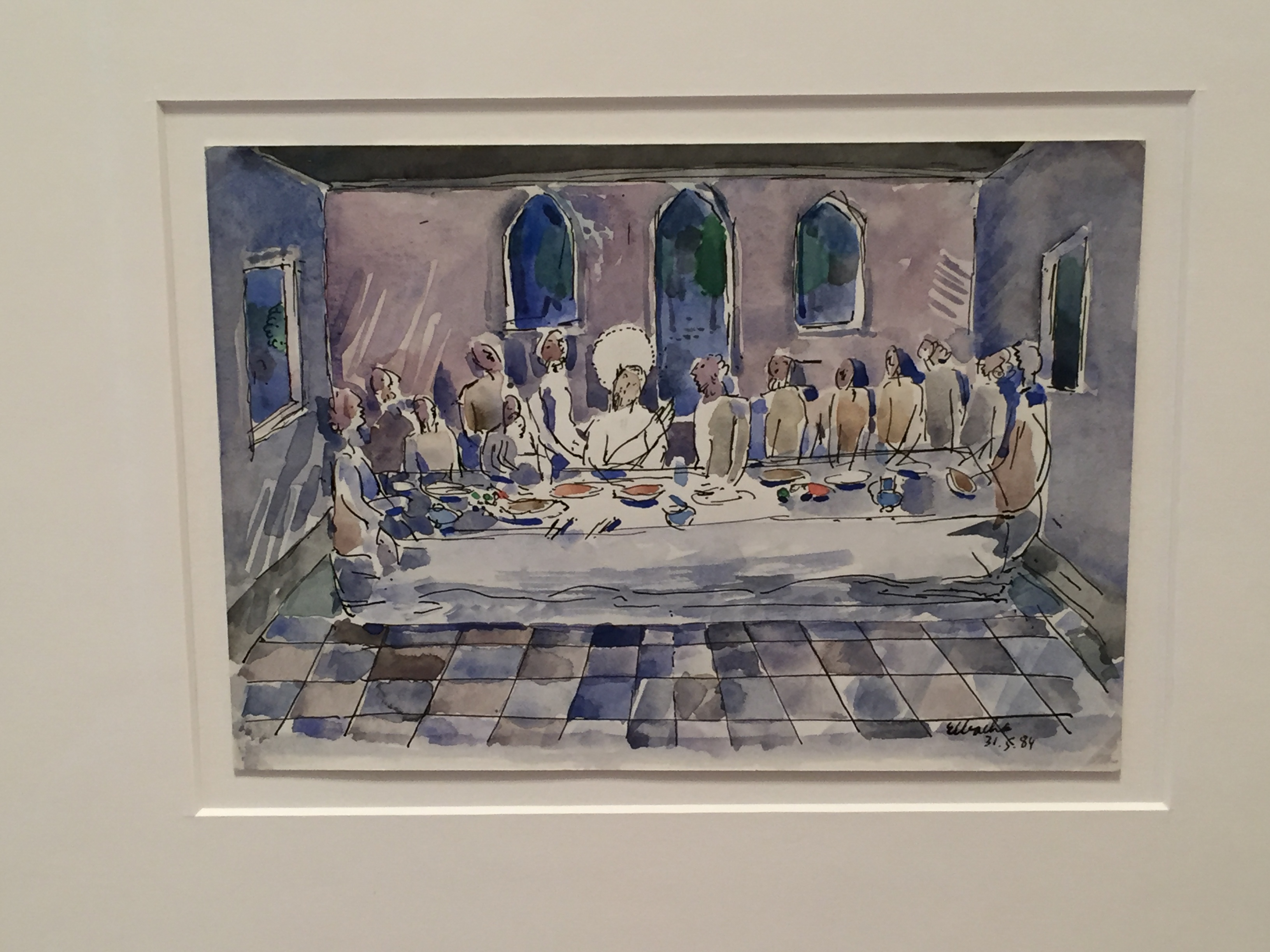
Past the painting of encounter, I discovered a series of paintings Mr. al Bacha did of the last supper, a meal we celebrate and remember every time we have communion. We encounter that same Jesus in the bread broken and the cup raised. That is the place where the gap is closed. And we all are invited to the table to encounter our brokenness and his sacrifice that forgives and heals and redeems us. It was fitting today that in Tripoli, Lebanon, we encountered him again. The words were in Arabic, but the breaking of the bread and the raised cup are universal. He drew us to each other as we shared the elements, and we were all drawn closer to him.

Rev. Nuhad Tomeh and Rev. Rola Sleiman offer the words of institution.

Whether for the first time, or the second, or the thirteenth, I remain grateful for these encounters and the opportunity to meet Jesus face to face.

Belmarouf: With what is known to be good

“Finally, beloved, whatever is true, whatever is honorable, whatever is just, whatever is pure, whatever is pleasing, whatever is commendable, if there is any excellence and if there is anything worthy of praise, think about these things. Keep on doing the things you have learned and received and heard and seen in me, and the God of peace will be with you.” (Phil. 4:8-9 NRSV)

TOF team outside of NEST

It is the end of our first day on this trip to Lebanon and Syria with The Outreach Foundation. I am tasked with encapsulating it for you at home, and so I have taken good notes through our visits on this Friday in Beirut. But as usually happens, the threads of the day all come together into a whole cloth of beauty and truth when someone brings the word to us in a team devotion. Tonight that was Marilyn, our fearless and faithful leader, who gave us the words of Paul (which he gave to the church at Philippi) and the title of this blog.

The words are appropriate for this group of American Presbyterians as we wait in hope for our visas into Syria next week. We will see many hard things. We will hear many hard things. We will wonder where to find hope in a land that is in its seventh year of war. Most of those on this team have experienced it before on other trips to Syria, but some have not. The seeing before does not make the seeing now easier, as those pictures are easily drawn to the front of our brains and we know the names of the people who are the subjects and objects of those stories. Lisa put it very well tonight: they are just like me. But Marilyn’s – and Paul’s – caution is to think on what is good, what is true, what is honorable, what is just and pure and pleasing and commendable. That is quite a list of words to keep in mind, so let us concentrate on the good. I will get to the title later!

Our program visits today were to two of the special partners of TOF in Beirut: the Near East School of Theology (NEST) and the offices of the National Evangelical Synod of Syria and Lebanon (NESSL). To sit with Dr. George Sabra, the leader of NEST, is always like being a part of the best class experience ever. He speaks softly, and is always willing to give the numerical facts of this theological institution – how old it is, how many students, how many faculty – but then will give you the meat of what this place means to the life and vitality of the reformed churches in Lebanon and Syria. For example, to celebrate the 85th anniversary of NEST this past November, NEST published the culmination of a multi-year project to translate John Calvin’s 16th century Institutes of Christian Religion into Arabic. It’s a book for scholars, not the every day reader, so why bother? What do 500-year-old words have to do with today? But then this educator goes on to remind us that Calvin wrote those words in a time when this new reformed faith of ours and the churches which professed it were under great oppression themselves. These words have importance in a 21st century context for Christians in the Middle East and so it was very worthwhile.

Rev. Joseph Kassab, general secretary of NESSL; Dr. Johnny Awad, New Testament professor at NEST; Rev. Lisa Culpepper, South Caroline and TOF team member

We also spent time with Rev. Joseph Kassab, general secretary of NESSL, and an esteemed group of Synod leaders, including Rev. Suhail Saoud, secretary of the Synod’s Committee on Social and Medical Services. Before the crisis in Syria, this committee was a minor committee of the Synod, but since the crisis began in 2011, its mission and ministry have increased exponentially. We have heard about the growth of a project dear to many of our hearts, the five – now six! – schools for Syrian refugee children. A sixth school was recently opened in Anjar, an Armenian area not far from Beirut that already serves 230 students in two shifts. Forty-five teachers in six schools are educating 600 students age 4-11 in English, Arabic, science and math in the Syrian system in the hope that when they can return home they will be ready to continue their education at grade level. These children and their families, almost all living in tents in camps, are cared for with the love of Christ. Rev. Suheil shared the words of one family: “This is the first time we have felt like humans.”

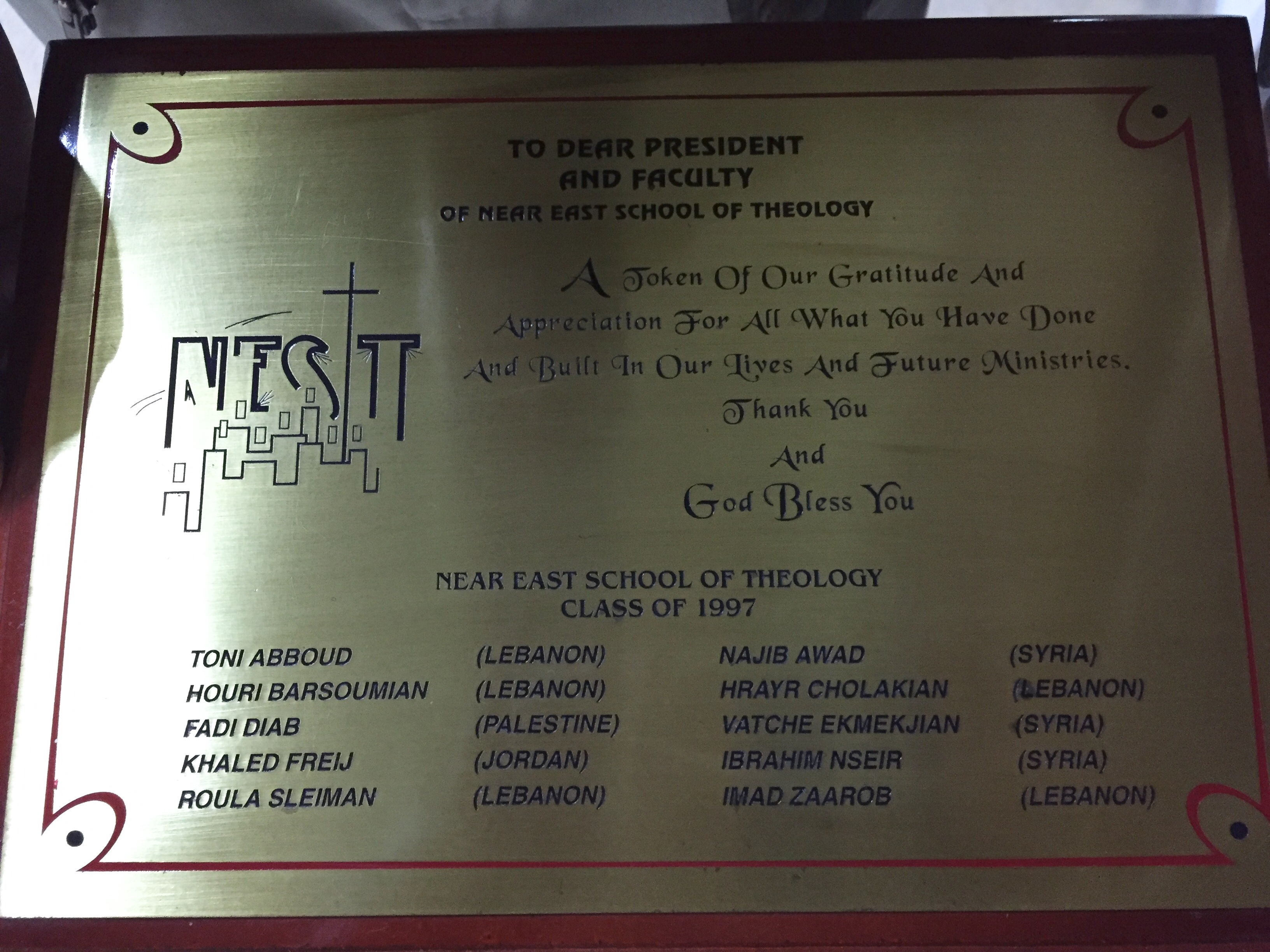
NEST class of 1997

These institutions have interesting challenges. For NESSL, it is coming to the conclusion that the church needs to get outside its walls; it cannot be an insular community. Projects like the refugee schools give the opportunity to daily touch the lives of refugees, nearly all Muslim, with the love of Christ. For NEST, one of those challenges is walking alongside their Syrian students and preparing them for future ministry in the east, in Syria, where the need is great for church leaders. I was reminded of the importance of that leadership as I took the picture of the plaque which represented the class of 1997. Three of those names go with faces I know well who perfectly represent the fact the NEST and NESSL are meeting those challenges. Rev. Tony Aboud is the pastor of the church in Kerbet Khanafar in the Bekaa Valley of Lebanon. His wife Ramak is the principal of the refugee school in Kab Elias. Together this ministry couple and their team touch the lives of sixty-plus students and their families daily. Rev. Rola Sleiman, pastor of the church in Tripoli in the north of Lebanon, is the spiritual leader of a large Synod school there as well as another of the refugee schools. She is also the first woman ordained to the pastorate of a Presbyterian church in the Middle East. Rev. Ibrahim Nsier is the pastor in Aleppo, Syria, a church that volumes can be written about the infinite ways they have served faithfully through the destruction of war. You will hear more about that church and others in the coming posts.

And that takes me back to the title of this post. Belmarouf is a word repeated in an old Syrian love song, which came to the mind of another pastor in Aleppo as he contemplated the destruction of his city. “Oh, how wildly I long for you; how cleaved is my soul to you! I am fully yours, belmarouf (with unconditional goodness). With patience, I will get what I am looking for belmarouf (with your unconditional goodness.” Out of the rape of war, “the new born will heal the wounds of many and will disturb others belmarouf, with goodness and justice.”

As we prepare to see what he has seen, and hear the stories of those who walked those days, we too will think on what is good and just, and remember that it is the people we met at NEST and NESSL who remind us that we have much material to work with.

Belmarouf.

For the team, Julie Burgess, West Hills, Omaha, Nebraska

We Are Marked

One of my chances to write the travel blog from my July trip back to Lebanon…

Traveling with The Outreach Foundation on these ministry experiences as I have for the last seven years, I have learned many things. One of them is that you are part of a team, and even though we begin as strangers, very quickly we bond into a family knowing we have a common Father. Tonight we had the privilege of coming into deeper community with each other as we reflected on the day. Pam Hillis of First Presbyterian Tulsa led our devotion around Romans 12:9-16. In my travel NRSV Bible, the heading says, “Marks of the True Christian.” To paraphrase, we share our gifts, we lift each other in faith, we love and we serve. Those marks should reflect our lives in Christ, marked for us on his head, hands, feet and in his side. This is our model, and today we experienced those same marks on those we came to be with.

The focus of our day was Our Lady Dispensary (OLD) in Beirut, a ministry founded in the days of the Lebanese Civil War (1975-1990). In a small second-floor office in a poor area of Beirut, fifty years worth of war refugees have found their way to Christ’s hands and feet in action. For the past seventeen years it has been lovingly and excellently run by Grace Boustani, a Lebanese social worker and sister in Christ. With limited resources, limited even more by donor fatigue due to the length of the conflicts in Iraq and Syria, she serves some 500 families looking for help with food, medicine, rent and trauma healing.

Our team of nine women gathered in a circle with Grace and Rola, who has been trained to lead trauma healing workshops with a Bible Society curriculum revised for the Middle East context. We heard of children in a pilot week-long camp who arrived on a Monday with no smiles, no words and no hope, and left on Friday as engaged young people, speaking, playing and using their own hands to draw pictures to share their stories.

We met two young women, one Iraqi, one Syrian, each the mother of three, each having experienced the flight-in-the-night story that is so common among refugee families. It is cruel and heartbreaking, and yet here at Our Lady Dispensary these two young women opened up to share with us. And in their stories is where I find Pam’s scripture so perfectly reflected today. Even in the brokenness of lives torn apart by loss and war, these two were in our midst sharing their gifts, lifting us in faith by their acts of love and service.

Sweet R. from Iraq was pregnant with her third child when forced to flee in the night with but a half-hour’s warning as ISIS moved in. Four days later in the temporary sanctuary of her church, she gave birth to her son, now two years old. Coming to Lebanon, her family found OLD and received some help. Not just willing to receive, she has since become Grace’s chief volunteer for the Iraqi refugees served by OLD, serving as a liaison for the families and OLD. She does whatever she can around the office to help, including making coffee and cleaning. How is it possible for this sweet young traumatized mom and wife to be able to serve out of her situation? A woman just waiting for hope whose prayer is “God, just open a door for us”? The answer we experienced is that she is marked: she uses her gifts, her faith lifts those around her, she loves and she serves.

Our new friend Y. is from Syria with another story of loss. So much loss for such young women! High rents. Menial labor for a husband if he can find it. How do you cope? And yet, when she made her way to the OLD neighborhood and Grace’s outstretched hands she found something different than she had ever known. In her words, “The day I started to know God, I started to hope and everything changed.” Y. met Jesus and came to know him through reading God’s word, going to church, and is now a Christian. Her husband has also accepted Christ. One day when she returns to angry parents in Syria who do not want to accept this she will repeat what she has already told them: “Open the Bible and you will see the truth.” She is marked, and having shared those marks with her husband, will one day share them with the rest of her family.

As we reflected on the lives of these two young women tonight, Pam’s devotion brought us all back to the same place: we are the Body of Christ, and that body is marked. May those marks be seen in us all and shine God’s glory as brightly as the marks on Grace, R. and Y.

Celebrating Christmas

Another question from my final exam in Theology 331, Jesus Christ, Liberator, asked us how we might celebrate the birth of the Christ child differently this year after being in this class. Here was my answer.

As a family of people who profess to follow Jesus – Christians – we act in faith and hope and love. These virtues are the highest exercise of our humanity, and in them we participate in the very life of God. But what does this look like for us as we look ahead to Christmas? Do we just believe that Jesus was incarnated so we could have a new television? Is that all we hope for on December 25? Is that how we show our love for each other as husband and wife? Is it so small? This Christmas we need to seek more deeply what it means to be human persons beloved by God so much that he would share this human life.

It begins in prayer. Not the prayer that says, “Bless us Father with all good gifts, especially the 55” one,” but the one that draws us to the foot of the cross and centers us in this reminder of how much he poured out his love for us. Let us pray that our lives would be poured out for each other and for the sister we share this home with. In the light of a candle burning, let us look around at each other’s faces and see the gift of each one and our need for each other. We cannot do this alone, but only together.

As we come together at the supper table, we can break the bread and drink the cup in communion as we remember what Jesus taught here: in the broken bread and poured out cup, he is there, and we share it together. In this sacrament of meal, our lives are joined in a dance of humanity and divinity. The only cookies we make this year shall not be a sugarfest of over-consumption, but a reason to walk the neighborhood and share this gift of love in the form of food with those around us.

martha-stewart-treeTo counter the culture that says BUY! BUY! BUY!, that is what makes for a good solid marketing dream of Christmas, we shall expend our resources in ways to benefit the poor and outcast in our community. The opportunities to provide for the homeless and helpless are the messages we will look to. Instead of presents under a tree in the living room, we will mark each ornament as a gift we have made to someone in the name of love. Here is the one for Wendi who needed a ride to Bible study. Here is the one for Verda Leigh who needed a weekly phone call to remind her that God loves her. Here is one for the gift to Bread for the World, to remind ourselves that advocating for the voiceless is a joy to participate in. Here is one for Amariah, in the hope that she is back with her family in California after a long bus ride from Omaha.

And we will mark the eve of Christmas in worship as we share in song and word with those who have shared our lives, who have mourned with us and rejoiced with us and listened to us unburden our hearts for people living in war in Syria and Iraq.

The work of peace

Homs peace signsI am now officially a graduate student in the Master of Arts in Ministry program at Creighton University here in Omaha. I have spent two weeks with the other members of my program in resident classes there in June. What a joy to meet face-to-face with these wonderful young people! Most of our class time together will be spent online, discussing in Facebook-like posts on what we are reading about, so be together in the classroom was great fun.

During the weekend that came between the two weeks, twelve of us spent time together in an Ignatian silent retreat led by one of the Jesuits from the Creighton community. Father Larry Gillick guided us through those hours of silence with scripture to pray on, stories to think on and the reminder that our identity is found in what we receive from God and not in what we achieve on our own or what the world tells us we are.

A silent retreat. I survived. And yet I still have to make it through an eight-day silent retreat to fulfull the requirements of the class. EIGHT DAYS! Please pray for me. 🙂

I think back on the wonder of that weekend on this day as I prepare to leave once again for Lebanon. I will be spending precious time with sisters in Christ, many of them from Syria. I think how the luxury of quiet would be to them in the days of war they continue to walk through. I think they would love to hear…

Bird song

Wind song

Stillness

Quiet

Peace

One of the best things Father Larry gave me on this retreat was a name: Gerard Manley Hopkins, S.J. Father Larry would bring a well-worn Braille book of poetry with him when he came to our gatherings to direct us. The poetry was all by Gerard Hopkins, a Jesuit and poet from the nineteenth century, who had a way with language that brings me to tears. As we were meeting in the library of the retreat center for these meetings, I investigated the card catalog for some of Fr. Hopkins’ work. Surely in the Jesuit library in the Jesuit retreat center I would find a book of Jesuit poetry…

I was not disappointed.

In my quiet time (there was a lot!) I thumbed through the book and found this waiting for me like a gift under the Christmas tree:

Peace by Gerard Manley Hopkins, S.J.

When will you ever, Peace, wild wood dove, shy wings shut,
Your round me roaming end, and under be my boughs?
When, when, Peace, will you, Peace? I’ll not play hypocrite
To my own heart: I yield you do come sometimes; but
That piecemeal peace is poor peace. What pure peace allows
Alarms of wars, the daunting wars, the death of it?

O surely, reaving Peace, my Lord should leave in lieu
Some good! And so he does leave Patience exquisite,
That plumes to Peace thereafter. And when Peace here does house
He comes with work to do, he does not come to coo,
He comes to brood and sit.

“He comes with work to do.”

peace.jpgThere it was. The peace I have been praying for, and continue to, requires work. It is not going to just sit there and say, “Here I am! All is quiet now.” It is the beginning of work and not an end. We have work to do to make peace and keep peace.

And so I go to be with those who are peacemakers and peacekeepers. And they are blessed. Says so in Matthew 5:9, you can look it up.

Just as Fr. Larry introduced me to Fr. Hopkins and his beautiful poetry and this special one about peace, he also gave me a scripture to contemplate which describes the work I am to do, and you can too if you want to join me in working for peace:

Finally, brothers an sisters, whatever is true, whatever is honorable, whatever is just, whatever is pure, whatever is lovely, whatever is gracious, if there is any excellence and if there is anything worthy of praise, think about these. Keep on doing what you have learned and received and heard and seen in me. Then the God of peace will be with you. (Philippians 4:8-9)

Back to work!

Dona nobis pacem.

Encountering the other

Many of the members of the consultation in Lebanon meet with the Syrian ambassador to Lebanon in dialogue about the situation in Syria.

Many of the members of the consultation in Lebanon meet with the Syrian ambassador to Lebanon in dialogue about the situation in Syria.

Our last full day at the consultation of global partners was a full day that once again began with worship and reflection. Elias Jabbour of Aleppo led us through the music of a Taize service and voices were raised in English, Latin and Arabic. Najla Kassab, who not only runs this conference center but is also in charge of Christian education in NESSL, offered a meditation on 2 Cor. 5:16-21. This portion of Paul’s letter to the church in Corinth is about reconciliation and offers that since we now know Jesus, it is through those lenses that we should look as we seek to reconcile one to the other. We need to look “beyond the flesh” and get beyond those prejudices and hatreds that hinder reconciliation. It is not a process that takes three days or months. This is April 13, the 41st anniversary of the start of the civil war in Lebanon that last for fifteen years. The process of reconciliation is ongoing here, and that was the message that Najla wanted us to hear. Reconciliation is a long journey, but we must do it from a perspective that is beyond the flesh.

Our speakers today had the task of reflecting biblically, theologically and personally on encounters with the other, and in the context we are in here in Lebanon/Syria, those encounters are of the interfaith variety: Christian to Muslim, Muslim to Christian. Rev. Agnete Holm of Denmark and Rev. Hadi Ghantous of Minyara, Lebanon, friends of long standing, carried us through several biblical passages – Old and New Testament – where these encounters take place. And Hadi offered this thought to us about how we read and understand the Bible. The Bible is about encounter. From the beginning God created someone to have an encounter with. Not only does it show us what we are meant to be, but what we really are…what we should NOT be! It is a mirror. The bible is not telling us to do that, but to learn from that.

Agnete reminded us that interfaith dialogue is about building loving relationships, but there are always ups and downs. We fall out, disagree, hate, debate. It is not about agreeing or reaching consensus, or creating harmony. It is about maintaining relationships no matter the fallings out or the comings together. That is long-term vision, not built up in three days, but three decades, the slowest type of ministry you can engage in and the easiest to destroy.

And from there we moved into an actual interfaith dialogue as Dr. Ibrahim Shamseddin, a Shi’ite Muslim, deeply religious man and friend of the Synod, came to the podium. His first words to us were that he had come with a prepared, written presentation, but as he listened to Najla’s reflection and those of Agnete and Hadi, he offered this: “We change our text when we dialogue.” He talked of the diversity of God’s creation: this is his will and should remain this way until he calls us home. If he had wanted merely clones, he would have made us this way. “Interfaith dialogue is about making relationship with others. We see ourselves in the other. Christ is a part of me as well.” And he finished with this thought, which is a good place to leave the formal part of this day: This is an earthly experiment, to live peacefully with each other. I can be with you fully without fitting into your doctrine or dogma. We do not need to clone each other. Diversity is salt, is wanted, and will remain a part of creation.

Rev. Tim McCalmont from California offers Christ's body, broken for us all.

Rev. Tim McCalmont from California offers Christ’s body, broken for us all.

And should you one day make the journey to this part of the world, you would be blessed to come to the end of a conference or consultation where the body of Christ is invited to his table. Lebanese, Syrian, American, Danish, French, Swedish and German followers share the peace of Christ and remember his sacrifice in broken bread and shared cup, for this is the encounter that changes us all.

Jars of Clay

The eight Presbyterian pastors serving in Syria (back row left to right) Jacoub Sabbaagh, Fairouzeh; Mofid Karajieli, Homs; Salam Hanna, Latakia; Elias Jabour, Aleppo; (front row left to right) Firas Ferah, Hasakeh, Kamishli and Malkieh; Ma'an Bitar, Mahardeh and Hama; Butros Zaour, Damascus; and Ibrahim Nsier.

The eight Presbyterian pastors serving in Syria (back row left to right) Jacoub Sabbaagh, Fairouzeh; Mofid Karajieli, Homs; Salam Hanna, Latakia; Elias Jabour, Aleppo; (front row left to right) Firas Ferah, Hasakeh, Kamishli and Malkieh; Ma’an Bitar, Mahardeh and Hama; Butros Zaour, Damascus; and Ibrahim Nsier.

“But we have this treasure in clay jars, so that it may be made clear that this extraordinary power belongs to God and does not come from us. We are afflicted in every way, but not crushed; perplexed, but not driven to despair; persecuted, but not forsaken; struck down, but not destroyed; always carrying in the body the death of Jesus, so that the life of Jesus may also be made visible in our bodies.” 2 Cor. 4:7-10

Marilyn led us in worship Tuesday morning around this passage of scripture which is incarnated for us here by the serving Syrian pastors who have been among us and are the reason we came: to sit with and listen to them tell the stories of affliction, persecution and perplexity of their home places, but also the resurrection stories that come from those same places. This is the church of Lebanon and Syria, and why we need each other. The global church models perseverance for us, and that is Paul’s theme. The church remains hopeful, constant. This text refers to the faithfulness of the church over the long time through difficult circumstances.

This is what the stories of the church in Lebanon and Syria do for us in the west: they become a living epistle. We lift up these stories of faith and faithfulness in Aleppo: Walking up five flights for worship because the building has been destroyed, and then building a new building because they may be struck down, but they are not destroyed as a body. Starting a water ministry for the community to love their neighbors. Or the stories from Homs: Nurturing a community in diaspora. The evangelical school that never closed despite mortar shells and bullets. The elderly home, not only providing loving care to this vulnerable population, but providing a place for worship when the church was bombed. A confirmation class that was conducted from home to home that took two years, but on Easter, 2015, the whole class was brought together. In Kamishli, the church found a way to be present to the Yazidi refugees by providing a source of fresh water and sunk a well. It seems that in these times the church could just hunker down and take care of itself. But the church is not called to survive, but to thrive. In Damascus, the church women devised a project for the refugee women to regain their dignity with the needlework project. In Mahardeh, the continuing education of young children by the kindergarten keeps faithful life incarnated. Mathilde Sabbaagh, a fourth-year student at the Near East School of Theology, who chooses not to flee to Canada because “God has not given me a word for Canada, but he has given me a word for Syria.”

Story upon story, picture upon picture, video footage that brought smiles one moment as smiling Sunday school children in the northeast of Syria showed their Christmas projects, and then sadness the next when a series of coffins was displayed, victims of a series of cruel bombings in the same city.

But as we hear the sadness and overwhelming circumstances of life in this war-ravaged clay pot of a country, we experience the resurrection as well. In Homs, a city under siege for almost three years, churches are being rebuilt and homes are being repaired and families are moving back in.

This is the church we have come to be with. This is the church we are a part of. This is the body of Christ and its life of faith and hope and love and endurance is the witness to the glory of God. May it ever be so.

Narrowing the distance

20160409 cranes photoHere we go again.

Steve and I are sitting in the airport in Minneapolis as we wait for our flight to Paris to board. From Paris, it is on to Beirut, Lebanon, and a rendezvous with our precious brothers and sisters in the National Evangelical Synod of Syria and Lebanon. As always, we are traveling with The Outreach Foundation and our intrepid leader, Marilyn Borst. After being in a consultation with NESSL and their global partners, we will make our way back into Syria.

It always make my heart sing to be setting off on the long journey to an ancient land, a land where the church was born and even Saul-turned-Paul saw the light, was blinded, healed and rose from the darkness to preach the light of the gospel of Jesus Christ.

This time I am going not as a church employee but as a theology student, and I just wanted to start this trip out with a short blog reflecting some truth from one of my classes: THL331, Jesus Christ: Liberator, led by Dr. Thomas W. Kelly, professor theology at Creighton University.

One of our texts for that class is a book that Dr. Kelly wrote with a very appropriate title for me coming from a church with the vision statement, “…on the journey with the living Christ.” The name of his book is When the Gospel Grows Feet, and it is about a Jesuit martyr from El Salvador, Rutilio Grande, and the church in El Salvador, and the gospel of liberation that has been preached from the first day of Jesus’ ministry. I have brought that book and my other required readings with me to keep up with the classes I will be missing and as I sit here in the airport, this is what I read:

“The Eucharist is the symbol of a shared table, with a stool for each person, and tablecloths long enough for everyone. It is the symbol of Creation, which requires redemption. It is already being sealed with martyrdom!” (From Fr. Grande’s last homily before he was assassinated)

This all-inclusive meal, the Eucharist, was the symbol par excellence for Rutilio that God wanted everyone to have a seat at the table of creation. He wanted this symbol of Jesus’ final meal to influence and structure social relationships very concretely. What followed in his homily was a careful argument for what the role of the church should be in the context of El Salvador, how that role should imitate the incarnation of Christ, and how it should perceive the world and its people. After a brief introduction of a church in service to the world, fragile but incarnated in history, the homily is divided into three distinct parts: (1) equality of the children of God, (2) the risk of living the Gospel, and (3) persecuted like Jesus of Nazareth. (Page 208)

There are a lot of geographical miles between El Salvador and Syria. But this I know: the church and its saints in El Salvador and Syria bring me closer to the meaning of this Gospel and that distance should be made smaller as we draw closer to it.

Dona nobis pacem.

Theology Classmates

My foray into higher education at Creighton University has kept me hopping over the last two months. But I made it through to spring break! No, I am not traveling to Myrtle Beach or South Beach or any other beach with the younger folks in my class. I am taking a few minutes to write something for this blog which has taken a back seat to writing for classes. I have written reflections on assigned movies, a letter about St. Ignatius and the Society of Jesus, mid-term essays, final essays and two research papers. It is hard to adjust my writing style to one that is more academic, but I am giving it my best shot!

THL110 class on final nightOne of my classes ended this past Monday as the seven of us in Theology 110 took our final. This group of new friends were a great reintroduction to university life. For seven Monday nights we met for four hours per class and our wonderful teacher, Mr. Mueting, fed us 2,000 plus years of theology. (That is about 300 years per week but one week we covered 800!) Every week he would bring us snacks to carry us through the dinner hour. Last Monday before we sat down to take our final exam we had a potluck dinner to celebrate. We took our picture to mark the end of this required class for all students at Creighton. There we are, Nancy and I, the two fifty-somethings; Heidi, mother of eight and studying creative writing; Manny who works for a bank and has three children; Kat the social worker who brought her perspective about adolescents searching for their identities; Brisa from Mexico whose bright purple socks made us smile; and Kit, a former EMT from Hawaii who is studying to be a nurse. Life in this class was never dull especially when Mr. Mueting, a dramaturge at heart and a former contestant on Jeopardy, stood at the front and opened the fire hydrant and poured out his extensive knowledge of theology.

It has been a marvelous two months.

Along with this class I have been taking another class in a more traditional format: 30 students (all 20 or 21, except for me!) led by a tenured professor whose doctorate in theology is on full throttle for each Monday and Wednesday class. This class has been such a gift as I have heard affirmation about what it means to love God and love your neighbor and that those two things are in tandem and should not and cannot be separated!

In both of these classes I have had good opportunities to share about the church I have been privileged to stand with in the Middle East and to bring a perspective that others might not be aware of. Even as I have been taught, I have tried to teach.

With all of these good people who share this time in history with me, I have learned about the saints who have handed down this faith to us, and it is these people I am most grateful to. Listen to their voices:

  • Disasters teach us humility. – Anselm of Canterbury
  • Man should not consider his material possession his own, but as common to all, so as to share them without hesitation when others are in need. – Thomas Aquinas
  • What does love look like? It has the hands to help others. It has the feet to hasten to the poor and needy. It has eyes to see misery and want. It has the ears to hear the sighs and sorrows of men. That is what love looks like. – Saint Augustine
  • Thou hast made us for thyself, O Lord, and our heart is restless until it finds its rest in thee. – Saint Augustine
  • Occupy yourself in beholding and bewailing your own imperfections rather than contemplating the imperfections of others. – Saint Ignatius
  • I wish not merely to be called Christian, but also to be Christian. -Saint Ignatius
  • Experience proves that in this life peace and satisfaction are had, not by the listless but by those who are fervent in God’s service. And rightly so. For in their effort to overcome themselves and to rid themselves of self-love, they rid themselves of the roots of all passion and unrest. – Saint Ignatius
  • Be who God meant you to be and you will set the world on fire. – St Catherine of Siena
  • You are rewarded not according to your work or your time, but according to the measure of your love. – St Catherine of Siena
  • Peace is not the product of terror or fear. Peace is not the silence of cemeteries. Peace is not the silent result of violent repression. Peace is the generous, tranquil contribution of all to the good of all. Peace is dynamism. Peace is generosity. It is right and it is duty. – Oscar Romero
  • If we are worth anything, it is not because we have more money or more talent, or more human qualities. Insofar as we are worth anything, it is because we are grafted onto Christ’s life, his cross and resurrection. That is a person’s measure. – Oscar Romero
  • There are not two categories of people. There are not some who were born to have everything and leave others with nothing and a majority that has nothing and can’t enjoy the happiness that God has created for all. God wants a Christian society, one in which we share the good things that God has given for all of us. – Oscar Romero
  • “he Lord God, in this plan, gave us a material world, like this material bread and this material cup which we lift up in offering to Christ the Lord. It is a material world for everyone, without borders. This what Genesis tells us. It is not something I make up. – Rutilio Grande

I think that there is song worth singing in those quotes, and a life worth living. And if we who call upon the name of the Lord could join that choir and craft our lives to the lyrics of that song, like St. Catherine said, we would set the world on fire.

Amen.

Heartburn

That's my trip journal for four trips to the Middle East. The spine is busted from stuffing it full of inserts of hymns, printed prayers, photos and bios of my teammates, devotionals I've led and other memories on paper too important to discard.

That’s my trip journal for four trips to the Middle East. The spine is busted from stuffing it full of inserts of hymns, printed prayers, photos and bios of my teammates, devotionals I’ve led and other memories on paper too important to discard.

I was looking through my dog-eared, spine-busted journal tonight for an email address. There are so many inserts into this broken-backed book! And while I found the email, I also found this. On this night, before I begin my journey into a master of arts study of ministry at Creighton University, it reminds me of one of the big reasons I am stepping out.

I wrote this article in May, 2013, shortly before my second trip to Lebanon. I am so happy to share it tonight.


Wading Into Deeper Waters

There is a difference between heartburn and a heart that burns. The former is felt usually around some poor eating habits or gastrointestinal issues. It’s very uncomfortable if you’ve ever experienced it, but you can take a pill. The latter can also be uncomfortable, but I would describe it more as comfort-afflicting. If your heart has ever burned for something or someone, your only response is action. If you don’t do something about it, it just gets worse. There is no magic pill.

My heart has burned for the situation across the Middle East since I was in high school and my step-brother Charlie worked for NBC News in Lebanon, covering their civil war which raged for fifteen years. Every night we would watch the news and see pictures of the atrocities that Charlie had stood in the midst of to get the story to us in the U.S. It was hard to watch and understand why these things went on, but more than anything, we hoped Charlie would be safe.

My heart kept burning through the years and then I met Maya in a women’s bible study here at West Hills. A native of Lebanon, she returned there to visit family in 2006 and was stuck in the middle of another war. When she came back thoroughly shaken, heartbroken and angry, reliving her childhood, she shared with us her story. This woman of faith simply asked, “Why do they hate us?”

Then I met Marilyn Borst of The Outreach Foundation and she was taking a group of faithful women to visit the churches of the Synod of Syria and Lebanon. We would travel to Beirut and visit the churches founded by missionaries in the 1800s. We would travel to Damascus and Aleppo in Syria, doing the same. We shared worship. We shared time at a women’s conference. We were welcomed into their homes. We shared coffee and tea and sweets. We met with Iraqi refugee families who were being cared for by the church. We heard stories of courage and of love and of faith, a faith lived out for over 2,000 years.

And I came home with new friends and new connections in this global gathering we call the Body of Christ. And my heart burned to return, to be back in the company of those women and those churches, to share life together again. And we would have returned the following year, 2011, but once again, war broke out.

This time the war was in Syria – first an uprising in a small town, now a two-year old war – and we couldn’t go back because it wasn’t safe…for us. It’s not safe for them either, but they live there. Or they did.

The Presbyterian Church in Aleppo, Syria, where we sang Amazing Grace and shared with the families who were caring for Iraqi refugees was completely destroyed in November, 2012. We got this news from synod officials who had traveled to be with us in a large gathering in Erbil, Iraq. Those of us in that room who had worshipped at the church in Aleppo were grieving: grieving for the ministry that would no longer be done in that neighborhood, grieving for the plans of the renovation of a Christian high school that would have served all faiths, grieving for the work that Assis Ibrahim and his congregation had done together as incarnational witnesses. Their church home was destroyed, many of their own homes were destroyed, their jobs were gone. Those who cared for refugees were now refugees themselves as they fled to safe parts of their country or to Lebanon.

In some of Paul’s epistles he refers to a collection for the church in Jerusalem. The churches created from his and other missionary journeys were collecting money for the benefit of the persecuted church there. The Outreach Foundation and other churches in our denomination are doing the same thing for the present day persecuted churches in Syria. They are collecting money to send to the Synod of Syria and Lebanon to aid these now displaced brothers and sisters in the small but important ways they can. And the people of our church have responded to that plea in the form of a $10,000 gift granted by our Mission Team. And my heart burns with gratitude at this response. We are not called to suffer as they have been. But we are called to stand with them: to show up when we can, to release the resources that God has provided us to be used in their time of need.

This burning heart of mine will return to Lebanon in May. My prayer is that these people of God will know his peace that passes all understanding. That they will be comforted by his gracious Holy Spirit. That they would have abundant life restored to them. That they would continue to shine the light of Christ wherever they are. And that they will be strengthened in this time of trial.

“I consider that our present sufferings are not worth comparing with the glory that will be revealed in us.” Romans 8:18

And now in January, 2016, I am happy to reflect back on this. The church building in Aleppo has been rebuilt in a safer place and the saints worshipped there for the first time on Christmas. The church body never stopped meeting, climbing five flights of stairs to meet in an apartment together for the last three years.

The Aleppo College for Boys, that Christian high school, has never closed its doors during the continuing conflict, now approaching its fifth anniversary. It continues to be a place where Christian and Muslim learn side by side.

My church, West Hills Presbyterian, has given other gifts to the Syria Appeal of The Outreach Foundation totaling some $25,000. (You can give too! http://www.theoutreachfoundation.org)

I have traveled back to Lebanon three times and to Syria twice. Steve and I will be returning to both again this spring.

And the inspiration of the church in persecution has put a vision of ministry in front of me, and the fulfillment of that vision begins tomorrow night when I take my first class at Creighton University.

May God continue to cause my heart to burn, and may he inflict you with that as well.

Dona nobis pacem.