Loaves and fishes

Amish friendship breadThe check-in question at staff bible study this week was “When have you been used by God in a way that you didn’t expect?” It’s the kind of question you search your memory banks to find an answer for. I couldn’t jog my memory in that way so instead came up with a story of how God used someone for me in an unexpected way. That was the subject of my blog entitled, “So Jesus walked into church today,” but that is not the subject of this blog!

My co-worker Kelley told the story of her 8-year-old son coming home from school and reporting that his friend only had a sandwich in his lunch and couldn’t they do something about it? As Kelley thought about who this friend was she remembered that he was the tenth child of a mother who had died while pregnant with what would have been her eleventh child. This mom was diagnosed with cancer and opted not to have chemo or radiation so she wouldn’t harm her still enwombed child. The sad ending of this story is that both died; dad and the other ten children are the remainder of this family.

That dad and mom were special in our community because of how they lived out God’s call to love our neighbors as explained in Matthew chapter 25. They created what is now the largest provider of food to families in our community who know what the term “food insecurity” means, Mission For All Nations, now known as Heartland Hope Mission. They feed thousands every month in Omaha, Nebraska.

The irony of the story (as I saw it) was that this little boy whose mother has been gone for five years, does not have enough to eat. But the good news of this story that Kelley shared is that she just stepped into that gap and not only sent her son with lunch to school, but packed an extra one for his friend. Then she discovered that a number of people at this school have stepped up to help all of the siblings who attend this school. The community – the family of God – is sharing their loaves and fishes so that there is enough for all.

The passage we studied that day in staff prayer was John 6:1-14, which is John’s version of the feeding of the 5,000, the only story that all four gospel writers recorded other than the story of Jesus’s death and resurrection. Two stories so amazing, that all four of these storytellers remembered and retold them.

It is such a familiar story to me and others that we can hardly expect to see something new there, and yet on Tuesday I did, prompted by Kelley’s story and pondering something I have imagined about how it happened that Jesus could feed all those multitudes with five loaves and two fish.

Verse 5: Lifting up his eyes, then, and seeing that a large crowd was coming toward him, Jesus said to Philip, “Where are we to buy bread, so that these people may eat?”

And then in verse 6 is this part that struck me in a new way:

He said this to test him, for he himself knew what he would do.

He himself knew what he would do…

Of course he knew. He is God after all. 🙂

But we spend a lot of time looking at this miracle and imagining Jesus just taking those loaves and fishes and using his magical miraculous powers to keep a basket of bread and fish from running out as the disciples pass it around to the 5,000 men seated there, and then collecting up the twelve baskets of leftovers. Haven’t you done a lectio divina study of this passage, closed your eyes as it was being read for the third time and pictured the basket with a level of bread that just doesn’t go down? I have. So maybe I’m the only one…

It is a memorable miracle recorded in Matthew, Mark, Luke and John, which we read – again – on Tuesday.

But right before we read it, Kelley shared that story…

And then Jake, who was leading our study, said that God uses what he has right there in front of him to meet the need – their need, our need – while we are worrying about where we are going to get the food to feed all these people.

“Here, Lord, this little boy has his lunch with him. A couple of small loaves with some fish. Looks like the makings of a sandwich for one. That’s one. You will have to take care of the other 4,999.”

And Jesus looks out there – he himself knew what he would do – and sees…

…his creation. A community of people. 5,000 men (so the account says). What it doesn’t say is (but we always mention it because it makes the miracle that much BIGGER) is that there are women and children, too, maybe 10,000 or 15,000 total. We know there are more than just men because, hey!, there is that one little boy with his sack lunch that Andrew has just offered to Jesus. (We don’t even know if Andrew asked the little boy if he could take it!)

And this is the miracle that I think happened, and go ahead and disagree with me if you want. You can close your eyes and see the story however the Holy Spirit puts it in your mind, but this is my version.

Jesus looks out there and knows what he will do. He sees a community of people, including boys with lunches their mothers packed, and most likely their mothers, too. Mothers who do what needs to be done when their sons go to school with well-packed lunches and their friends have less. Mothers get together to meet the need. And surely if there is one little boy with a well-packed lunch in that crowd of people learning from the master teacher, the Lord of creation, there are hundreds of little boys and little girls and their mothers who know they need to eat so they can learn and work and live.

Jesus – God – uses what he has right there in front of him. He knows what’s there because he made it: US! He gave us what we need: FOOD! He created us to be a community: LIKE WHAT HE GATHERED AROUND HIM.

You’re right. It doesn’t say that in John 6 or Matthew 14 or Mark 6 or Luke 9. It doesn’t indicate how Jesus fed all those people. But like Jake said, he uses what is there to make his kingdom come.

I just love this story. Jana and I have been advocating on hunger and poverty issues for years with Bread for the World and will do so again in June when we head up with hundreds of others on Capitol Hill in Washington, D.C. We will be mothers and fathers and sisters and brothers asking our government – our WE the PEOPLE – to use what God gave us to feed the hungry multitudes in our midst, in our cities, in our country, in the world.

“My friend has a very small lunch,” said Kelley’s son when he came home from school. The tenth child of the man who created the biggest supplier of food for hungry people in our community, is hungry himself. And God looked out there and saw Kelley and used her and the lunch she made for her son that day when he went to school. And just like Matthew, Mark, Luke and John, she told us the story so that we would know.

God uses what is right there in front of him. You and me and our lunches, because it is more than enough for all.
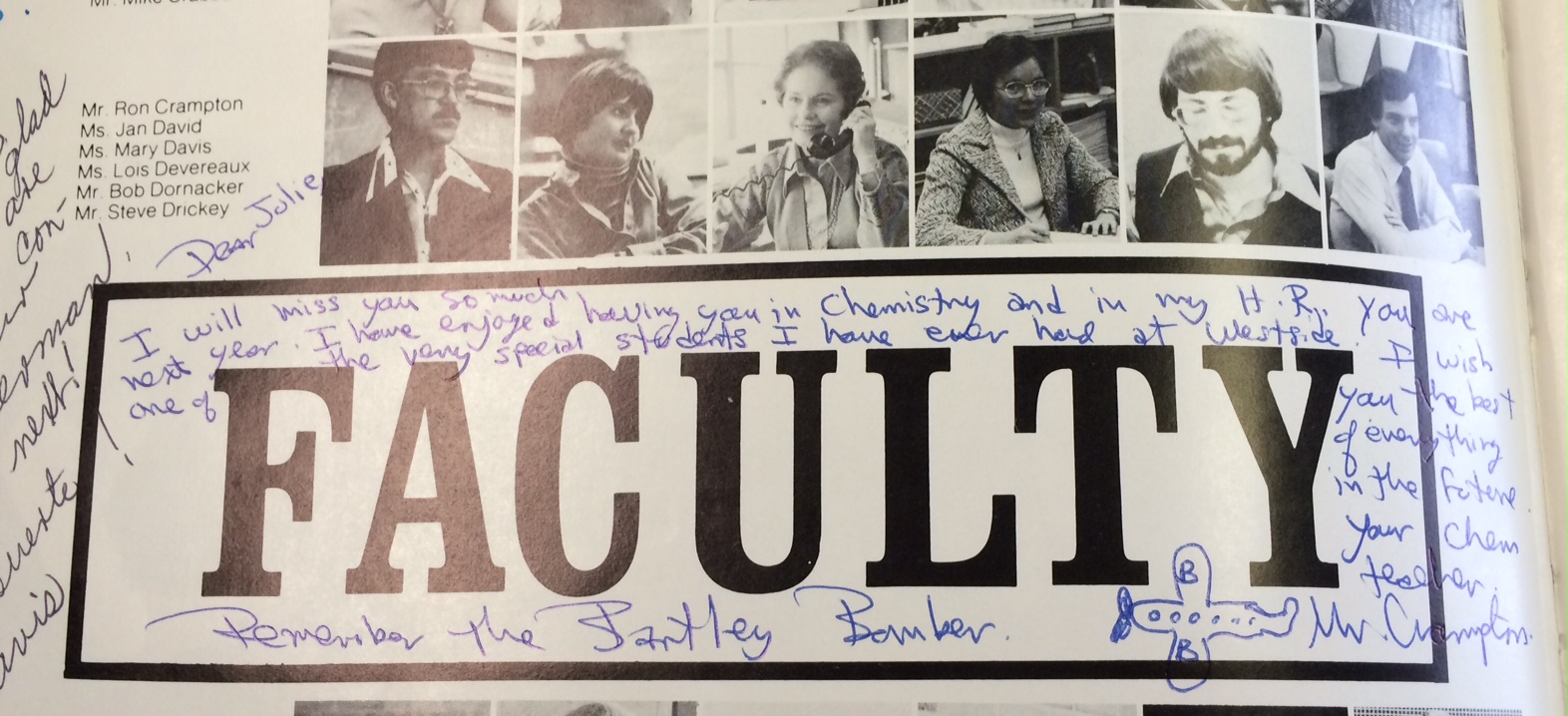
Teaching Chemistry

"Dear Julie, I will miss you so much next year. I have enjoyed having you in chemistry and in my H.R. You are one of the very special students I have ever had at Westside. I wish you the best of everything in the future. Your Chem teacher, Mr. Crampton. Remember the Bartley Bomber."

“Dear Julie, I will miss you so much next year. I have enjoyed having you in chemistry and in my H.R. You are one of the very special students I have ever had at Westside. I wish you the best of everything in the future. Your Chem teacher, Mr. Crampton. Remember the Bartley Bomber.”

Not every teacher can teach chemistry. And not every chemistry teacher has the chemistry to teach. I had a chemistry teacher with both qualities. He made me, a person much more comfortable with nouns and verbs and adjectives, a confirmed non-thinking-especially-in-a-scientific-manner kind of student, actually enjoy and look forward to chemistry class. I understood what was going on! I worked for him and the chemistry team as a lab assistant for two years, following in the footsteps of my much brighter and more scientifically inclined sister Jana. My sister Susan followed me into the same position in the lab.

His name is Ron Crampton.

I have the most wonderful memories of my years in school in District 66 and love it when I come across my teachers on Facebook to let them know the impact they had on my life. Whether in the English department, the German department, math or science, they gave me the desire to always learn; to ask questions; to tell the stories that come from life. I wish every student, past, present and future, could have teachers like I have had.

Working for and learning from Ron was a joy. Those two years in the chem lab as an assistant I worked alongside my best friend, Sharon Uhrich, now Heimes. We ran the water distiller, filling hundreds and hundreds of five-gallon bottles. We mixed solutions. We set up trays for experiments. We typed stencils and then ran off reams and reams of worksheets and exams. We washed billions and billions of beakers and flasks and eye dropper bottles of reagents. We organized and alphabetized chemicals.

We created The Phantom!

Mr. Crampton indulged our every whim in that lab for those two years. As we finished advanced biochemistry in our senior year, he kept us on to monitor test-taking in his other chemistry classes. He trusted us and he laughed with us at our phantom antics.

Crampton OWH articleMr. Crampton was a chemistry teacher who would do anything to get you to understand a concept. Along with Dr. Flub (Louie Niemann) he would make chemistry large group in the auditorium into a production. As Dr. Flub explained the way a nuclear accelerator worked by speeding up atoms so they could crash into each other, knocking nuclei together to release their protons to form new elements, Mr. Crampton, dressed in white lab coat with a toilet plunger in his hands like a knight’s lance, ran at full speed down the aisle and flipped into the orchestra pit, breaking his arm. It was legendary! Chemistry at its finest!

We graduated in 1977, and I still have a clip from the Omaha World-Herald extolling the teaching virtues of this educational virtuoso. Sharon and I added our own headline to the story for our classmates.

Crampton ice cream inviteThis was Ron Crampton. Every semester after the advanced biochem class ended, he would invite those who had taken the class over to his home for a “carbohydrate” party. Dinner was served picnic style by Ron and his wife Meri, and was followed by his own homemade ice cream. Ice cream turned in a hand-cranked freezer was just another way to show us the practical ways chemistry was a part of our lives. Adding salt to water creates an endothermic reaction – one that requires energy for the salt to dissolve in the water. This natural lowering of the temperature in the system, along with the rotation of the freezer, makes ice crystals form in the milk-egg-sugar solution inside the canister, moving it from a liquid form to the tasty frozen treat served in bowls with toppings.

He went on to win multiple awards for his teaching at the local, state and even national levels.

He knocked on my door last night. 38 years after graduating from Westside High School we are still friends. He even came to my wedding in 2002! He tends the gardens at the church two doors north of my house and they are blooming in glory right now in this April spring. Retired from teaching since 2001, he is a master gardener.

He also tends the flower beds at a local historic landmark, the Joslyn Castle. He was there last evening doing his thing and noticed there was an event going on, so being the curious scientific type, he investigated. Inside there was a book-signing going on for a new children’s book, The Oracle’s Fables, about Warren Buffett, our local billionaire. Ron noticed the author’s name was John Prescott, so he continued his investigation and discovered that John is the cousin of his three former lab assistant sisters: Jana, Susan and me. That conversation led to John explaining that our other sister Sally (never served as lab assistant, but he certainly had her as a student) was also a published author, just releasing her second book. (Both of Sally Gerard’s books, Windows in the Loft and Worthy of Love are available on Amazon. Shameless plug. 🙂 )

And that is why Ron was on my doorstep last night. He had come to share his joy at having had such amazing students in his classroom all those years ago. We hugged and laughed. I showed him Jana’s new digs coming to completion in the addition to our house. Just friends. Not teacher and student anymore, just friends.

He has a teaching chemistry. Combine knowledge of a subject and a creative way of imparting it and it creates exothermic, energy-producing, reactions. His classroom antics and inspiration are seen in the lives of his students decades later. Peace and hunger activists. Environmental activists. World travelers. Authors.

Makers and eaters of homemade ice cream.

He signed my senior yearbook under his faculty picture that year. It’s at the top of this post. “I wish you the best in everything in the future,” he wrote 38 years ago.

A wish that has come true, and not because of magic thinking.

A wish come true because of teaching chemistry.

The Politics of Hope

crabapple tree in bloomIt’s started.

Our great American political circus, I mean the presidential campaign season, has started for 2016. Cruz is in! Rubio is in! Hillary is in! (In case you don’t know me, that last one makes me happy. 🙂 )

“I still believe in a place called ‘Hope,'” said the last president named Clinton.

I still believe in that place as well, although I don’t find it in the political circus or any of the performers in that ring, even Hillary.

But I don’t blame politics for that. I just blame what we have let the meaning of that word become.

In the Merriam-Webster dictionary the fifth listed definition of politics is this:

the total complex of relations between people living in society

Total. Complex. Relations. Between people. Living. In society.

It’s what has been modeled for me in the body of Christ – the church – a place that has struggled with politics since its birthday two thousand years ago, and yet still walks on, humbly and imperfectly. With hope.

Its totality: global, existing in its varied parts across the whole planet. I have walked with my brothers and sisters – the eyes and ears and limbs I cannot get along without – in Cameroon, the Czech Republic, Germany, Iraq, Lebanon, Syria. It’s a big family!

It’s complex: orthodox, catholic, reformed, apostolic, evangelical, monotheistic but based on a trinitarian dance of Father, Son and Holy Spirit.

It’s relational: in worship, in creeds, in sacrament – sharing life together with the one who gives us life.

Between people: and among people! Caring for each other in crisis. Praying at the bedside of the dying. Feeding the hungry. Standing with the oppressed and imprisoned. Seeing the value of our human lives as our created made us. High and low, young and old, male and female. Between. Among. Connected.

It’s living: ISIS can’t destroy it (although it is trying); purveyors of the prosperity gospel can’t dilute it and sell it like indulgences (although they try). Its message of the real good news – death is defeated! – puts air in our lungs.

In society: I have seen it care for the least of these in a home for the handicapped in Ludwigsburg, Germany. I have it walked with it among Syrian refugees in camps in Lebanon. I have heard it shouted from displaced Iraqis now in Kurdistan: we may have lost everything, but we still have Jesus! It will not be silenced. It is in the public square and ministering there.

And that is where I find hope in politics. Not in the mud-slinging that is to come as we sort out who our leaders should be, but there in that buried fifth definition from Merriam-Webster.

I find hope in that crabapple tree on our back patio. It’s roots are bound by concrete on all but one side, and yet every year it pushes out those gorgeous pink blossoms which will fall like snow in a week. The blossoms will wither and descend. The tree will hibernate in the fall. And then…BAM! Here they are again.

John 1:14 says the word was made flesh and pitched its tent with us. The complex totality of the word of God moved into the neighborhood, into our society, to live with us.

And hope is here still.


Three days

Cathy and Mommy's headstones 2014

March 24 was this past Tuesday, and it marked the second anniversary of Cathy’s brutal, inhuman exit from this world. Sally and Susan had asked us Omaha siblings to put some flowers at her cemetery marker that day. Mike, Jana and I, along with Barb, did just that. It was cold and rainy, but we put a beautiful small bouquet in the vase by Mommy’s stone (soon it will be between the two matching stones). Mike brought some of Cathy’s own stones which were precious to her, and some sage, which we burned. I reminded him that in the church when incense is burned, it is a fragrant representation of our prayers rising to God in heaven.

We each prayed in our own way that day. And we took pictures and shared them with Sally and Susan and George. As I have said, we once were seven even if now we are only six.

The picture above is from last year when we began this new, poignant tradition. Year one, and now year two; next year will mark three years.

But standing there in the chilly misty air, I was again struck by the dates on the stones: Cathy’s death was on March 24 and Mommy’s was on March 27.

Three days.

It took me back to 1966, when I was seven years old and we had said good-bye to Mommy at the mortuary as they closed her casket. I can still see Daddy kissing her good-bye one more time.

I don’t remember the funeral at all. But I remember, a spring day after the funeral. Mommy’s rosebush was blooming so it must have been many weeks later, May or June, and not the chilly spring days of late March or early April. The bush by the front door was covered in those tiny pink roses and I picked some. I broke some small limbs off the yews that were planted across the front of the house, and I made a little floral altar where I could pray. I can remember this all so clearly, just like it happened this past Tuesday, but it was 49 years ago.

Genuflecting in front of my little homemade altar, I prayed:

In the name of the Father and of the Son and of the Holy Ghost. Dear God. You brought your son Jesus back to life after three days. Would you please just bring Mommy back like that?

Here we are now in 2015 coming into Holy Week. Palm Sunday is three days from now. Maundy Thursday is three days from then. And then Easter, three days later.

Three days.

In the hymnal,  it goes like this:

  • All Glory, Laud and Honor
  • O Sacred Head, Now Wounded
  • Christ the Lord Is Risen Today!

And as I look at the twin headstones and see the three days there (47 years apart) separating the end dates of two women whom I have loved and who loved me, I have to pause here in that middle place. I have to get through Maundy Thursday and O Sacred Head, Now Wounded. I can’t leap from the joy of life to the joy of resurrection without walking through the suffering and death of the cross.

Yes, I have to go through. But…I can’t stop there. The deaths of Mommy and Cathy have colored and shaped my life, just as the death of Jesus has. I have mourned, I do mourn and I will mourn.

But oh, that third day – Resurrection Sunday – is where my victory is. And it is where Mommy’s is and Cathy’s is as well. And so I will celebrate their lives and I will find joy there.

Christ the Lord is risen today! The third day.

Amen.

Sounding Stones

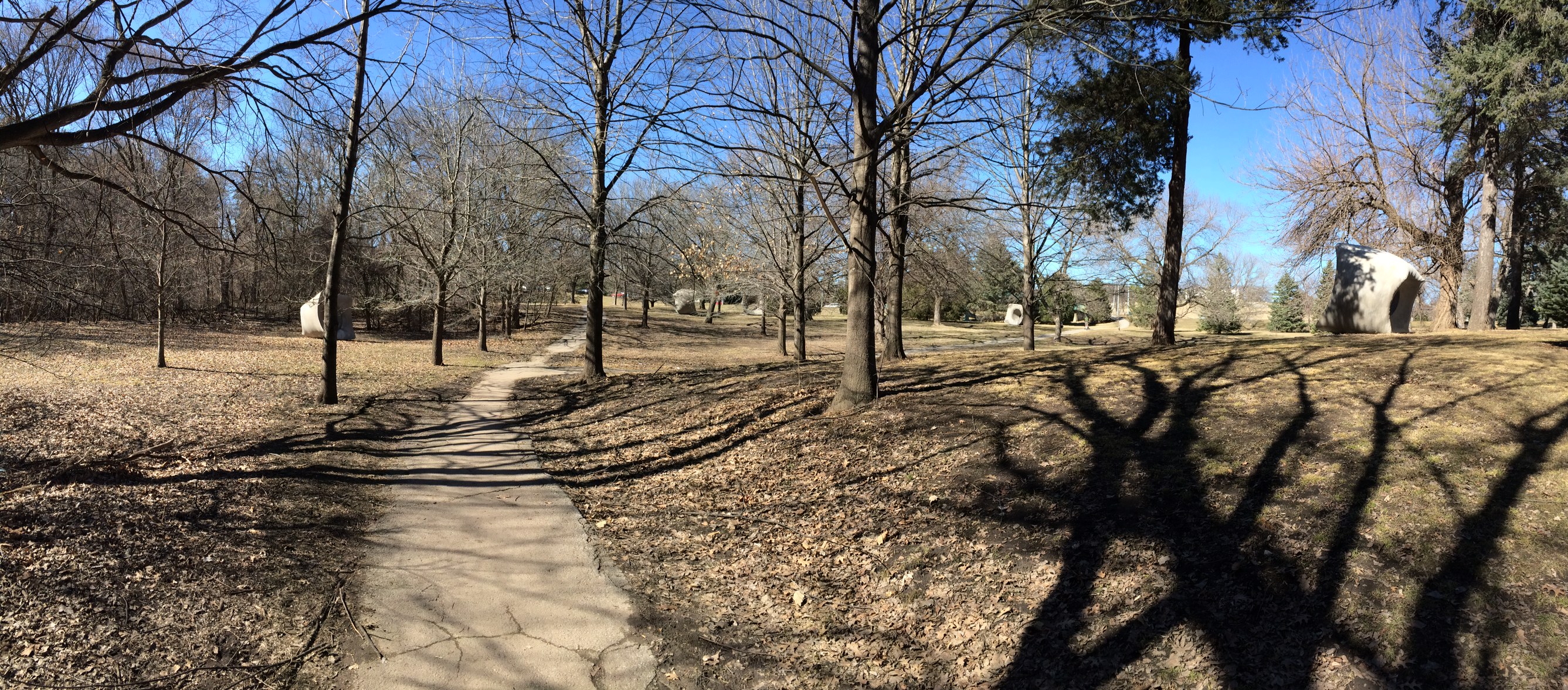
sounding stones panoramaI took a walk on a beautiful day in Omaha this past Sunday. On days like that, I just set out and let my feet go where they will, and on this day, they took me south toward Elmwood Park and the Sounding Stones.

This five-piece concrete sculpture was moved to this corner of the park along Dodge Street several years ago from another park about two miles east. A new development in midtown called for changes to Turner Park and so the sculpture was carefully packed up and moved west. There was quite a bit of resistance to this move by folks in my neighborhood. “That’s art? It’s ugly!” The NIMBY crowed was vocal, but city officials were unmoved and the Sounding Stones arrived.

Personally, I like them. I drive by them daily on my way home, and now several years later, they are a part of the landscape.

So Sunday, my feet took me along the path where they sit and for the very first time I saw them up close.

sounding stone brokenness sounding stone submission

sounding stone humility     sounding stone simplicity

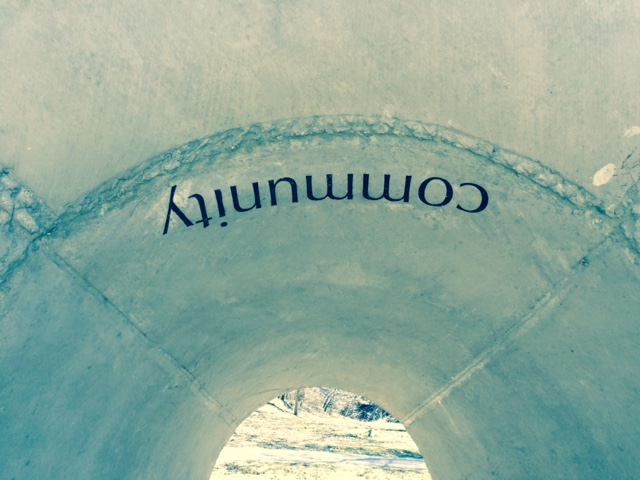
sounding stone communityThese are the sounding stones. Five values or attributes, five nouns that describe my life of faith. And amazingly, when I went home to search out the story of this sculpture, this is what I found in artist Leslie Iwai’s own words:

“The location of these stones in Omaha – a city in the middle of our nation – is important. Soundings are taken in the middle of a body of water to measure its depth. Likewise, in taking the ‘soundings’ of our community, we measure its depth. The open core of each stone is to be a place for crying out. God purposes for all people to break complacency and praise Him. But even, ‘if they keep quiet, the stones will cry out.’ (Luke 19:40),” Iwai wrote in her artist statement about the work. (Wayne State College Magazine, Summer, 2006 issue)

I don’t know what the depth of faith is in the middle of my city of Omaha, but on a sunny Sunday afternoon in the middle of Omaha, I lay down in the hollow of that first stone labeled “brokenness” and knew that the depth of my faith starts there, in the brokenness of my life. Loss of my mother at age 7. The child abuse of my siblings by an evil stepmother. My sisters’ near life-ending car/train collision. My brother’s HIV diagnosis. The death of my father from renal failure. The rape and murder of my baby sister.

All those broken parts of my heart have brought me closer to the one who can heal.

And I wondered where the stone of brokenness would take me on that path and so I left that hollow in the middle of brokenness and walked on. I found myself looking upon humility and submission; I found myself at the foot of the cross where I kneel in obedience to a Lord whose blood was poured out for me and for all of us. Humbly. Gratefully.

And then I wandered on to simplicity, because it is so simple. He takes it all away: the loss, the pain, the horror, the fear, leaving just me, the Julie he created me to be. He is all I need and all I want.

And just when I think there is no more, he leads me down the path to community. He has shown me his body – the global church – and connected me into something so much bigger than I could ever imagine.

A depth sounding in the middle of Omaha, landlocked in the middle of the USA, on the staple of the map.

But even as I lingered at community, I thought how each of those stones has become more real to me as I have traveled far from the staple of this map to the places where human sounding stones have fleshed out the depth of faith for me in the past five years.

I thought of the brokenness of Syria and Iraq. I saw the humility of people who have lost everything and yet serve their neighbors who have lost even more. I saw the simplicity of life lived without stuff, yet lived in joy because of their love for a God who holds them and comforts them in their losses. I have seen the obedient submission of those who stay where they have have been planted and grown deep roots, to continue to share the good news in a place that needs to hear it more than ever. I have seen the community of orthodox and catholic and protestant come together as one family and love their Muslim and Yazidi neighbors who are also broken.

My friend Marilyn is currently in Iraq sending back stories of this faithful community of God’s living stones, and two lines in her recent emails struck me as I ponder these five sounding stones standing in my park nine time zones to her west:

  • “Do not cry for us—we have may have lost everything, but we still have Jesus.” – A woman driven from Mosul by ISIS, now living in a tiny space in a former Sunday school room of a church in the safer northeast
  • “how strange that we (Muslims) try to kill you (Christians) and you help us anyway.” -shared by an elder of the church in Kirkuk

As Marilyn added, “What a powerful testimony to the of sharing Christ’s love and of God bringing good out of evil!”

They are the living stones who cry out in thanksgiving and praise for the one who made them and saved them and loves them still.

And from the depth of my heart and soul, I cry out in thanksgiving and praise to him along with them.

And pray for his peace to descend on us all.


Memory loss

Mark Mueller, Elmarie Parker, Rob Weingartner, Elder Zuhair, Marshall Zieman, Tom Boone and Larry Richards offer communion at the Evangelical Church of Basrah, November, 2012.

Mark Mueller, Elmarie Parker, Rob Weingartner, Elder Zuhair, Marshall Zieman, Tom Boone and Larry Richards offer communion at the Evangelical Church of Basrah, November, 2012.

Today was communion Sunday at our church and the familiar words were spoken as we began the celebration of the Lord’s supper:

And he took bread, gave thanks and broke it, and gave it to them, saying, “This is my body given for you; do this in remembrance of me.” Luke 22:19

It’s a ritual I first took part in when I received my first communion in second grade at Christ the King Catholic Church here in Omaha, fifty years ago. I wrote about it in my blog last October:

Remembering

And every time I receive the elements, the bread and the cup, I remember back to that night.

I remember the communion in Basrah, Iraq, that I witnessed in 2011 as the Presbyterian church there was able to celebrate it because our group brought four pastors with us.

I remember that communion repeated in Basrah in 2012 as we returned with six pastors.

And I remember communion in that same church in March, 2014, as we returned to celebrate communion with them as they now had their own pastor to lead it.

Memories. I collect them like others collect stamps or baseball cards. It’s what makes me Julie, or at least contributes to the essence of me.

Remembering in communion, remembering the sacrifice made for us out of great love, is the center of our Christian worship, its holy essence in the body and blood of Jesus Christ.

Jana and I just came back from seeing the movie, “Still Alice.” It stars Julianne Moore in the role of a brilliant linguist and college professor, wife and mother of three, who is diagnosed with early onset Alzheimer’s disease. Bit by bit, she loses the words she is a master of. She gets lost on the campus in her familiar daily run. She forgets where the bathroom is in her home. She forgets the names of those most familiar to her.

And even though her family grieves her loss as she disappears day by day, they love her and care for her and know that she is, after all, still Alice. But in the end, she really is not the Alice that we saw in the beginning. She has been robbed of her essence.

I have seen it happen to others I know as well, real people, not characters in a movie. It is very hard to watch and a feeling of helplessness in the situation is overwhelming.

This movie struck a bitter, minor chord in my heart today because of the recent news of what is happening in Iraq and Syria: the destruction of ancient works of art and ancient manuscripts in Mosul and other places as ISIS deems them idols of the apostate. “These things didn’t exist at the time of the Prophet. They have been invented and must be destroyed,” or something like that.

It’s a bitter chord because it is like a deliberate attack on the essence of who we are as humans and how we developed the languages to tell our story, the grand story of our creation by a loving God. The same creativity he exhibited by speaking us into being and breathing his very breath into us to give us life, has been left behind by those who wrote it down on parchment manuscripts, who sculpted it into winged creatures of bigger-than-life size, who painted it onto canvas or stone walls.

And it is systematically being destroyed, erased, even as the words that Alice knew intimately were wiped one by one from her brain.

I am reading a book right now called High Tea in Mosul by Lynne O’Donnell. She was one of the first journalists to reach this ancient city after the war ended (it never really did, did it?) after the invasion in 2003. I haven’t finished it yet, but in reading it this week I came to a part that just made me want to cry out.

Mosul is the ancient Ninevah of the Bible. The Ninevah that God sent the reluctant prophet Jonah to in order to preach his word of repentance. There is – I mean was – a temple there where Jonah was said to be buried. Lynne talks about it standing there still as testament to the power of the human spirit to hang on even in the hardest and darkest of times.

The book was written in 2007. In 2014, this temple of Jonah was destroyed.

As Alice’s family learns early on after her diagnosis, there is no cure for Alzheimer’s.

I don’t know the cure for the scourge of evil that is ISIS. And bit by bit, this disease is robbing our human family of its collective memories, the ancient artifacts that tell our story.

And so I cry out with my brothers and sisters who live there and who watch it happen and are helpless to do anything,

How long, LORD, must I call for help, but you do not listen? Or cry out to you, “Violence!” but you do not save? Habakkuk 1:2

And then I remember the bread and the cup of sacrifice. And I say thank you for the gift of memory. And I write it down and look at the pictures I have taken of men and women and children.

And I pray.


Prayer of solidarity in a string of beads

Bowl of glass stones

Sisters and brothers in Christ, today we gather around the baptismal font, remembering both God’s gracious promises to us and our sisters and brothers in Iraq, Syria and Lebanon (and Egypt). We are united by a common faith in Jesus Christ and a family bond that reaches from east to west, and north to south around this globe; one that covers all time.

This was the start of a prayer of solidarity for our brothers and sisters in the Middle East. Mission co-workers with our denomination, the PCUSA – and friends of mine – came to our pulpit to share stories of their first year living in Beirut and working with the National Evangelical Synod of Syria and Lebanon. Powerful stories. I have shared a few on this blog myself, that I have experienced personally. I recognized the places, the faces and the loss and grief as Scott and Elmarie spoke.

And since we are God’s children, we are God’s heirs. In fact, together with Christ we are heirs of God’s glory. But if we are to share Christ’s glory, we must also share his suffering.

On this day we shared by praying together in solidarity with them. And to remind ourselves to keep praying, we each came forward to the baptismal font and took a polished stone to hold in our hands.

Glass stoneMine is green glass. Polished. Smooth. Easy to hold and to admire. And when it is cupped in my hands, clasped in a gesture of prayer, it is a tactile reminder of those who are heirs to God’s glory and even now sharing in his suffering.

As I look at that picture of the collection of glass stones, I can easily assign names to them; each representing a real person, people I know and love.

There’s Lamis from Lattakia who gave me lovely earrings in 2010 in a quieter time and place.

There is Toeh, a young woman from Homs, now a refugee with her family in Amr Hasn, who doesn’t even have any photos to remind her of life before the war.

There is Huda in Yazdieh, the pastor’s wife who collects food and blankets and distributes with love and prayer to some 1700 families, like Toeh’s.

There are the eight pastors still serving fifteen Presbyterian congregations in Syria: Salam, Ibrahim, Yacoub, Ma’an, Michel, Boutrous, Firas and Mofid.

There are the synod leaders: Fadi and Josef and Adeeb and George, along with Assis Salim, the head of the organization of evangelical churches.

There are the pastors in Lebanon as well, serving their own congregations plus those who have fled there: Mikhael and Rola and Fouad and Hadi.

Educators bringing the word of God and the values of Christ to new generations: Najla and Dr. Mary and Nellie and Hala and Izdihar and Riad.

Pastors and elders and priests who are doing the same work of provision and reconciliation in Iraq: Haitham and Farook and Magdy, Patriarch Louis Sako, Fr. Aram and Fr. Turkum and Msgr. Emad and Zuhair and all the teachers in the kindergartens.

One polished stone for each of them, and I hold this green one in my hands and pray.

Saving God, hear this day the cries of those in Syria, Iraq and Lebanon (and Egypt) who have been over-run by violence. For those who are able to flee, guide them to safe havens. For those who stay, whether by choice or lack of means to leave, grant them courage, perseverance, hope and what they need to survive. May your church embody and freely share these gifts with those around them.

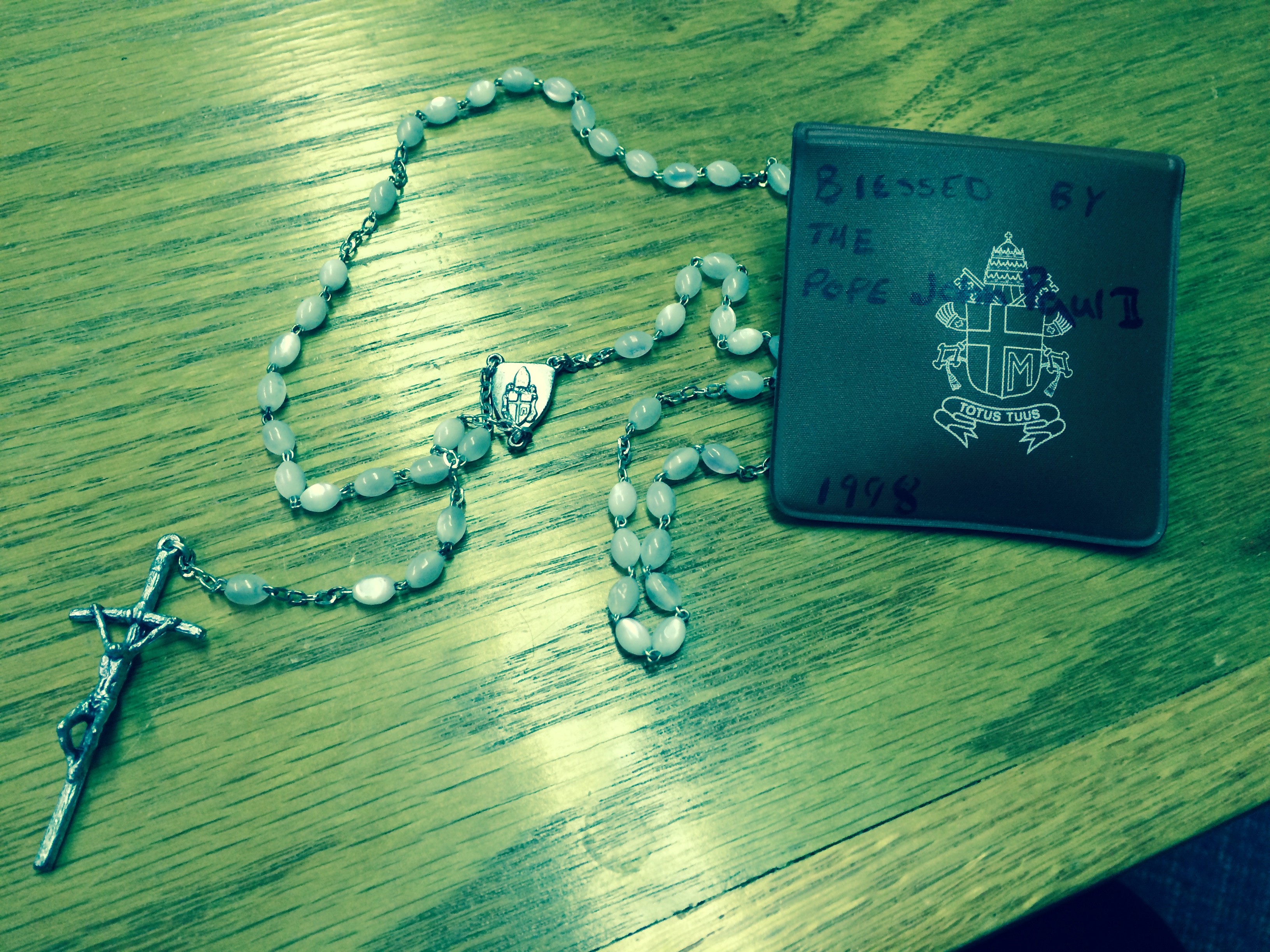
RosaryI always carry a rosary with me, a habit from my Roman Catholic upbringing. It’s a tool for prayer: 59 beads strung together with a crucifix on the end. My Aunt Carolyn, a Franciscan nun, gave this one to me on a trip earlier this year. She received it on a trip to Rome in 1998 and it has been blessed by Pope John Paul II. It’s a lovely remembrance of her trip, her vocation, and my connection to her and to the faith I was raised in.

Adeeb's prayer beadsI also have a set of beautiful amberwood prayer beads that I purchased in Lebanon this past November from a street vendor named Mohammed. Many of the pastors I know in the Middle East carry these same 33-bead strands with them everywhere, constantly moving the beads through their fingers, not out of habit, but in prayer. It was one of the first things I noticed about Assis Adeeb when I met him in 2010.

And this green polished glass stone that is now in front of me while I work, is a visual and tactile connector for me to these strings of beads used in prayer by people like me who follow Jesus. It may be a solitary stone, but it binds me in solidarity with each of those other stones as we pray together.

So let us pray.

God of peace, empower and guide those who are working to make visible your kingdom ways of justice, peace, and transforming love in Iraq, Syria and Lebanon (and Egypt). Bring your transforming peace to these lands. For Christian schools and teachers working with both Muslim and Christian students we pray – grant them wisdom, creativity, and enduring love. For Muslim and Christian students studying side-by-side – grant them the courage to live into a new kind of future together in the Middle East where there is respect and opportunity for all, regardless of religious creed, ethnicity, or gender. For those working with children orphaned and traumatized by war – grant them daily hope and joy-filled love. For children, women and men maimed in spirit, mind, or body by violence – grant them healing and a new future. For government officials – grant them the will to seek the good of their people and courage to turn away from personal or outside agendas that seek gain from war and instability. For those caught up in violent political and religious radicalism – wake them up to true life. Grant that we, disciples of Jesus from east and west, north and south, bound together by baptism and the Holy Spirit, may live each day with Christ’s kind of self-giving love: doing justice, loving kindness, walking humbly with you. Amen.

And amen.

(A special thank you to Revs. Scott and Elmarie Parker for this prayer, which is adapted from The Worship Sourcebook, pp. 286-304; Job 19:7; Habakkuk 1:2; Romans 8:17; I Thess. 5:16-18, 23-24; Micah 6-8.)

Assis Ibrahim from Aleppo

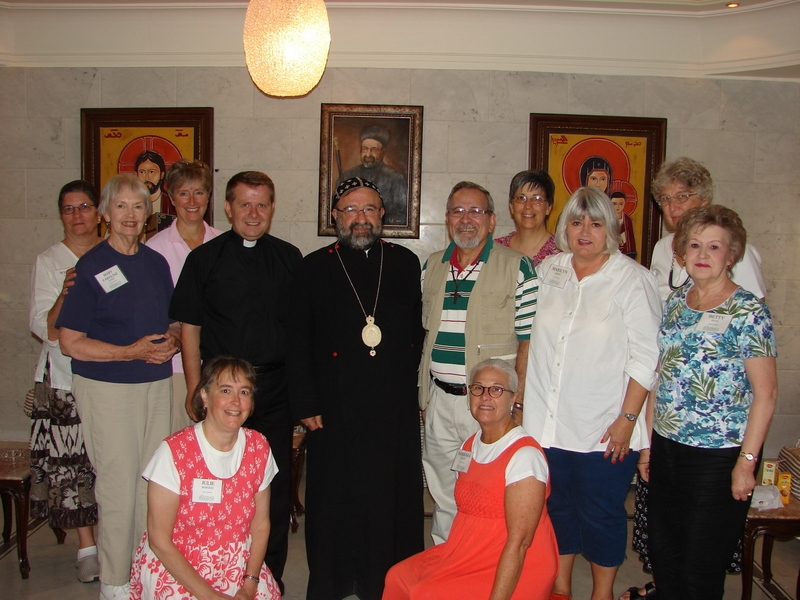
(Back) Wendy Moore, Sue Jacobsen, Kate Kotfila, Emily Brink; (standing in middle) Mary Caroline Lindsay, Assis Ibrahim Nsier, Archbishop Yohanna Ibrahim, Rev. Nuhad Tomei, Marilyn Borst, Betty Saye; (kneeling) me and Barbara Exley

(Back) Wendy Moore, Sue Jacobsen, Kate Kotfila, Emily Brink; (standing in middle) Mary Caroline Lindsay, Assis Ibrahim Nsier, Archbishop Yohanna Ibrahim, Rev. Nuhad Tomei, Marilyn Borst, Betty Saye; (kneeling) me and Barbara Exley

I first met this man of God in the summer of 2010. I remember coming home and telling my pastor George about him. His church in Aleppo was doing the kind of relational, incarnational ministry in their neighborhood that our church in Omaha was doing. Their neighborhood in Aleppo was a bit different than ours, to say the least.

But this was before the war that came to them just seven months later. We were privileged to worship with them in their lovely building, and to hear how they were caring for Iraqi refugee families in their midst. These displaced families were, of course, refugees from the war our country had brought to Iraq in 2003. Like other refugees from other wars who could not go home, they were waiting to be resettled in still other countries, unknown to them.

But this small Presbyterian congregation in Aleppo, led by this young energetic cleric was making a difference to those families, and to the kingdom of God.

I still keep a picture on Facebook as my cover photo to remind me of those precious days in August, 2010. It’s the one on the top of this post. Assis Ibrahim is in the back row standing next to another Ibrahim, Syrian Archbishop Yohanna Ibrahim, who was kidnapped in April, 2013, and still has not been heard from. I pray for them both when I see this picture, and I hope others do as well when they visit my Facebook page. I wrote about them here:

Abraham: Father of Many

Assis Ibrahim is a man I admire, to say the least, and I will never forget him.

I had the chance to hear him on phone calls twice in the last two years as I returned to Lebanon to hear about what was happening to the Syrian churches in the midst of the war. Other Syrian pastors had been able to make it to Beirut, Lebanon, to tell us firsthand of the difficulties they were facing, but Assis Ibrahim could not come from Aleppo. I listened to his voice as he told us what had happened, and what was happening. I closed my eyes and remembered the worship we had participated in back in that hot glorious August in a building that was now rubble.

And I could see the face of that young, energetic, man of God, holding onto faith and hope and love.

IMG_0936This past November, for only the second time in four years I got to spend some precious time with him as he came to Beirut to meet with our group. He may not have remembered me, but oh! how I remembered him. His face unchanged. His voice strong as ever. His vision for the future was God-sent. Who else could see a Presbyterian boys’ high school reimagined as the National Evangelical University of Aleppo, even while a war still raged?

Assis Ibrahim.

And I wanted to tell you about him so you could pray for him.

Before I could come up with my own words, I received this extraordinary email from him telling the story of the church in Aleppo. And I think in the reading you will know what I have come to know about him:

This morning I woke up early at 4:30 to the sound of a mortar exploding. I said to myself, “A new day is started.” This is something normal in Aleppo.

I went to the kitchen, hoping to get some tea or Nescafe, but I had an urgent call from one of our members who was injured by the shelling. He needed someone to take him to the hospital. I got my shoes and got to the car quickly.

Thanks to God, they dealt with his wounds very quickly, and he was in church for our service.

Today, I preached that we should use what God has given us. No one can say, “I don’t have,” because if God has given us even a tiny thing, we can do a lot with this tiny thing in this situation in this community.

The church where we worshipped before the war was bombed, so now we meet in an apartment building. It’s up five floors, almost 120 stairs. We have had mortars hit the building, but God saved us and as many as 150 of us continue to worship there.

Being a pastor in this crisis is not as much about preaching as it is being with the people in their difficult time. Even if we cannot give money or fulfill their physical needs, we can at least pray with them, at least try to comfort them.

After the service, I received another call — two older women who had not one ounce of water and had run out of money to purchase water after paying for their rent and medicine. I got my family and went looking for someone in order to get them water, which I am sorry to say costs a lot of money. We need $300 a month for a family of five for drinking and washing water.

After that I received more calls asking me to go quickly to look for a home for two people whose houses were damaged from the mortar attacks that morning. We called a family from church that was out of town. They agreed to lend their house for a week until we can make repairs.

This day I described is like every day. Even what I have said doesn’t describe fully what is going on.

I am thankful to my wife and my family who remain with me in Aleppo during this crisis. Without my wife, I could be failing. She is my supporter.

We have three children, ages 6 to 12. This situation has forced itself over their lives. My children, when they hear a lot of bombing, they come to our room to feel a little bit secure. When we send our children to school, believe me, we say goodbye to each other because we don’t know if we’ll have the opportunity to see each other once again.

Always we teach the children that although it is difficult in this time, our security is in God. We try to teach them that we suffer as Jesus suffered and that the day of resurrection will come someday.

We believe we have a lot left to do in this community. As I walk around the neighborhood, I see the despair on the faces of the people. I see children on the streets begging for money. I can see people walking in the streets without shoes.

In 2013, through the church, we distributed food baskets to 100 families for two months. Last summer we were able to help 118 families with monthly cash allowances, which helps families pay for things like medical treatment, food, tuition. From August to December 2014, 65 of the most vulnerable families got monthly allowances. (MCC supported these efforts through its partner, the Fellowship of Middle East Evangelical Churches.)

We are not only supporting Christians, we are supporting the whole community to teach them that being a human means having a responsibility to the others. Believe me, we never think in ways that this is Muslim or this is Christian. We think differently. We think we are here for a message and this message should be clear for everybody — that God loves all the people and I insist on the word “all.”

We are called to live in hope. We trust God and we do our job — praying, taking care of each other, reading the Bible and being an instrument of love and peace in this community. This is what we do, and this is the hope we live in.

Please don’t forget us in your prayers.

Please don’t forget them in your prayers. And if you can do even more than pray, please consider sending a donation for the work of the church in Syria to The Outreach Foundation, 381 Riverside Drive, Suite 110, Franklin, TN 37064.

“This is what we do, and this is the hope we live in.”

Amen.

Shoveling with St. Francis

Pine tree with bent topWinter arrived in Omaha this week. We don’t have as much snow as Buffalo or Boston or Bangor, but we have what I consider to be our share. It came on Saturday, canceling church on Sunday, and it came again today, Wednesday, causing another snow day.

It came mostly today after Steve left for work, and if I was going to get out I would have to shovel. My small snowblower is busted and Steve’s is too big for me to handle, so the shovel would have to be my tool.

I was facing another 4” in our lengthy driveway, and thought if I could just shovel the top part I could make it out to the office.

Wrong.

Two hours later I am back in the living room, boots off, jean bottoms soggy with melting snow and a pulled muscle in my left arm. No getting out today.

And the thing is, I went out to do the task in the darkest of moods. More snow? Sheesh! Can’t winter which just arrived on Saturday be over already?

When it was just Jana and me on Chicago Street, we had an equally long driveway, front stoop and stairs and miles of sidewalk to clear as we lived on a corner. And once my dad got that snowblower for me, I would head out and clear it all, even doing the whole west sidewalk to the next block! Steve and I have made a great team here on Happy Hollow Boulevard with our his-and-hers snowblowers, but mine is twenty years old and out of commission. I knew the shoveling would be hard, and it was. I am older now and don’t have the strength. My weakness makes me mad and grumbly.

So I knew it would be rough, but amazingly, there was this blessing of quiet time where all the cares of the world just rolled off my shoulders.

Without the noise of the gas engine turning the turbine of the blower, there was the sound of the wind in the pine trees, which reach to the sky. And the sky was this beautiful shade of pale grey blue as the clouds were dissipating. The sound of the wind in those tall graceful trees was like music.

And that’s when I realized there was music, too.

“All creatures of our God and king. Lift up your voice and with us sing. Alleluia! Alleluia!”

Dundee Church towerThe carillon at Dundee Presbyterian Church was playing this wonderful old hymn, written by my favorite saint, Francis.

“Let all things their Creator bless,
And worship Him in humbleness,
O praise Him! Alleluia!
Praise, praise the Father, praise the Son,
And praise the Spirit, Three in One!”

And I just sang along as I shoveled, the trees keeping a rhythm with the gentle blowing of the wind. It was a moment of worship. And I took the time to pray a prayer of gratitude and thanksgiving for turning my grumbling heart to joyful praise.

I came inside, arm hurting, soggy jeans and all, to look up the story of St. Francis’ glorious hymn. And what I discovered is that he was paraphrasing Psalm 148, which begins this way:

Praise the Lord!
 Praise the Lord from the heavens; 
praise him in the heights! Praise him, all his angels;
 praise him, all his host!

And down a bit further in verses 7 and 8, after the psalmist has exhorted sun and moon and stars and so much of the rest of creation to praise God, he says this:

Praise the Lord from the earth,
 you sea monsters and all deeps, fire and hail, snow and frost, stormy wind fulfilling his command!

Snow and frost and stormy wind: Praise the Lord!

Julie B. with pulled muscle and soggy jeans: Praise the Lord!

How could I not? And so I do!

Alleluia! Alleluia!

Amen.

Sunday snow

Elmwood panorama 1

My first thought upon waking up today was to be mad at the weatherman.

Friday’s forecast: snow coming for Saturday night. Total of a trace to an inch.

This is the kind of winter storm forecast I love. I’ve gotten kind of grumpy about snow as I get older. My dad moved to the ninth floor of an Omaha high rise in 2000 and laughed at the rest of us. “It can snow as much as it wants. I live on the ninth floor!” and then he would smile.

It was snowing when I got up on Saturday morning. So much for the timing of this negligible snow that the weatherman had told us about.

It was snowing when we went to the grocery store. Sloppy stuff that was pretty while it was falling, but it was slushy on the drive, on the walks and in the parking lots.

It got to be the inch pretty quickly. Sheesh! We would probably have to shovel.

Upon waking up this morning, Sunday, it was still coming down. Steve had gotten up and out to start moving it and popped his head in the kitchen to tell me it was about six inches so far. Heavy. Wet. Six inches. And still coming down.

God bless this husband of mine. He knew Jana and I wanted to get to church and he actually moved enough out of the driveway for the little red Mini to head out. I had talked to the pastor already and he wasn’t canceling, so Jana and I proceeded through the gray landscape, trying to take the route that would be the most clear and the safest.

Arriving at church to find one car, we went into the dark space. No power. I guess I should have realized it would be that way when we drove through intersections with no stoplights working. The power came on about that same time, but we discovered that our pastor had decided to cancel just before we got there, so home we drove.

And I must say, I was so glad we had made the trip. The beauty of what God had done overnight was overwhelming. The amazing sight of a black and white and gray world was a gift to me. With hardly anyone moving through the city by car or foot, the snow blankets everything wherever you look. The trees outside our windows which are thick with leaves in the spring and summer, are just as thickly coated with snow right now. The temperatures were in the 30s yesterday when it started, and so the wet branches are holding on to every flake that came after. It is just beautiful!

Elmwood panorama 2

Just like when we were kids all those decades ago, pulling out our sleds to make multiple trips down the big hill behind our house, the kids in this neighborhood have hit the hill across the street. Good for them!

I had to call the television stations to let them know that West Hills Church’s youth group would not be meeting this evening for their Super Bowl party. On the call to KMTV-3, I had this conversation:

“Channel 3 newsroom, this is Jim.”

“Hello Jim. I’ve got to change our church’s weather cancellation. We aren’t just canceling services today, but all evening activities, too.”

“Okay. We’ll take care of that.”

“Thank you! Did you say your name was Jim? Are you Jim Flowers?”

“Why yes, I am.”

Snow from front car windowJim Flowers is the chief meteorologist for Channel 3. The same guy I was mad at when I woke up. Somehow, the trace to one inch of snow had become the six to eight inches Steve was clearing out of the driveway, and still coming down. But something had changed since I had made that drive through the beauty of my city on the way to a church service which had been cancelled after I left the driveway.

I was able to see this glorious beauty with different eyes.

“Thank you, Jim, for the snow! It’s beautiful! The trees are amazing and the landscape is a winter wonderland.”

“You’re the first person to say ‘thank you’ to me for the snow! I bet it is beautiful.”

“Have a great day. I hope you get to enjoy it like I have.”

I hope you get to enjoy it, too. A trace of snow has never been more beautiful.