Mom’s Missal

Mom's missal Agnus DeiI recognized it right away, even though I hadn’t seen it in years. It was my mother’s missal.

Mike was leading a tour of our family print shop for a special dinner Steve and I were catering on the rooftop that night. Good friends of ours had purchased this sweet package at a silent auction. It included the dinner on the roof with a great view of the fireworks that 100,000 or so people had crowded downtown to see that Thursday night. It also included a ride on our 100-year old freight elevator (possibly one of the three oldest in Omaha) and a tour of the plant and building.

We were upstairs in the space over the old offices, which at one time in the early history of the building (before our family owned it) was the home of a prostitute. It has laughingly been referred to as “the whore’s nest” by more than one generation of family and friends. We always used it for storage, and a couple of years ago we emptied it out as we thought we had a buyer for the building. I hadn’t been up there since that day.
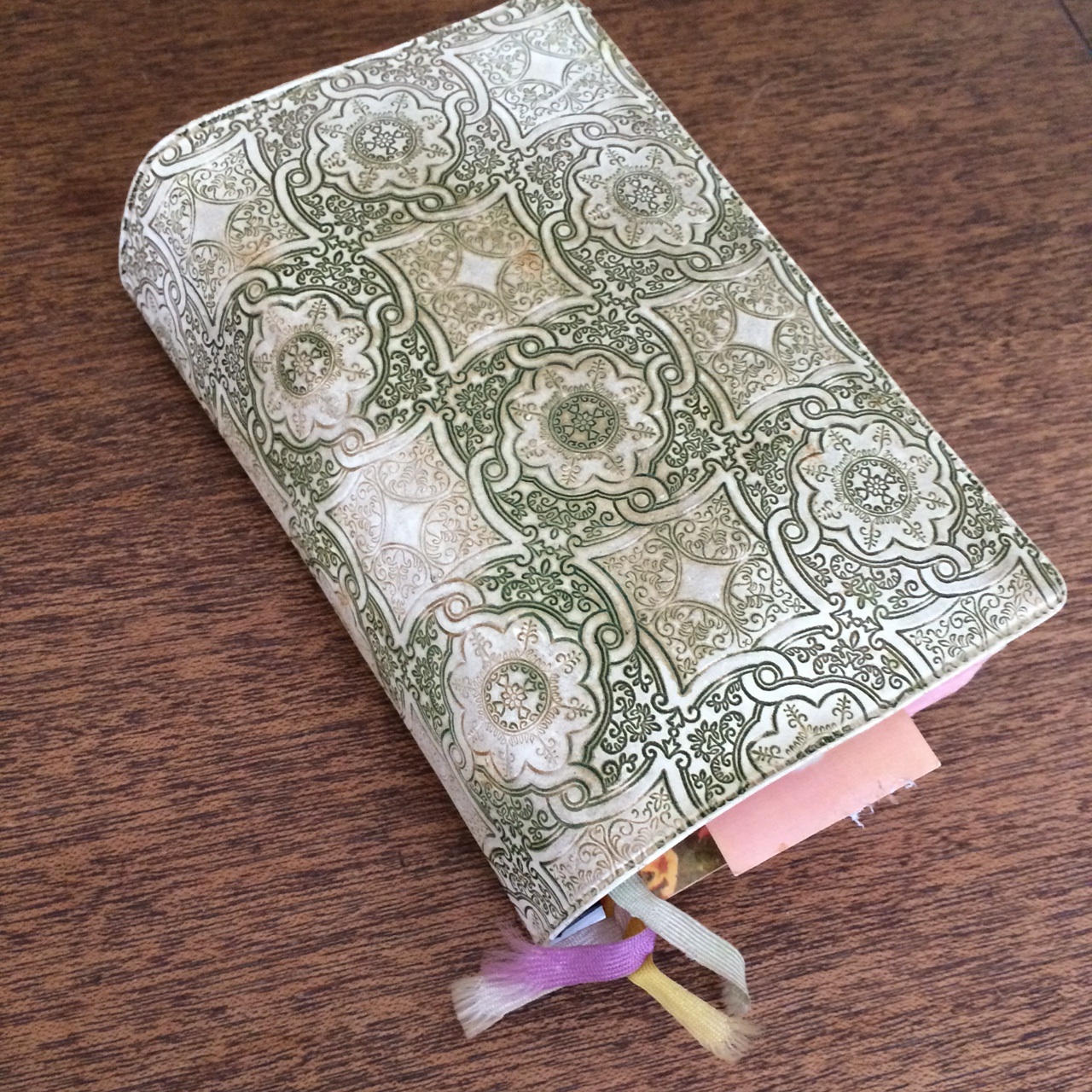
Mom's missalAnd that’s where I saw it, mom’s missal. It was on top of a small pile of family possessions that managed to survive our cleaning mission. It’s white vinyl cover now dirty and darkened by time, I knew what it was instantly.

“It’s mom’s missal,” I said aloud mostly to myself, but others heard.

“You were meant to find it today!” said my friend Chris. I had just told her that this day, July 2, 2015, had been my last day on the staff of the Presbyterian church I have served for the last thirteen and a half years.

I picked it up and carried it back downstairs for further review at home, and then we proceeded with what was a really fun night up on the roof.

This past Monday, since I am now unemployed, I took some time to just quietly thumb through the pages, remembering how it looked it my mom’s hands as she followed the mass on Sundays at Christ the King Catholic Church.

It is The New Marian Missal for Daily Mass by Sylvester P. Juergens, S.M., doctor of sacred theology (the new large type edition), published in May, 1961, by Regina Press of New York. I tried Googling it and found that you can still pick up a copy on Ebay, for about $4. There were many hits for this particular missal, so it must have been popular.

At nearly 1500 pages, it contains the masses for all the holy days, all the liturgical seasons, ordinary time as well. There is a full list of saints and their feast days, and you can also find the masses for those days.

Since it was published in 1961, it is a Latin missal with English translations on the opposite page. If you didn’t know Latin (other than the most common prayers like the Nicene Creed and the Lord’s Prayer), you could still follow along with the priest as the words were said and know what they meant. And that was and is the whole purpose of the missal: to be an active participant in the mass and not just an observer. I have tried to explain this to a number of my reformed church friends who make the most amusing but uninformed comments about the Roman Catholic mass.

I forgive them. 🙂

Its liturgical calendar at the front of the book includes dates from 1961-1980, so this was meant to be a tool for worship for the long term.

It has five now faded color ribbons to mark the sections as you moved back and forth depending on the season. I think I remember those best of all because when I could get my hands on this as little girl, I would move them back and forth among the pages to mark the colorful plates that illustrated biblical scenes like Jesus riding the donkey into Jerusalem on Palm Sunday.

Mom's missal nameplateThe back of the book has a name plate indicating that it is my mom’s. In her very neat printing in blue ink it says: Mrs. George Prescott, 7806 Ontario St, Omaha 24, Nebr, 391-9586. A later addition in pencil has this corrected to: Jana Prescott, 2526 So. 105th St. Jana must have appropriated it sometime after we moved in 1965, and Mom died in 1966.

And I stop right here and remember both those places. My dad built the house on Ontario Street in 1958. He moved the then small family of Mom and George, Jr. and Jana to that house where I joined them in December that year when I was born. In the fall of 1965, our family that now included Susan, Mike, Sally and Cathy, moved to the house on 105th Street. We had the same phone number, 391-9586, and the same ZIP code, 68124. The house was not much bigger, but Daddy had a small addition built on that gave us one more bathroom, one more bedroom, and a big dining room. I can still see my mom washing dishes at the sink or cooking at the stove, the old yellow telephone tucked under her ear as she kept up with family news while talking to Aunt Tillie or Grandma Thirtle, the phone cord stretched out to its full length, which always seemed like about fifty feet.

Such good memories.

Mom's missal Ephesians passageAs I paged through the missal I found prayer cards that Mom had tucked in there. Favorite Bible readings. The 23rd Psalm. The Beatitudes. Easy references for scriptures that spoke to her heart. There were other picture cards as well. When I turned them over to see the back, I found scriptures written in her handwriting. She must have written them out to keep them close by, handy in a book she probably used every day. And I too, love this one from Ephesians, as it uses the words that describe the dimensions of the cross to remind us just indeed how great the love of Christ is for all of us.

I turned to the section where I knew I would find the prayer that is so much on my heart these days, the Agnus Dei, a reminder of why I am folding all those paper cranes. The words are there for the ordinary mass and also for a funeral mass like the one that was offered for Mom after she left us on March 27, 1966. Dona eis requiem, dona eis requiem, dona eis requiem sempiternam. Grant them rest, grant them rest, grant them eternal rest.

There are so many days nearly fifty years since she died, that I miss my mom. I wonder what she would think of what her children have grown up to be and to do. I like to think she has smiled down at us as we have experienced love and joy, and that she has wept a mother’s tears at our failures and our sorrows. I know she has marked our lives by her love and her faith, and I am so grateful for what she passed on to me that is so important to my life and my journey.

Finding that missal in the whore’s nest on a July night in Omaha, Nebraska, with fireworks blasting and lighting up the night sky, felt like a sweet kiss blown my way from heaven. It was as if she was telling me that even though my time on the church staff has ended, my journey of faith has not. My work on earth is not done until I am called home like she was. I have good news yet to hear, and good news yet to tell. I have travels left to make with the living Christ in Lebanon, in Syria, in Iraq, places where other mothers and fathers are marking their children in the same way mine have marked me.

And so I will keep going.

Deo gratias.


Peace in the garden


garden panorama
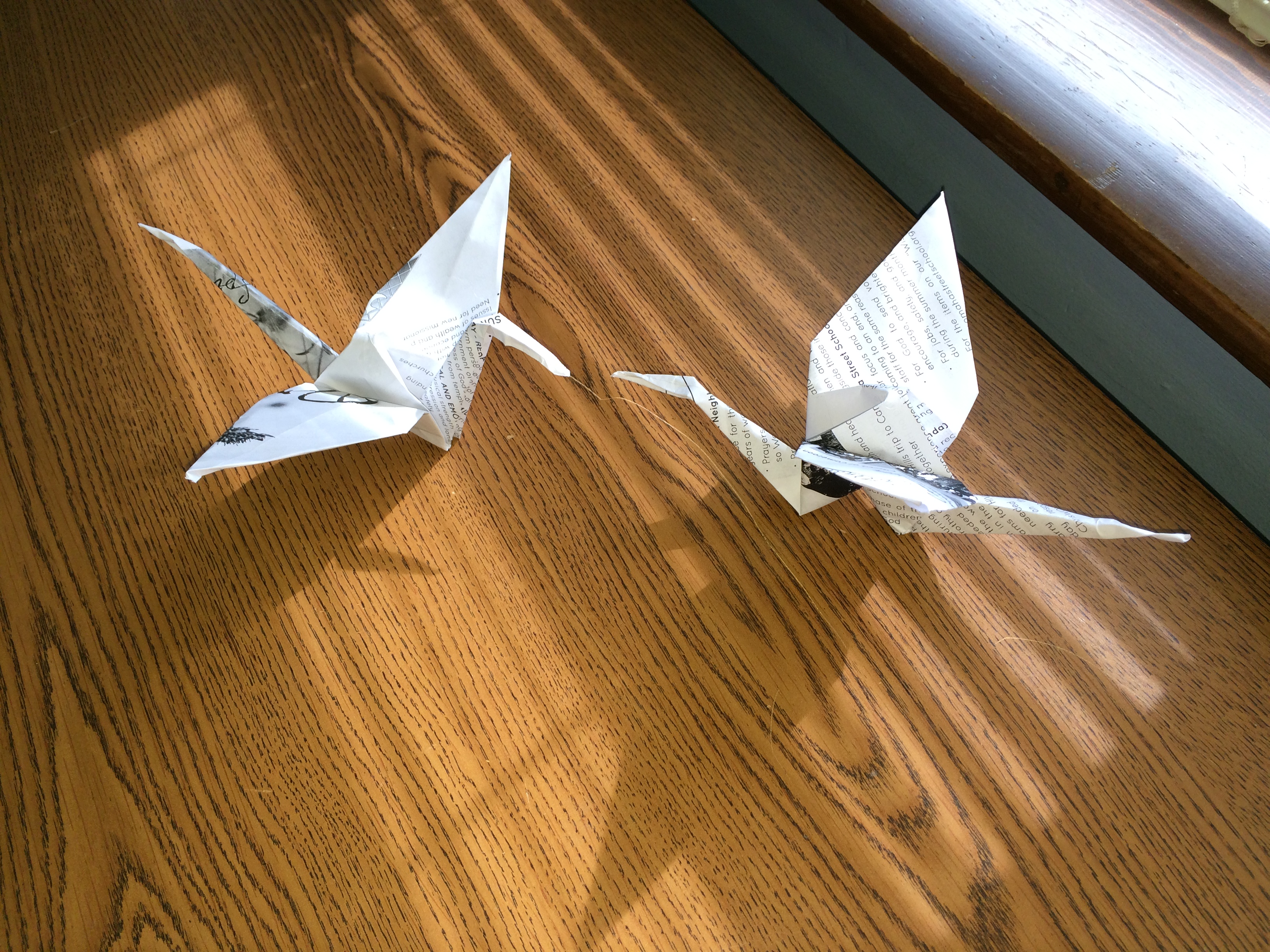
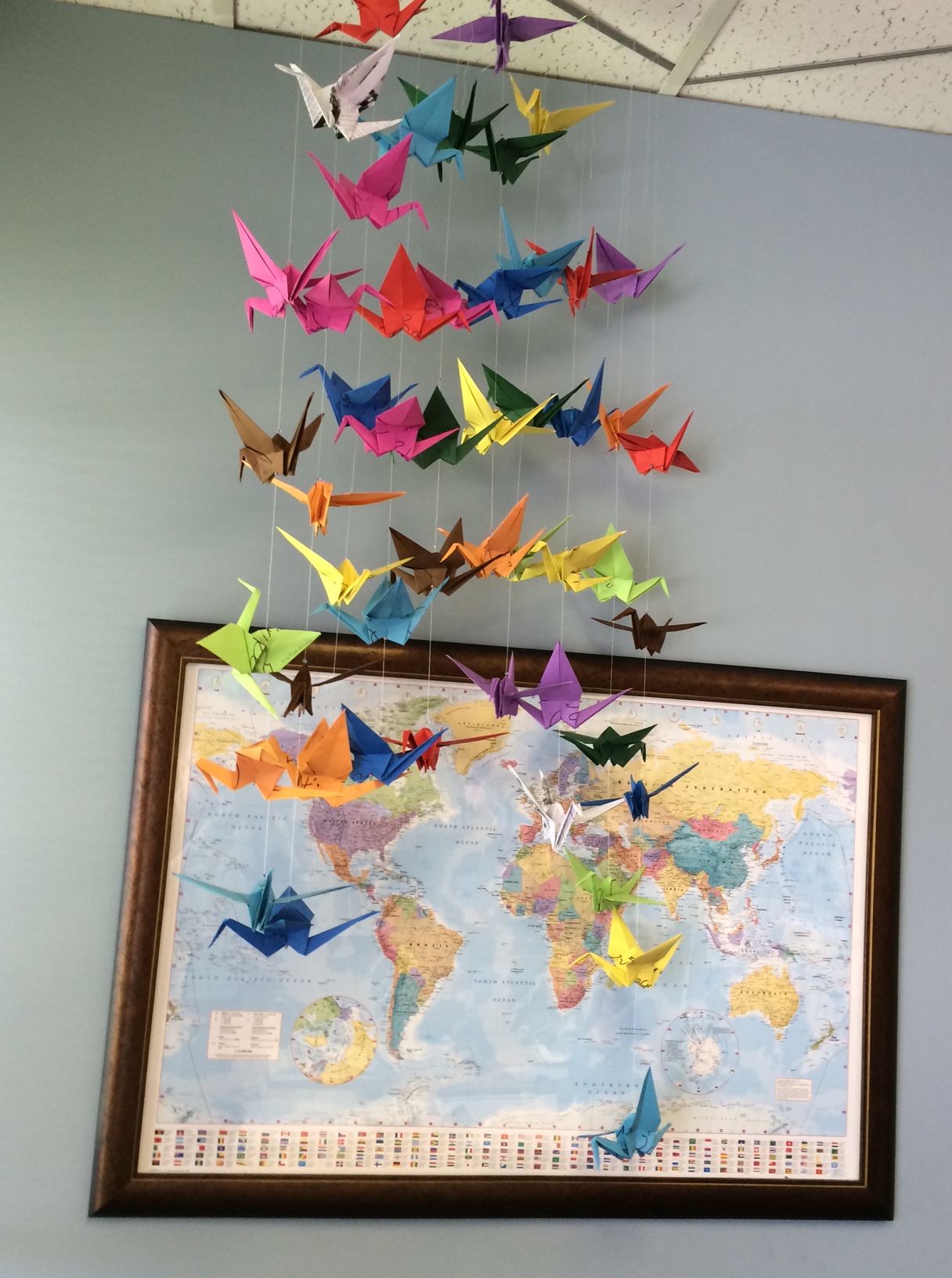
Paper cranes 323 totalI have been praying for peace for a long time, and lately I have prayed through the folding and stringing and hanging of paper cranes, 323 at last count in my office. It is a beautiful sight when I come in every morning, and catches others by surprise as well.

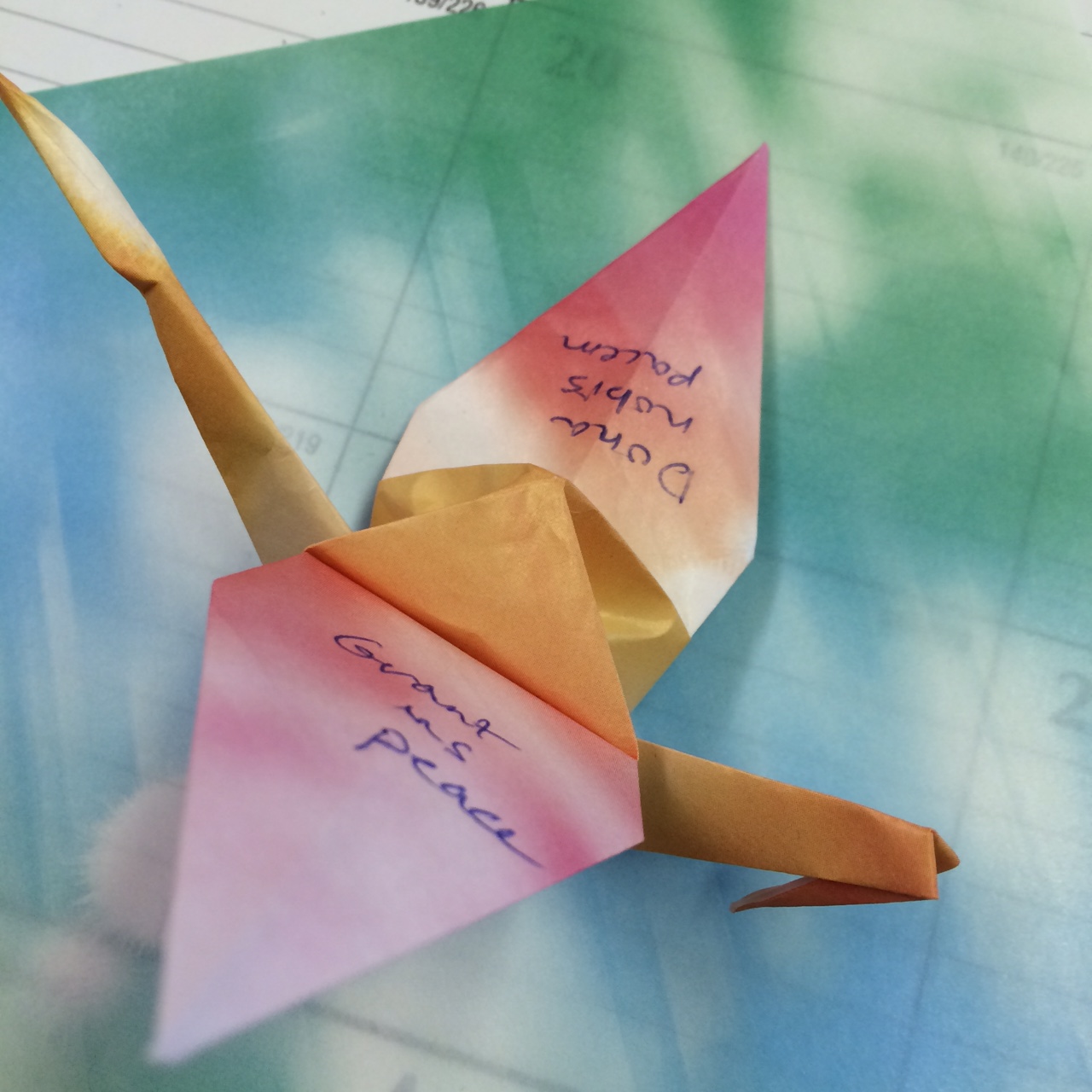
Dona nobis pacem. Grant us peace.

They are the colors of the rainbow, hanging on their strings, separated by glass beads and hugging my world map, a map that also reflects those same colors.

dayliliesAnd tonight I walked in my garden, which is showing many of those same colors. The oranges of day lilies, the blues and violets of cranesbill, white daisies with bright yellow centers. And so many greens! That God of ours had way more than 64 crayons in his box when he started this whole garden thing.

Daisies and cranesbillAnd so as I walked through my garden tonight, I was reminded of my peace cranes by the colors of the flowers and the greenery and the way the cranesbill and daisies tangle together, just like the strings of the cranes when I brush by them and it made me smile and it stopped me in my tracks to say it again:

Dona nobis pacem. Grant us peace.

As I came around to the steps that take me up to our little circular terrace, a place that is our secret room where we sit on Fridays and Saturdays and enjoy the peace of the garden after a long day, I passed my peace pole which contains another prayer in five languages:

May peace prevail on the earth.

Peace pole in the gardenAs I walk through this peaceful garden with prayers on my mind and on my heart and on my peace pole, I am also reminded that I am not in this alone. Just as the daisies are a gift from Susan and Lee next door and so many of the day lilies came from my cousin Kathy, the cranes in my office are a reflection of those praying with me like Cleo and Wendi and Deb and Kathy and Wilson from church; and all the faithful women like Babs and Marilyn and MC and Kate and Sue and Wendy and Betty and Emily; pastors whom I have met and those I haven’t, the Tobies and Michaels and Tripps and Chrisses; and all the people who read the papers and weep with me.

God made the garden for us as a place to walk with him in peace, and we blew it. And we continue to blow it. But even still, he makes the flowers grow and the cranes fly and invites us all to walk in places with him, inviting us into conversation. And my conversation with him most days – every day! – is for his peace to prevail.

And I believe he hears us.

And I believe he listens to us.

And I believe he will answer and redeem and make it so.

I believe his peace will prevail on this earth.

And so I will keep asking.

Dona nobis pacem. Grant us peace.

Amen.

Protection while we sleep

Sami Sadeeh Syrian national guardsman from SafitaI am on the worship team this Sunday at church and the special song we are singing is Laura Story’s “Blessings.” It is a lovely song and I am happy to be singing it with three good friends for the glory of the Lord.

There is a line that goes like this:

We pray for blessings, we pray for peace, comfort for families, protection while we sleep.

And it’s true, we pray for all of that. Peace, peace, peace, has been my prayer these last four years especially, since my traveling to the Middle East started.

But today I am centered on these words: protection while we sleep.

Protection while we sleep…

We had it in spades on our trip to Damascus in January, 2014, and I didn’t even realize it until the last day we were there. We would come up to our room in the hotel and there would be two or three normal looking men sitting in the lobby on our floor, like they were waiting on their wives or something. When we left in the mornings to accomplish our schedule and make our visits, there they would be again. Back and forth and back and forth for our three days there, those gentlemen were always in the lobby on our floor.

Walking through the Christian quarter in Damascus after having visited the church where Saul became Paul (Acts 9), we visited a craftsman shop to make some purchases of fine Syrian wood inlay boxes and lovely local fabrics and scarves. As we continued our walk back to the Presbyterian church, Steve commented about our security detail.

“There must be ten or twelve of them,” he said.

“Really?” I replied. “Where?”

In front of us, behind us, bulky automatic weapons bulging from under their jackets, they had been with us the whole time. They had also been staying in the lobby of our hotel floor. Protection while we sleep.

And now I flash forward from Damascus to our trip back to Syria in November. We had another contingent of security with us as soon as we crossed the border. I was not so naive this time and grateful for their presence. I had the opportunity to talk to them and discovered that some of them had come from the city of Raqqa in Syria. Raqqa is now the capital or main city that ISIS controls. These men had lost family members there and their homes as well to this evil that is trying to drag their country back to the seventh century.

And there they were for us: protection while we sleep.

Tony in between Marilyn and I, Syria, November, 2014.

Tony in between Marilyn and I, Syria, November, 2014.

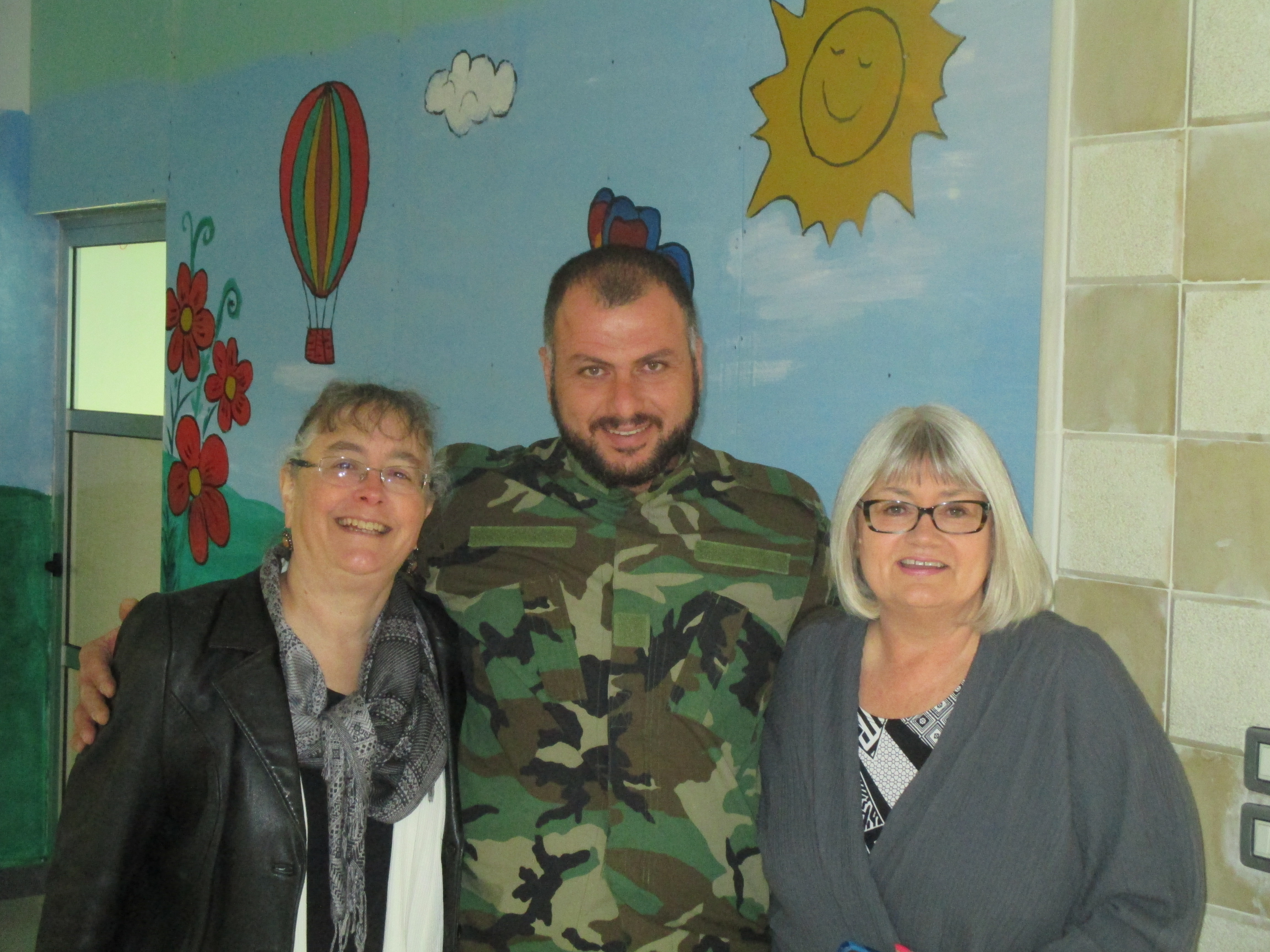
When we arrived in the Wadi al Nassara – the Christian valley of Syria – these troops handed us off to four men from Safita, all members of the national guard. They were with us for our remaining time in Yazdieh, Amar al Hasan and in Lattakia. Sweet, sweet men! The one named Tony held Marilyn’s hand through all our walking and hiking, to steady her as she was due for orthopedic surgery when we returned home.

Up and down the roads we traveled, through town after town on our way to the places on our schedule. Every town had pictures of those who had given their lives for their country, Syria, in this four-year old war. Poster after poster after poster would be at every intersection, in front of every business. And I am sure these men with us knew many of them. And I am sure that every one of those martyred soldiers had families that were missing them greatly, and who would share that same prayer: protection while we sleep.

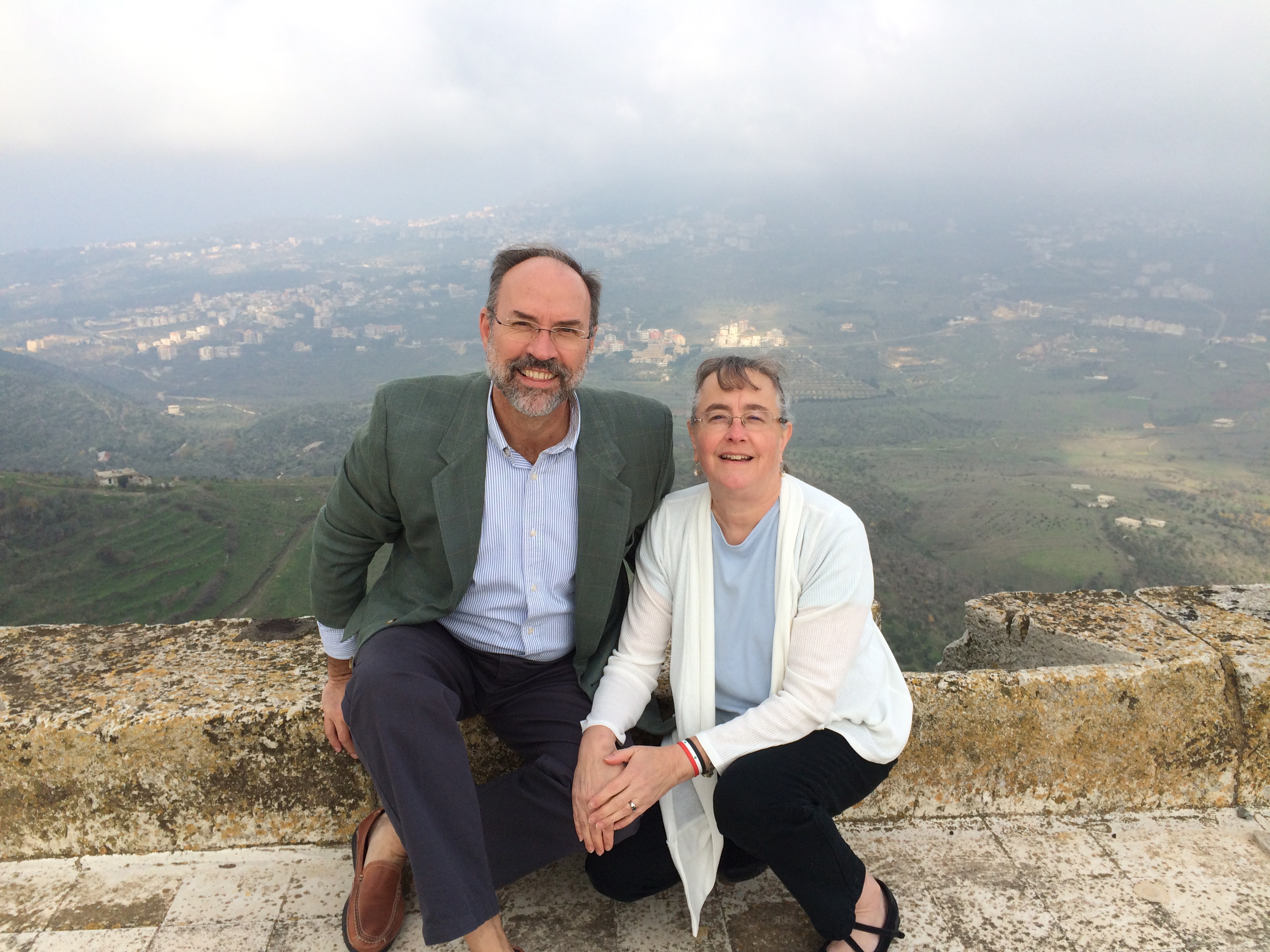
Steve and I on the top of the Krak de Chevaliers, Wadi al Nassara, Syria, November, 2014.

Steve and I on the top of the Krak de Chevaliers, Wadi al Nassara, Syria, November, 2014.

For four days and three nights, they were with us as we traveled through this beautiful place to meet with churches and refugees and families who had been driven out by ISIS from Homs and that part of the country. They went to church services with us. They ate dinner with us. They stood by while we traipsed through the world heritage site known as the Krak de Chevaliers, a former crusader castle in wars fought long ago. They told us how fanatic rebels had taken this high ground to fire on the Christians and others in the towns below. They told us how terrible things had been done to those captured, including throwing them from the high ramparts where we sat and had our photos snapped.

These four went with us everywhere for those four days, and were our protection while we slept.

On our last day there and before we left them behind, we gave them each an Arabic bible as a gift. All four are Christians, probably Greek Orthodox, and were thrilled to get the bibles and the little peace dove ornaments that we gave with them.

On the grounds of the St. George Monastery near Homs, Syria, with our national guardsmen. Sami is third from the left. God rest his soul.

On the grounds of the St. George Monastery near Homs, Syria, with our national guardsmen. Sami is third from the left. God rest his soul.

When we arrived back in the U.S. we talked about what more we could do for them. Those four gentlemen were all serving in the National Guard of Syria, but their day jobs were just like us, maybe an engineer, a teacher, or some other normal job. They weren’t doing those paying jobs while they were with us. They were volunteering their time as members of their unit to protect us while we slept and while we worshiped and while we ate and while we climbed crusader castles and had our photos taken. And we wanted to do something for them.

So Nuhad wrote to their commanding officer to find out how we could give them a small monetary honorarium for our appreciation of their great service to us, and this was the response we got back:

What he asked instead is that we make a gift in their honor to support the 100 displaced families in Safita that their unit is responsible for.

No money for them, but money for the refugees that their unit is responsible for. That is what they wanted. No greater gift…

Today on Facebook, my friend Nuhad shared this picture of one them, Sami Sadeeh. He has lost his life in this war, in protection of his family and his country. I am sure there will be a poster of him on the roads of Safita, just like the others we saw.

And so now I pray for his family: protection while they sleep.

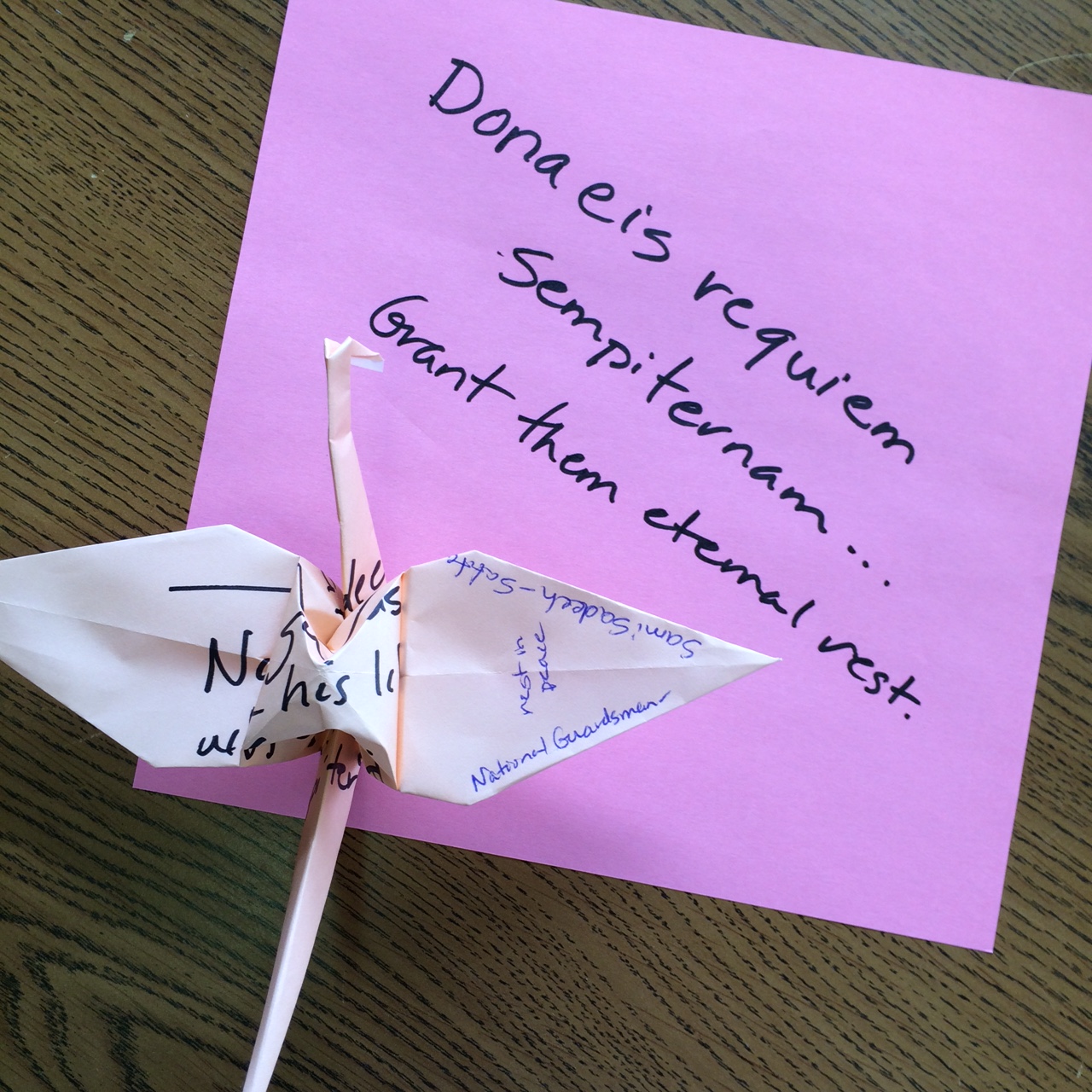
Paper crane Sami SadeehBut my prayer for Sami is different and I wrote it on the 301st paper crane that I folded just today in his memory. It was not dona nobis pacem, for peace has been granted to him. Instead I used the words from that prayer used at a requiem mass, dona eis requiem sempiternam.

Grant him eternal rest.

And I will sing “Blessings” on Sunday in worship, and when I sing the line, protection while we sleep, I will see Sami’s face, and know how that prayer was answered by God through Sami and all the others.

209…one at a time

Paper cranes 209My one thousand paper cranes for peace have been a journey through this month of May. I have made 209 so far.

One at a time.

I started with two sheets of prayer-printed pages from my church, West Hills in Omaha. My friend and colleague on staff here, our Mission director Caitlin O’Hare, publishes prayers of our mission partners each quarter. When my friend Mark Borst was here visiting in March, he saw our wall of crosses in the reception area and told me about the paper cranes that carry prayers heavenward in the sanctuary at Central Presbyterian Church in Atlanta.

Connectivity being one of my strengths as measured by the Clifton Strength Finder assessment, I connected the two. All those prayer booklets…what do we do with them every quarter when the new come?

Paper cranes, of course!

After folding three of them with that paper, I decided to order 500 sheets of 8″x8″ origami paper from Amazon. Beautiful colors. Lighter weight. Easier to fold and to be held by a delicate nylon string.

I am now a master folder of paper cranes. Stop by my office and see the 209 flying here and I will fold one for you with the prayer of my heart for this project:

Paper cranes dona nobis pacemDona nobis pacem. Grant us peace.

These first 209 are a reflection of the places I have traveled in the last five years with The Outreach Foundation. They are photographic memories developed onto the pages of my heart of the people who live there, the people who love there, the people who are loved there by an amazing God who made us all. Each one. In his image.

And all these God-imaged people are suffering now, as they have suffered in the past. War is a journey no one should have to take.

But at the end of it should come peace. In the midst of it, they seek peace.

And that is what I pray for.

As I have folded these cranes and prayed over them in the process of folding and stringing and hanging, it has renewed my spirit to know that God hears every one of them.

And as I have continued to watch the news, I have found more to pray for, as if I didn’t have enough already. And some of those stories just emphasize that God hears those prayers. They seem to me to be answers for the peace I pray for.

You can read about Karim Wasfi, a cello player in the orchestra in Baghdad, who plays in the aftermath of a car bombing in his city.

A prayer crane for Karim. Dona nobis pacem.

You can read about Zahed Haftlang and Najad Aboud, two former combatants in the Iraq-Iran war who are now friends as they live in Canada. And on the battlefield one said of the other, “He became a human being, not an enemy.”

A prayer crane for these brothers. Dona nobis pacem.

And there is a prayer crane for Hope Came Down, in the prayer and the hope that people will watch it and be moved to send their monetary gifts to a place that is bringing hope and encouragement to those who are suffering.

A prayer crane for Hope Came Down, and others for the scriptures that inspired it, John 1:14 and Hebrews 11:1.

Dona nobis pacem…prayer by prayer…crane by crane.

One at a time.


Dona nobis pacem

Paper cranes in vitroI have very faint memories of the Roman Catholic mass being said in Latin from when I was very young. I remember mouthing what I thought were actual words, although they meant nothing to me, and thinking that I was an active participant in the mass like my sisters and brothers and parents, next to me in the pew. When I investigate now when the change from Latin to English happened, it began in 1964, right before I turned six. Mostly I just remember mass in English.

So my Latin was non-existent through most of my life, if I had ever even known any!

At Girl Scout camp in 1970, I learned this beautiful song sung as a round. It went like this:

Dona…nobis…pacem, pacem. Dona…nobis…pacem.

I didn’t know it was Latin; I only knew when four groups of girls’ voices sang it in offsetting phrases to make the round, it sounded like angels.

Years later when Jana and I attended one of our annual Lobby Day gatherings with Bread for the World, a wonderful singer named Beth Nielsen Chapman sang the blessing at a large banquet. Fascinated with the song she sang, There’s a Light, when I returned home I bought her CD called simply Hymns. There were great songs from my RC childhood that we sang in church. And there was this:

Dona…nobis…pacem, pacem.

She laid down all the tracks, so the round was recreated with her beautiful voice filling out the angel chorus. As it went straight to my heart and triggered that memory of camp and singing and angel choirs, it made me want to know more.

So all those years later, I finally looked up what those Latin words mean.

Dona nobis pacem…grant us peace.

Grant us peace.

Paper cranesAnd that has been my prayer ever since in the midst of family upheavals and tragedies, in the midst of transitions at church, and of course, in my journeys into the deep waters of a relationship with God in the Middle East.

Dona nobis pacem. Grant us peace.

And as I have delved into this old Latin phrase from my childhood, I have reconnected it to the beginning of that part of the mass:

Agnus Dei, qui tollis peccata mundi, miserere nobis.
Agnus Dei, qui tollis peccata mundi, dona nobis pacem.

Lamb of God, who takes away the sins of the world, have mercy on us.
Lamb of God, who takes away the sins of the world, grant us peace.

Not only does this prayer in an ancient language remind me of the generations of people who prayed it in community before I was conceived and born, but it reminds me to whom I am asking this request. It is a prayer to the Jesus who knows suffering because he experienced it. Because of his great mercy, he redeems us and wipes our slates clean. And we know this, and I know this. And so we come to his feet and ask him: have mercy on us. Grant us peace.

And he can. And he will. And he does.

And I know this because I have seen it in Lebanon and in Syria and in Iraq. I have witnessed those living this suffering even now as they are put upon by forces and evil that would wipe them out.

And they stay. And they pray in ancient languages: in Syriac, in Latin, in Arabic.

Grant us peace.

Dona nobis pacem.

Their prayers take flight and arise heavenward to the Lamb of God who takes away the sins of the world.

And mine join with theirs in this upward trajectory.

Prayers, like birds on the wing, flying to the throne room of the Lamb of God.

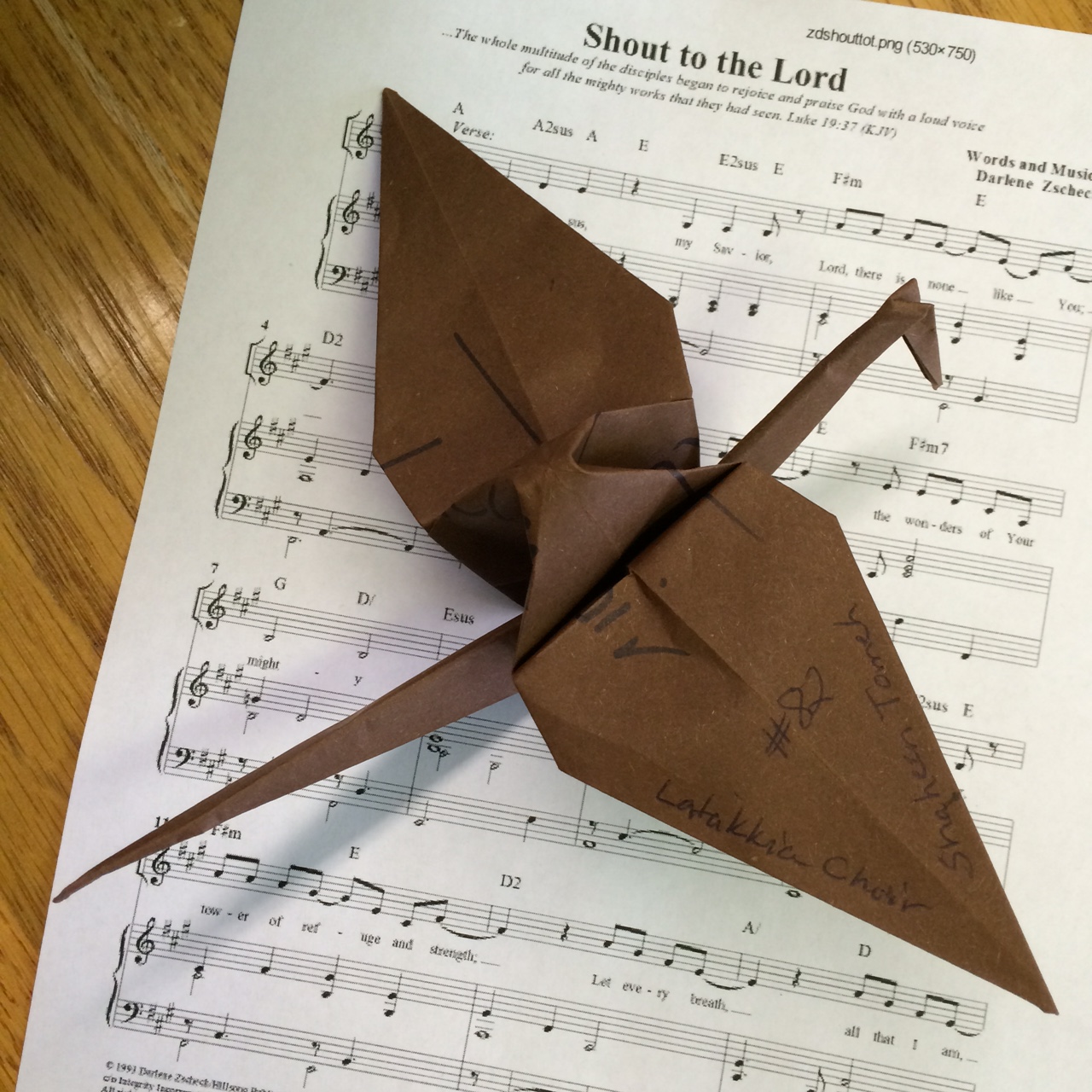
Paper cranes Shaheen TomehAnd because the Clifton Strength Finders tells me that one of my top five strengths is connectivity, I have connected my journeys with the faithful of the Middle East to my prayers of peace for them to this visible expression of those prayers in origami cranes.

The legend of the one thousand paper cranes comes from Japan, and is especially poignant when you read of a young girl who was poisoned with radiation from the bombing of Hiroshima. Folding one thousand paper cranes is supposed to bring you luck or a wish granted. She was hoping for healing of her cancer, which didn’t come to her. She was not healed, but maybe one day her wish will be granted in another way: maybe nuclear weapons will be eliminated so the threat of cancers and destruction caused by them will be wiped out. Maybe. Maybe there will be peace.

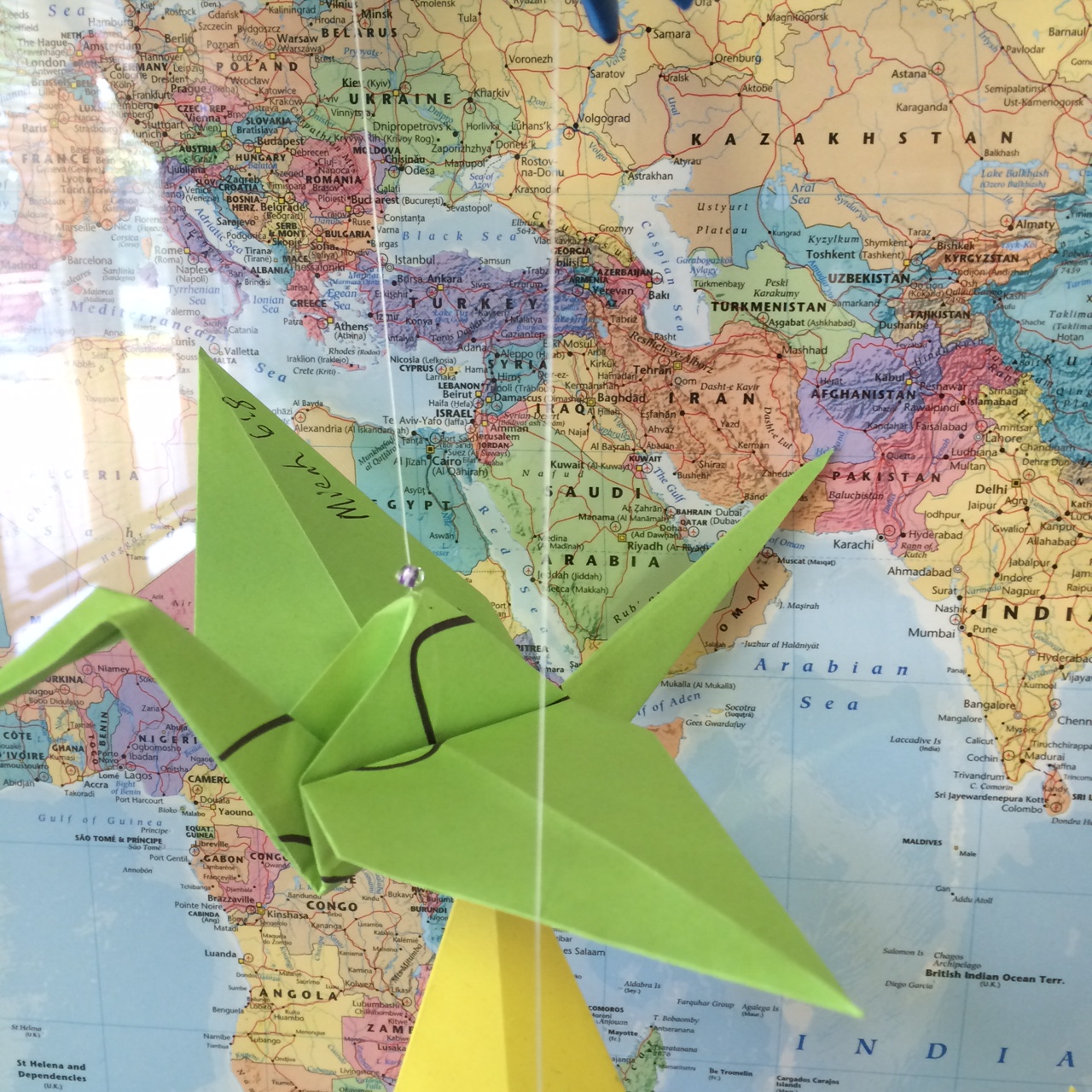
Paper cranes prayers ascendingI have folded 96 so far on my journey to one thousand. On each one is written the name of a person, or a place, or a piece of scripture, or the words of a hymn, or simply the word peace in any language I can find. As I fold each one my simple prayer of peace is attached to each one in the motions of making the crane.

The prayers are repeated and joined as I string them on nylon thread, separated by beads. It reminds me of the act of praying the rosary.

The prayers are repeated again as I hang the strings of cranes in my office near my map of the world – God’s creation – where this peace is so needed.

Every day as I enter my office, I have this visual reminder and expression of those silent prayers. And it gets larger every day with another crane, ten more cranes; another string; five more strings. And one day it will reach one thousand.

My wish – my prayer! – in folding these cranes is simply this:

Dona nobis pacem…grant us peace.

Grant peace to the people of Syria, whose war has dragged on for over four years.

Dona nobis pacem.

Paper cranes Micah 6 8Grant peace to the people of Iraq, whose troubles and war run on unabated since our country’s terrible decision to invade in 2003.

Dona nobis pacem.

Grant peace to the people of Lebanon, a country that becomes a proxy and pawn for the evil ideas of others; a small country that has borne a heavy burden from these other two wars as they are overrun with refugees.

Dona nobis pacem.

Grant peace to the pastors and churches and their congregations who stay and serve and minister in the midst of extremist attacks and destruction and death.

Dona nobis pacem.

Grant peace to those who have lost everything and are searching for new homes.

Dona nobis pacem.

Grant peace to your world, Lamb of God. Let us know your peace which surpasses all understanding.

Agnus Dei, qui tollis peccata mundi, miserere nobis.
Agnus Dei, qui tollis peccata mundi, dona nobis pacem.

Dona nobis pacem.

Amen.


The Politics of Hope

crabapple tree in bloomIt’s started.

Our great American political circus, I mean the presidential campaign season, has started for 2016. Cruz is in! Rubio is in! Hillary is in! (In case you don’t know me, that last one makes me happy. 🙂 )

“I still believe in a place called ‘Hope,'” said the last president named Clinton.

I still believe in that place as well, although I don’t find it in the political circus or any of the performers in that ring, even Hillary.

But I don’t blame politics for that. I just blame what we have let the meaning of that word become.

In the Merriam-Webster dictionary the fifth listed definition of politics is this:

the total complex of relations between people living in society

Total. Complex. Relations. Between people. Living. In society.

It’s what has been modeled for me in the body of Christ – the church – a place that has struggled with politics since its birthday two thousand years ago, and yet still walks on, humbly and imperfectly. With hope.

Its totality: global, existing in its varied parts across the whole planet. I have walked with my brothers and sisters – the eyes and ears and limbs I cannot get along without – in Cameroon, the Czech Republic, Germany, Iraq, Lebanon, Syria. It’s a big family!

It’s complex: orthodox, catholic, reformed, apostolic, evangelical, monotheistic but based on a trinitarian dance of Father, Son and Holy Spirit.

It’s relational: in worship, in creeds, in sacrament – sharing life together with the one who gives us life.

Between people: and among people! Caring for each other in crisis. Praying at the bedside of the dying. Feeding the hungry. Standing with the oppressed and imprisoned. Seeing the value of our human lives as our created made us. High and low, young and old, male and female. Between. Among. Connected.

It’s living: ISIS can’t destroy it (although it is trying); purveyors of the prosperity gospel can’t dilute it and sell it like indulgences (although they try). Its message of the real good news – death is defeated! – puts air in our lungs.

In society: I have seen it care for the least of these in a home for the handicapped in Ludwigsburg, Germany. I have it walked with it among Syrian refugees in camps in Lebanon. I have heard it shouted from displaced Iraqis now in Kurdistan: we may have lost everything, but we still have Jesus! It will not be silenced. It is in the public square and ministering there.

And that is where I find hope in politics. Not in the mud-slinging that is to come as we sort out who our leaders should be, but there in that buried fifth definition from Merriam-Webster.

I find hope in that crabapple tree on our back patio. It’s roots are bound by concrete on all but one side, and yet every year it pushes out those gorgeous pink blossoms which will fall like snow in a week. The blossoms will wither and descend. The tree will hibernate in the fall. And then…BAM! Here they are again.

John 1:14 says the word was made flesh and pitched its tent with us. The complex totality of the word of God moved into the neighborhood, into our society, to live with us.

And hope is here still.


Sounding Stones

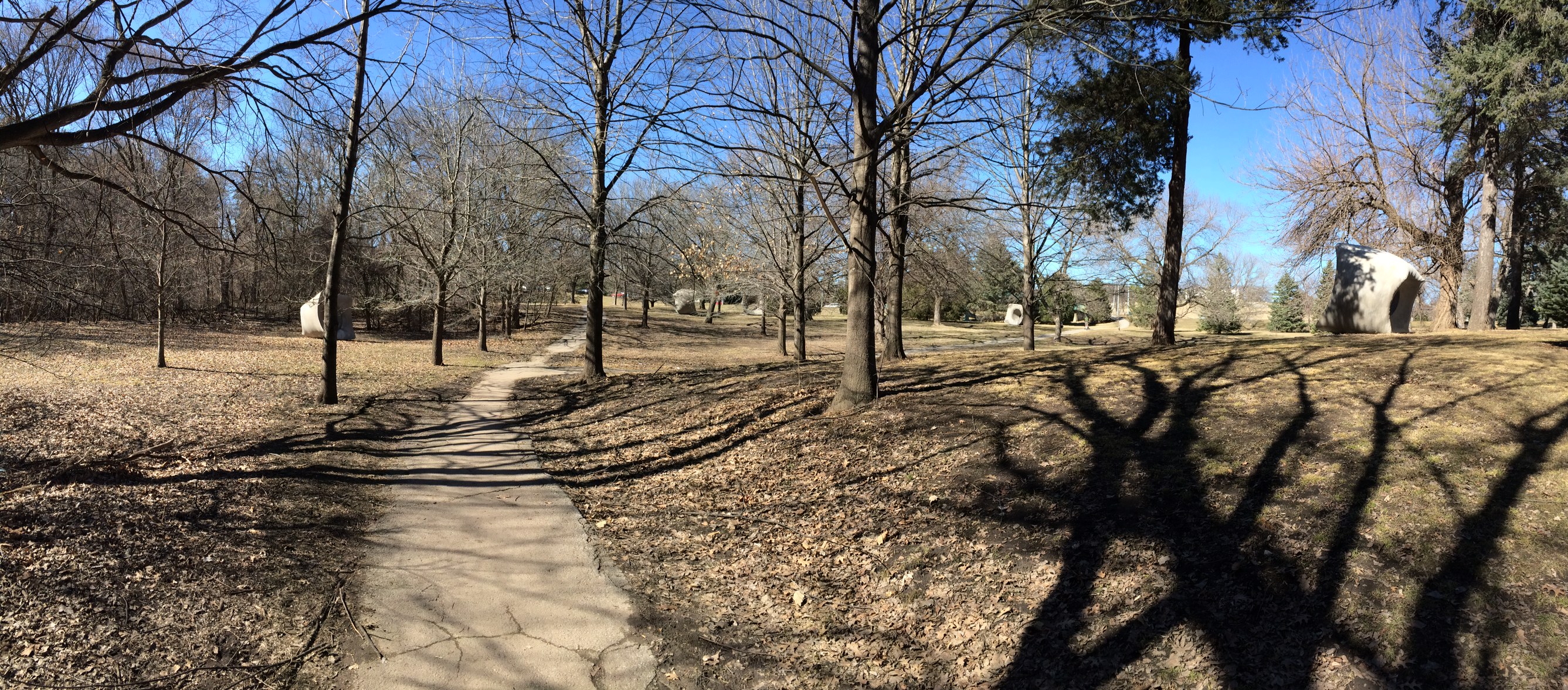
sounding stones panoramaI took a walk on a beautiful day in Omaha this past Sunday. On days like that, I just set out and let my feet go where they will, and on this day, they took me south toward Elmwood Park and the Sounding Stones.

This five-piece concrete sculpture was moved to this corner of the park along Dodge Street several years ago from another park about two miles east. A new development in midtown called for changes to Turner Park and so the sculpture was carefully packed up and moved west. There was quite a bit of resistance to this move by folks in my neighborhood. “That’s art? It’s ugly!” The NIMBY crowed was vocal, but city officials were unmoved and the Sounding Stones arrived.

Personally, I like them. I drive by them daily on my way home, and now several years later, they are a part of the landscape.

So Sunday, my feet took me along the path where they sit and for the very first time I saw them up close.

sounding stone brokenness sounding stone submission

sounding stone humility     sounding stone simplicity

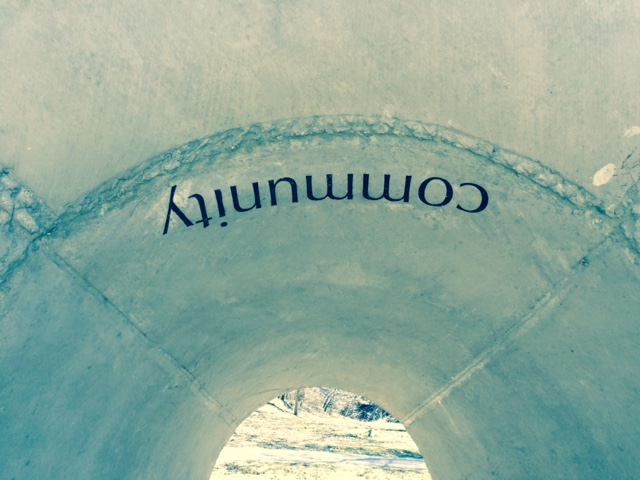
sounding stone communityThese are the sounding stones. Five values or attributes, five nouns that describe my life of faith. And amazingly, when I went home to search out the story of this sculpture, this is what I found in artist Leslie Iwai’s own words:

“The location of these stones in Omaha – a city in the middle of our nation – is important. Soundings are taken in the middle of a body of water to measure its depth. Likewise, in taking the ‘soundings’ of our community, we measure its depth. The open core of each stone is to be a place for crying out. God purposes for all people to break complacency and praise Him. But even, ‘if they keep quiet, the stones will cry out.’ (Luke 19:40),” Iwai wrote in her artist statement about the work. (Wayne State College Magazine, Summer, 2006 issue)

I don’t know what the depth of faith is in the middle of my city of Omaha, but on a sunny Sunday afternoon in the middle of Omaha, I lay down in the hollow of that first stone labeled “brokenness” and knew that the depth of my faith starts there, in the brokenness of my life. Loss of my mother at age 7. The child abuse of my siblings by an evil stepmother. My sisters’ near life-ending car/train collision. My brother’s HIV diagnosis. The death of my father from renal failure. The rape and murder of my baby sister.

All those broken parts of my heart have brought me closer to the one who can heal.

And I wondered where the stone of brokenness would take me on that path and so I left that hollow in the middle of brokenness and walked on. I found myself looking upon humility and submission; I found myself at the foot of the cross where I kneel in obedience to a Lord whose blood was poured out for me and for all of us. Humbly. Gratefully.

And then I wandered on to simplicity, because it is so simple. He takes it all away: the loss, the pain, the horror, the fear, leaving just me, the Julie he created me to be. He is all I need and all I want.

And just when I think there is no more, he leads me down the path to community. He has shown me his body – the global church – and connected me into something so much bigger than I could ever imagine.

A depth sounding in the middle of Omaha, landlocked in the middle of the USA, on the staple of the map.

But even as I lingered at community, I thought how each of those stones has become more real to me as I have traveled far from the staple of this map to the places where human sounding stones have fleshed out the depth of faith for me in the past five years.

I thought of the brokenness of Syria and Iraq. I saw the humility of people who have lost everything and yet serve their neighbors who have lost even more. I saw the simplicity of life lived without stuff, yet lived in joy because of their love for a God who holds them and comforts them in their losses. I have seen the obedient submission of those who stay where they have have been planted and grown deep roots, to continue to share the good news in a place that needs to hear it more than ever. I have seen the community of orthodox and catholic and protestant come together as one family and love their Muslim and Yazidi neighbors who are also broken.

My friend Marilyn is currently in Iraq sending back stories of this faithful community of God’s living stones, and two lines in her recent emails struck me as I ponder these five sounding stones standing in my park nine time zones to her west:

  • “Do not cry for us—we have may have lost everything, but we still have Jesus.” – A woman driven from Mosul by ISIS, now living in a tiny space in a former Sunday school room of a church in the safer northeast
  • “how strange that we (Muslims) try to kill you (Christians) and you help us anyway.” -shared by an elder of the church in Kirkuk

As Marilyn added, “What a powerful testimony to the of sharing Christ’s love and of God bringing good out of evil!”

They are the living stones who cry out in thanksgiving and praise for the one who made them and saved them and loves them still.

And from the depth of my heart and soul, I cry out in thanksgiving and praise to him along with them.

And pray for his peace to descend on us all.


Memory loss

Mark Mueller, Elmarie Parker, Rob Weingartner, Elder Zuhair, Marshall Zieman, Tom Boone and Larry Richards offer communion at the Evangelical Church of Basrah, November, 2012.

Mark Mueller, Elmarie Parker, Rob Weingartner, Elder Zuhair, Marshall Zieman, Tom Boone and Larry Richards offer communion at the Evangelical Church of Basrah, November, 2012.

Today was communion Sunday at our church and the familiar words were spoken as we began the celebration of the Lord’s supper:

And he took bread, gave thanks and broke it, and gave it to them, saying, “This is my body given for you; do this in remembrance of me.” Luke 22:19

It’s a ritual I first took part in when I received my first communion in second grade at Christ the King Catholic Church here in Omaha, fifty years ago. I wrote about it in my blog last October:

Remembering

And every time I receive the elements, the bread and the cup, I remember back to that night.

I remember the communion in Basrah, Iraq, that I witnessed in 2011 as the Presbyterian church there was able to celebrate it because our group brought four pastors with us.

I remember that communion repeated in Basrah in 2012 as we returned with six pastors.

And I remember communion in that same church in March, 2014, as we returned to celebrate communion with them as they now had their own pastor to lead it.

Memories. I collect them like others collect stamps or baseball cards. It’s what makes me Julie, or at least contributes to the essence of me.

Remembering in communion, remembering the sacrifice made for us out of great love, is the center of our Christian worship, its holy essence in the body and blood of Jesus Christ.

Jana and I just came back from seeing the movie, “Still Alice.” It stars Julianne Moore in the role of a brilliant linguist and college professor, wife and mother of three, who is diagnosed with early onset Alzheimer’s disease. Bit by bit, she loses the words she is a master of. She gets lost on the campus in her familiar daily run. She forgets where the bathroom is in her home. She forgets the names of those most familiar to her.

And even though her family grieves her loss as she disappears day by day, they love her and care for her and know that she is, after all, still Alice. But in the end, she really is not the Alice that we saw in the beginning. She has been robbed of her essence.

I have seen it happen to others I know as well, real people, not characters in a movie. It is very hard to watch and a feeling of helplessness in the situation is overwhelming.

This movie struck a bitter, minor chord in my heart today because of the recent news of what is happening in Iraq and Syria: the destruction of ancient works of art and ancient manuscripts in Mosul and other places as ISIS deems them idols of the apostate. “These things didn’t exist at the time of the Prophet. They have been invented and must be destroyed,” or something like that.

It’s a bitter chord because it is like a deliberate attack on the essence of who we are as humans and how we developed the languages to tell our story, the grand story of our creation by a loving God. The same creativity he exhibited by speaking us into being and breathing his very breath into us to give us life, has been left behind by those who wrote it down on parchment manuscripts, who sculpted it into winged creatures of bigger-than-life size, who painted it onto canvas or stone walls.

And it is systematically being destroyed, erased, even as the words that Alice knew intimately were wiped one by one from her brain.

I am reading a book right now called High Tea in Mosul by Lynne O’Donnell. She was one of the first journalists to reach this ancient city after the war ended (it never really did, did it?) after the invasion in 2003. I haven’t finished it yet, but in reading it this week I came to a part that just made me want to cry out.

Mosul is the ancient Ninevah of the Bible. The Ninevah that God sent the reluctant prophet Jonah to in order to preach his word of repentance. There is – I mean was – a temple there where Jonah was said to be buried. Lynne talks about it standing there still as testament to the power of the human spirit to hang on even in the hardest and darkest of times.

The book was written in 2007. In 2014, this temple of Jonah was destroyed.

As Alice’s family learns early on after her diagnosis, there is no cure for Alzheimer’s.

I don’t know the cure for the scourge of evil that is ISIS. And bit by bit, this disease is robbing our human family of its collective memories, the ancient artifacts that tell our story.

And so I cry out with my brothers and sisters who live there and who watch it happen and are helpless to do anything,

How long, LORD, must I call for help, but you do not listen? Or cry out to you, “Violence!” but you do not save? Habakkuk 1:2

And then I remember the bread and the cup of sacrifice. And I say thank you for the gift of memory. And I write it down and look at the pictures I have taken of men and women and children.

And I pray.


Prayer of solidarity in a string of beads

Bowl of glass stones

Sisters and brothers in Christ, today we gather around the baptismal font, remembering both God’s gracious promises to us and our sisters and brothers in Iraq, Syria and Lebanon (and Egypt). We are united by a common faith in Jesus Christ and a family bond that reaches from east to west, and north to south around this globe; one that covers all time.

This was the start of a prayer of solidarity for our brothers and sisters in the Middle East. Mission co-workers with our denomination, the PCUSA – and friends of mine – came to our pulpit to share stories of their first year living in Beirut and working with the National Evangelical Synod of Syria and Lebanon. Powerful stories. I have shared a few on this blog myself, that I have experienced personally. I recognized the places, the faces and the loss and grief as Scott and Elmarie spoke.

And since we are God’s children, we are God’s heirs. In fact, together with Christ we are heirs of God’s glory. But if we are to share Christ’s glory, we must also share his suffering.

On this day we shared by praying together in solidarity with them. And to remind ourselves to keep praying, we each came forward to the baptismal font and took a polished stone to hold in our hands.

Glass stoneMine is green glass. Polished. Smooth. Easy to hold and to admire. And when it is cupped in my hands, clasped in a gesture of prayer, it is a tactile reminder of those who are heirs to God’s glory and even now sharing in his suffering.

As I look at that picture of the collection of glass stones, I can easily assign names to them; each representing a real person, people I know and love.

There’s Lamis from Lattakia who gave me lovely earrings in 2010 in a quieter time and place.

There is Toeh, a young woman from Homs, now a refugee with her family in Amr Hasn, who doesn’t even have any photos to remind her of life before the war.

There is Huda in Yazdieh, the pastor’s wife who collects food and blankets and distributes with love and prayer to some 1700 families, like Toeh’s.

There are the eight pastors still serving fifteen Presbyterian congregations in Syria: Salam, Ibrahim, Yacoub, Ma’an, Michel, Boutrous, Firas and Mofid.

There are the synod leaders: Fadi and Josef and Adeeb and George, along with Assis Salim, the head of the organization of evangelical churches.

There are the pastors in Lebanon as well, serving their own congregations plus those who have fled there: Mikhael and Rola and Fouad and Hadi.

Educators bringing the word of God and the values of Christ to new generations: Najla and Dr. Mary and Nellie and Hala and Izdihar and Riad.

Pastors and elders and priests who are doing the same work of provision and reconciliation in Iraq: Haitham and Farook and Magdy, Patriarch Louis Sako, Fr. Aram and Fr. Turkum and Msgr. Emad and Zuhair and all the teachers in the kindergartens.

One polished stone for each of them, and I hold this green one in my hands and pray.

Saving God, hear this day the cries of those in Syria, Iraq and Lebanon (and Egypt) who have been over-run by violence. For those who are able to flee, guide them to safe havens. For those who stay, whether by choice or lack of means to leave, grant them courage, perseverance, hope and what they need to survive. May your church embody and freely share these gifts with those around them.

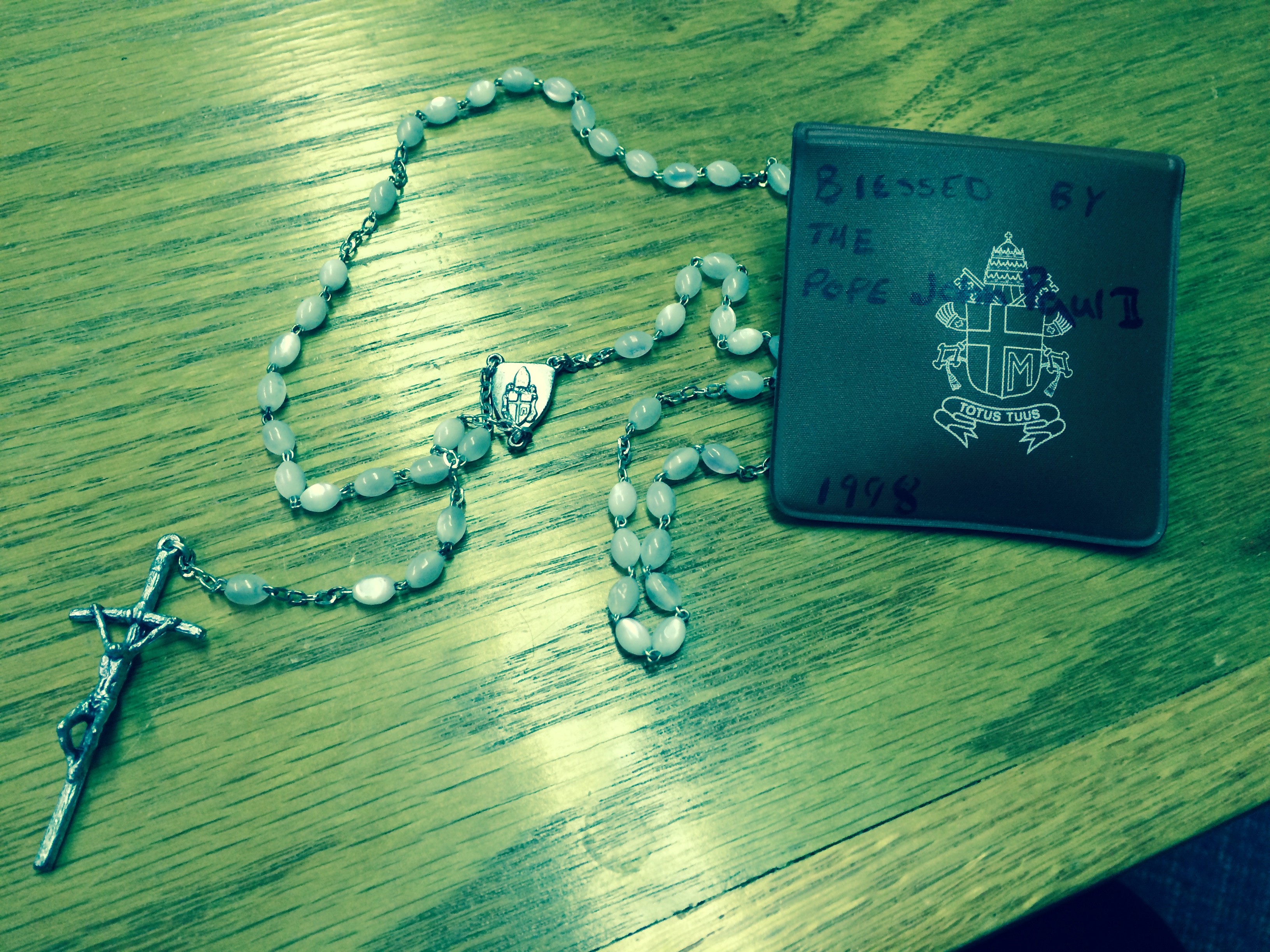
RosaryI always carry a rosary with me, a habit from my Roman Catholic upbringing. It’s a tool for prayer: 59 beads strung together with a crucifix on the end. My Aunt Carolyn, a Franciscan nun, gave this one to me on a trip earlier this year. She received it on a trip to Rome in 1998 and it has been blessed by Pope John Paul II. It’s a lovely remembrance of her trip, her vocation, and my connection to her and to the faith I was raised in.

Adeeb's prayer beadsI also have a set of beautiful amberwood prayer beads that I purchased in Lebanon this past November from a street vendor named Mohammed. Many of the pastors I know in the Middle East carry these same 33-bead strands with them everywhere, constantly moving the beads through their fingers, not out of habit, but in prayer. It was one of the first things I noticed about Assis Adeeb when I met him in 2010.

And this green polished glass stone that is now in front of me while I work, is a visual and tactile connector for me to these strings of beads used in prayer by people like me who follow Jesus. It may be a solitary stone, but it binds me in solidarity with each of those other stones as we pray together.

So let us pray.

God of peace, empower and guide those who are working to make visible your kingdom ways of justice, peace, and transforming love in Iraq, Syria and Lebanon (and Egypt). Bring your transforming peace to these lands. For Christian schools and teachers working with both Muslim and Christian students we pray – grant them wisdom, creativity, and enduring love. For Muslim and Christian students studying side-by-side – grant them the courage to live into a new kind of future together in the Middle East where there is respect and opportunity for all, regardless of religious creed, ethnicity, or gender. For those working with children orphaned and traumatized by war – grant them daily hope and joy-filled love. For children, women and men maimed in spirit, mind, or body by violence – grant them healing and a new future. For government officials – grant them the will to seek the good of their people and courage to turn away from personal or outside agendas that seek gain from war and instability. For those caught up in violent political and religious radicalism – wake them up to true life. Grant that we, disciples of Jesus from east and west, north and south, bound together by baptism and the Holy Spirit, may live each day with Christ’s kind of self-giving love: doing justice, loving kindness, walking humbly with you. Amen.

And amen.

(A special thank you to Revs. Scott and Elmarie Parker for this prayer, which is adapted from The Worship Sourcebook, pp. 286-304; Job 19:7; Habakkuk 1:2; Romans 8:17; I Thess. 5:16-18, 23-24; Micah 6-8.)

Assis Ibrahim from Aleppo

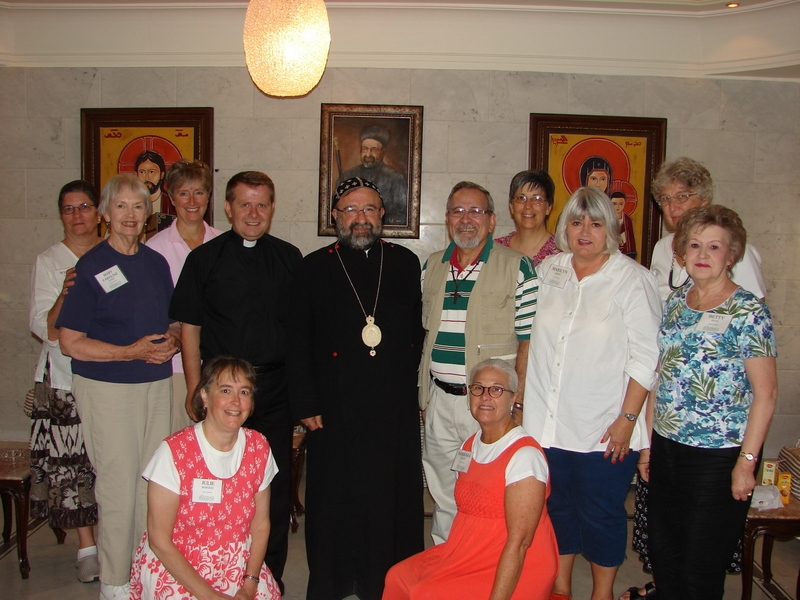
(Back) Wendy Moore, Sue Jacobsen, Kate Kotfila, Emily Brink; (standing in middle) Mary Caroline Lindsay, Assis Ibrahim Nsier, Archbishop Yohanna Ibrahim, Rev. Nuhad Tomei, Marilyn Borst, Betty Saye; (kneeling) me and Barbara Exley

(Back) Wendy Moore, Sue Jacobsen, Kate Kotfila, Emily Brink; (standing in middle) Mary Caroline Lindsay, Assis Ibrahim Nsier, Archbishop Yohanna Ibrahim, Rev. Nuhad Tomei, Marilyn Borst, Betty Saye; (kneeling) me and Barbara Exley

I first met this man of God in the summer of 2010. I remember coming home and telling my pastor George about him. His church in Aleppo was doing the kind of relational, incarnational ministry in their neighborhood that our church in Omaha was doing. Their neighborhood in Aleppo was a bit different than ours, to say the least.

But this was before the war that came to them just seven months later. We were privileged to worship with them in their lovely building, and to hear how they were caring for Iraqi refugee families in their midst. These displaced families were, of course, refugees from the war our country had brought to Iraq in 2003. Like other refugees from other wars who could not go home, they were waiting to be resettled in still other countries, unknown to them.

But this small Presbyterian congregation in Aleppo, led by this young energetic cleric was making a difference to those families, and to the kingdom of God.

I still keep a picture on Facebook as my cover photo to remind me of those precious days in August, 2010. It’s the one on the top of this post. Assis Ibrahim is in the back row standing next to another Ibrahim, Syrian Archbishop Yohanna Ibrahim, who was kidnapped in April, 2013, and still has not been heard from. I pray for them both when I see this picture, and I hope others do as well when they visit my Facebook page. I wrote about them here:

Abraham: Father of Many

Assis Ibrahim is a man I admire, to say the least, and I will never forget him.

I had the chance to hear him on phone calls twice in the last two years as I returned to Lebanon to hear about what was happening to the Syrian churches in the midst of the war. Other Syrian pastors had been able to make it to Beirut, Lebanon, to tell us firsthand of the difficulties they were facing, but Assis Ibrahim could not come from Aleppo. I listened to his voice as he told us what had happened, and what was happening. I closed my eyes and remembered the worship we had participated in back in that hot glorious August in a building that was now rubble.

And I could see the face of that young, energetic, man of God, holding onto faith and hope and love.

IMG_0936This past November, for only the second time in four years I got to spend some precious time with him as he came to Beirut to meet with our group. He may not have remembered me, but oh! how I remembered him. His face unchanged. His voice strong as ever. His vision for the future was God-sent. Who else could see a Presbyterian boys’ high school reimagined as the National Evangelical University of Aleppo, even while a war still raged?

Assis Ibrahim.

And I wanted to tell you about him so you could pray for him.

Before I could come up with my own words, I received this extraordinary email from him telling the story of the church in Aleppo. And I think in the reading you will know what I have come to know about him:

This morning I woke up early at 4:30 to the sound of a mortar exploding. I said to myself, “A new day is started.” This is something normal in Aleppo.

I went to the kitchen, hoping to get some tea or Nescafe, but I had an urgent call from one of our members who was injured by the shelling. He needed someone to take him to the hospital. I got my shoes and got to the car quickly.

Thanks to God, they dealt with his wounds very quickly, and he was in church for our service.

Today, I preached that we should use what God has given us. No one can say, “I don’t have,” because if God has given us even a tiny thing, we can do a lot with this tiny thing in this situation in this community.

The church where we worshipped before the war was bombed, so now we meet in an apartment building. It’s up five floors, almost 120 stairs. We have had mortars hit the building, but God saved us and as many as 150 of us continue to worship there.

Being a pastor in this crisis is not as much about preaching as it is being with the people in their difficult time. Even if we cannot give money or fulfill their physical needs, we can at least pray with them, at least try to comfort them.

After the service, I received another call — two older women who had not one ounce of water and had run out of money to purchase water after paying for their rent and medicine. I got my family and went looking for someone in order to get them water, which I am sorry to say costs a lot of money. We need $300 a month for a family of five for drinking and washing water.

After that I received more calls asking me to go quickly to look for a home for two people whose houses were damaged from the mortar attacks that morning. We called a family from church that was out of town. They agreed to lend their house for a week until we can make repairs.

This day I described is like every day. Even what I have said doesn’t describe fully what is going on.

I am thankful to my wife and my family who remain with me in Aleppo during this crisis. Without my wife, I could be failing. She is my supporter.

We have three children, ages 6 to 12. This situation has forced itself over their lives. My children, when they hear a lot of bombing, they come to our room to feel a little bit secure. When we send our children to school, believe me, we say goodbye to each other because we don’t know if we’ll have the opportunity to see each other once again.

Always we teach the children that although it is difficult in this time, our security is in God. We try to teach them that we suffer as Jesus suffered and that the day of resurrection will come someday.

We believe we have a lot left to do in this community. As I walk around the neighborhood, I see the despair on the faces of the people. I see children on the streets begging for money. I can see people walking in the streets without shoes.

In 2013, through the church, we distributed food baskets to 100 families for two months. Last summer we were able to help 118 families with monthly cash allowances, which helps families pay for things like medical treatment, food, tuition. From August to December 2014, 65 of the most vulnerable families got monthly allowances. (MCC supported these efforts through its partner, the Fellowship of Middle East Evangelical Churches.)

We are not only supporting Christians, we are supporting the whole community to teach them that being a human means having a responsibility to the others. Believe me, we never think in ways that this is Muslim or this is Christian. We think differently. We think we are here for a message and this message should be clear for everybody — that God loves all the people and I insist on the word “all.”

We are called to live in hope. We trust God and we do our job — praying, taking care of each other, reading the Bible and being an instrument of love and peace in this community. This is what we do, and this is the hope we live in.

Please don’t forget us in your prayers.

Please don’t forget them in your prayers. And if you can do even more than pray, please consider sending a donation for the work of the church in Syria to The Outreach Foundation, 381 Riverside Drive, Suite 110, Franklin, TN 37064.

“This is what we do, and this is the hope we live in.”

Amen.