O Holy Night

15740751_10211438722274199_4657497256410435989_nIt’s 12:55 a.m. on Christmas morning. I just came home from the late Christmas Eve service at the church next door to our house, a tradition I began about nine or ten years ago when the services at our church were moved to earlier times. It’s a short walk to Dundee and I love being an anonymous worshiper in a church where I know practically no one. It is always a blessing to see the people I do know, Meri and Ron Crampton, and to give them a Christmas hug. Tonight I walked out of the church with another Ron I know. His wife Tami was sick, so if you think about it, please say a prayer for her healing.

Christmas at West Hills was bittersweet. There were glorious moments of praise on this night as we sang “Joy to the World,” “Silent Night,” and other familiar carols which take me back to the earliest Christmases I can remember. Our dear Michael Dryver soloed on “O Holy Night,” and did it in a way that would have put you right there in Bethlehem. It is my favorite Christmas carol, and I especially love the third verse: Truly he taught us to love one another. His law is love and his gospel is peace. Chains shall he break, for the slave is our brother, and in his name all oppression shall cease. The bitter came as I reflected that this would be the last Christmas Eve service I would get to share with Nicole and Mike Geiler. There they were, seeing to all the details of a wonderful service. They didn’t miss a beat. They love Jesus and they have helped us celebrate his incarnation for all these years. I don’t even want to think about next year. Steve, Jana and I were the Advent candle lighters and readers for this night. And I know in the bitter and the sweet that lighting that center Christ candle is the visual symbol that he is the light of the world and the darkness does not overcome it.

And that reminder came in the sweetest of forms as I watched the global church celebrate Christmas in the hours before I did. Nine hours east of Omaha came the posts from Basrah, Iraq. Merry Christmas Zuhair Fathallah and all the faithful there! And in the darkest of places on the world stage these days, in places where I have been praying for God’s gospel of peace and for the ceasing of all oppression, came the posts from Syria. Mathilde Michael Sabbagh leading in the children to the sanctuary in Hasakeh singing pa-rum-pa-pum-pum. And there was Assis Salam Hanna of Latakia soloing in a bass voice on O Little Town of Bethlehem, and I didn’t know he could sing! Elias Y. Ousta Jabbour was playing the keyboard, and that song had an awesome beat. Tami Dekrmnjian Nseir had posted a video earlier of the church in Aleppo singing “Silent Night.” Can you imagine? A silent night in Aleppo.

So here it is Christmas in Omaha and I am celebrating the reality that the word was made flesh and moved into our neighborhood, into Basrah, into Hasakeh, Latakia and Aleppo, and indeed the whole world. That word was the light of the world and all the darkness in it yesterday, today and tomorrow, cannot and will not overcome it.

O holy night, the stars are brightly shining. It is the night of the dear savior’s birth.

Merry Christmas!

Celebrating Christmas

Another question from my final exam in Theology 331, Jesus Christ, Liberator, asked us how we might celebrate the birth of the Christ child differently this year after being in this class. Here was my answer.

As a family of people who profess to follow Jesus – Christians – we act in faith and hope and love. These virtues are the highest exercise of our humanity, and in them we participate in the very life of God. But what does this look like for us as we look ahead to Christmas? Do we just believe that Jesus was incarnated so we could have a new television? Is that all we hope for on December 25? Is that how we show our love for each other as husband and wife? Is it so small? This Christmas we need to seek more deeply what it means to be human persons beloved by God so much that he would share this human life.

It begins in prayer. Not the prayer that says, “Bless us Father with all good gifts, especially the 55” one,” but the one that draws us to the foot of the cross and centers us in this reminder of how much he poured out his love for us. Let us pray that our lives would be poured out for each other and for the sister we share this home with. In the light of a candle burning, let us look around at each other’s faces and see the gift of each one and our need for each other. We cannot do this alone, but only together.

As we come together at the supper table, we can break the bread and drink the cup in communion as we remember what Jesus taught here: in the broken bread and poured out cup, he is there, and we share it together. In this sacrament of meal, our lives are joined in a dance of humanity and divinity. The only cookies we make this year shall not be a sugarfest of over-consumption, but a reason to walk the neighborhood and share this gift of love in the form of food with those around us.

martha-stewart-treeTo counter the culture that says BUY! BUY! BUY!, that is what makes for a good solid marketing dream of Christmas, we shall expend our resources in ways to benefit the poor and outcast in our community. The opportunities to provide for the homeless and helpless are the messages we will look to. Instead of presents under a tree in the living room, we will mark each ornament as a gift we have made to someone in the name of love. Here is the one for Wendi who needed a ride to Bible study. Here is the one for Verda Leigh who needed a weekly phone call to remind her that God loves her. Here is one for the gift to Bread for the World, to remind ourselves that advocating for the voiceless is a joy to participate in. Here is one for Amariah, in the hope that she is back with her family in California after a long bus ride from Omaha.

And we will mark the eve of Christmas in worship as we share in song and word with those who have shared our lives, who have mourned with us and rejoiced with us and listened to us unburden our hearts for people living in war in Syria and Iraq.

Jesus Christ: Liberator

I have had a great year as a student at Creighton University. Earlier this year, as I was fulfilling some undergraduate theology credits for my master’s program, I was enrolled in an amazing class with a professor who inspired me. The class was Theology 331, Jesus Christ: Liberator, a christology class. Here is one of the answers I gave on our final exam last May. Who is Jesus?

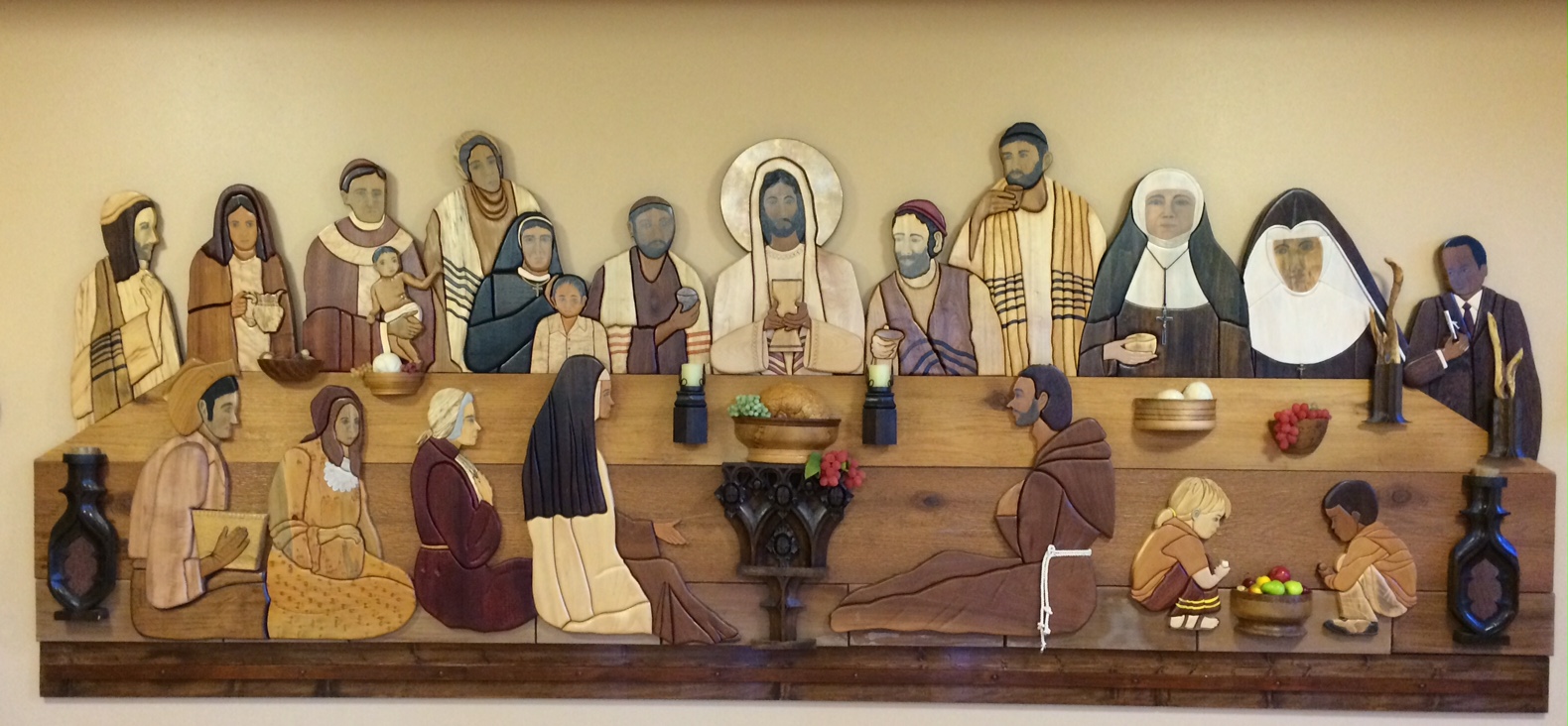
Mt St Francis last supper

“For me, in the figure of Monseñor Romero, Christ passed through El Salvador.” This one line in a documentary has stayed with me since I watched it. This is the Jesus I have come to know in my life, through my readings of scripture and story and narrative. The Jesus who reaches out to those left behind or discarded. I first met this Jesus as a seven-year old whose mother had died. That poor lost little girl was tended to by three nuns when she made her first communion in second grade. They saw her grief and worry and brought her to the table.

I have seen that Jesus who cares in a very special way for the poor all over the world as I have walked the halls of congress with my own disabled sister as we advocated for food and nutrition policy, for sustainable development, for increased funding for HIV/AIDS patients.

I have seen that Jesus in Iraq and Syria as he walks in the refugee camps and tends to newborn babies whose parents have nothing and no one to turn to. I have heard others tell his story in the form of kidnapped and murdered priests, just like Oscar Romero.

Mt St Francis Love like FrancisAs I have participated in this class and read all three authors, I have read the words out loud to my precious husband. “Look! Do you see this? This is what I keep saying over and over! You cannot profess to love God and not love your neighbor. These two are inseparable! That neighbor on the side of the road who looks scary is obviously in need of help. We can’t walk by her like the others.” What would Jesus do seems so cliché…but how do we answer that question, cliché or not?

That question and so many others rise from the depth of a heart that has not been immunized against empathy and compassion by the consumer society around me, but inflamed by the lack of justice in our laws and institutions. Sometimes it has been a lonely journey to walk. To sit in church and hear about Jesus week after week, but only in the sense that he is some kind of ideal absolute, is not what has given me cause to step out and walk with him. That Jesus is an idol, a statue on the shelf that I cannot reach.

The Jesus in this class is the Jesus that asks me to open my eyes and look around to see that others need this hands-on, give-me-a-hug, wipe-my-tears-away, human contact that reminds them that they, too, are human beings, made to love and to be loved. This is the Jesus who tells me to conscienticize myself: ask the questions of why is the world like this? What have we done to make it this way? What can we do to liberate and heal it? See. Judge. Act.

From my first reading of the entirety of scripture upon discovering Micah 6:8, my faith finally had the simplicity of six words to guide me: Act justly. Love tenderly. Walk humbly. This is the praxis of Jesus that his life demonstrated and I believe him when he tells me in Matthew 25 that our judgment will be based on this. Even when we don’t call on his name and step out in this way not expecting to see him in the moment, he is there, and we are loving him by loving our neighbor.

This is the Jesus who calls out the rich who withhold from the poor and can’t understand how serving the common good is how we all develop fully as persons, and the hypocritical church leader whose letter-following legality keeps people out and denies them hope.

This is the Jesus I have met in the community of this class. This is Rutilio Grande, Oscar Romero, Pope Francis, anyone who stands against the commodity form and sees their lonely neighbor as a person in need of human contact and comes into her life as friend. I have met this Jesus in this class and will always be grateful that I had the chance to share him with others.

Dona nobis pacem.

Holy Tears

This is my final reflection paper from my recently completed mini-class in my master’s program at Creighton University. The class was the first part of three on the history of Christian spirituality, and was appropriately titled “Martyrs and Monks.”

I first traveled to the Middle East, Syria specifically, in August, 2010. This was before the war in Syria, and the country was intact. Muslims and Christians lived together in a secular, mostly peaceful society. I visited a number of places, and one that struck me deeply was St. Simeon, the ruins of a fifth century church near Aleppo built around the pillar that St. Simeon the Stylite sat on for most of his life, praying to God. I had quiet moments of contemplation as I thought about this saint and his life and his attitude of prayer. But the highlight of my trip in 2010 was a visit to Aleppo and the Presbyterian church. This church had an amazing outreach to refugees from the American-led war in Iraq, which had begun in 2003. I met a woman named Nawal, a faithful and prayerful saint of her church, who chastised us (and rightfully so) for what our country had done to the Iraqi people. I have never forgotten Nawal, and had the chance to reconnect with her this past summer in Lebanon, but I will reflect on that later. We also had the chance to share a meal with an Iraqi refugee family in the less than modest apartment they could afford.

As a member of a group of women traveling together to learn about our sister Presbyterian church in Syria, we were each given the opportunity to lead devotion. I had chosen this passage in Acts: “All who believed were together and had all things in common; they would sell their possessions and goods and distribute the proceeds to all, as any had need. Day by day, as they spent much time together in the temple, they broke bread at home and ate their food with glad and generous hearts, praising God and having the goodwill of all the people” (2:44-47a). As I began to read, I was overwhelmed with tears and could not get through to the end. Hearing Nawal’s words to us about what we had done to the Iraqis, being welcomed into the home of an Iraqi refugee family who shared the bounty of their poverty with us in the hospitality that is the hallmark of Middle Eastern culture, I was utterly convicted of the corporate sin my people committed against the Iraqis. It was this memory that grabbed my heart as I read the readings for this class.

Over and over in the stories of the desert harlots – of Mary Magdalene and Mary of Egypt specifically – there are waterfalls of tears. Anselm’s prayer to Mary Magdalene captures it well:

St. Mary Magdalene,
You came with springing tears
To the spring of mercy, Christ…
How can I find words to tell
About the burning love with which you sought Him
Weeping at the sepulcher
And wept for Him in your seeking?…
For the sweetness of love He shows Himself
Who would not for the bitterness of tears.[1]

In his gospel, Luke tells us that a woman (possibly Mary Magdalene) who was a sinner, washed the feet of Jesus with her tears and dried them with her hair in an act of repentance (7:37-38). Mary of Egypt tells us, “Thus I understood the promise of God and realized how God receives those who repent…‘you will find rest.’ When I heard the voice say this, I believed it had come because of me, and I cried out weeping…”[2] As she tells Zossima her story of her prostitute’s life and the temptation to return to it she tells him, “When such thoughts grew in me, I would fling myself on the ground and flood the earth with weeping.”[3] When she asks Zossima to pray for her, he falls to his knees and his prayers and tears flow together.[4]

The connective tissue of tears and prayers in these stories resonated deeply with me and my experiences in the Middle East in 2010 and continuing for nine more trips through this past summer, including time in Lebanon, Iraq, and the now war-torn Syria, all places where the desert fathers and mothers actually lived. Why do the tears flow so easily, and especially in times of their prayers and mine? “Tears connect us with a part of ourselves and an expression of our deepest feelings that is far beyond our words or even our thoughts. Tears are a way that our bodies express our hearts.”[5] Said another way, “Tears are an outward manifestation of a biological release that is usually triggered by a profound emotional sensation.”[6] Being able to express emotion instead of suppressing it is a way for me to be real. On the thinking-feeling spectrum of the Myers-Briggs assessment, I register an absolute zero on thinking and am off the chart on feeling. To not express my feelings, especially to God in prayer, would violate the very meaning of prayer, according to Mother Maria. “It is only if we are rooted and grounded in reality, if we have found our own ‘heart,’ if we do not hide, that we can truly pray. All true prayer is a prayer of the heart, because it is the heart – not our physical heart but the deepest centre of our being – where we are touched by the divine, where we are fully ourselves, fully alive, fully one…present before the face of God.”[7]

As I have read through these texts, I have been thankful for what my friends have called my prayer language, which is tears of the heart. In further reading, I discovered St. Catherine of Siena and her great question to God: what is the reason and the fruit of tears?[8] Reading about the six kinds of tears God explained to her, I find that mine fall somewhere between level three and four:

Sweet tears of imperfect love: These are the sweet tears of those who have abandoned sinful ways and are beginning to serve God because they have begun to know and love him; however, their love is still imperfect, causing their tears to be imperfect as well. The person’s life is then characterized by exercising virtue, acknowledging God’s goodness, practicing self-discovery in the light of God’s goodness, and moving away from fear and toward hope in God’s mercy.

Sweet tears of perfect love: Perfect tears of mature love come from those who have developed perfect love for their neighbor and learned to love God without regard for themselves. These are the people who live the words of the Great Commandment: to love God with all your heart, mind, soul and strength; and to love your neighbor as yourself.[9]

Between those two levels is a maturing, a growth in love and in humility; a growth in the knowledge that it is only God’s love and goodness that invites us closer to him and his mercy, and away from our own sins and fears. I think those tears of mine somewhere between the imperfect and the perfect fall into the same place that St. Benedict described: “With growth in humility came ever-deeper awareness of one’s own sinfulness, as well as compassion and tears for the sins of other people. Such mindfulness meant deep feeling, and deep feeling meant tears.”[10]

As Mother Maria talks about the prayer of the heart, I discovered that my tears open my heart to the love of God. My heart moves from a heart of stone to a heart of flesh, which is what God promises in Ezekiel 36:26. Tears are a part of that process of heart softening, making real meaningful prayer possible. Abba Poemen says it this way: “The nature of water is soft, that of stone is hard; but if a bottle is hung above the stone, allowing the water to fall drop by drop, it wears away the stone.”[11]

With the Presbyterian church in Aleppo, Syria, August, 2010.

With the Presbyterian church in Aleppo, Syria, August, 2010.

So as I end this reflection, I want to return to my story of Nawal in Aleppo. Sitting on the porch of the Carslow Building at Ain Al-Kassis (which translates to “fountain of the father,” an appropriate description for how my tears flow!) in the mountains above Beirut, Lebanon, I was waiting for some of the Syrian women to arrive for the annual gathering of Presbyterian women in the Synod of Lebanon and Syria. A young woman came and sat on the porch with me, and as it turned out, we were Facebook friends although we had never met. Her name is Nisryn, and she lives in Paris, France. She had come to the conference because her mom was making the long and dangerous journey from Aleppo to be there as well. She told me it had been six years since she had seen her mother. As we sat and talked, I realized who the woman she was talking about was. “I know your mother!” I exclaimed. I jumped up to get my laptop and found this picture from my 2010 trip. I am standing behind the little boy in the front row, and Nisryn’s mom Nawal is to the right of me in the blue dress. Nisryn’s mom is the same woman who gave me pause to weep as I read the text from Acts about sharing everything, and no one was in need. She was the woman who showed me what the hands and feet of Jesus look like when serving the refugees of war. And now she was living in Aleppo still, a victim of another war and was coming to experience Sabbath at the women’s conference. Here I was, sitting with her daughter, and together we prayed at the fountain of the father for her safe travel…and our tears flowed as we came into the presence of God together and brought Nawal there with us.

Nawal, me, Nisryn, Ain al Kassis, Lebanon, July, 2016

Nawal, me, Nisryn, Ain al Kassis, Lebanon, July, 2016

It is only because we long for the presence of God, for a glimpse of his perfect beauty, for holiness, for ceaseless prayer, for union of love, for Paradise, that our hearts break with sadness when we realize how far away from it we are. It is this sadness – this “affliction” – which, I think, the Fathers called “compunction” and why they called the life of prayer – the life of trying to pray – “white martyrdom” – a way of pain. Without the longing, without repentance, without the breaking of the heart, there can be no practice of prayer and no true prayer on earth at all.[12]

These two weeks of reading the stories of the desert fathers and the harlots of the desert have touched a deep place in my heart. The message I took was so clear. My life of praying with tears is a gift I take with me in my experiences of ministry with and for the people I am privileged to journey with in Lebanon, Syria and Iraq. In repenting – in turning to God – in this way, I am my true self. I have found my heart, and it has been softened with tears of mercy and compassion. I know I have many more to shed.

Bibliography

Kangas, Billy. “The Role of Tears in the Spiritual Life: Lessons from the Desert Fathers.” The Orant. Entry posted May 2, 2011. http://www.patheos.com/blogs/billykangas/2011 /05/the-role-of-tears-in-the-spiritual-life-lessons-from-the-desert-fathers.html (accessed November 2, 2016).

Sheetz, Jenny. “The Gift of Tears: A Reflection.” stjosephinstitute.com. http://www.stjosephinstitute.com/_Assets/pdf/jennysheetz/The%20Gift%20of%20Tears.pdf (accessed November 2, 2016).

Stewart, Columba. Prayer and Community: the Benedictine Tradition. Maryknoll, NY: Orbis Books, 1998.

Ward, Benedicta. Harlots of the Desert: a Study of Repentance in Early Monastic Sources. Kalamazoo, MI: Cistercian Publications, 1987.

Zeleski, Irma. Encounter with a Desert Mother, 108-126.

Footnotes

[1] Benedicta Ward, Harlots of the Desert: a Study of Repentance in Early Monastic Sources (Kalamazoo, MI: Cistercian Publications, 1987), 20.

[2] Ibid, 48.

[3] Ibid, 50.

[4] Ibid, 51.

[5] Billy Kangas, “The Role of Tears in the Spiritual Life: Lessons from the Desert Fathers,” The Orant, entry posted May 2, 2011, http://www.patheos.com/blogs/billykangas/ 2011/05/the-role-of-tears-in-the-spiritual-life-lessons-from-the-desert-fathers.html (accessed November 2, 2016).

[6] Jenny Sheetz, “The Gift of Tears: A Reflection,” stjosephinstitute.com, http://www. stjosephinstitute.com/_Assets/pdf/jennysheetz/The%20Gift%20of%20Tears.pdf  (accessed November 2, 2016), 1.

[7] Irma Zeleski, Encounter with a Desert Mother, 110.

[8] Sheetz, 3.

[9] Ibid.

[10] Columba Stewart, Prayer and Community: the Benedictine Tradition (Maryknoll, NY: Orbis Books, 1998), 49.

[11] Sheetz, 4.

[12] Zeleski, 125.

The work of peace

Homs peace signsI am now officially a graduate student in the Master of Arts in Ministry program at Creighton University here in Omaha. I have spent two weeks with the other members of my program in resident classes there in June. What a joy to meet face-to-face with these wonderful young people! Most of our class time together will be spent online, discussing in Facebook-like posts on what we are reading about, so be together in the classroom was great fun.

During the weekend that came between the two weeks, twelve of us spent time together in an Ignatian silent retreat led by one of the Jesuits from the Creighton community. Father Larry Gillick guided us through those hours of silence with scripture to pray on, stories to think on and the reminder that our identity is found in what we receive from God and not in what we achieve on our own or what the world tells us we are.

A silent retreat. I survived. And yet I still have to make it through an eight-day silent retreat to fulfull the requirements of the class. EIGHT DAYS! Please pray for me. 🙂

I think back on the wonder of that weekend on this day as I prepare to leave once again for Lebanon. I will be spending precious time with sisters in Christ, many of them from Syria. I think how the luxury of quiet would be to them in the days of war they continue to walk through. I think they would love to hear…

Bird song

Wind song

Stillness

Quiet

Peace

One of the best things Father Larry gave me on this retreat was a name: Gerard Manley Hopkins, S.J. Father Larry would bring a well-worn Braille book of poetry with him when he came to our gatherings to direct us. The poetry was all by Gerard Hopkins, a Jesuit and poet from the nineteenth century, who had a way with language that brings me to tears. As we were meeting in the library of the retreat center for these meetings, I investigated the card catalog for some of Fr. Hopkins’ work. Surely in the Jesuit library in the Jesuit retreat center I would find a book of Jesuit poetry…

I was not disappointed.

In my quiet time (there was a lot!) I thumbed through the book and found this waiting for me like a gift under the Christmas tree:

Peace by Gerard Manley Hopkins, S.J.

When will you ever, Peace, wild wood dove, shy wings shut,
Your round me roaming end, and under be my boughs?
When, when, Peace, will you, Peace? I’ll not play hypocrite
To my own heart: I yield you do come sometimes; but
That piecemeal peace is poor peace. What pure peace allows
Alarms of wars, the daunting wars, the death of it?

O surely, reaving Peace, my Lord should leave in lieu
Some good! And so he does leave Patience exquisite,
That plumes to Peace thereafter. And when Peace here does house
He comes with work to do, he does not come to coo,
He comes to brood and sit.

“He comes with work to do.”

peace.jpgThere it was. The peace I have been praying for, and continue to, requires work. It is not going to just sit there and say, “Here I am! All is quiet now.” It is the beginning of work and not an end. We have work to do to make peace and keep peace.

And so I go to be with those who are peacemakers and peacekeepers. And they are blessed. Says so in Matthew 5:9, you can look it up.

Just as Fr. Larry introduced me to Fr. Hopkins and his beautiful poetry and this special one about peace, he also gave me a scripture to contemplate which describes the work I am to do, and you can too if you want to join me in working for peace:

Finally, brothers an sisters, whatever is true, whatever is honorable, whatever is just, whatever is pure, whatever is lovely, whatever is gracious, if there is any excellence and if there is anything worthy of praise, think about these. Keep on doing what you have learned and received and heard and seen in me. Then the God of peace will be with you. (Philippians 4:8-9)

Back to work!

Dona nobis pacem.

The church, The Church, THE CHURCH

Confession: This last post from our trip to Lebanon and Syria will be written in first person. I (Julie) have had several days of traveling time with Marilyn and Nuhad. On the curvy narrow roads from Damascus to Homs and then to Mahardeh, there has been a lot to reflect on between speed bumps, or “sleeping policeman” as Rob told us they were called in parts of Africa. Every time I have traveled on a TOF trip, Marilyn has been my leader and teacher and her words ring in my ears, but never as much as this time. These trips are not about our faithfulness, our bravery, or anything that is preceded by the word our, but they are about the church, The Church, THE CHURCH! In times of peace, in times of war, the church is here. It remains and we have come to stand with it and be embraced within it. Since the rest of our team returned home, we have been with three faithful parts of the body of Christ, the bride of Christ, his church.

The Presbyterian church in Bloudan, Syria.

The Presbyterian church in Bloudan, Syria.

Last summer, Marilyn and I spent several days beyond the women’s conference at Dhour Choiuer to travel to Syria and visit a church she had never been to. Our visas were not granted and so we have waited an extra nine months to finally visit the Presbyterians in Bloudan. Bloudan is a village of about 5,000 permanent residents that in normal times expands to 400,000 as summer residents come up the mountain to escape the heat of the valley cities for its cool breezes, summer homes and restaurants. It is a mere 50 miles from Damascus, so the drive is short. Well, the drive was short. Now, the last nine miles up the road once you’ve turned off the main highway require ten different checkpoint stops. This little village is surrounded by five other villages, one of which is Zabadani. Last summer when we tried to get here, Zabadani was the scene of pitched battles between radicals, Hezbollah and Syrian army forces. Similar battles were fought in all five of the cities, and as we made our way slowly up the road, one of those cities was still cordoned off by razor wire as the battles still rage.

The Bloudan church elders and women's leaders on the chancel of the church. Assis Feras Ferah, who is pastoring the churches in Hasakeh, Kamishli and Malkieh in the northeast, is from this church. Many of these people are family to him. His mother is embraced by Marilyn Borst in the center.

The Bloudan church elders and women’s leaders on the chancel of the church. Assis Feras Ferah, who is pastoring the churches in Hasakeh, Kamishli and Malkieh in the northeast, is from this church. Many of these people are family to him. His mother is embraced by Marilyn Borst in the center.

Upon arriving (finally!) in Bloudan, we were greeted by the faithful elders and members of the Presbyterian church. There have been five years without electricity here. Five years when precious little supplies have made it up the road. Five years of shelling, some of which has hit and killed, including the sone of one of the elders. But in five years this faithful church without a pastor has not missed worshiping the one we call Lord. Indeed, we had an impromptu worship service led by Kamishly pastor Feras Ferah who is from Bloudan. The little children from the KG processed in and recited Psalm 100 from memory, sang us a song and then all bowed their heads and prayed. And as we sat there in this church

The Bloudan KG kids lead us in worship.

The Bloudan KG kids lead us in worship.

together, we were reminded that they might not have electricity but that the light of Jesus shines brightly in and through them all. In solidarity with the other Christians here who are Greek Orthodox, they will all celebrate Easter together on the Eastern calendar day of May 1. And they were teaching the children this word in song: Jesus is risen! He is risen indeed!

This is the church!

After a refreshing drink from the spring that flows from this mountain place, we headed back down the road, through the ten checkpoints, past the razor wire and the pancaked buildings and back to Damascus for our final night there. Saying goodbye to Assis Butros and his wife Wafaa, we headed to Homs.

Michelline Koudmani in her Aunt' Mona's house which is currently under reconstruction.

Michelline Koudmani in her Aunt Mona’s house which is currently under reconstruction.

When Marilyn and I last visited Homs with a group from TOF it was November, 2014, and Homs had only been relieved of its near three-year siege for about five months. We visited seven different churches in the old city, which once was home to about 60,000 Christians. The churches, including the Presbyterian church, had all suffered destruction in different degrees. We gathered together as a group with the newly minted confirmation class under a cross-shaped hole in the roof and they sang hymns of joy for us in the promise that this church would be repaired. Now standing inside the beautifully restored church on an April day in 2016, the promise is indeed fulfilled. God is good. All the time. Elder Abdul Almessieh Salta, a civil engineer, pointed out the beautiful wood ceiling panels. Most of them are original but some are made of new materials to replace the damaged ones. The craftsmanship used on the new ones makes them indistinguishable from the original. Assis Mofid and his wife Michelline also walked us through what will be the pastor’s home once it too is repaired and refurbished.

Elder Najwa's home in Homs, now fully restored. This chair is the only one of her belongings to survive ISIS, but her home is filled with the love and light of Jesus, as she lives here with here brother and sister.

Elder Najwa’s home in Homs, now fully restored. This chair is the only one of her belongings to survive ISIS, but her home is filled with the love and light of Jesus, as she lives here with here brother and sister.

Refurbished homes in Homs was our next order of business. Although there is still much destruction all around on a massive scale, people are returning to this place. We were told that about 2,000 of those 60,000 Christians have returned to the old city. Driving through the narrow streets, we saw small shops and restaurants where hopeful people wait on those few who are back. And there is reconstruction going on. The Presbyterian church identified 39 homes of church members that could and should be repaired so people could return home. With several gifts, including one from TOF, a number of those 39 have been completed or are in different stages of completion. We visited the home of Michelline’s aunt Mona where workmen were busy. Although the rear of the fourth-floor walk-up is still open to the outside, structural posts and beams have been replaced, tiles have been laid in the kitchen and bathroom, and six rooms are defined. In my mind I can see Mona back here with her husband.

From there, we drove a short distance to the home of elder Najwa, who had been our constant companion on this visit in Homs. We had first met her on a video at the consultation of this home-rebuilding project in Homs. She was the first one from the church to return to her place and begin rebuilding it even before this project was put in motion. She was a teacher and a principal in a government school, and before the war lived in this apartment with a sister and two brothers. They had precious little time to leave before ISIS came storming in. These radicals had moved all of her beautiful furniture out of the sitting room and just sat on the floor. Before they left, they burned most of it and stole the rest. Now sitting here with her sister and brother (one died before he could return), it was like every other beautiful home we had been invited to on these trips. Pictures on the walls. Rugs on the floor. Reminders of life all around. And one precious original chair, which had somehow survived.

We enjoyed lunch at a newly opened restaurant called Cello, owned and operated by yet another Presbyterian church member named George. It had always been his dream to have a real restaurant in Homs, more grand than his former fast-food operation, and here we sat. Ninety would be here later this evening for dinner and karaoke. Dream realized. Life renewed.

This is the church!

Assis Ma'an Bitar and wife Gwath Hanna of Mahardeh. Ma'an also pastors the church in Hama which is nearby.

Assis Ma’an Bitar and wife Gwath Hanna of Mahardeh. Ma’an also pastors the church in Hama which is nearby.

From Homs we headed back to the road. Faithful Assis Nuhad drove through more unfamiliar roads on a roundabout way to Mahardeh, our final destination in Syria. Through small towns and farm fields, even where all seems peaceful, there are reminders of war. Besides the numerous checkpoints we stop for (maybe 30-40 on this part of our journey) we drive by gas stations where empty pumps stand. We know when a station has fuel because there will be a long line of cars, trucks and motorcycles waiting, sometimes as long as six hours, for maybe five gallons. Nuhad stops periodically at roadside stands. “Benzene?” he asks. As we watch the fuel gauge drop to about a quarter of a tank, his question is answered in the affirmative and a 20-liter container of gas is brought to the side of the car with a funnel and hose. A quick transaction and we return to the journey, but this is daily life here.

Mahardeh. Sitting peacefully on the terrace of Assis Ma’an and his wife Gwath, I have my own dream come true. Six years have passed since I first made this journey with TOF, Marilyn and a group of faithful US Presbyterian women. Sipping a cold beverage, I take in the blooming beauty of roses, onions and parsley in the garden and a view of the church where Ma’an’s father served before him. As we speak about how the war has affected this place in Syria, the only 100% Christian town in the whole country, we hear about the 6,000 mortars and shells that have rained down since the beginning back in 2011. Claude, a young man without family here now except for this church family, obediently retrieves an unexploded shell that had implanted itself in the garden bed right next to the terrace.

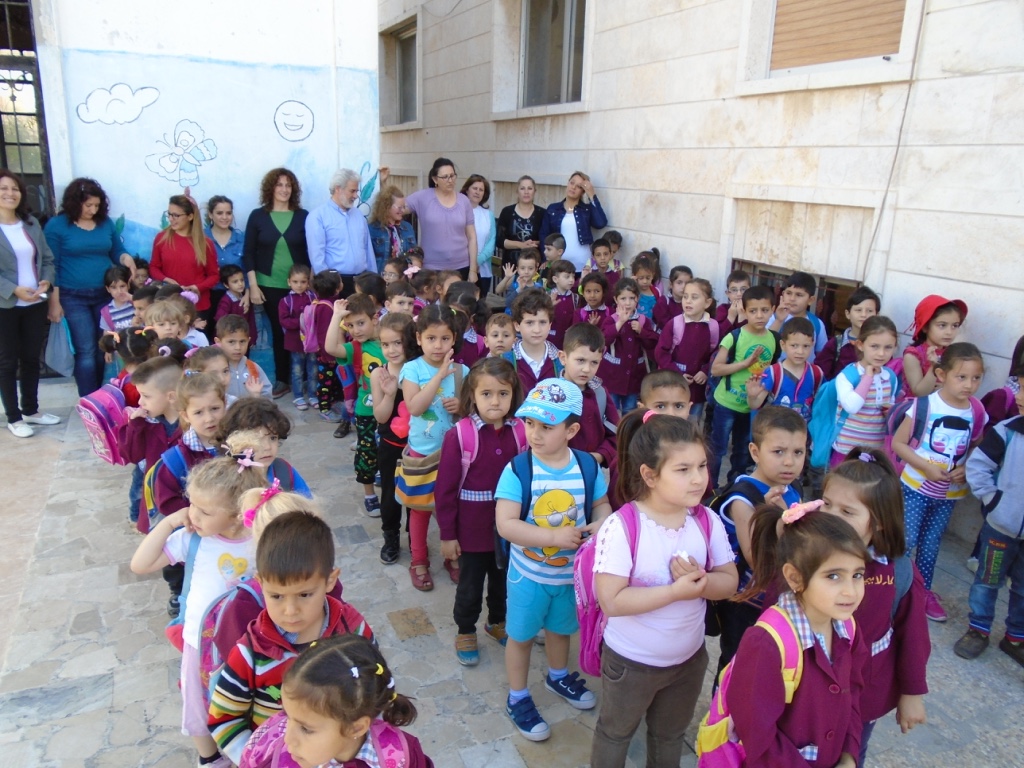
The children, teachers and staff of the Mahardeh KG. The little five-year-olds on the far right will graduate in May.

The children, teachers and staff of the Mahardeh KG. The little five-year-olds on the far right will graduate in May.

A bright beautiful morning greeted us after a peaceful night’s sleep in the Bitar’s home. Breakfast of fried eggs right from the chicken, homemade zatar, dried figs, birthday cake (another story!) and coffee gave us strength for this day. If you think our energy tanks were empty, we quickly had them filled with a visit to the KG run by this church and led by Gwath. 70 precocious children had arrived in the church yard and were standing in lines organized by age groups, singing a welcome for us. Dark hair, blond hair, brown eyes, blue eyes, some in their official KG uniforms, they said in unison “Good morning! We welcome you! Thank you for everything!” This vital ministry has never stopped and its importance cannot be over emphasized. These children will be the reconcilers of this land in the future as they learn the ways of Jesus.

Looking a little closer beyond the group to an individual, we look into the deep dark eyes of three-year-old Fala. Clutching her rolled up bread sandwich, taking intermittent tiny bites, her eyes never leave Marilyn’s face. We are told that her father suffers from mental illness and the church has tried to help him find a job, and to supervise his taking his medication so he can remain stable. This KG is a place of peace and solitude for this precious little girl and all the Falas like her.

Finally we spend some time with about twenty men of Mahardeh who have organized themselves into a kind of national guard unit to protect this place. They have 13 separate points around the city where they take turns on patrol and duty. When shells do hit homes and buildings in Mahardeh, they immediately repair the damage because they are determined that they will remain in their homes. We walk to a place where we can look just a short distance down into the valley and see how close the front line is. All of these men are volunteers with every day normal jobs: contractor, painter, carpenter, engineer, teacher. They are men of the chuches – four Greek Orthodox and one Presbyterian. They are men with families, and their families have suffered loss, but they remain constant and determined. One man named Simon who acts as the leader, invites us into his home and we are served refreshing lemonade and the always present cookies by his wife Reema. And before we leave, in solidarity as brothers and sisters in Christ, he gives us each a Russian icon of Jesus which reminds us that we are one in the Lord.

This is the church!

This is the joy I have as I travel with The Outreach Foundation: the church, The Church, THE CHURCH! I am humbled to be a part of a global body, to be present with them in times of war and in times of peace. To mourn with them. To rejoice with them. To walk with them and to sing with them and to dance with them. I pray it for each of you who reads this: to lift them up daily and see their faces when you close your eyes to pray. They are you and you are them, and we are one together in Christ.

Encountering the other

Many of the members of the consultation in Lebanon meet with the Syrian ambassador to Lebanon in dialogue about the situation in Syria.

Many of the members of the consultation in Lebanon meet with the Syrian ambassador to Lebanon in dialogue about the situation in Syria.

Our last full day at the consultation of global partners was a full day that once again began with worship and reflection. Elias Jabbour of Aleppo led us through the music of a Taize service and voices were raised in English, Latin and Arabic. Najla Kassab, who not only runs this conference center but is also in charge of Christian education in NESSL, offered a meditation on 2 Cor. 5:16-21. This portion of Paul’s letter to the church in Corinth is about reconciliation and offers that since we now know Jesus, it is through those lenses that we should look as we seek to reconcile one to the other. We need to look “beyond the flesh” and get beyond those prejudices and hatreds that hinder reconciliation. It is not a process that takes three days or months. This is April 13, the 41st anniversary of the start of the civil war in Lebanon that last for fifteen years. The process of reconciliation is ongoing here, and that was the message that Najla wanted us to hear. Reconciliation is a long journey, but we must do it from a perspective that is beyond the flesh.

Our speakers today had the task of reflecting biblically, theologically and personally on encounters with the other, and in the context we are in here in Lebanon/Syria, those encounters are of the interfaith variety: Christian to Muslim, Muslim to Christian. Rev. Agnete Holm of Denmark and Rev. Hadi Ghantous of Minyara, Lebanon, friends of long standing, carried us through several biblical passages – Old and New Testament – where these encounters take place. And Hadi offered this thought to us about how we read and understand the Bible. The Bible is about encounter. From the beginning God created someone to have an encounter with. Not only does it show us what we are meant to be, but what we really are…what we should NOT be! It is a mirror. The bible is not telling us to do that, but to learn from that.

Agnete reminded us that interfaith dialogue is about building loving relationships, but there are always ups and downs. We fall out, disagree, hate, debate. It is not about agreeing or reaching consensus, or creating harmony. It is about maintaining relationships no matter the fallings out or the comings together. That is long-term vision, not built up in three days, but three decades, the slowest type of ministry you can engage in and the easiest to destroy.

And from there we moved into an actual interfaith dialogue as Dr. Ibrahim Shamseddin, a Shi’ite Muslim, deeply religious man and friend of the Synod, came to the podium. His first words to us were that he had come with a prepared, written presentation, but as he listened to Najla’s reflection and those of Agnete and Hadi, he offered this: “We change our text when we dialogue.” He talked of the diversity of God’s creation: this is his will and should remain this way until he calls us home. If he had wanted merely clones, he would have made us this way. “Interfaith dialogue is about making relationship with others. We see ourselves in the other. Christ is a part of me as well.” And he finished with this thought, which is a good place to leave the formal part of this day: This is an earthly experiment, to live peacefully with each other. I can be with you fully without fitting into your doctrine or dogma. We do not need to clone each other. Diversity is salt, is wanted, and will remain a part of creation.

Rev. Tim McCalmont from California offers Christ's body, broken for us all.

Rev. Tim McCalmont from California offers Christ’s body, broken for us all.

And should you one day make the journey to this part of the world, you would be blessed to come to the end of a conference or consultation where the body of Christ is invited to his table. Lebanese, Syrian, American, Danish, French, Swedish and German followers share the peace of Christ and remember his sacrifice in broken bread and shared cup, for this is the encounter that changes us all.

Jars of Clay

The eight Presbyterian pastors serving in Syria (back row left to right) Jacoub Sabbaagh, Fairouzeh; Mofid Karajieli, Homs; Salam Hanna, Latakia; Elias Jabour, Aleppo; (front row left to right) Firas Ferah, Hasakeh, Kamishli and Malkieh; Ma'an Bitar, Mahardeh and Hama; Butros Zaour, Damascus; and Ibrahim Nsier.

The eight Presbyterian pastors serving in Syria (back row left to right) Jacoub Sabbaagh, Fairouzeh; Mofid Karajieli, Homs; Salam Hanna, Latakia; Elias Jabour, Aleppo; (front row left to right) Firas Ferah, Hasakeh, Kamishli and Malkieh; Ma’an Bitar, Mahardeh and Hama; Butros Zaour, Damascus; and Ibrahim Nsier.

“But we have this treasure in clay jars, so that it may be made clear that this extraordinary power belongs to God and does not come from us. We are afflicted in every way, but not crushed; perplexed, but not driven to despair; persecuted, but not forsaken; struck down, but not destroyed; always carrying in the body the death of Jesus, so that the life of Jesus may also be made visible in our bodies.” 2 Cor. 4:7-10

Marilyn led us in worship Tuesday morning around this passage of scripture which is incarnated for us here by the serving Syrian pastors who have been among us and are the reason we came: to sit with and listen to them tell the stories of affliction, persecution and perplexity of their home places, but also the resurrection stories that come from those same places. This is the church of Lebanon and Syria, and why we need each other. The global church models perseverance for us, and that is Paul’s theme. The church remains hopeful, constant. This text refers to the faithfulness of the church over the long time through difficult circumstances.

This is what the stories of the church in Lebanon and Syria do for us in the west: they become a living epistle. We lift up these stories of faith and faithfulness in Aleppo: Walking up five flights for worship because the building has been destroyed, and then building a new building because they may be struck down, but they are not destroyed as a body. Starting a water ministry for the community to love their neighbors. Or the stories from Homs: Nurturing a community in diaspora. The evangelical school that never closed despite mortar shells and bullets. The elderly home, not only providing loving care to this vulnerable population, but providing a place for worship when the church was bombed. A confirmation class that was conducted from home to home that took two years, but on Easter, 2015, the whole class was brought together. In Kamishli, the church found a way to be present to the Yazidi refugees by providing a source of fresh water and sunk a well. It seems that in these times the church could just hunker down and take care of itself. But the church is not called to survive, but to thrive. In Damascus, the church women devised a project for the refugee women to regain their dignity with the needlework project. In Mahardeh, the continuing education of young children by the kindergarten keeps faithful life incarnated. Mathilde Sabbaagh, a fourth-year student at the Near East School of Theology, who chooses not to flee to Canada because “God has not given me a word for Canada, but he has given me a word for Syria.”

Story upon story, picture upon picture, video footage that brought smiles one moment as smiling Sunday school children in the northeast of Syria showed their Christmas projects, and then sadness the next when a series of coffins was displayed, victims of a series of cruel bombings in the same city.

But as we hear the sadness and overwhelming circumstances of life in this war-ravaged clay pot of a country, we experience the resurrection as well. In Homs, a city under siege for almost three years, churches are being rebuilt and homes are being repaired and families are moving back in.

This is the church we have come to be with. This is the church we are a part of. This is the body of Christ and its life of faith and hope and love and endurance is the witness to the glory of God. May it ever be so.

Narrowing the distance

20160409 cranes photoHere we go again.

Steve and I are sitting in the airport in Minneapolis as we wait for our flight to Paris to board. From Paris, it is on to Beirut, Lebanon, and a rendezvous with our precious brothers and sisters in the National Evangelical Synod of Syria and Lebanon. As always, we are traveling with The Outreach Foundation and our intrepid leader, Marilyn Borst. After being in a consultation with NESSL and their global partners, we will make our way back into Syria.

It always make my heart sing to be setting off on the long journey to an ancient land, a land where the church was born and even Saul-turned-Paul saw the light, was blinded, healed and rose from the darkness to preach the light of the gospel of Jesus Christ.

This time I am going not as a church employee but as a theology student, and I just wanted to start this trip out with a short blog reflecting some truth from one of my classes: THL331, Jesus Christ: Liberator, led by Dr. Thomas W. Kelly, professor theology at Creighton University.

One of our texts for that class is a book that Dr. Kelly wrote with a very appropriate title for me coming from a church with the vision statement, “…on the journey with the living Christ.” The name of his book is When the Gospel Grows Feet, and it is about a Jesuit martyr from El Salvador, Rutilio Grande, and the church in El Salvador, and the gospel of liberation that has been preached from the first day of Jesus’ ministry. I have brought that book and my other required readings with me to keep up with the classes I will be missing and as I sit here in the airport, this is what I read:

“The Eucharist is the symbol of a shared table, with a stool for each person, and tablecloths long enough for everyone. It is the symbol of Creation, which requires redemption. It is already being sealed with martyrdom!” (From Fr. Grande’s last homily before he was assassinated)

This all-inclusive meal, the Eucharist, was the symbol par excellence for Rutilio that God wanted everyone to have a seat at the table of creation. He wanted this symbol of Jesus’ final meal to influence and structure social relationships very concretely. What followed in his homily was a careful argument for what the role of the church should be in the context of El Salvador, how that role should imitate the incarnation of Christ, and how it should perceive the world and its people. After a brief introduction of a church in service to the world, fragile but incarnated in history, the homily is divided into three distinct parts: (1) equality of the children of God, (2) the risk of living the Gospel, and (3) persecuted like Jesus of Nazareth. (Page 208)

There are a lot of geographical miles between El Salvador and Syria. But this I know: the church and its saints in El Salvador and Syria bring me closer to the meaning of this Gospel and that distance should be made smaller as we draw closer to it.

Dona nobis pacem.

Theology Classmates

My foray into higher education at Creighton University has kept me hopping over the last two months. But I made it through to spring break! No, I am not traveling to Myrtle Beach or South Beach or any other beach with the younger folks in my class. I am taking a few minutes to write something for this blog which has taken a back seat to writing for classes. I have written reflections on assigned movies, a letter about St. Ignatius and the Society of Jesus, mid-term essays, final essays and two research papers. It is hard to adjust my writing style to one that is more academic, but I am giving it my best shot!

THL110 class on final nightOne of my classes ended this past Monday as the seven of us in Theology 110 took our final. This group of new friends were a great reintroduction to university life. For seven Monday nights we met for four hours per class and our wonderful teacher, Mr. Mueting, fed us 2,000 plus years of theology. (That is about 300 years per week but one week we covered 800!) Every week he would bring us snacks to carry us through the dinner hour. Last Monday before we sat down to take our final exam we had a potluck dinner to celebrate. We took our picture to mark the end of this required class for all students at Creighton. There we are, Nancy and I, the two fifty-somethings; Heidi, mother of eight and studying creative writing; Manny who works for a bank and has three children; Kat the social worker who brought her perspective about adolescents searching for their identities; Brisa from Mexico whose bright purple socks made us smile; and Kit, a former EMT from Hawaii who is studying to be a nurse. Life in this class was never dull especially when Mr. Mueting, a dramaturge at heart and a former contestant on Jeopardy, stood at the front and opened the fire hydrant and poured out his extensive knowledge of theology.

It has been a marvelous two months.

Along with this class I have been taking another class in a more traditional format: 30 students (all 20 or 21, except for me!) led by a tenured professor whose doctorate in theology is on full throttle for each Monday and Wednesday class. This class has been such a gift as I have heard affirmation about what it means to love God and love your neighbor and that those two things are in tandem and should not and cannot be separated!

In both of these classes I have had good opportunities to share about the church I have been privileged to stand with in the Middle East and to bring a perspective that others might not be aware of. Even as I have been taught, I have tried to teach.

With all of these good people who share this time in history with me, I have learned about the saints who have handed down this faith to us, and it is these people I am most grateful to. Listen to their voices:

  • Disasters teach us humility. – Anselm of Canterbury
  • Man should not consider his material possession his own, but as common to all, so as to share them without hesitation when others are in need. – Thomas Aquinas
  • What does love look like? It has the hands to help others. It has the feet to hasten to the poor and needy. It has eyes to see misery and want. It has the ears to hear the sighs and sorrows of men. That is what love looks like. – Saint Augustine
  • Thou hast made us for thyself, O Lord, and our heart is restless until it finds its rest in thee. – Saint Augustine
  • Occupy yourself in beholding and bewailing your own imperfections rather than contemplating the imperfections of others. – Saint Ignatius
  • I wish not merely to be called Christian, but also to be Christian. -Saint Ignatius
  • Experience proves that in this life peace and satisfaction are had, not by the listless but by those who are fervent in God’s service. And rightly so. For in their effort to overcome themselves and to rid themselves of self-love, they rid themselves of the roots of all passion and unrest. – Saint Ignatius
  • Be who God meant you to be and you will set the world on fire. – St Catherine of Siena
  • You are rewarded not according to your work or your time, but according to the measure of your love. – St Catherine of Siena
  • Peace is not the product of terror or fear. Peace is not the silence of cemeteries. Peace is not the silent result of violent repression. Peace is the generous, tranquil contribution of all to the good of all. Peace is dynamism. Peace is generosity. It is right and it is duty. – Oscar Romero
  • If we are worth anything, it is not because we have more money or more talent, or more human qualities. Insofar as we are worth anything, it is because we are grafted onto Christ’s life, his cross and resurrection. That is a person’s measure. – Oscar Romero
  • There are not two categories of people. There are not some who were born to have everything and leave others with nothing and a majority that has nothing and can’t enjoy the happiness that God has created for all. God wants a Christian society, one in which we share the good things that God has given for all of us. – Oscar Romero
  • “he Lord God, in this plan, gave us a material world, like this material bread and this material cup which we lift up in offering to Christ the Lord. It is a material world for everyone, without borders. This what Genesis tells us. It is not something I make up. – Rutilio Grande

I think that there is song worth singing in those quotes, and a life worth living. And if we who call upon the name of the Lord could join that choir and craft our lives to the lyrics of that song, like St. Catherine said, we would set the world on fire.

Amen.