Thanksgiving 2015

Every day is a day to give thanks, and I try to do that every night in my evening prayers. But in the U.S. we set aside the fourth Thursday of November as a special day.

Happy Thanksgiving!

On this fourth Thursday in 2015, I have so much to be thankful for.
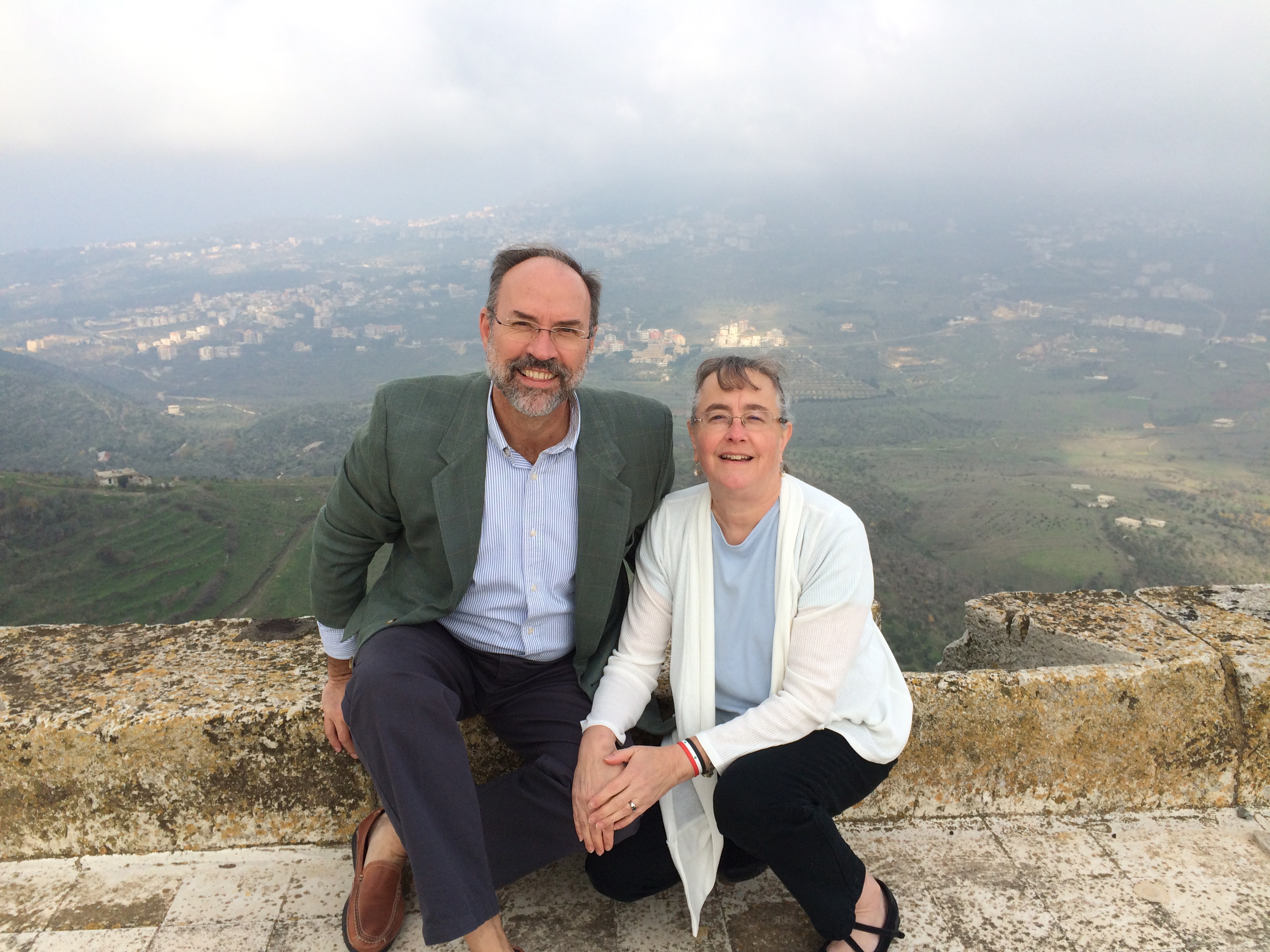
Steve and I on the top of the Krak de Chevaliers, Wadi al Nassara, Syria, November, 2014.

Steve and I on the top of the Krak de Chevaliers, Wadi al Nassara, Syria, November, 2014.

First on my list is my husband, Steve, who is standing in the kitchen chopping vegetables for a savory bread dressing, a staple of the meal that goes with this day. I am thankful for the miracle he is in my life; not looking for a life mate, our paths crossed fourteen years ago and here we are today. Sharing life. Sharing love. Sharing joy and sorrow. ‘Til death do us part.
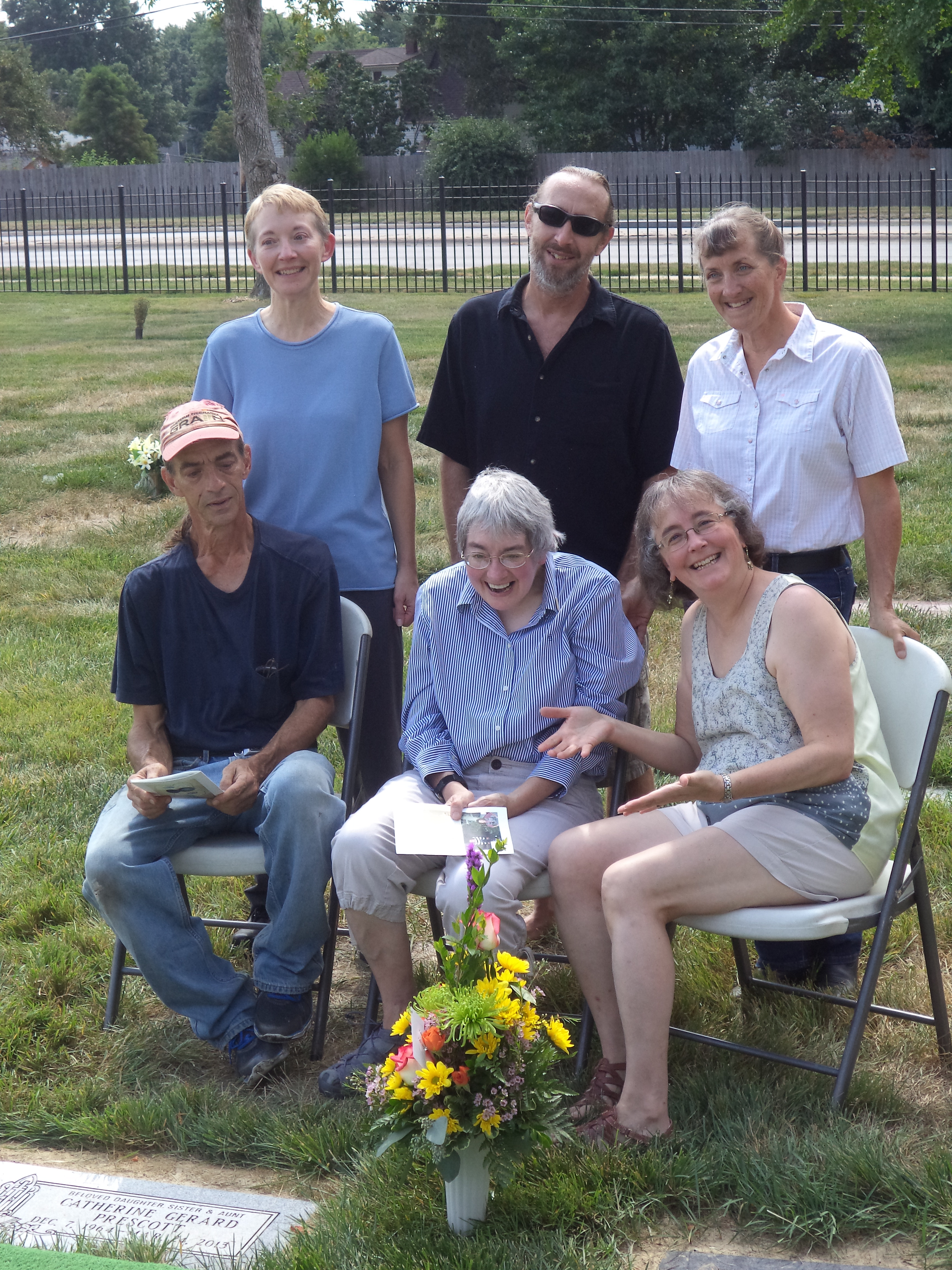
 

Six siblings at the memorial service for the seventh, our baby sister Cathy.

Six siblings at the memorial service for the seventh, our baby sister Cathy..

I am thankful for brothers and sisters who have walked through the hard times of head injury, of broken marriages and of new marriages, of loss through disease and grievous loss through crime. We once were seven, and now we are six, but the six remain a unit bound together through love. We are family.

I am thankful for friends who open up the world as a place to experience God’s glory and his grace. They encourage. They grieve for, mourn with, and on the other side they celebrate in joy. They are faithful women. They are lay and clergy – men and womenI am thankful for friends who open up the world as a place to experience God’s glory and his grace. They encourage. They grieve for, mourn with, and on the other side they celebrate in joy. They are faithful women. They are lay and clergy – men and women.
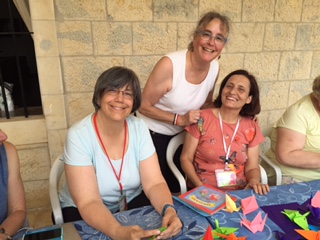
Flanked by Rev. Kate Kotfila of Cambridge, New York, and my new friend Mahsen, from Hasakeh, Syria, we fold peace cranes together.

Flanked by Rev. Kate Kotfila of Cambridge, New York, and my new friend Mahsen, from Hasakeh, Syria, we fold peace cranes together.

They sing. They dance. Their tears flow with mine. Their laughter is a symphony. They will go anywhere. They will do anything. Even when it is so hot the sweat pours off their faces; even when they are drinking their tenth cup of deep, dark, sweet Arabic coffee when they would rather have an iced tea. They will venture to places that cause people to say, “You are so brave!”, even when they know it is not their courage, but the courage of others that draws them into participation in life because they know where real courage comes from.
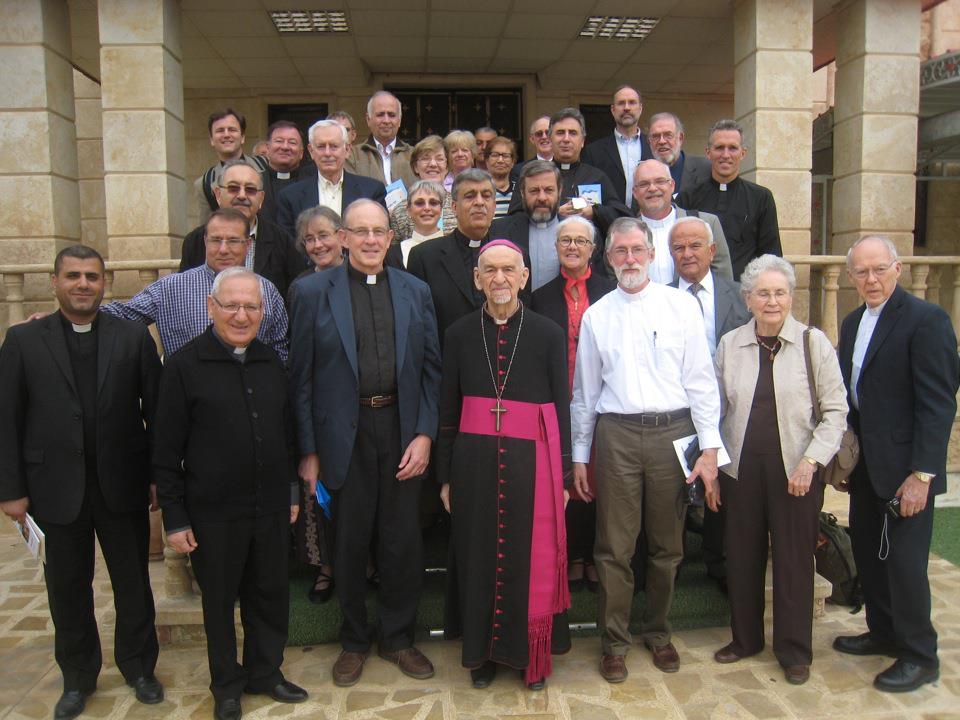
Kirkuk, Iraq, November, 2012, with The Outreach Foundation. The gentleman in the front row, second from the left, is now the patriarch of the Chaldean Catholic Church, His Grace, Louis Raphael Sako.

Kirkuk, Iraq, November, 2012, with The Outreach Foundation. The gentleman in the front row, second from the left, is now the patriarch of the Chaldean Catholic Church, His Grace, Louis Raphael Sako.

I am thankful for the church I have come to know in Lebanon and Syria and Iraq. I am thankful that when I say I believe in God the Father almighty, and in his son, my savior Jesus Christ, and in the Holy Spirit who is my guide and comfort, that I say it in community with the saints of old and the saints of now. They are embodied in Catholic, Orthodox and Reformed congregations and the faith and courage and perseverance they model every day in the midst of war and terror and death is a reminder to me of what it means to follow this triune God. He does not promise us life without loss, but he does offer us life abundant. And when I see how abundant life is in the church in these hard places, I have seen this promise lived out daily.

I am thankful for grace. For I have deserved it not, earned it not, purchased it not. But it has been freely given at great cost.

Happy Thanksgiving.

Dona nobis pacem.

Fathers loved. Fathers lost.

Easter Sunday, 2007. Daddy is on the far right of the couch in the light blue shirt.

Easter Sunday, 2007. Daddy is on the far right of the couch in the light blue shirt.

I lost my dad on April 23, 2007. As a family, we knew it was coming because he had decided to stop dialysis after one year. Three days a week he was tethered by tubes to a machine for four hours. The machine would do the work his kidneys could no longer accomplish due to the ravages of diabetes. A good man of sound mind, he made the decision for himself. As his children we were glad he could make this decision, but we knew it would mean we would no longer have him and his sense of humor and his love for high notes.

We were all by his bed in the hospice house when he took his last breath. We had been sitting with him for thirty hours, rushing there when the nurse told us to come. He wasn’t awake. His breathing was labored. The end was coming. It was the most precious time we have ever had as brothers and sisters with this man who had brought us up day by day. Since Mom died in 1966, it was his love and persistence and faith that held us together without her, and it was that same love and persistence and faith that brought us to his bedside for that very long night.

He donated his body to the medical center and a whole group of young doctors-to-be learned about the anatomy of a human body from him. I am most positive that they were even able to identify his funny bone, and were amazed by the make-up of his vocal cords, even though they never heard him nail a pun or sing “Danny Boy.”

We lost him that early Monday morning eight years ago. And as I was supposed to receive his ashes back after the anatomy department was finished with him and then never did, I thought, “Well, I guess he won’t get to lay next to Mom at Calvary Cemetery.” It was okay. I knew where he was and that Mom was there with him, rooting us all on in the lives we had left to lead.

And then Daddy came back to me.

My stepmother had apparently been the recipient of his ashes back in 2008. She recently passed away and my sister-in-law asked me what to do with Daddy’s ashes.

“You have them?” I asked, astounded at the information.

“Yes. We can put them in with Pat, or you can have them back,” was her end of the conversation.

Knowing that my sisters and brothers would, like me, want them with Mom, I asked for them back.

My lost father is now in my laundry room. I need to convince the cemetery to let us bury them with Mom and our sister Cathy, who are resting side by side. Again, I know my dad’s essence is not in those ashes. Mom and Cathy are not in the ground. They are all living in heavenly glory, free of the grief and pain and troubles on this side of life.

But there is a place we can gather as a family when we need to to remembere them together.

There was no impediment to us gathering to sit with Daddy in the moment he passed. Some had to come from miles away, but good roads and peaceful times make roads shorter.

And I think sometimes we take that for granted. It’s 2015, for Pete’s sake. There is nothing hard about traveling from one side of this big country to the other.

I pray that it would be that easy in other parts of the world.

My friend Hala lost her father this past week.

IMG_0019I pieced it together from the weirdness of Facebook’s Arabic translation and the photos Hala had posted of her dad and her on her wedding day and when she was a child. It became very clear when I saw photos of his service posted from the church in Aleppo, Syria. I knew it was Aleppo because Assis Ibrahim was in the pictures. Again the Arabic translation indicated that the coffin pictured contained the earthly remains of a person named Bitar, which is Hala’s last name. It was confirmed when I exchanged messages with this dear sister in Christ.

And so I am grieving with and for Hala and her family. Grieving for the loss of a father, something I know well.

But my grief for her is compounded by the circumstances of this death. You see, Hala lives and works in Beirut. She is an amazingly gifted and educated teacher at the Beirut Evangelical School for Girls and Boys. She teaches religion and leads chapel services for students who are Christian and Muslim. I have been the recipient of her gift of teaching as she led our summer group of women in a study of the book of Ruth.

Hala lives in Beirut, but she is from Aleppo, and that is where her parents live.

Aleppo. Syria. Where war has destroyed 60% of a city of two million. There are no safe roads in or out.

And so where me and my brothers and sisters could gather at my father’s bedside in response to a phone call in the middle of the night, Hala could only pray and grieve from a distance. It used to be only a few hours’ drive from Beirut to Aleppo. Now, it is a journey that is impossible.

I am grateful that there was a church community to celebrate the resurrected life of Edward Bitar with his family still in Aleppo. There was the family of God to grieve his loss in Hala’s absence and to comfort her mother as the man who said, “I do, in sickness and health, in good times and bad, till death do us part,” was laid to rest. These are the tender mercies of life in Christ.

But sitting in my home, eight time zones west of Hala, I grieve with her. And I share the deep feelings of loss as a beloved father is gone. I wanted Hala’s words to be in this essay and I take comfort from her description of her father. I see in her words that she loved him as the father and teacher and faithful man he was. So hear my sister’s voice:

My father’s name is Edward Bitar, and my mother is Najah. We are four in the family, Amal, Bashar, Manar and me. My father was more than a father, he was my example of faith and love. He never received a day without the Bible in his hand, and never ended a day without having his knees down to the ground praying, asking for blessings.

He was a teacher, but not like any teacher I ever met. He taught English, he dedicated his time to his students and us. He used to go around from one library to another to check out new novels and we were his first audience and listeners.

As a woman living in the Middle East I was raised by one of the most well educated and open-minded persons. His dream was to see me and my sisters happy, but happiness had to be through finishing our college degrees and continuing education. I shocked him when I decided to study theology, but knowing I will dedicate my life to serve God gave him extreme joy. He used to tell me whenever he used to see me tired and depressed, “Hala, you are serving a powerful lord, depend on Him and he will be beside you.”

His memory, his picture, his smile, his hands touching my face and head will never leave my eyes. His spirit is a source of joy, and I will never forget him. Having a father like him was so helpful to understand the meaning of the word “the fatherhood of God.” I will never forget him Julie. I will never.

Fathers loved. Fathers lost. Tender memories of times shared and lessons learned.

My prayer for Hala is that peace will return to Syria, and the road from Beirut to Aleppo will be as in the days of her childhood. That she will be able to travel that road and sit by his resting place, mark it with flowers and in the silence, hear his gentle voice and leading. She will know that she can depend on the Lord, the same one she learned of from Edward Bitar. This same Lord who was beside him, and continues to be by her side and by mine.

Fathers loved. Fathers lost.

The Father who finds us. We are sisters in him.

Dona nobis pacem: rest stops

H.W.S. Cleveland was a landscape architect of the 19th century, and as I have been walking through my own neighborhood these past two months, I have come to appreciate how he helped my city develop some beautiful parks.

I live on Happy Hollow Boulevard, part of the system of city streets that were planned to link the Omaha parks together. Happy Hollow winds beautifully along two of the bests parks in Omaha: Elmwood and Memorial. And in my daily steps along the sidewalks and paths, I have come to find rest stops for my journey.

IMG_1980

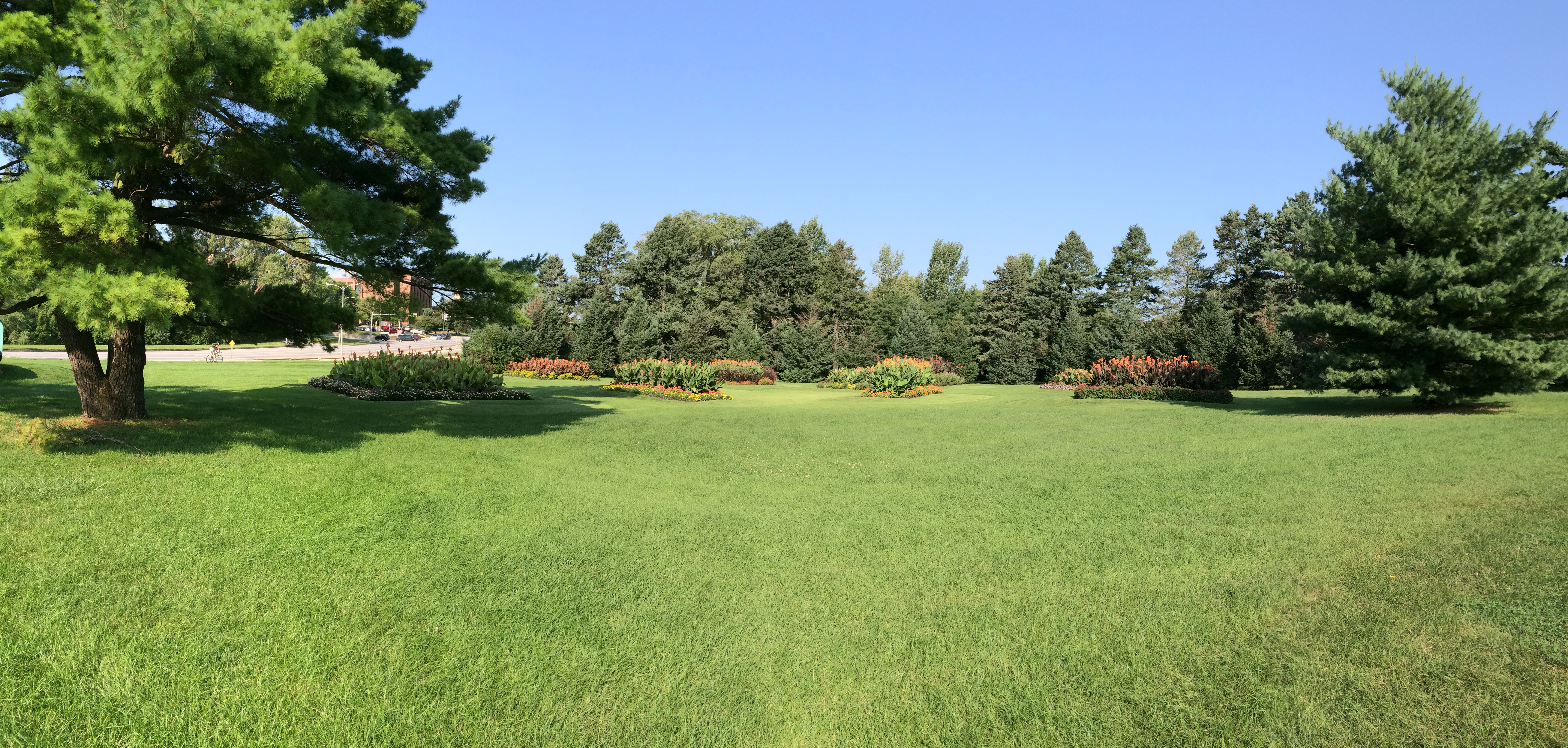
A panoramic view of Memorial Park facing west from the path.

IMG_1967

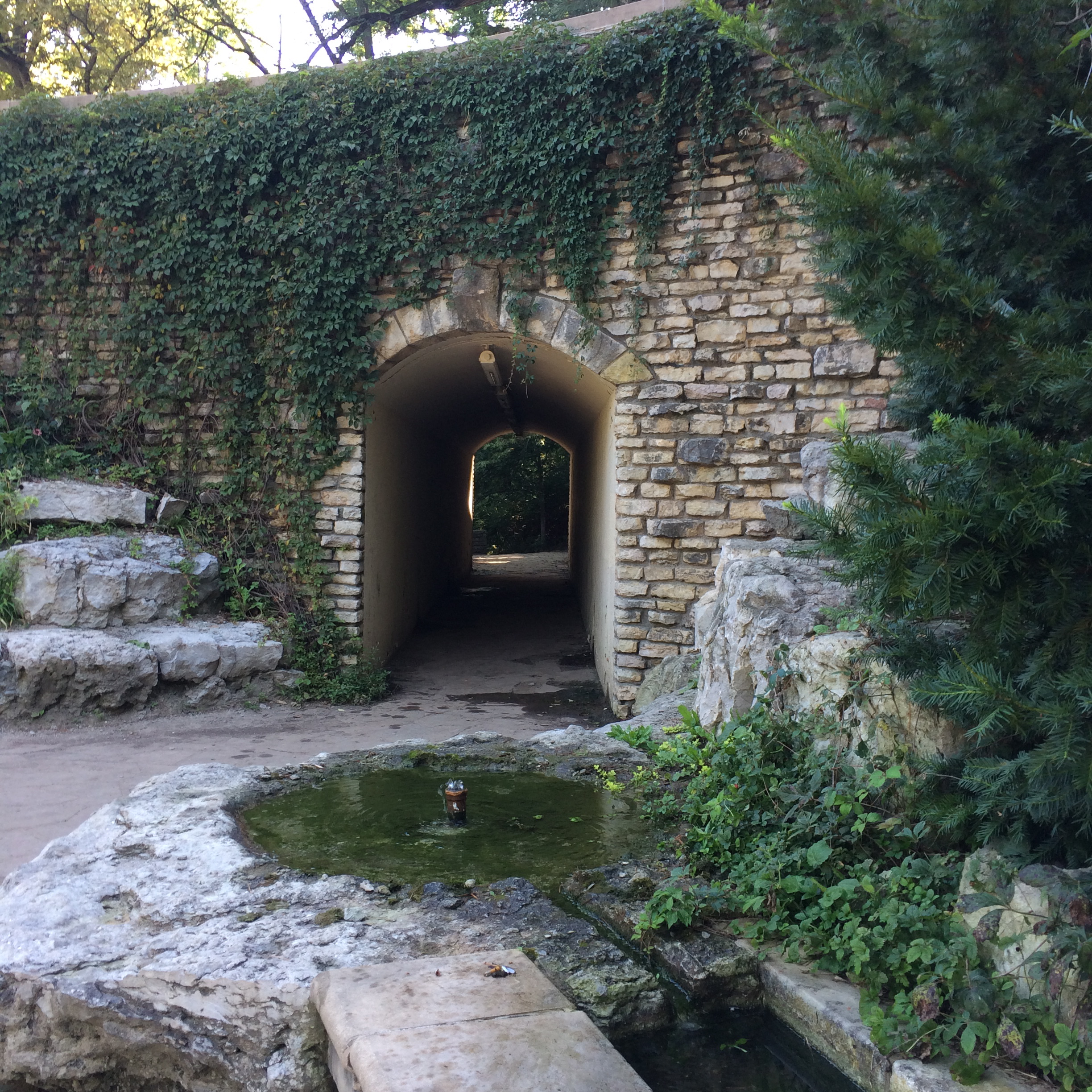
The grotto at Elmwood Park with its natural spring running through the channel.

“He leads me in paths of righteousness for his name’s sake…” goes the 23rd Psalm. Beside still waters. Green pastures. All these things are in this amazing section of Omaha that I find myself wandering through.

As I think about my friends in Syria, Lebanon and Iraq, or my family in crisis, walking has become a prayer time for me as I put one foot in front of the other, and doing it in green pastures with still waters and carefully planted trees and flower beds, is a reminder that this God who made and loves us all, is there with me at each step.

Between the two parks is my college alma mater, the University of Nebraska – Omaha. As I walk through the campus, I have found other places that also remind me of how God has unique ways of encouraging me on this daily journey as I seek his pace, his peace.

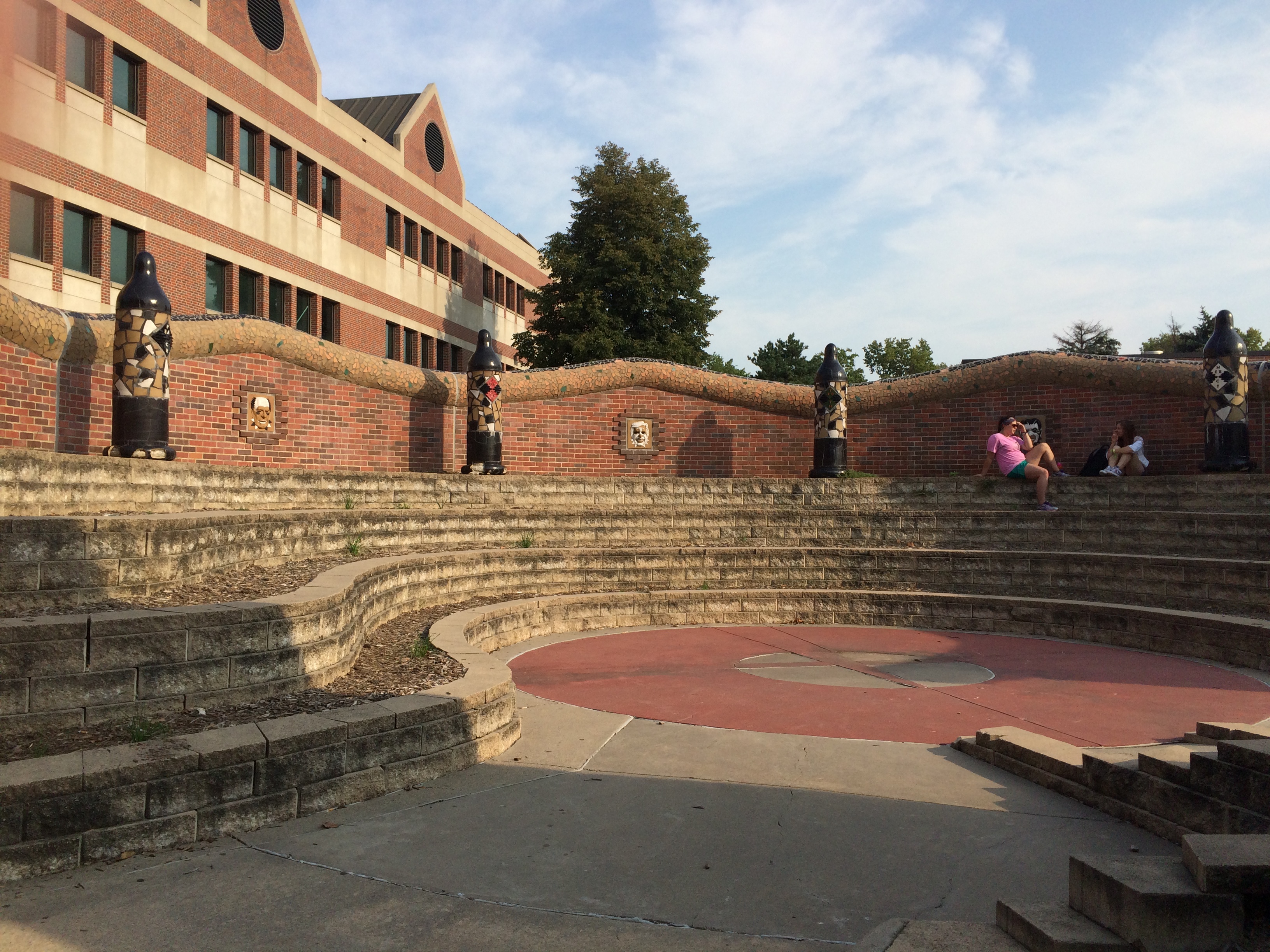
IMG_2007There is the Castle of Perseverance, an outdoor amphitheater designed by Andrew Leicester of Minneapolis. I came upon it one day several weeks back as I chugged uphill from the College of Fine Arts, and the first thing I saw was this: the word peace on a missile-shaped sculpture. I followed the semi-circle around and found justice, mercy and truth to complete the set. “Act justly. Love tenderly. Walk humbly.” My six-word reminder from Micah 6:8 was echoing through my head.

IMG_2011This place also brings Romans chapter 5 to my mind, a scripture shared at my father’s memorial service and one that speaks to my heart about the church in the Middle East that I have been humbled to walk with:

Therefore, since we have been justified through faith, we have peace with God through our Lord Jesus Christ,  through whom we have gained access by faith into this grace in which we now stand. And we boast in the hope of the glory of God.  Not only so, but we also glory in our sufferings, because we know that suffering produces perseverance;  perseverance, character; and character, hope.  And hope does not put us to shame, because God’s love has been poured out into our hearts through the Holy Spirit, who has been given to us. (Romans 5:1-5 NIV)

Song

Suffering, perseverance, character, hope. Steps on the journey of the family of God in Syria, even as I write this. Never have I seen a people who model hope in such times of suffering.

Or walking south through campus as I approach the east side of the soccer stadium I found “Song,” another art piece, many of which are sprinkled around this urban campus. With my earbuds bringing “All to Us” by Chris Tomlin into my head and heart, all I can do is sing aloud, just like the little bird:

Precious cornerstone,
Sure foundation
You are faithful to the end.
We are waiting on you, Jesus
We believe you’re all to us.

sounding stone brokenness

Walking down the hill and into Elmwood Park, past students scurrying up the hill to class, I come up the east side of the park and find the Sounding Stones, which I’ve written about before, Sounding Stones. Brokenness. Humility. Submission. Simplicity. Community. Each of those is part of our journey, my journey. And each one invites a prayer. My prayers for peace – dona nobis pacem – are so centered in that stone of brokenness these days.

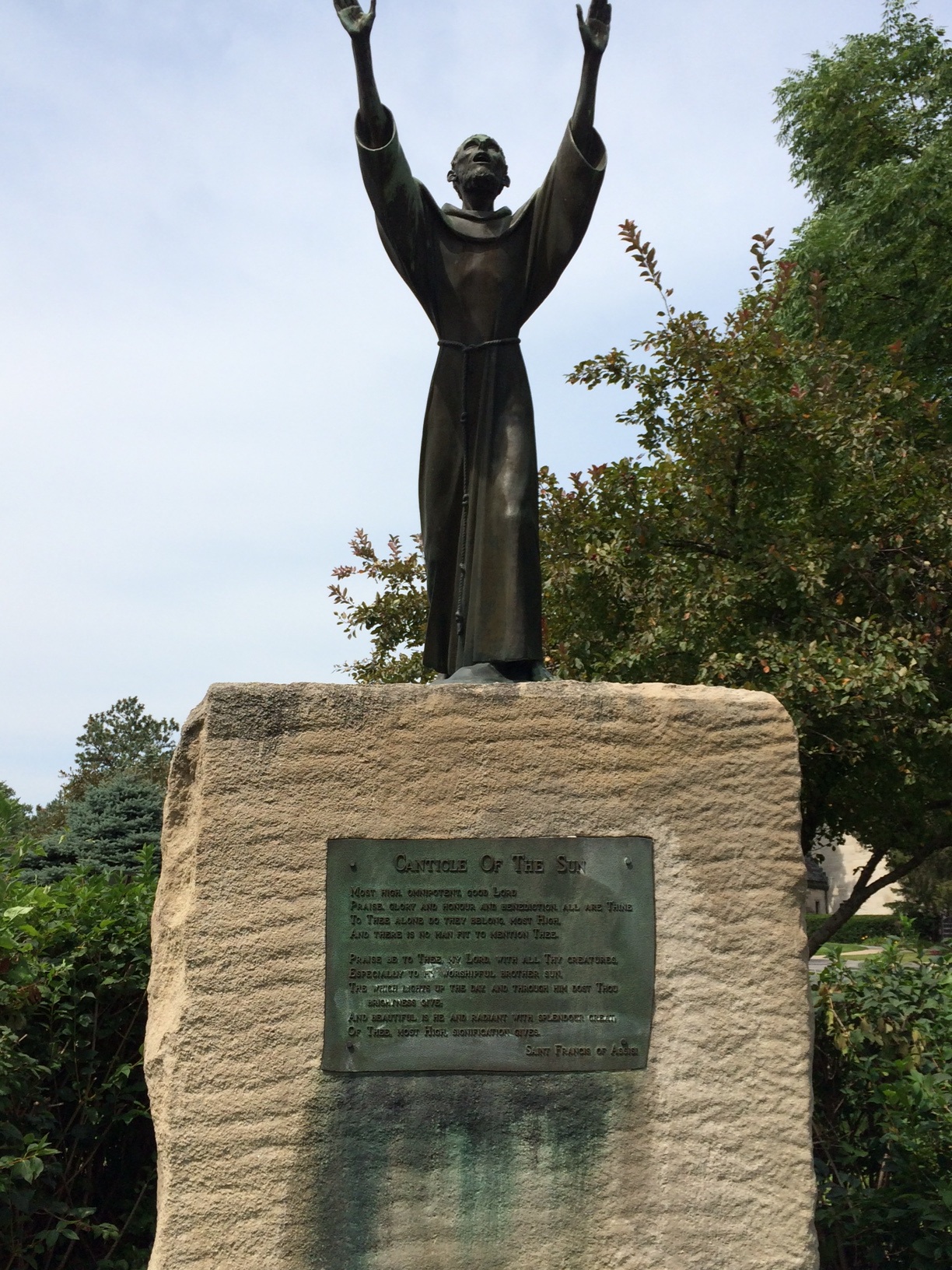
St Margaret Mary's PeaceAnd if these special rest stops on the journey don’t invite me into peaceful places (which they do), there is yet another spot I can wander between the two parks. Saint Margaret Mary’s Catholic Church stands facing the university from the north side of Dodge Street, right next to Memorial Park. If the words carved into its entryway aren’t enough to remind me of God’s peace, the sweet statue of my favorite saint, Francis of Assisi, is there, too. And though the words on his statue there are the canticle of Brother Sun, the ones he is speaking to me are, “make me a channel of your peace.”

St Margaret Mary's St FrancisShalom.

Salam.

Pace.

Paz.

Peace.

Whatever language the word is spoken in, I want to be a conduit of peace. Let my words speak it. Let my actions be its witness. And I am so grateful for these reminders in these rest stops along the way – in green valleys, in still waters, in righteous paths.

Dona nobis pacem.

Amen.


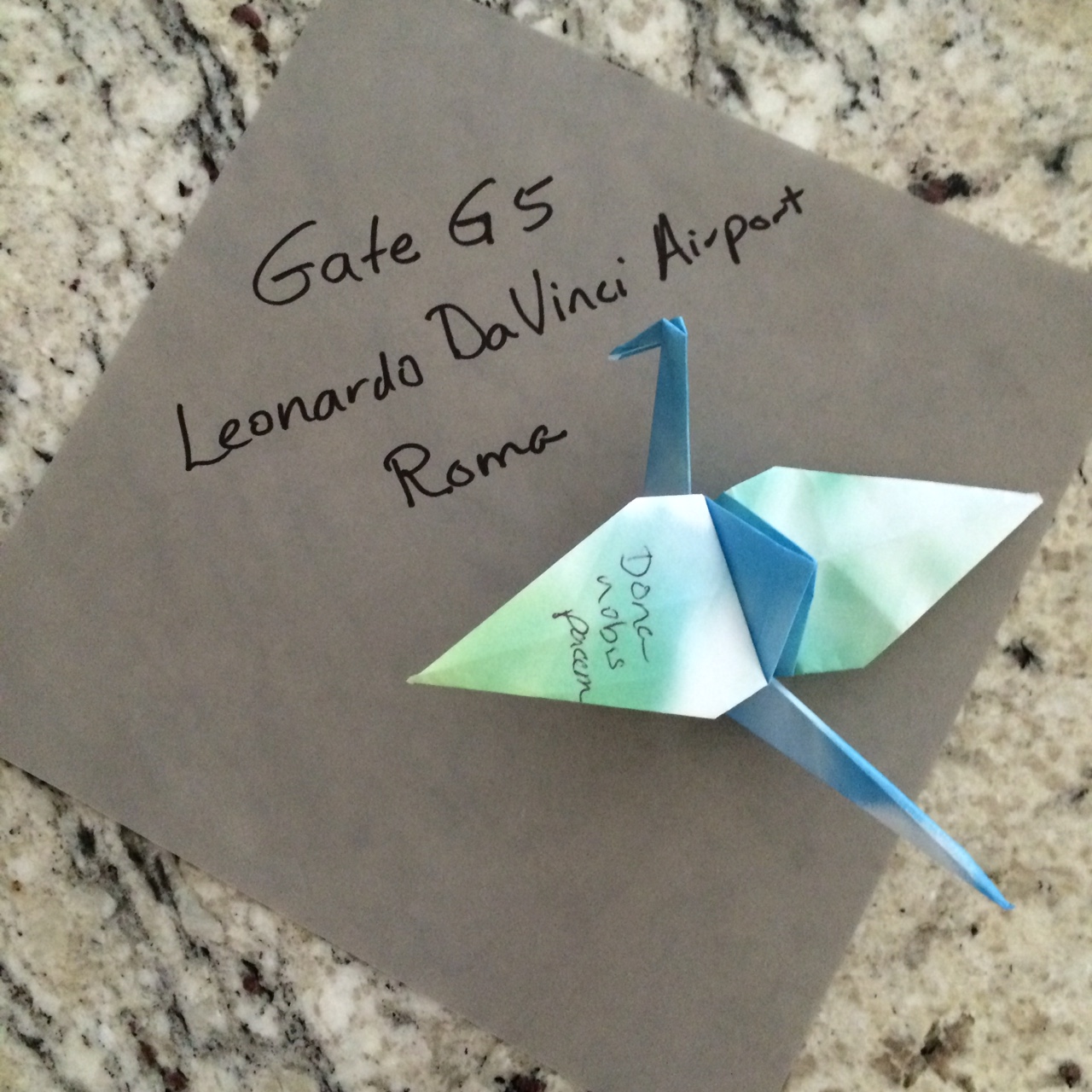
Finding peace at gate G5 in Rome

Paper crane gate G5 RomeAs a little girl I made a memorable visit to the United Nations in New York. It was the summer after third grade so I must have been all of nine, but I remember being struck by all the different flags and all the different people. It was and is a place where those of many nations come together to seek the good of all of us who share this big blue marble of a planet.

As a now much older woman, middle-aged at 56, I have seen the United Nations at work in the refugee camps in Lebanon that are filled to overflowing with those who have fled the war next door in Syria. UNHCR, the United Nations High Commission on Refugees, is stenciled on the tents and on shipments of food and supplies. Nations have come together to provide for those in need, and there are millions upon millions in need.

But I think the biggest purpose of this organization is to somehow help nations come together to talk and to prevent such wars, and maybe even to stop those already in progress. I think the bigger purpose is peace, and it is seems impossible in these days to achieve.

The stories I heard in Lebanon about what is happening in Syria are overwhelmingly horrible. Loss of work. Loss of home. Loss of life. No peace.

And so last Friday I traveled home from there, my heart left behind with some pretty amazing women. The only peace I expected to find in my 24-hour journey from Beirut to Rome to Chicago to Omaha was with a pair of noise-dampening earphones stuck to my head while I lost myself in movies. But something happened…

Gate G5, Leonardo da Vinci International Airport, Rome, Italy, happened.

My plane from Beirut landed on time and my friend Meryle and I, who had spent those amazing days in Lebanon together as part of a team of eight women, said our goodbyes to each other. I sent her off to gate G3 with a hug as she headed home to Santa Barbara. I had two hours to settle into a seat at gate G5 until my Alitalia flight headed to Chicago was scheduled to leave.

Gate G6 was next to us with a flight headed to Tel Aviv, Israel. My attention was drawn to those over there who seemed to obviously belong in Tel Aviv by their attire: long black coats with wide-brimmed black hats. Prayer shawl tassels dangling. Yarmulkas on the heads of several men, young and old.

At my gate was a collection of all sorts of people, including many Muslims, some of whom had been on my flight from Beirut, including a sweet mother of two four-year-old twins who were heading to Chicago to visit family. The hijabs and abayas were visible, as well as the longish beards on some of the men.

And I will say there were Christians, too, as I am one and I was there.

So in the airport of the eternal city of Rome, not far from Vatican City where the patriarch of the Roman Catholic Church leads a large flock in the name of Jesus, at these twin gates – G5 and G6 – the three Abrahamic faiths were sitting together in peace, waiting to go someplace else.

And then came the music. Not the swelling soundtrack of a movie scored by John Williams, that might be playing in my head because I thought I had discovered how to achieve peace, but actual music. There was a grand piano in the corner and someone sat down to play it. A woman with short, dark hair started picking out a jazz melody. A man quickly joined her to watch and listen, and she stopped, kind of embarrassed that someone would come over. They had a quick conversation about their joint love of music and the piano, and then he sat down and started to play. She stood by his side and periodically leaned over and added some notes on the high end.

Soon, many were listening and smiling and just enjoying this spontaneous concert in the airport. And I looked around at the faces and everyone had just been transported someplace else as they listened along.

Eventually these two stopped and others took their own turns at the ivory and black keys. Mary had a little lamb was plucked out, followed by row, row, row your boat. I’m a little lamb who’s lost in the wood, I hope I could, always be good to someone who’ll watch over me, had me closing my eyes thinking of my sweet Steve at home.

And then came that hymn…

For the beauty of the earth,
For the glory of the skies,
For the love which from our birth,
Over and around us lies:
Lord of all to thee we raise, this our hymn of grateful praise.

She played four verses and added an amen at the end.

I looked around again as we all stood up to have our boarding passes and passports checked before going down the escalator to get on the plane. I saw old and young. Blond and brunette and gray hair, some in dreadlocks piled high, some in the soft curls of youth, and some heads that probably claimed one of those kinds of hair but hadn’t seen it in a while. Men and women, boys and girls. Muslim and Hebrew and Christian and probably some who called on no God. Italian and Lebanese and Israeli and American and other folks from all over.

And as our boarding was delayed, there was simply no pushing or shoving or shouting. There was just this music coming from the piano in the corner. And there was this kind of peace.

And I thought, why not like this all the time everywhere? If we can cram this many people into a small area of space in a busy international airport and throw in a piano for good measure, wouldn’t this be a good way to figure it out? To look at all the others crammed in there with you and say, “Hey! They’re people just like me, trying to get to the place they call home, or maybe just taking some time to see someplace new.”

I know that sounds naive and idealistic, but that’s who I am and I offer no apology for it.

It was just a two-hour window at gate G5/6 in the Rome airport, but it reminded me of that hopeful memory of standing in the United Nations in 1968. And my prayers rose anew for peace. With the help of God, I think we can figure this out.

For the love which from our birth, over and around us lies. Lord of all to thee we raise, this our hymn of grateful praise.

Amen. And amen.

Thursday in the new normal

July 2 was a Thursday this year, just two weeks ago today. For me it was not a normal Thursday, although I did sign the checks at church for invoices and reimbursements, a normal Thursday event for the last ten years.

Ten years.

Last.

It was the last normal Thursday in an old normal, as it was my last day on staff at the church I have served since January 2, 2002, the last ten as business manager, aka signer of the checks, aka money changer in the temple. Didn’t you know? Every temple needs one!

That’s the way I used to introduce myself to people who came in the door at West Hills Church, including a couple of candidates for our interim senior pastor position.

Well, you might as well be honest. 🙂

So July 2, 2015, was my last day on staff there, and it was a Thursday.

July 6, 2015, began a new chapter in my life. No, it wasn’t a Thursday, but it was a Monday after a three-day weekend for the Fourth of July holiday. I woke up a very different person: for the first time since 1977 I was unemployed.

Let me say, it was my choice. I think that is important. I left with a sense of peace, albeit with no sense of purpose. It felt right: the decision, the timing, the reason.

So here I am, two weeks later living a very different kind of life.

I have applied for a new job.

I am preparing to return to Lebanon and Syria for the fifth time in five years.

I am cleaning up my home office so we can reattach the bookshelves which are pulling away from the walls. (Can I just digress for a moment and say that the reason they are pulling away from the walls is that they were too heavy with books? I think that counts in my family’s favor that we love to read actual printed BOOKS!)

I am spending time letting folks know that I have a different e-mail address and discovering just how many places I used my church email for a point of contact.

Note to self: don’t do that again!

I am playing Bejeweled Blitz, Yuma Blitz, Pet Rescue Saga and other assorted Facebook games in my moments of solitude. Hey! Everyone needs some down time.

But it has been two weeks now. I don’t leave for Lebanon for another week and I was feeling like I needed to produce something. Not spreadsheets for the session so they have good financial information. Not attendance figures for Sunday school and worship. Not editing and proofreading marks on the Sunday bulletin (although it was obvious from last Sunday, that somebody still needs to do that function!).

No, today I needed to produce something physical, something that made me feel like I could still create beautiful aromas and flavors and to actually feed people – not the Word – but actual food.

So I pickled onions.

Beautiful cipollini onions with thin, yellow skins would be my target. I set out on this hot, humid, sunny day in Omaha, Nebraska, to find them at the grocery store. The clerk at the store wondered what I was going to do with that bulging cellophane bag of onions, so I told her.

“I am going to pickle them in a balsamic vinegar and white wine brine. But first I have to melt dry sugar into a beautiful dark caramel. They are awesome!”

“We’ve got pickled onions at our olive bar,” she explained.

“I know. That’s where the inspiration came from,” I replied. “Oh, my! They are yummy. And I am going to make some.”

July 16 cipollini onionsSo home I went with my five pounds of aromatic layered gold. I blanched them, adding another layer of yellow coloring to the pasta strainer, dumped them in an ice water bath and then squeezed the usable part of the onion out of its skin.

A couple of hours later I had this treasure, not in clay pots, but in six one-pint Ball jars.

It wasn’t enough.

For thirteen years, my dear spouse St. Stephen has been the chief chef at our house. I like to cook. He loves to cook. He finds peace in the kitchen at the end of day of architectural drawings and meetings and trying to please clients.

He is a great chef!

But he has been so busy lately and I have been, well, unemployed.

July 16 mac and cheeseSo today besides shopping for pickled balsamic cipollini onions, I shopped for macaroni and cheese. No, not the blue box my family grew up with, but the creamy, cheesy, homemade kind.

Half and half. Sharp cheddar. Colby. Large elbow macaroni. Butter. Onions.

Homemade bliss.

I love to care for people, including my family. But I also I know that Thursdays are just Thursdays.

I know that my old normal and my new normal are the perception of a well-resourced, finely educated, blessed married woman in a first world country. When I put on the glasses of my sisters – equally educated, equally blessed and formerly well-resourced – in a part of the world that had the same economic advantages of my country until years and decades of war caused their worlds to collapse, I stopped in my tracks.

Their new normal is not of their own choice or their own making like mine has been.

And so in the midst of onions and macaroni and cheese, I pray.

I pray that they, too, will come to have a Thursday like this. A Thursday of sunshine and humidity. A Thursday of pickling onions or making jelly. A Thursday of sharp cheddar cheese and creamy sauce as they wait for a hard-working spouse to come home.

I pray that their new Thursday normal will be like their old Thursday normal.

A Thursday of peace.

Peace in the garden


garden panorama
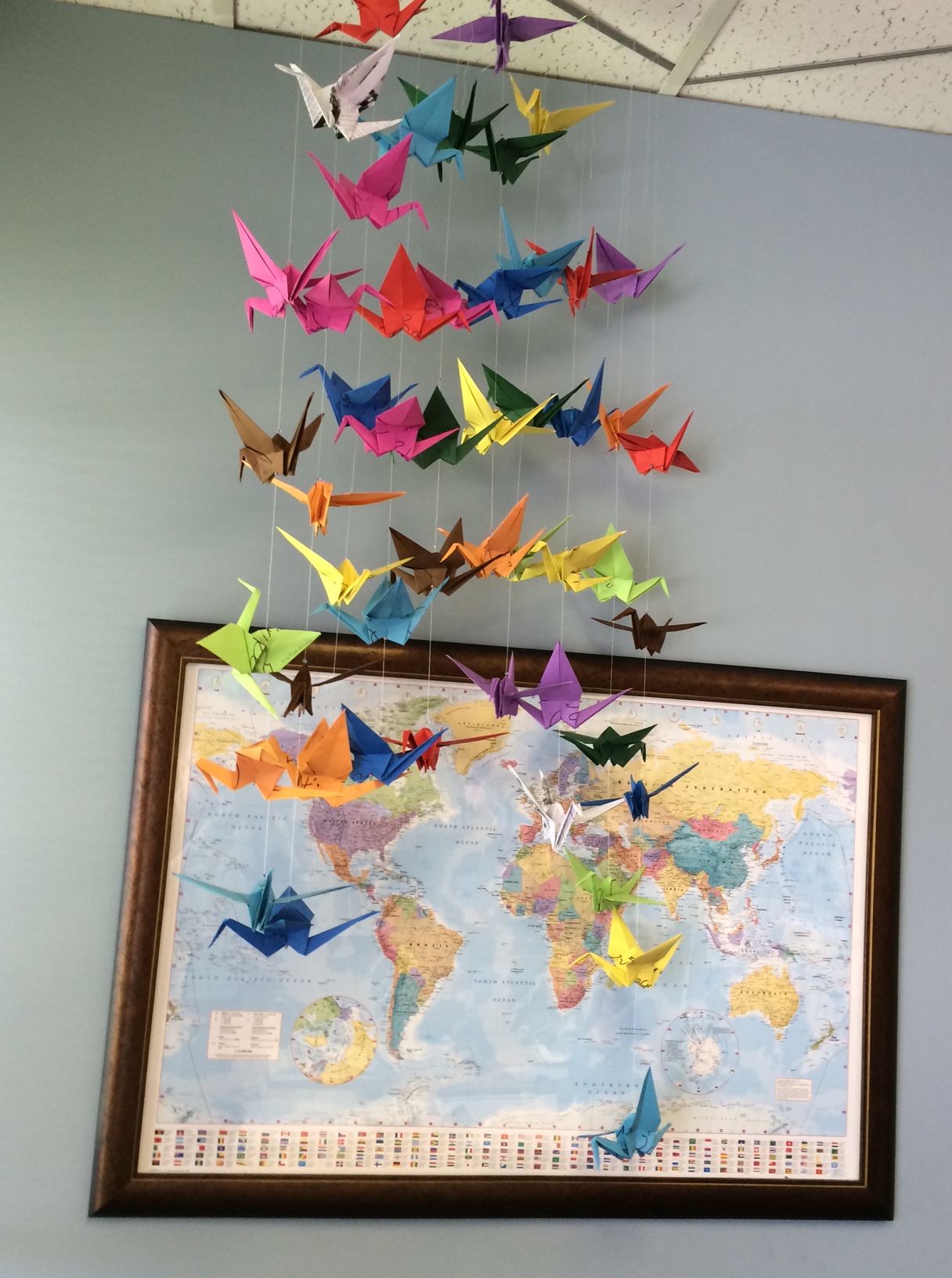
Paper cranes 323 totalI have been praying for peace for a long time, and lately I have prayed through the folding and stringing and hanging of paper cranes, 323 at last count in my office. It is a beautiful sight when I come in every morning, and catches others by surprise as well.

Dona nobis pacem. Grant us peace.

They are the colors of the rainbow, hanging on their strings, separated by glass beads and hugging my world map, a map that also reflects those same colors.

dayliliesAnd tonight I walked in my garden, which is showing many of those same colors. The oranges of day lilies, the blues and violets of cranesbill, white daisies with bright yellow centers. And so many greens! That God of ours had way more than 64 crayons in his box when he started this whole garden thing.

Daisies and cranesbillAnd so as I walked through my garden tonight, I was reminded of my peace cranes by the colors of the flowers and the greenery and the way the cranesbill and daisies tangle together, just like the strings of the cranes when I brush by them and it made me smile and it stopped me in my tracks to say it again:

Dona nobis pacem. Grant us peace.

As I came around to the steps that take me up to our little circular terrace, a place that is our secret room where we sit on Fridays and Saturdays and enjoy the peace of the garden after a long day, I passed my peace pole which contains another prayer in five languages:

May peace prevail on the earth.

Peace pole in the gardenAs I walk through this peaceful garden with prayers on my mind and on my heart and on my peace pole, I am also reminded that I am not in this alone. Just as the daisies are a gift from Susan and Lee next door and so many of the day lilies came from my cousin Kathy, the cranes in my office are a reflection of those praying with me like Cleo and Wendi and Deb and Kathy and Wilson from church; and all the faithful women like Babs and Marilyn and MC and Kate and Sue and Wendy and Betty and Emily; pastors whom I have met and those I haven’t, the Tobies and Michaels and Tripps and Chrisses; and all the people who read the papers and weep with me.

God made the garden for us as a place to walk with him in peace, and we blew it. And we continue to blow it. But even still, he makes the flowers grow and the cranes fly and invites us all to walk in places with him, inviting us into conversation. And my conversation with him most days – every day! – is for his peace to prevail.

And I believe he hears us.

And I believe he listens to us.

And I believe he will answer and redeem and make it so.

I believe his peace will prevail on this earth.

And so I will keep asking.

Dona nobis pacem. Grant us peace.

Amen.

209…one at a time

Paper cranes 209My one thousand paper cranes for peace have been a journey through this month of May. I have made 209 so far.

One at a time.

I started with two sheets of prayer-printed pages from my church, West Hills in Omaha. My friend and colleague on staff here, our Mission director Caitlin O’Hare, publishes prayers of our mission partners each quarter. When my friend Mark Borst was here visiting in March, he saw our wall of crosses in the reception area and told me about the paper cranes that carry prayers heavenward in the sanctuary at Central Presbyterian Church in Atlanta.

Connectivity being one of my strengths as measured by the Clifton Strength Finder assessment, I connected the two. All those prayer booklets…what do we do with them every quarter when the new come?

Paper cranes, of course!

After folding three of them with that paper, I decided to order 500 sheets of 8″x8″ origami paper from Amazon. Beautiful colors. Lighter weight. Easier to fold and to be held by a delicate nylon string.

I am now a master folder of paper cranes. Stop by my office and see the 209 flying here and I will fold one for you with the prayer of my heart for this project:

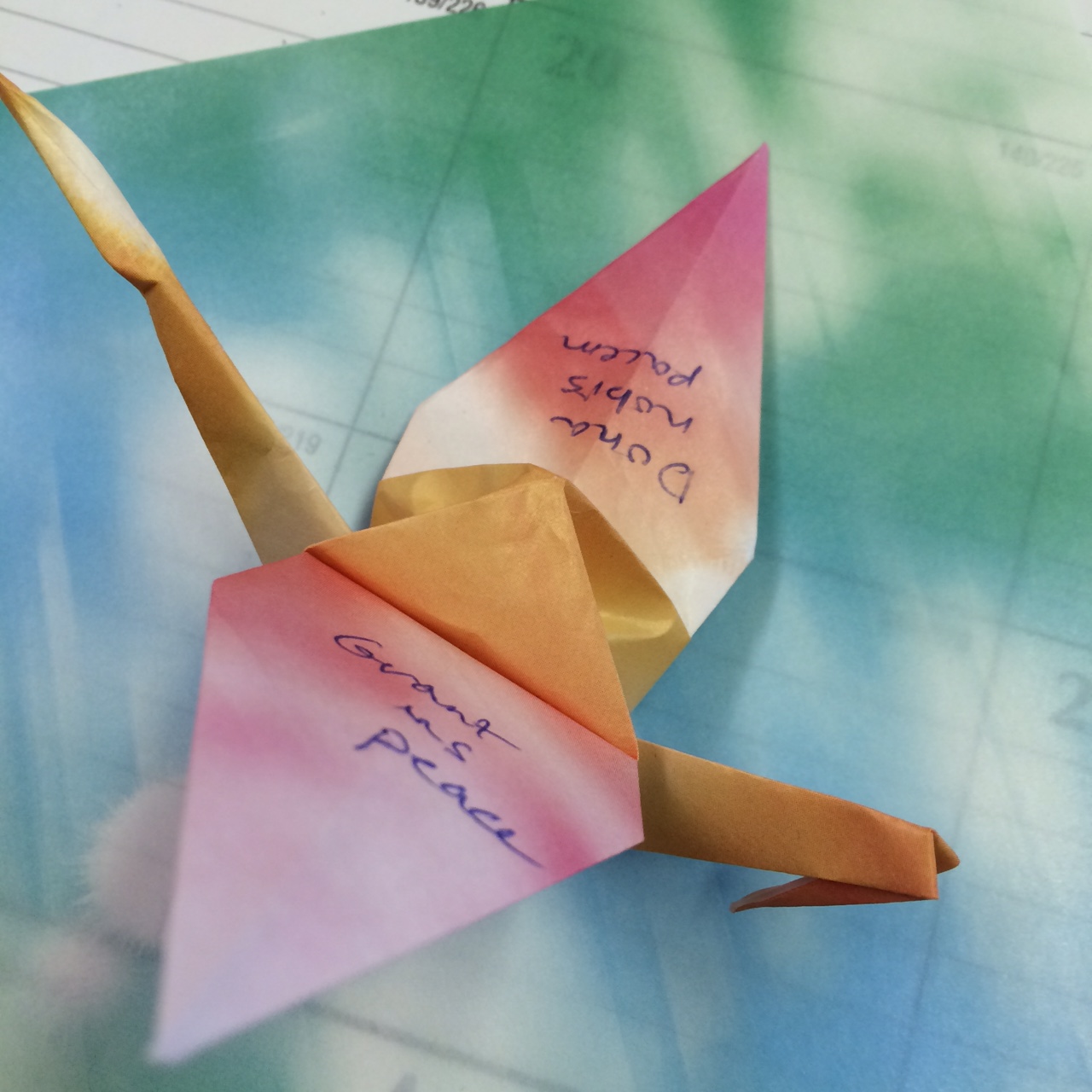
Paper cranes dona nobis pacemDona nobis pacem. Grant us peace.

These first 209 are a reflection of the places I have traveled in the last five years with The Outreach Foundation. They are photographic memories developed onto the pages of my heart of the people who live there, the people who love there, the people who are loved there by an amazing God who made us all. Each one. In his image.

And all these God-imaged people are suffering now, as they have suffered in the past. War is a journey no one should have to take.

But at the end of it should come peace. In the midst of it, they seek peace.

And that is what I pray for.

As I have folded these cranes and prayed over them in the process of folding and stringing and hanging, it has renewed my spirit to know that God hears every one of them.

And as I have continued to watch the news, I have found more to pray for, as if I didn’t have enough already. And some of those stories just emphasize that God hears those prayers. They seem to me to be answers for the peace I pray for.

You can read about Karim Wasfi, a cello player in the orchestra in Baghdad, who plays in the aftermath of a car bombing in his city.

A prayer crane for Karim. Dona nobis pacem.

You can read about Zahed Haftlang and Najad Aboud, two former combatants in the Iraq-Iran war who are now friends as they live in Canada. And on the battlefield one said of the other, “He became a human being, not an enemy.”

A prayer crane for these brothers. Dona nobis pacem.
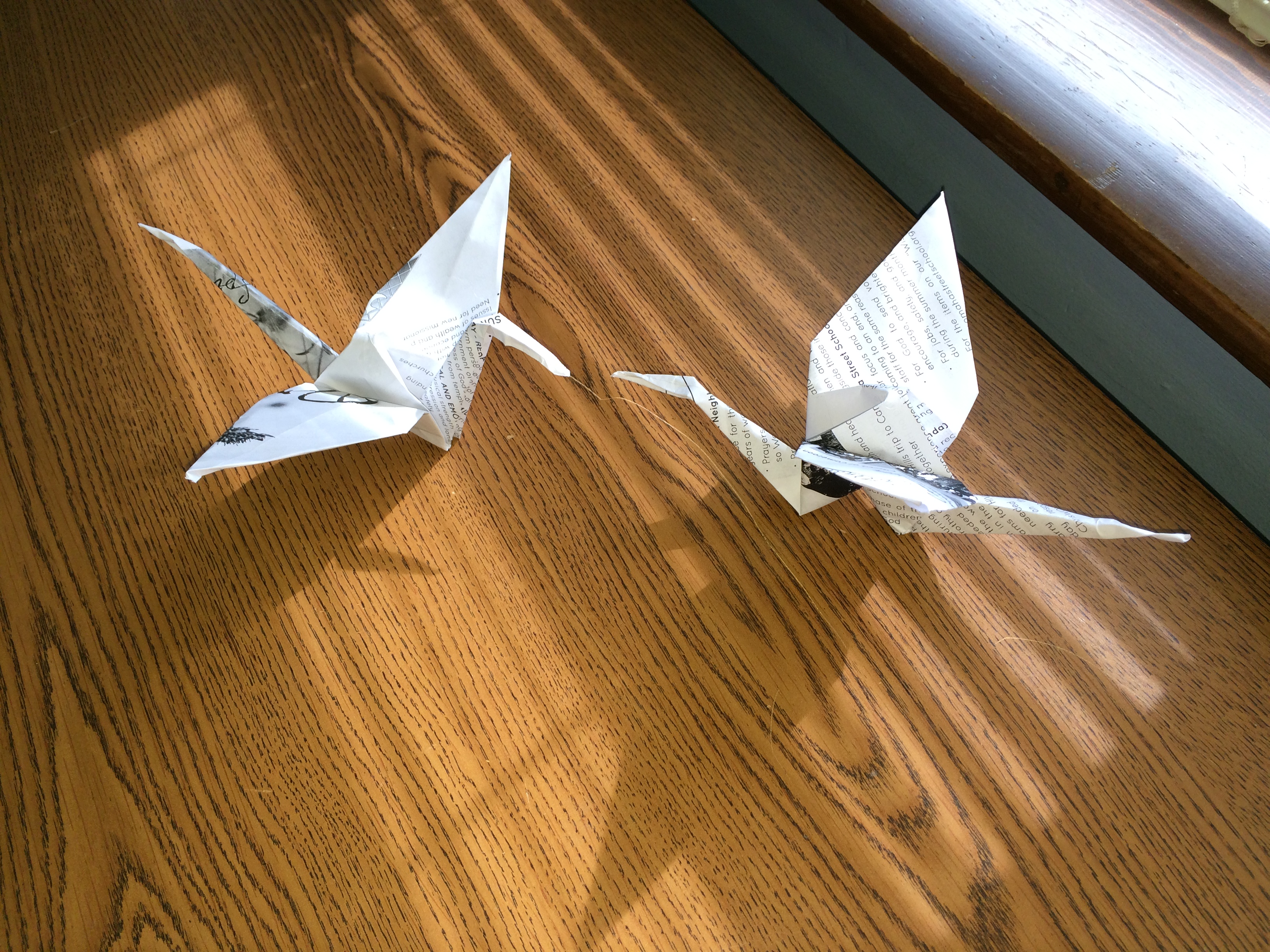
And there is a prayer crane for Hope Came Down, in the prayer and the hope that people will watch it and be moved to send their monetary gifts to a place that is bringing hope and encouragement to those who are suffering.

A prayer crane for Hope Came Down, and others for the scriptures that inspired it, John 1:14 and Hebrews 11:1.

Dona nobis pacem…prayer by prayer…crane by crane.

One at a time.


Dona nobis pacem

Paper cranes in vitroI have very faint memories of the Roman Catholic mass being said in Latin from when I was very young. I remember mouthing what I thought were actual words, although they meant nothing to me, and thinking that I was an active participant in the mass like my sisters and brothers and parents, next to me in the pew. When I investigate now when the change from Latin to English happened, it began in 1964, right before I turned six. Mostly I just remember mass in English.

So my Latin was non-existent through most of my life, if I had ever even known any!

At Girl Scout camp in 1970, I learned this beautiful song sung as a round. It went like this:

Dona…nobis…pacem, pacem. Dona…nobis…pacem.

I didn’t know it was Latin; I only knew when four groups of girls’ voices sang it in offsetting phrases to make the round, it sounded like angels.

Years later when Jana and I attended one of our annual Lobby Day gatherings with Bread for the World, a wonderful singer named Beth Nielsen Chapman sang the blessing at a large banquet. Fascinated with the song she sang, There’s a Light, when I returned home I bought her CD called simply Hymns. There were great songs from my RC childhood that we sang in church. And there was this:

Dona…nobis…pacem, pacem.

She laid down all the tracks, so the round was recreated with her beautiful voice filling out the angel chorus. As it went straight to my heart and triggered that memory of camp and singing and angel choirs, it made me want to know more.

So all those years later, I finally looked up what those Latin words mean.

Dona nobis pacem…grant us peace.

Grant us peace.

Paper cranesAnd that has been my prayer ever since in the midst of family upheavals and tragedies, in the midst of transitions at church, and of course, in my journeys into the deep waters of a relationship with God in the Middle East.

Dona nobis pacem. Grant us peace.
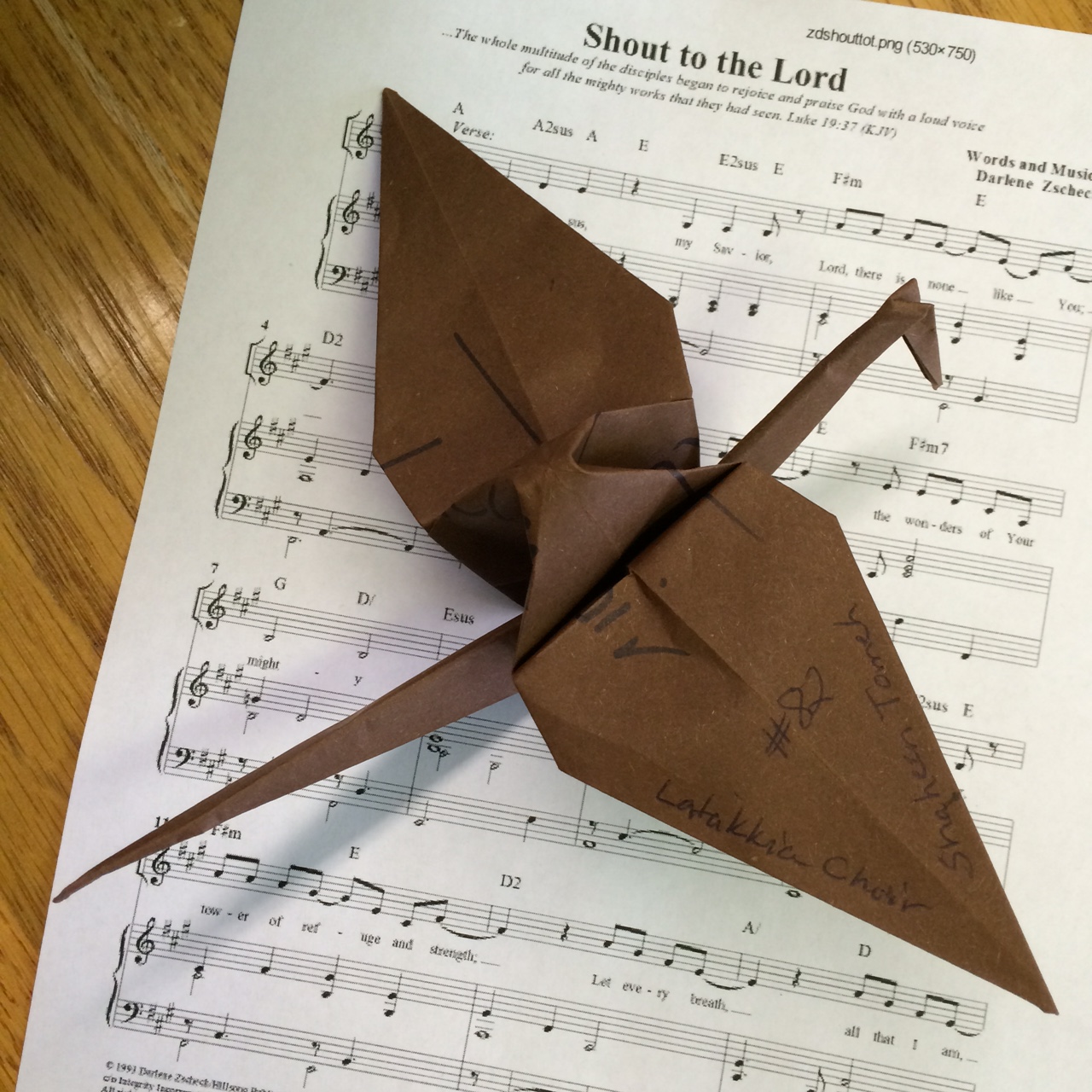
And as I have delved into this old Latin phrase from my childhood, I have reconnected it to the beginning of that part of the mass:

Agnus Dei, qui tollis peccata mundi, miserere nobis.
Agnus Dei, qui tollis peccata mundi, dona nobis pacem.
Lamb of God, who takes away the sins of the world, have mercy on us.
Lamb of God, who takes away the sins of the world, grant us peace.

Not only does this prayer in an ancient language remind me of the generations of people who prayed it in community before I was conceived and born, but it reminds me to whom I am asking this request. It is a prayer to the Jesus who knows suffering because he experienced it. Because of his great mercy, he redeems us and wipes our slates clean. And we know this, and I know this. And so we come to his feet and ask him: have mercy on us. Grant us peace.

And he can. And he will. And he does.

And I know this because I have seen it in Lebanon and in Syria and in Iraq. I have witnessed those living this suffering even now as they are put upon by forces and evil that would wipe them out.

And they stay. And they pray in ancient languages: in Syriac, in Latin, in Arabic.

Grant us peace.

Dona nobis pacem.
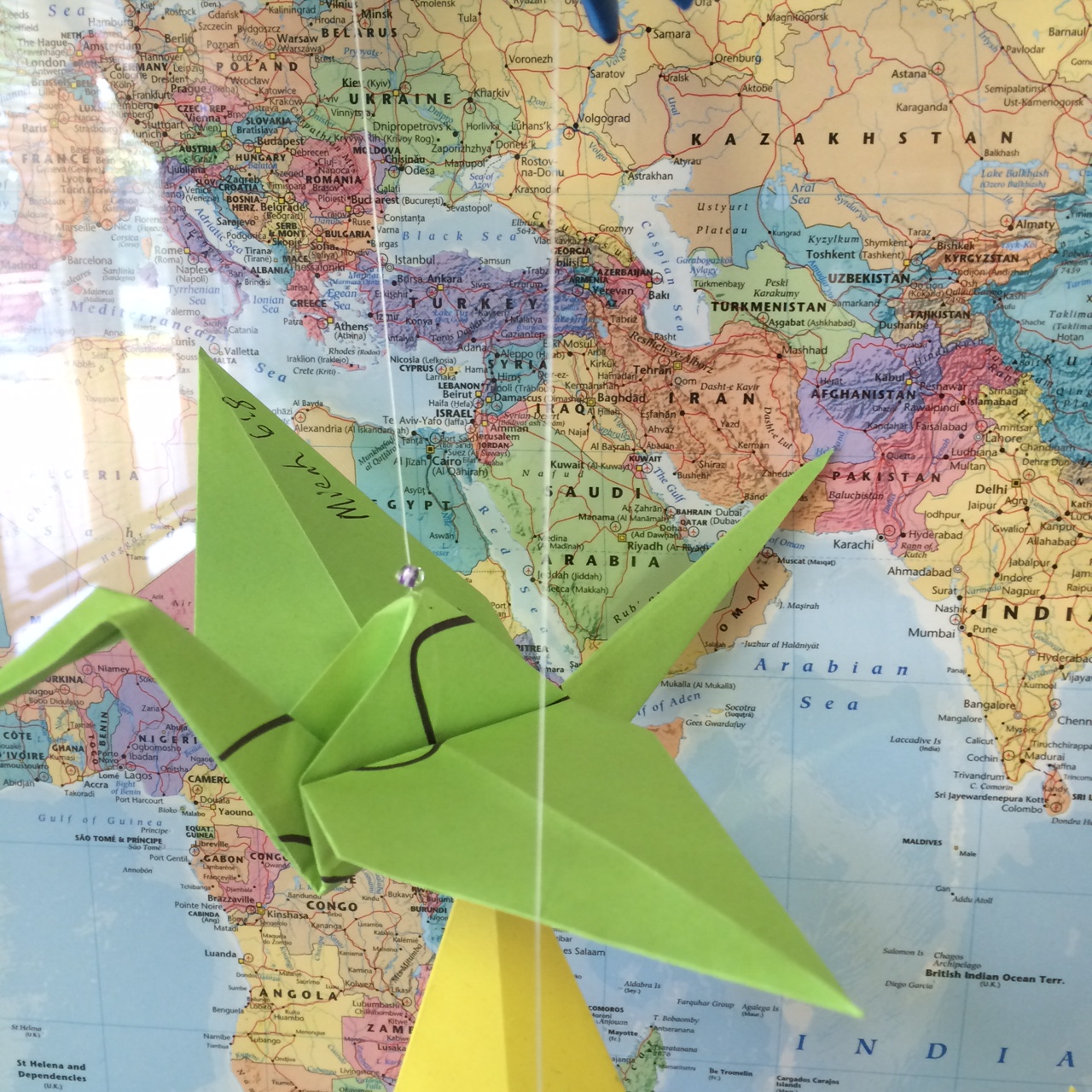
Their prayers take flight and arise heavenward to the Lamb of God who takes away the sins of the world.

And mine join with theirs in this upward trajectory.

Prayers, like birds on the wing, flying to the throne room of the Lamb of God.

Paper cranes Shaheen TomehAnd because the Clifton Strength Finders tells me that one of my top five strengths is connectivity, I have connected my journeys with the faithful of the Middle East to my prayers of peace for them to this visible expression of those prayers in origami cranes.

The legend of the one thousand paper cranes comes from Japan, and is especially poignant when you read of a young girl who was poisoned with radiation from the bombing of Hiroshima. Folding one thousand paper cranes is supposed to bring you luck or a wish granted. She was hoping for healing of her cancer, which didn’t come to her. She was not healed, but maybe one day her wish will be granted in another way: maybe nuclear weapons will be eliminated so the threat of cancers and destruction caused by them will be wiped out. Maybe. Maybe there will be peace.

Paper cranes prayers ascendingI have folded 96 so far on my journey to one thousand. On each one is written the name of a person, or a place, or a piece of scripture, or the words of a hymn, or simply the word peace in any language I can find. As I fold each one my simple prayer of peace is attached to each one in the motions of making the crane.

The prayers are repeated and joined as I string them on nylon thread, separated by beads. It reminds me of the act of praying the rosary.

The prayers are repeated again as I hang the strings of cranes in my office near my map of the world – God’s creation – where this peace is so needed.

Every day as I enter my office, I have this visual reminder and expression of those silent prayers. And it gets larger every day with another crane, ten more cranes; another string; five more strings. And one day it will reach one thousand.

My wish – my prayer! – in folding these cranes is simply this:

Dona nobis pacem…grant us peace.

Grant peace to the people of Syria, whose war has dragged on for over four years.

Dona nobis pacem.
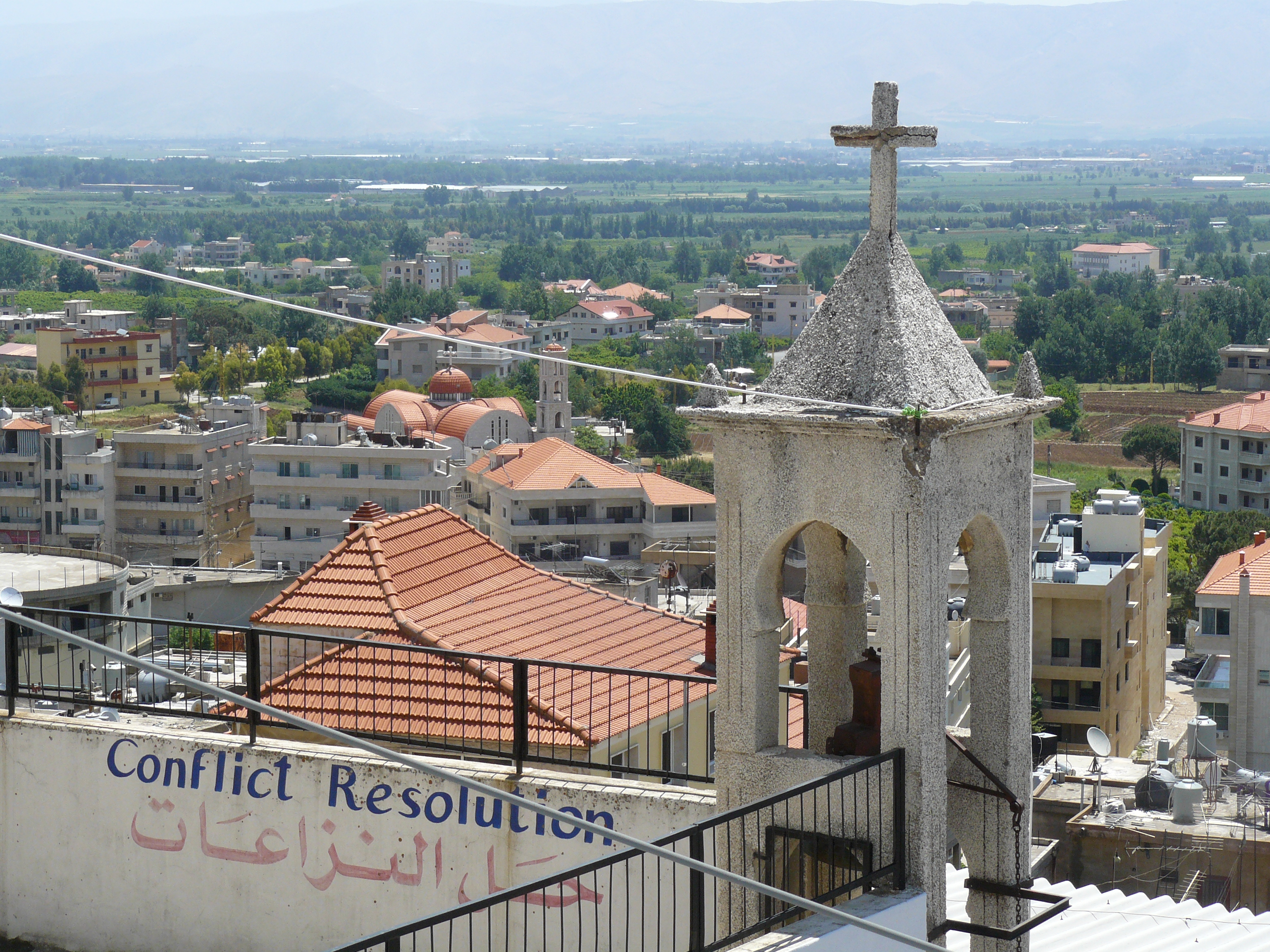
Paper cranes Micah 6 8Grant peace to the people of Iraq, whose troubles and war run on unabated since our country’s terrible decision to invade in 2003.

Dona nobis pacem.
Grant peace to the people of Lebanon, a country that becomes a proxy and pawn for the evil ideas of others; a small country that has borne a heavy burden from these other two wars as they are overrun with refugees.

Dona nobis pacem.
Grant peace to the pastors and churches and their congregations who stay and serve and minister in the midst of extremist attacks and destruction and death.

Dona nobis pacem.
Grant peace to those who have lost everything and are searching for new homes.

Dona nobis pacem.
Grant peace to your world, Lamb of God. Let us know your peace which surpasses all understanding.

Agnus Dei, qui tollis peccata mundi, miserere nobis.
Agnus Dei, qui tollis peccata mundi, dona nobis pacem.
Dona nobis pacem.

Amen.


Kab Elias, Lebanon

P1080389I am in Beirut, Lebanon, for the fourth time since 2010, when I first came and was introduced to my Presbyterian brothers and sisters in this small country by the Mediterranean Sea. We spent about four or five days here on that trip visiting various expressions of the National Evangelical Synod of Syria and Lebanon (NESSL), whether the leadership of the synod, the pastors and churches, a beautiful mountainside elder care facility or a brand new school in the Bekaa Valley. These are amazing, resilient, intelligent and educated people. The evangelical, or reformed, church took root here in the 1830s as American missionaries came in the great movement of that century.

We also spent a week in Syria, visiting the ancient cities of Damascus and Aleppo and the Syrian parts of NESSL, as well as historic places such as the Street called Straight and the Ananias House (see Acts 9), the Grand Ummayyad Mosque in Damascus, and the ancient maze-like souq and the citadel in Aleppo.

These are old places bearing the marks of an ancient church as well with names like Chaldean, Maronite and Melkite Catholic, and Greek, Armenian and Syrian Orthodox. Christians have walked here since the first Pentecost after the resurrection.

In 2010 in Lebanon we learned how the church had a prominent role in offering hope and witness during the civil war here that lasted from 1975-1990, and we also saw how the church in Syria offered that same hope and witness to refugees who had fled from the Iraq war to their east, beginning in 2003.

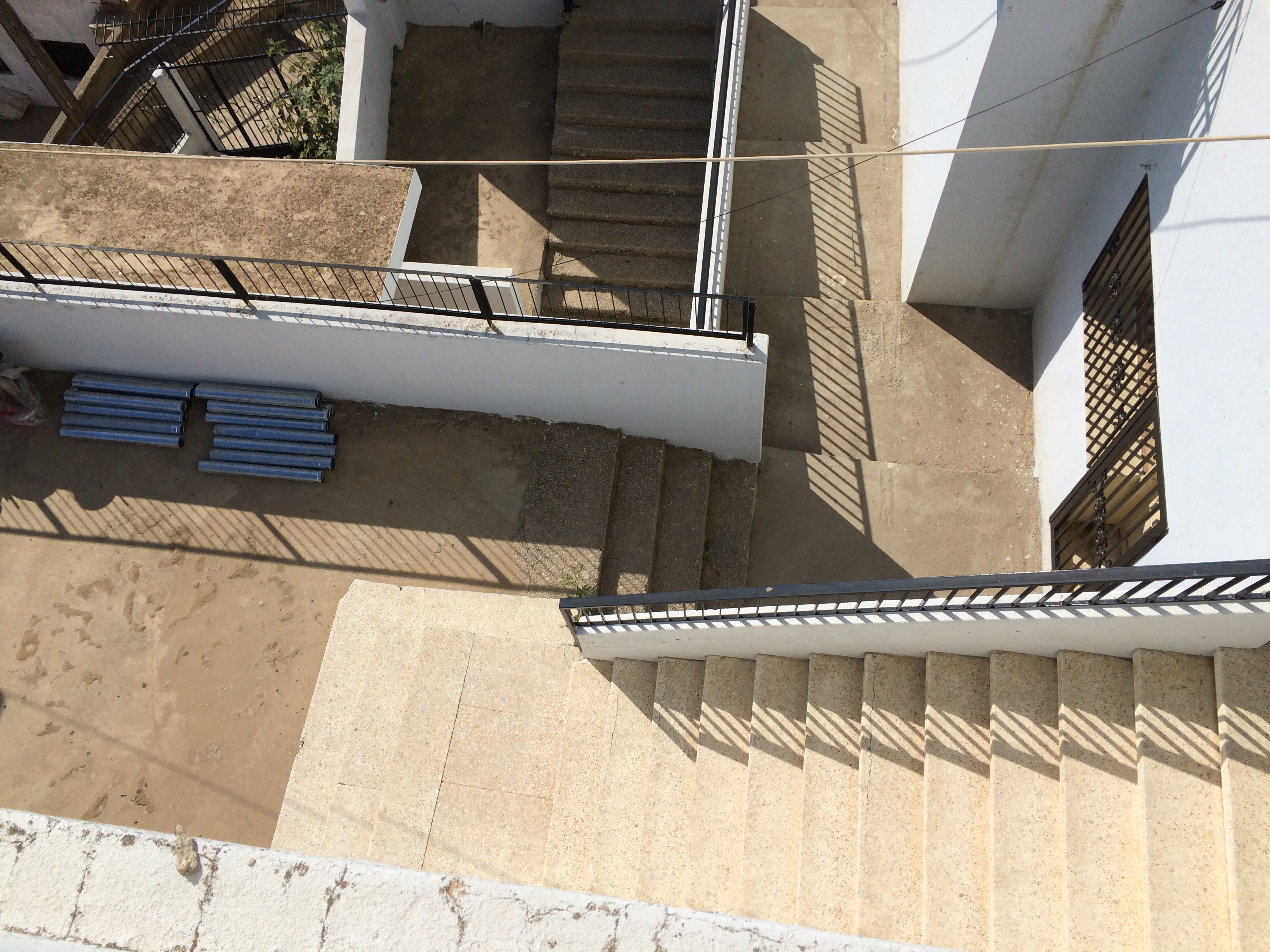
Looking down at the stairs below from top of the Kab Elias school, now apartments for refugees.

Looking down at the stairs below from top of the Kab Elias school, now apartments for refugees.

Returning to Lebanon in 2013, there was a completely different set of circumstances. The new war being fought was in Syria and had been going on for two years at the time of that trip. Refugees from that war had found their way to Lebanon as well as being internally displaced in Syria. And what we found was that same church offering hope and witness anew.

Now, in November, 2014, the crisis has increased ten and maybe a hundredfold. There seems to be no end to the streams of people being forced out their homes in one place, carrying only what their hands can hold, and setting out in a vast migration to a new place. And hopefully one where they can find at least a semblance of peace. Syrians – maybe a million or more – have come to Lebanon, a country of only four million people. They live in tents. There is really no infrastructure for their children to go to school. There are no jobs. But at least the war and the bombs and the killing machine are on the other side of the mountains.

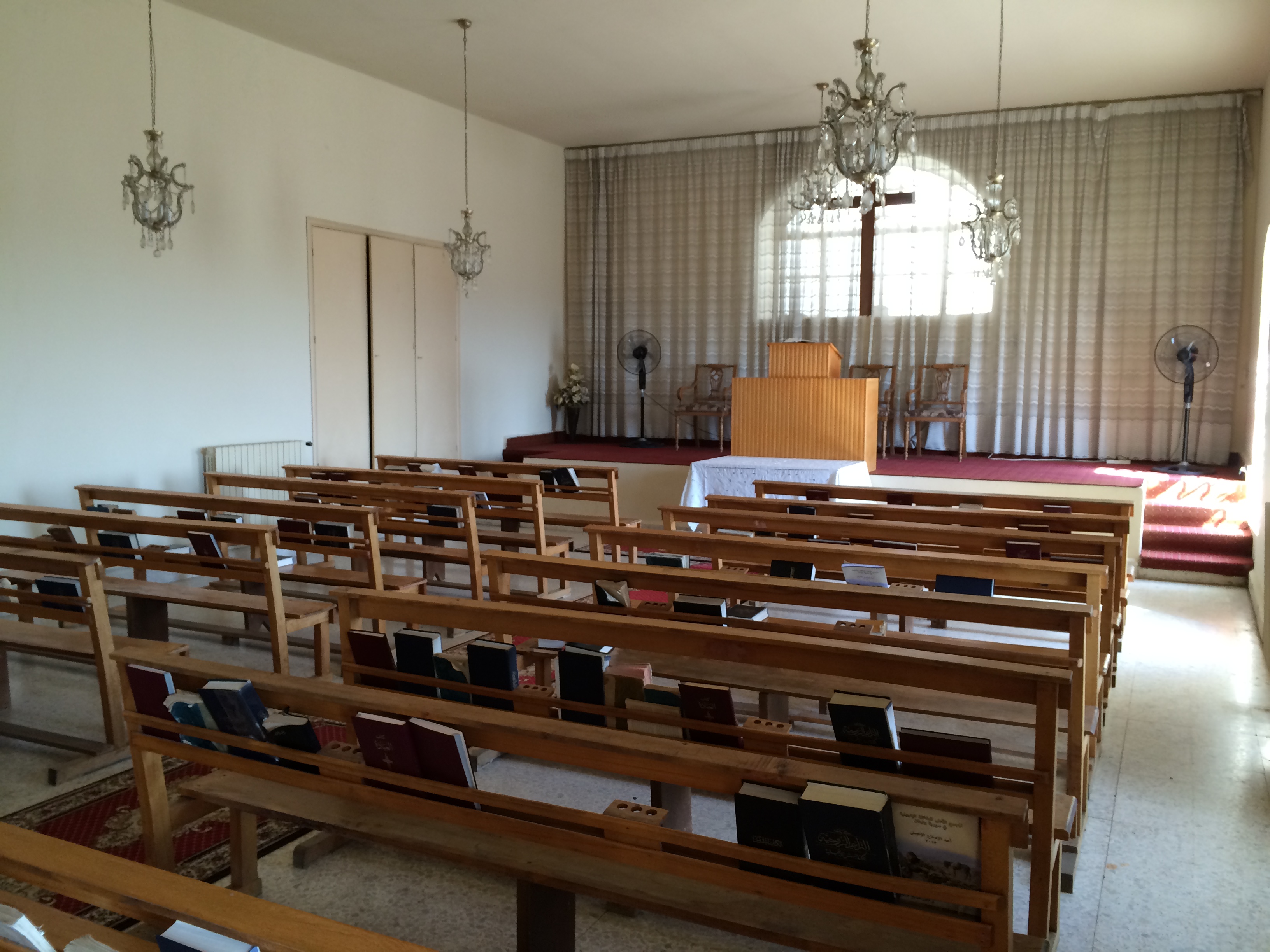
About halfway up the stairs of the former Kab Elias Evangelical School compound there is a door to your right. Inside is the small church where worship is still held on Sundays. Now part of the worshiping community are the refugees from Syria who are living here.

About halfway up the stairs of the former Kab Elias Evangelical School compound there is a door to your right. Inside is the small church where worship is still held on Sundays. Now part of the worshiping community are the refugees from Syria who are living here.

But one thing that is common on both sides of the mountain is the church. It is a common and constant presence in Syria and Lebanon. The church is here. God is here. Hope is here.

In 2013 we had the chance to visit one of those places of hope. NESSL was refitting an old, now unused school to become apartments for refugees from Syria. Rooms where once uniformed students learned reading and math and science, would be transformed into bedrooms and kitchens and bathrooms. There was even a small church here and that would remain as a weekly gathering place to come together and worship the God of peace and salvation and to study his word in the Bible.

Walking up the hundred-plus stone stairs of this multi-level compound, we saw workmen installing kitchen equipment and making bathrooms for the families who would eventually call this place home. All of those items needed for daily living – sinks, toilets, cooking stoves, refrigerators, heating stoves – had to be hauled up those stairs that had been worn by years of small feet going up and down to learn the lessons of life. Now they would be trod by families who had learned the lessons of war and fear, and would find peace in this place of God.

Yesterday upon my return here, I met three of the families who have found refuge here.

Ziad from Homs.

Ziad from Homs.

There was Ziad from Homs, who was sharing his apartment with another young, single man who was not there when we arrived. Homs is a city that had been under siege for a full three years, having been liberated just this past May. I am sure if we had more time and more ability to communicate, we could have heard some horrible stories from Ziad, but also stories of escape and survival. His simple room contained a small bed, a chest with a television on top and some meager mementos from home. It looked like a college dorm room. Young men really don’t need much, do they?

Another room was occupied by Dunia, who had come from Safita in the northwest. Her apartment was much cozier, made so by a beautiful rug on the floor, a couch and chairs in the living room and a few more reminders of her home. Her son was living there with her and he has been recruited by a local Christian leader in helping others. He has applied for admission to the Near East School of Theology in Beirut with the hope of studying to be a pastor. These are seeds of hope being planted for the future of his land.

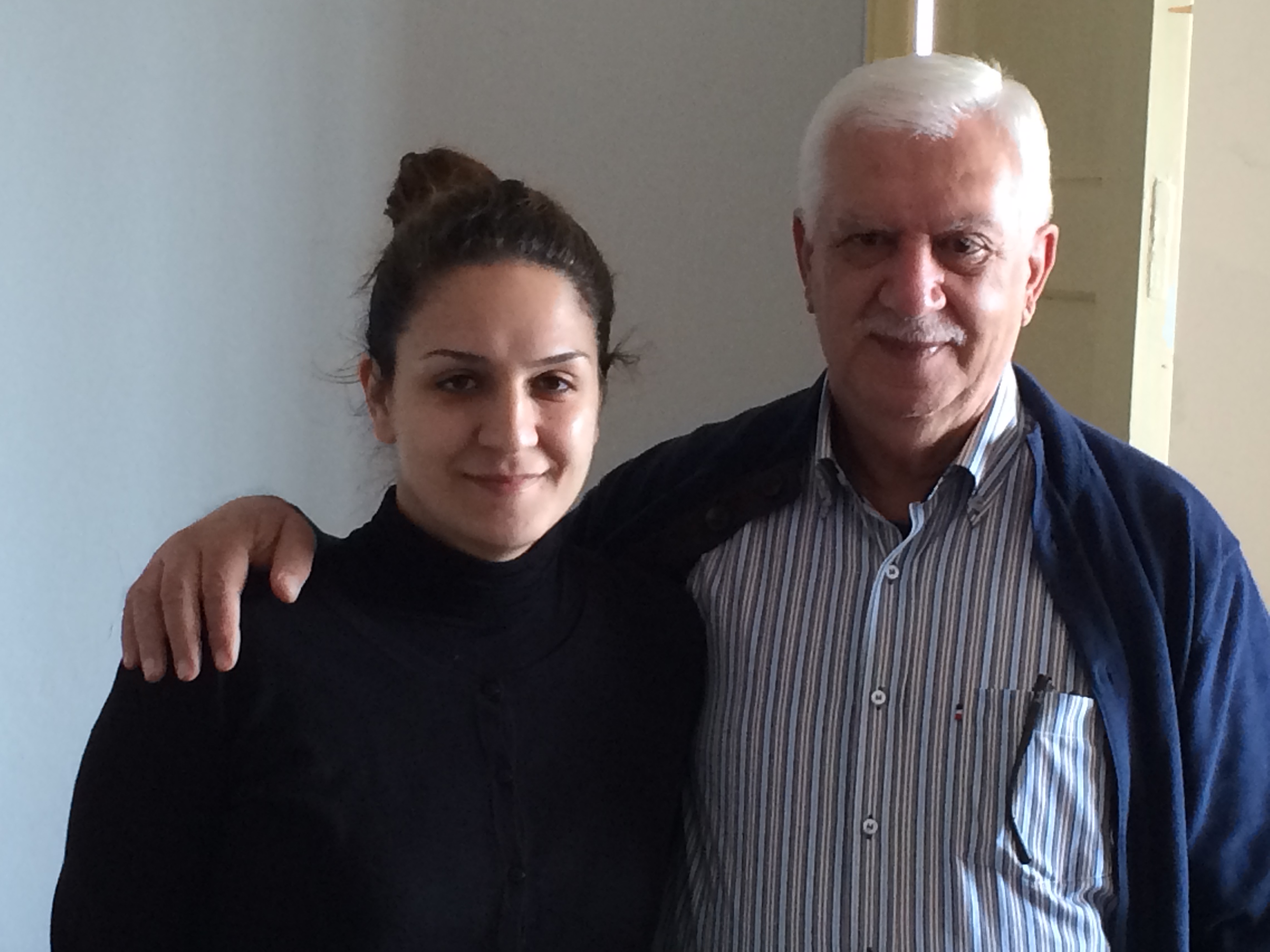
Climbing to the very top level of this vertical compound we met Elder Moussa from Aleppo and his daughter Fibi. Elder Moussa was an electrical engineer by trade and one day his skills will be needed desperately as a city of two million people will have to be rebuilt. We have heard that 55% of Aleppo has been destroyed; ISIS is active there and soon the government forces will try to surround them and deprive them of weapons and supplies to snuff them out. There is more tragedy still to be experienced in the months to come. There is still an active Presbyterian congregation there meeting in a fifth floor apartment with no electricity or water, led by a courageous pastor named Ibrahim Nsier. But that is another story.

Elder Moussa of the Aleppo Presbyterian Church and his daughter Fibi.

Elder Moussa of the Aleppo Presbyterian Church and his daughter Fibi.

Let me tell you why Moussa and his daughter Fibi and her sister Grace were in this apartment at the top of the stairs. They had not fled Aleppo in fear for their lives. Indeed, they were a part of that congregation still meeting there in an equally high place at the top of five flights of stairs. Moussa is an elder there (and I most likely met him in that church in 2010). He is a leader, seeing to the spiritual needs of that congregation. But his wife had cancer. Oh, how I curse cancer! His wife had cancer and there were no longer working hospitals or even doctors in Aleppo. (Think about that for a minute. In a city of two million people, what used to be a modern 21st-century city, there were no working hospitals.) Moussa and Fibi and Grace left with wife and mother to find treatment in Latakia to the west.

Moussa’s wife died two months ago. This man, who is probably only in his early 60s, this educated electrical engineer who owned his house and raised his family with a wife of decades, now lives with his daughters at the top of the former school. A widower, he can look out the window to the mountains, knowing she is not buried in her homeland, but that she is in the arms of a loving God.

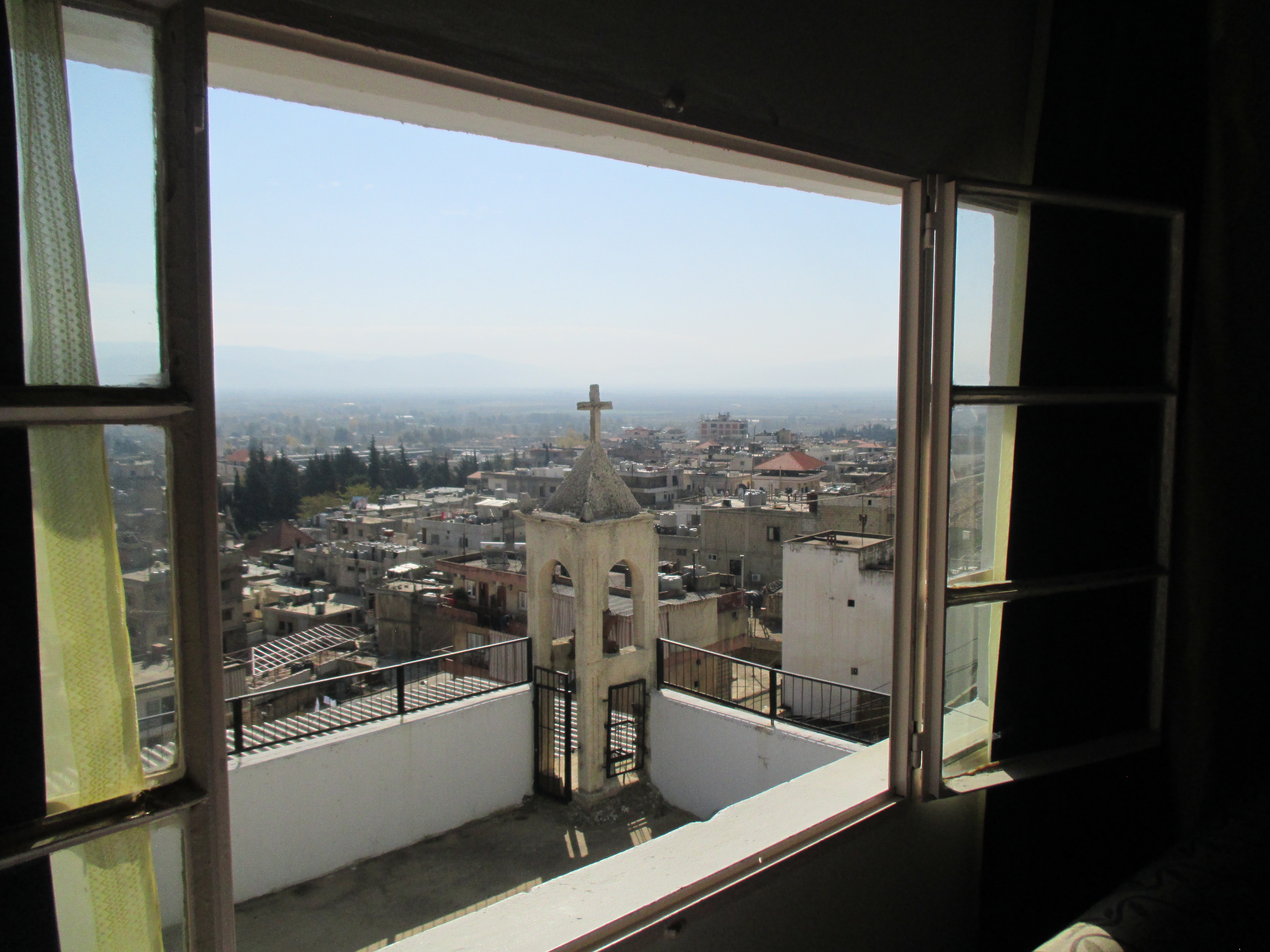
This is the view out of Dunia's window, looking to the church steeple with its bell.

This is the view out of Dunia’s window, looking to the church steeple with its bell.

A loving God, who has led him to this place for this time.

A loving God who will see him come home, either to Aleppo to help rebuild or to one of the mansions in his father’s house.

A loving God who walks up the stairs with him to the top of the school, now made home.

A loving God who walks among the thousands of tents in the valley below.

A loving God he worships in the small church a few flights below.

A loving God embodied in the churches and pastors and flocks of this place.

I pray a prayer of thanksgiving to this loving God for allowing me to enter into the lives of these people who are living in a place prepared for them by brothers and sisters of mine and yours.

And I pray to this God for peace in this land.

Praise God from whom all blessings flow, praise him all creatures here below. Praise him above ye heavenly host. Praise Father, Son and Holy Ghost.

Amen.

What hurts them, hurts us

Peace hands worldIt is the day after another election here in the U.S.

Sigh.

Personally, as a liberal in a conservative state, it was a tough night politically for the people I supported. But I woke up this morning and the sun was up and God was still on the throne. God’s mercies are new every morning!

And it was not a total disappointment for me and others. The people of our state voted to raise the minimum wage, and the people of our city voted to approve a bond issue that will improve the facilities of older schools in our main district and also build new ones to meet the responsibility to educate future generations.

I guess the best part of an election being over and done with is that the airwaves will now be free of the millions of dollars worth of advertising spent telling us over and over again why that person is a no good, dirty, crime loving, tax raising, hog castrating, gun hating, gun loving, idiot who speaks out of both sides of the mouth. There has been nothing uplifting about any of it. And the waste of money in such a way is just mind boggling to me. Think how many more schools could have been built, or people fed, or cancers healed, if the money spent in an election cycle were used for those kind of building up activities, instead of the tearing down kind.

As I was driving home in the early evening before coming back to church for a meeting, I was listening to NPR. It was too early for any election coverage, but I thought they might be doing some commentary. I was going to be at that meeting during prime time coverage so I was just a bit anxious I guess to hear something now. But what I heard instead was this report about happenings in Iraq’s struggle with ISIS:

http://www.npr.org/blogs/parallels/2014/11/04/361422673/we-are-not-slaughterers-an-iraqi-village-rejects-islamic-militants

The tribe mentioned in this story is the Jubbour tribe, who are Sunni. They are trying to protect themselves from ISIS, who are also Sunni. But as the headline says, “We are not slaughterers.” The Jubbour see ISIS as an ideology not for anyone’s good; they are just a killing machine. The Jubbour reject this ideology and name it for what it is. They have also paid a very heavy price.

What struck me most about the story, however, is the reaction of a neighboring village of Shiite Muslims. The schism between Sunni and Shia happened almost at the beginning of Islam, once Muhammad had died. It is a deep divide of long standing.

This Shiite village, so the report goes, has been working in defense of and to protect their Jubbour neighbors. Why? “Because what hurts them, hurts us.”

What hurts them, hurts us.

What hurts you, hurts me.

And so on a night of people speaking through the action of filling out a ballot, I have found some good news.

In my city, we have decided that it hurts us all when children – yours, mine, ours – don’t have good safe schools to learn in. It is not good for any of us to raise generations of children who lack knowledge, who lack opportunities to debate and discuss, who don’t have access to new technologies and safe surroundings.

In my state, we decided that folks who work in jobs where the minimum wage is the standard rate of pay, should have a raise so maybe they can move a bit farther from the abyss of food insecurity or poverty. Many people working in these jobs work more than one, so maybe this means they can have more time with their families, more time to sit down with their children as they work on their homework. What hurts them, hurts us…or it should.

I woke up this morning feeling some hope. I still believe that when we say “we the people” we mean all of us. I still believe that not only what hurts them, hurts us, but what helps them, helps us all. For really, we are them.

Let us be us together.