Dancing in Circles

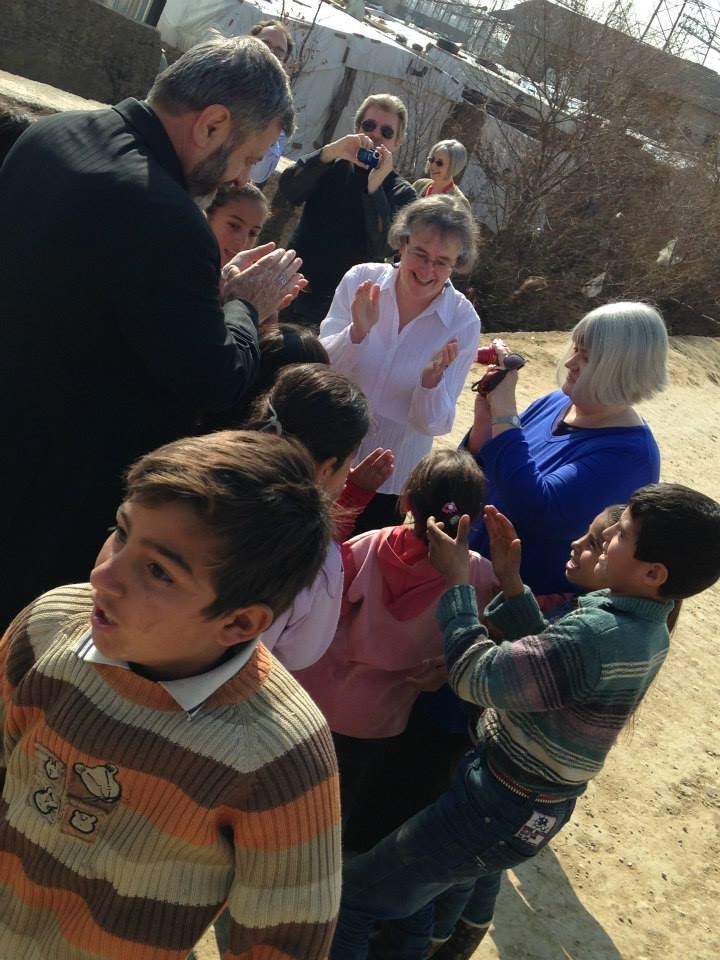
Dancing in circles photoI visited a refugee camp near Zahle, Lebanon, on a trip I made in May, 2013. It was part of a visit of presence to offer fellowship and encouragement to Christian brothers and sisters in the National Evangelical Synod of Syria and Lebanon who were dealing with the refugee crisis from the war in Syria.

Eight months later, in January, 2014, I went back on a similar trip and we visited another camp near Zahle which hadn’t existed eight months before. Instead of visiting a pretty small camp of 45 families, we visited one of two in the area that was now home for thousands of families.

In Lebanon alone, there are approximately 1.5 million refugees from the Syrian war which has raged since March, 2011. It was the onset of that war that had prohibited my wonderful group of faithful women friends from returning to Syria to take part in a women’s conference that would allow more of our Iraqi sisters to join us. So much sorrow and pain is concentrated in this small part of our world. It’s heartbreaking to say it in my most understated words. There is an ever-flowing stream of tears to accompany them.

At that camp last January our group was surrounded by a sight I never expected to see in such a place of sadness. Children singing and dancing came pouring down the dirt road beside the sewage filled canal that drained their camp. Singing. Dancing. Smiling. Laughing. We were swept into their midst and joined in.

From that encounter came this poem:

Down the hill they came running with smiles on their faces
Unusual I thought, in this saddest of places
But they sang and they clapped
Oh my word! How infectious
So we clapped and we smiled in this moment of grace notes.
They grabbed on to our hands and soon came the dance
Round and round we did circle in this desperate land
We kissed and we cooed, just like all children do
Voices raised in sweet choruses of “I love you too!”

It wasn’t ‘til later when I learned that their song
Was a reminder of all in their world had gone wrong
“I used to live in a house” – so it went,
“But now I live here in this land in a tent.
Tomorrow will come and a house there will be
For me and my folks, the whole family.”
It made me so grieved for the horror of loss
I still cannot grasp the heartbreaking cost
Of hatred and war that would drive them away
From the home where they spent every night, every day.

And yet here we were in a circle of glee
And they had this vision, in mind’s eye could see
That where they were now was just temporary
Even though it was alien, maybe even quite scary
It was only a stop on the journey of life
That someday the end would come to this strife
And they would be dancing and singing with glee
Enlarging their circle with people like me
God in heaven above, hear my prayer, let it be.

I came home from that place with an idea I have no clue how to proceed with, but I have. I have a wonderful co-worker, friend and brother in Christ who has taken a version of this poem and put it to music. Mike did it because he could see what I saw with my heart and not with my eyes. I would like to take that song and make a video to share the story of the suffering and the sadness, but also of the hope that exists there, to raise money for the needs of the refugees from this war and the now renewed war in Iraq. I want the video to be able to take on a life of its own – it won’t be mine or Mike’s or whoever can help me make it – but it will be a tool that almighty God can use to bring a small amount of love to a place of overwhelming need.

Please pray with me that God will make a way.

Amen.
Peace through Music

I love this video clip. It’s Jeff Vojtech, Mike Geiler, me and Alisha Sauer singing this beautiful hymn by Stuart Townend. I love the music. I love the text. I love the harmony. And when I sang it with these three, and when I listen and watch now, I feel peace.

I think music is one of those places where we do find peace. It strikes me always when I watch the musical, “The Music Man.” My favorite part of that movie is when Professor Harold Hill diverts the school board from investigating him for fraud by forming them into a barbershop quartet. These four quarreling men who seem to really have no respect for each other, blend their voices into perfect four-part harmony by simply singing the words “ice cream,” each on his own note. It’s beautiful. It’s perfect. And the fight is over; there is peace.

I wrote a lengthy essay on that topic a few years back and the thought comes back to me now in this time of global crisis. Wars in Syria, Iraq, Israel/Palestine, the Ukraine. All over the world we are experiencing the lack of peace in the form of conflict and people – people just like you and me – are being killed and maimed and are suffering in so many ways.

It is hard to watch this on a daily basis and feel inadequate to do anything about it. I pray. I cry. I shout at God and say, “Why?”

And then I think back on that fictional account of four school board members in River City, Iowa, singing together. Their fight is over and music was the answer. And I know that is very simplistic thinking.

But that is my dream and my prayer and maybe it is just that simple.

Wouldn’t it be amazing to organize the world’s largest choir? I am talking one or two or six billion people! I imagine that we would all sing just one word – peace – in whatever language was our own, in harmony. And for the briefest of moments, there would be peace and harmony.

And maybe it would lead to more moments. And maybe there would be peace.

On days like today when planes are shot out of the sky, and armies march, and missiles fly, and children die, that’s what I think about.

Abraham: Father of Many

It is the end of  day and time for sleep. My nightly ritual as I lay in bed is to say my prayers. As I expressed before in an earlier blog, most of my prayers are of gratitude. And those follow my prayers for peace. In between, I pray intercessory prayers for specific individuals. For the past fifteen months, since April 22, 2013, I have prayed for a father named Abraham.

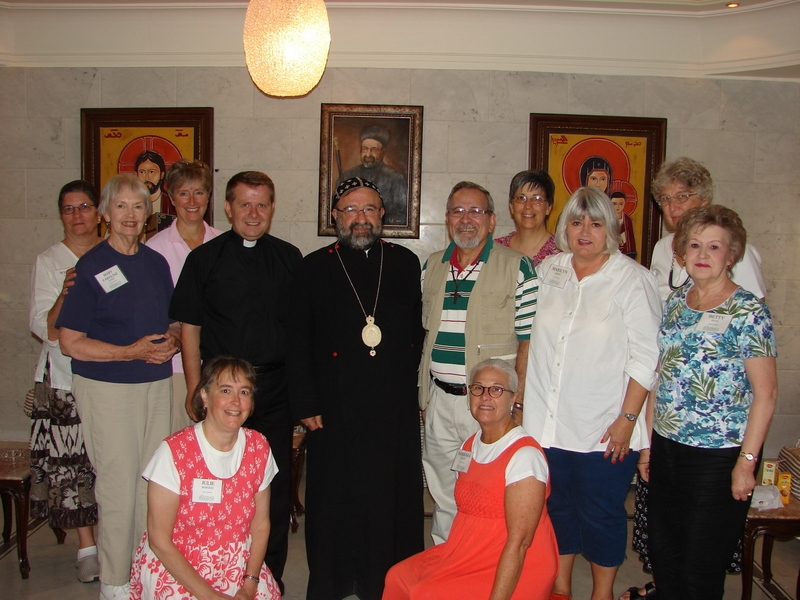
With Bishop of Syrian Orthodox ChurchIn this case, the father is actually a priest, and more properly, an archbishop. He is in the center of this photo from my trip to Aleppo, Syria, in August, 2010. His name is Yohanna Ibrahim (Ibrahim being the Arabic form of Abraham) and he is the Syriac Orthodox archbishop of Aleppo, Syria. As I look back on this photo, he is surrounded by a group of women who made this journey together – faithful women, we were called for this trip – to travel to Lebanon and Syria and learn of our brothers and sisters in Christ in a land so far from home. (How is it possible that a woman who grew up in the middle of the U.S., in Omaha, Nebraska, could travel so far from home and meet such an eminent representative of a faith that can trace its origins back to the original apostles? On this side of heaven, I will never know!)

He is an important figure in that ancient church, a church that has schools and hospitals, and has a liturgy in a language that is similar to what Jesus spoke while he was here on earth. And after the war broke out in 2011, he was a voice for peace and reconciliation. His voice was silenced along with his Greek Orthodox colleague, Archbishop Boulos Yazigi, when they were kidnapped on that day in 2013, April 22. The story is they were negotiating the release of other hostages when they were taken themselves. There has been no evidence to this day that they are alive or dead. No remains found. No ransom demanded. Just silence. And so I pray nightly between my prayers for peace and my prayers of gratitude for their safe release. They are fathers of many and they are loved and missed. Their voices for peace and reconciliation are missed. Their example and their witness are missed.

Assis Ibrahim and Abuna IbrahimWe were introduced to Msgr. Ibrahim that day by one of his clerical colleagues in Aleppo, another Ibrahim: Assis (Rev.) Ibrahim Nsier, the Presbyterian pastor of the church in Aleppo. Before meeting the archbishop, Assis Ibrahim introduced us to yet another colleague this one named Efrem, a Syriac Orthodox priest (Abuna Efrem) who served with the archbishop in Aleppo. One of my most endearing and enduring memories of that day is this photo of  Assis Ibrahim and Abuna Efrem. They were having a conversation in Arabic together, smiling and laughing as they talked. I asked them what was so funny and they told me they were talking about the differences between different branches of our faiths. “It’s a language issue,” they said. “We split over things we don’t have the words to explain. How do you find the words to explain the mystery of the divine and human natures of Christ in one being?” To this day, it strikes me that I went halfway around the world to see a pastor of our reformed faith having this amazing conversation with a priest of the ancient faith that began in the Middle East. This faith had traveled from one side of the world to the other, reforming and refining as it went, and it still exists in all these expresssions so many decades and centuries later…and we can talk together about it even if we understand it differently. There was peace; there was reconciliation; there was collegiality and conversation. It was the most marvelous picture of the church I have ever experienced.

Abram was called out of his homeland by God and told his descendants would be more numerous than the stars in the sky. God changed his name to Abraham, father of many. And tonight I am thinking of his decendants that I met in Aleppo and praying that those who call them Archbishop, Pastor, Father, will be able to do so again in peace, continuing the reconciling mission of Jesus.

Amen.

Fragile

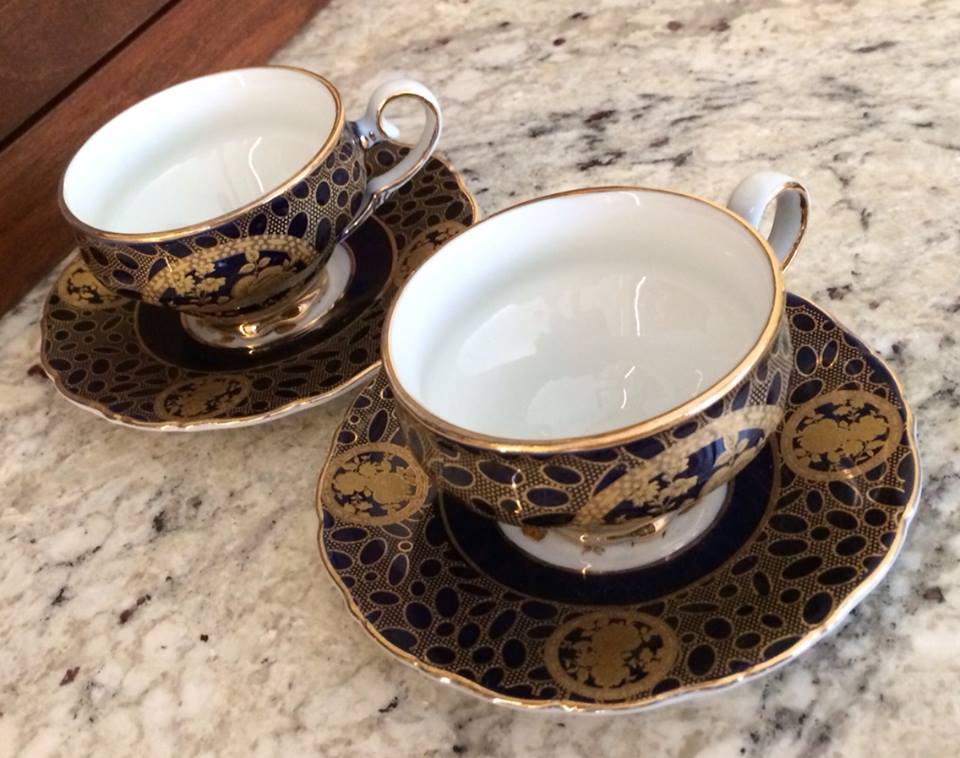
Aleppo porcelainI have been reading stories all day long about what is happening in Israel and Palestine, what so many of us refer to as “The Holy Land.” It’s awful. Horrendous. Unspeakable. Tragic. There are so many words to describe what is happening to actual flesh-and-blood human beings in an exchange of bombs and missiles between people whose family histories can be traced back to the same beginnings. They are brothers and sisters, just as we are with them.

I pray, I weep, I mourn. Some days I can’t do anything else. “How long, oh Lord?” is a constant thought.

There are wars going on in lands where I have walked with my brothers and sisters in Christ and they are holy lands to me. Syria. Iraq. Lebanon. The same bone-shattering weapons are flung back and forth between people who have shared the land for centuries. Homes lost. Churches and mosques blown to bits. Cities flattened. A generation of children who, if they haven’t already been killed, will spend their early years in shattered shells of buildings and minds. It’s all so fragile and tonight all I can think of is the broken pieces.

I wrote this poem after a visit to Lebanon when the only way I could visit the pastor I had met in Aleppo, Syria, in 2010 was to hear his voice on a phone. In that long ago summer – only four years ago! – we walked the streets of his city. We worshiped in his church. We saw the reconstruction of a high school for boys. We shopped for treasures in a souk whose aisles stretched into the eternity of the maze it was. I was looking for a set of the small cups and saucers that we were served coffee in everywhere we went. My shopping excursion paid off and I brought home a set of blue and gold china cups and saucers, which sit in my cupboard. Such fragile things, but they are a constant reminder of what has been lost. The church building has been destroyed. The school was bombed and ransacked. The ancient souk is no more. So many have died and the war continues.

Aleppo Porcelain

They sit ensconced upon my shelf
In glorious gold and blue
Perfectly matched for twelve of us
For tea and coffee too

We searched for them inside the souq
We went from stall to stall
‘twas in Aleppo, Syria
Me and Kate and all

We had been served so many times
In every place we went
Dark coffee with such sumptuous sweets
Hospitably, time well spent.

When I look upon the pictures now
Of Aleppo in the news
I see the shattered buildings
Broken homes and scattered shoes
People running for their lives
Their idea of normal is lost
Children crying, people dying
This is what war has cost.

The cups are gone, the saucers too,
The souq is history
All are now but faded scenes
Inside my memory.

But there is another memory
Of another cup and plate
A reminder of a sacrifice
Made on an earlier date
Of one who spilled his blood and life
That we might know forgiveness
The gifts upon these precious plates
Would remind us of the richness
Of life poured out for you and me
In sacrifice divine
Redeeming love for all on earth
For each of us for all time.

Each night as I raise prayers for peace
I ask this Lord of life
That he would send his spirit to earth
To end the days of strife
That he would show us how to serve
With fragile cup and plate
The kind of love he modeled
The love that conquers hate.