Thursday in the new normal

July 2 was a Thursday this year, just two weeks ago today. For me it was not a normal Thursday, although I did sign the checks at church for invoices and reimbursements, a normal Thursday event for the last ten years.

Ten years.

Last.

It was the last normal Thursday in an old normal, as it was my last day on staff at the church I have served since January 2, 2002, the last ten as business manager, aka signer of the checks, aka money changer in the temple. Didn’t you know? Every temple needs one!

That’s the way I used to introduce myself to people who came in the door at West Hills Church, including a couple of candidates for our interim senior pastor position.

Well, you might as well be honest. 🙂

So July 2, 2015, was my last day on staff there, and it was a Thursday.

July 6, 2015, began a new chapter in my life. No, it wasn’t a Thursday, but it was a Monday after a three-day weekend for the Fourth of July holiday. I woke up a very different person: for the first time since 1977 I was unemployed.

Let me say, it was my choice. I think that is important. I left with a sense of peace, albeit with no sense of purpose. It felt right: the decision, the timing, the reason.

So here I am, two weeks later living a very different kind of life.

I have applied for a new job.

I am preparing to return to Lebanon and Syria for the fifth time in five years.

I am cleaning up my home office so we can reattach the bookshelves which are pulling away from the walls. (Can I just digress for a moment and say that the reason they are pulling away from the walls is that they were too heavy with books? I think that counts in my family’s favor that we love to read actual printed BOOKS!)

I am spending time letting folks know that I have a different e-mail address and discovering just how many places I used my church email for a point of contact.

Note to self: don’t do that again!

I am playing Bejeweled Blitz, Yuma Blitz, Pet Rescue Saga and other assorted Facebook games in my moments of solitude. Hey! Everyone needs some down time.

But it has been two weeks now. I don’t leave for Lebanon for another week and I was feeling like I needed to produce something. Not spreadsheets for the session so they have good financial information. Not attendance figures for Sunday school and worship. Not editing and proofreading marks on the Sunday bulletin (although it was obvious from last Sunday, that somebody still needs to do that function!).

No, today I needed to produce something physical, something that made me feel like I could still create beautiful aromas and flavors and to actually feed people – not the Word – but actual food.

So I pickled onions.

Beautiful cipollini onions with thin, yellow skins would be my target. I set out on this hot, humid, sunny day in Omaha, Nebraska, to find them at the grocery store. The clerk at the store wondered what I was going to do with that bulging cellophane bag of onions, so I told her.

“I am going to pickle them in a balsamic vinegar and white wine brine. But first I have to melt dry sugar into a beautiful dark caramel. They are awesome!”

“We’ve got pickled onions at our olive bar,” she explained.

“I know. That’s where the inspiration came from,” I replied. “Oh, my! They are yummy. And I am going to make some.”

July 16 cipollini onionsSo home I went with my five pounds of aromatic layered gold. I blanched them, adding another layer of yellow coloring to the pasta strainer, dumped them in an ice water bath and then squeezed the usable part of the onion out of its skin.

A couple of hours later I had this treasure, not in clay pots, but in six one-pint Ball jars.

It wasn’t enough.

For thirteen years, my dear spouse St. Stephen has been the chief chef at our house. I like to cook. He loves to cook. He finds peace in the kitchen at the end of day of architectural drawings and meetings and trying to please clients.

He is a great chef!

But he has been so busy lately and I have been, well, unemployed.

July 16 mac and cheeseSo today besides shopping for pickled balsamic cipollini onions, I shopped for macaroni and cheese. No, not the blue box my family grew up with, but the creamy, cheesy, homemade kind.

Half and half. Sharp cheddar. Colby. Large elbow macaroni. Butter. Onions.

Homemade bliss.

I love to care for people, including my family. But I also I know that Thursdays are just Thursdays.

I know that my old normal and my new normal are the perception of a well-resourced, finely educated, blessed married woman in a first world country. When I put on the glasses of my sisters – equally educated, equally blessed and formerly well-resourced – in a part of the world that had the same economic advantages of my country until years and decades of war caused their worlds to collapse, I stopped in my tracks.

Their new normal is not of their own choice or their own making like mine has been.

And so in the midst of onions and macaroni and cheese, I pray.

I pray that they, too, will come to have a Thursday like this. A Thursday of sunshine and humidity. A Thursday of pickling onions or making jelly. A Thursday of sharp cheddar cheese and creamy sauce as they wait for a hard-working spouse to come home.

I pray that their new Thursday normal will be like their old Thursday normal.

A Thursday of peace.

Protection while we sleep

Sami Sadeeh Syrian national guardsman from SafitaI am on the worship team this Sunday at church and the special song we are singing is Laura Story’s “Blessings.” It is a lovely song and I am happy to be singing it with three good friends for the glory of the Lord.

There is a line that goes like this:

We pray for blessings, we pray for peace, comfort for families, protection while we sleep.

And it’s true, we pray for all of that. Peace, peace, peace, has been my prayer these last four years especially, since my traveling to the Middle East started.

But today I am centered on these words: protection while we sleep.

Protection while we sleep…

We had it in spades on our trip to Damascus in January, 2014, and I didn’t even realize it until the last day we were there. We would come up to our room in the hotel and there would be two or three normal looking men sitting in the lobby on our floor, like they were waiting on their wives or something. When we left in the mornings to accomplish our schedule and make our visits, there they would be again. Back and forth and back and forth for our three days there, those gentlemen were always in the lobby on our floor.

Walking through the Christian quarter in Damascus after having visited the church where Saul became Paul (Acts 9), we visited a craftsman shop to make some purchases of fine Syrian wood inlay boxes and lovely local fabrics and scarves. As we continued our walk back to the Presbyterian church, Steve commented about our security detail.

“There must be ten or twelve of them,” he said.

“Really?” I replied. “Where?”

In front of us, behind us, bulky automatic weapons bulging from under their jackets, they had been with us the whole time. They had also been staying in the lobby of our hotel floor. Protection while we sleep.

And now I flash forward from Damascus to our trip back to Syria in November. We had another contingent of security with us as soon as we crossed the border. I was not so naive this time and grateful for their presence. I had the opportunity to talk to them and discovered that some of them had come from the city of Raqqa in Syria. Raqqa is now the capital or main city that ISIS controls. These men had lost family members there and their homes as well to this evil that is trying to drag their country back to the seventh century.

And there they were for us: protection while we sleep.

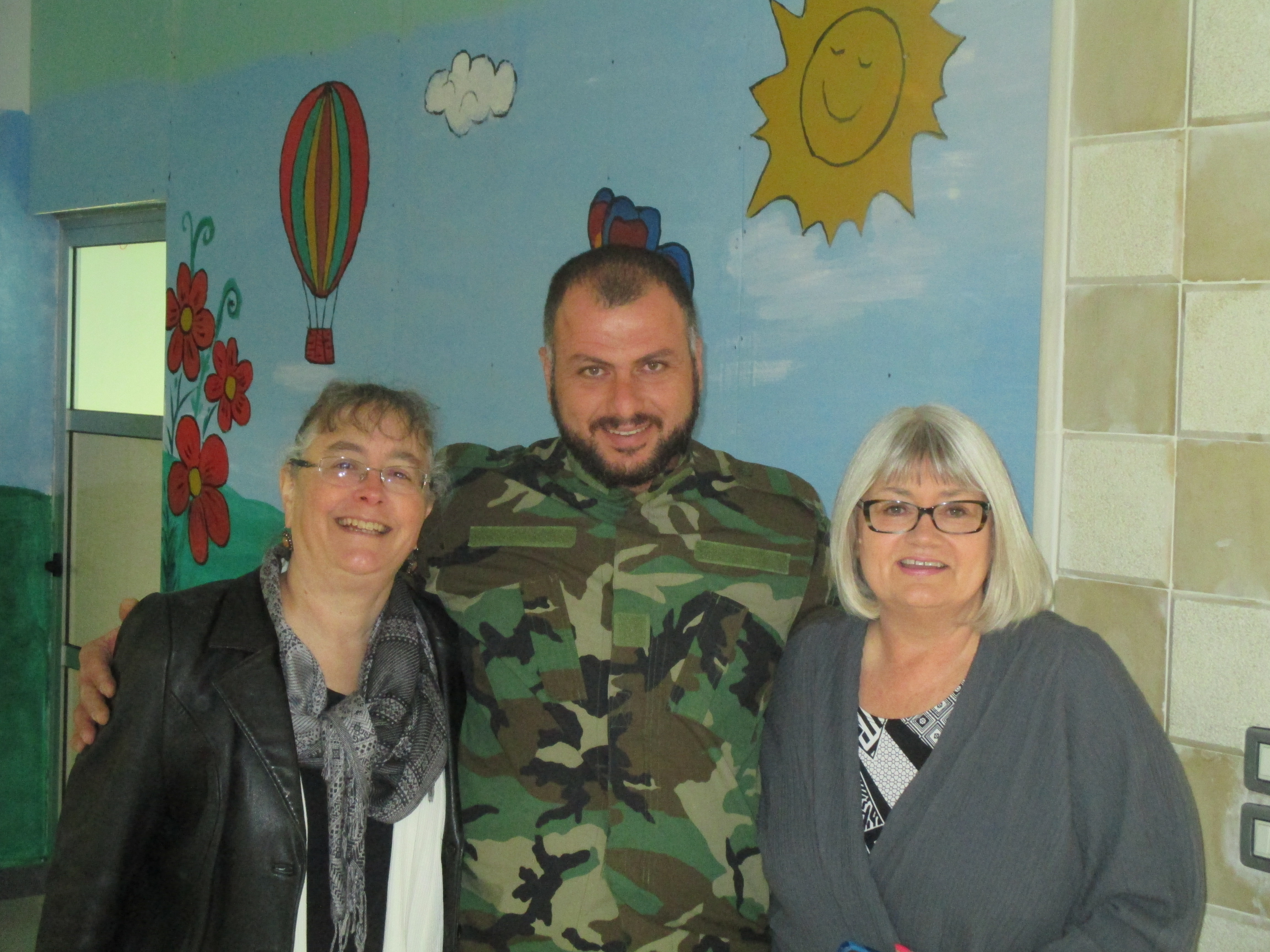
Tony in between Marilyn and I, Syria, November, 2014.

Tony in between Marilyn and I, Syria, November, 2014.

When we arrived in the Wadi al Nassara – the Christian valley of Syria – these troops handed us off to four men from Safita, all members of the national guard. They were with us for our remaining time in Yazdieh, Amar al Hasan and in Lattakia. Sweet, sweet men! The one named Tony held Marilyn’s hand through all our walking and hiking, to steady her as she was due for orthopedic surgery when we returned home.

Up and down the roads we traveled, through town after town on our way to the places on our schedule. Every town had pictures of those who had given their lives for their country, Syria, in this four-year old war. Poster after poster after poster would be at every intersection, in front of every business. And I am sure these men with us knew many of them. And I am sure that every one of those martyred soldiers had families that were missing them greatly, and who would share that same prayer: protection while we sleep.

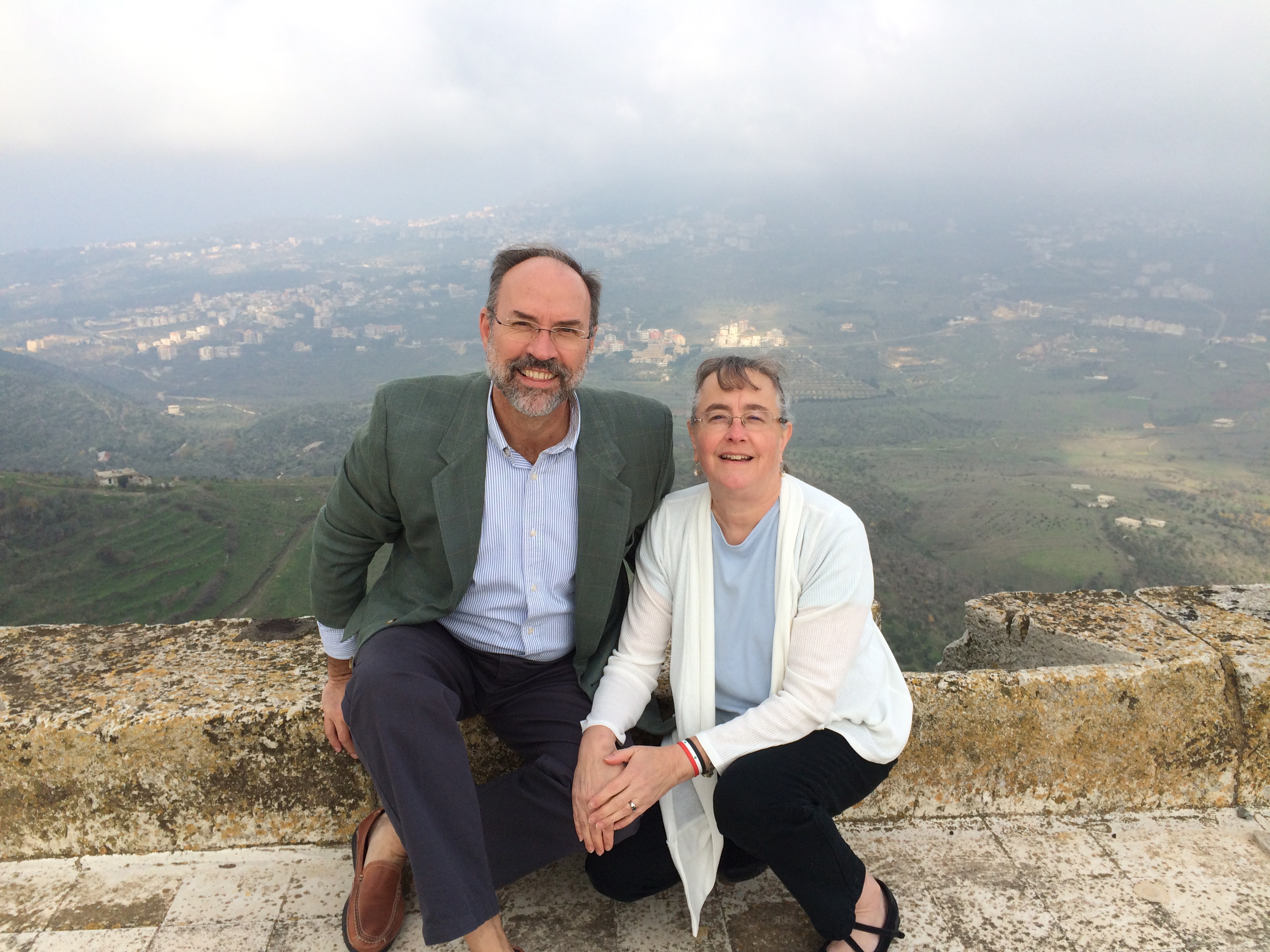
Steve and I on the top of the Krak de Chevaliers, Wadi al Nassara, Syria, November, 2014.

Steve and I on the top of the Krak de Chevaliers, Wadi al Nassara, Syria, November, 2014.

For four days and three nights, they were with us as we traveled through this beautiful place to meet with churches and refugees and families who had been driven out by ISIS from Homs and that part of the country. They went to church services with us. They ate dinner with us. They stood by while we traipsed through the world heritage site known as the Krak de Chevaliers, a former crusader castle in wars fought long ago. They told us how fanatic rebels had taken this high ground to fire on the Christians and others in the towns below. They told us how terrible things had been done to those captured, including throwing them from the high ramparts where we sat and had our photos snapped.

These four went with us everywhere for those four days, and were our protection while we slept.

On our last day there and before we left them behind, we gave them each an Arabic bible as a gift. All four are Christians, probably Greek Orthodox, and were thrilled to get the bibles and the little peace dove ornaments that we gave with them.

On the grounds of the St. George Monastery near Homs, Syria, with our national guardsmen. Sami is third from the left. God rest his soul.

On the grounds of the St. George Monastery near Homs, Syria, with our national guardsmen. Sami is third from the left. God rest his soul.

When we arrived back in the U.S. we talked about what more we could do for them. Those four gentlemen were all serving in the National Guard of Syria, but their day jobs were just like us, maybe an engineer, a teacher, or some other normal job. They weren’t doing those paying jobs while they were with us. They were volunteering their time as members of their unit to protect us while we slept and while we worshiped and while we ate and while we climbed crusader castles and had our photos taken. And we wanted to do something for them.

So Nuhad wrote to their commanding officer to find out how we could give them a small monetary honorarium for our appreciation of their great service to us, and this was the response we got back:

What he asked instead is that we make a gift in their honor to support the 100 displaced families in Safita that their unit is responsible for.

No money for them, but money for the refugees that their unit is responsible for. That is what they wanted. No greater gift…

Today on Facebook, my friend Nuhad shared this picture of one them, Sami Sadeeh. He has lost his life in this war, in protection of his family and his country. I am sure there will be a poster of him on the roads of Safita, just like the others we saw.

And so now I pray for his family: protection while they sleep.

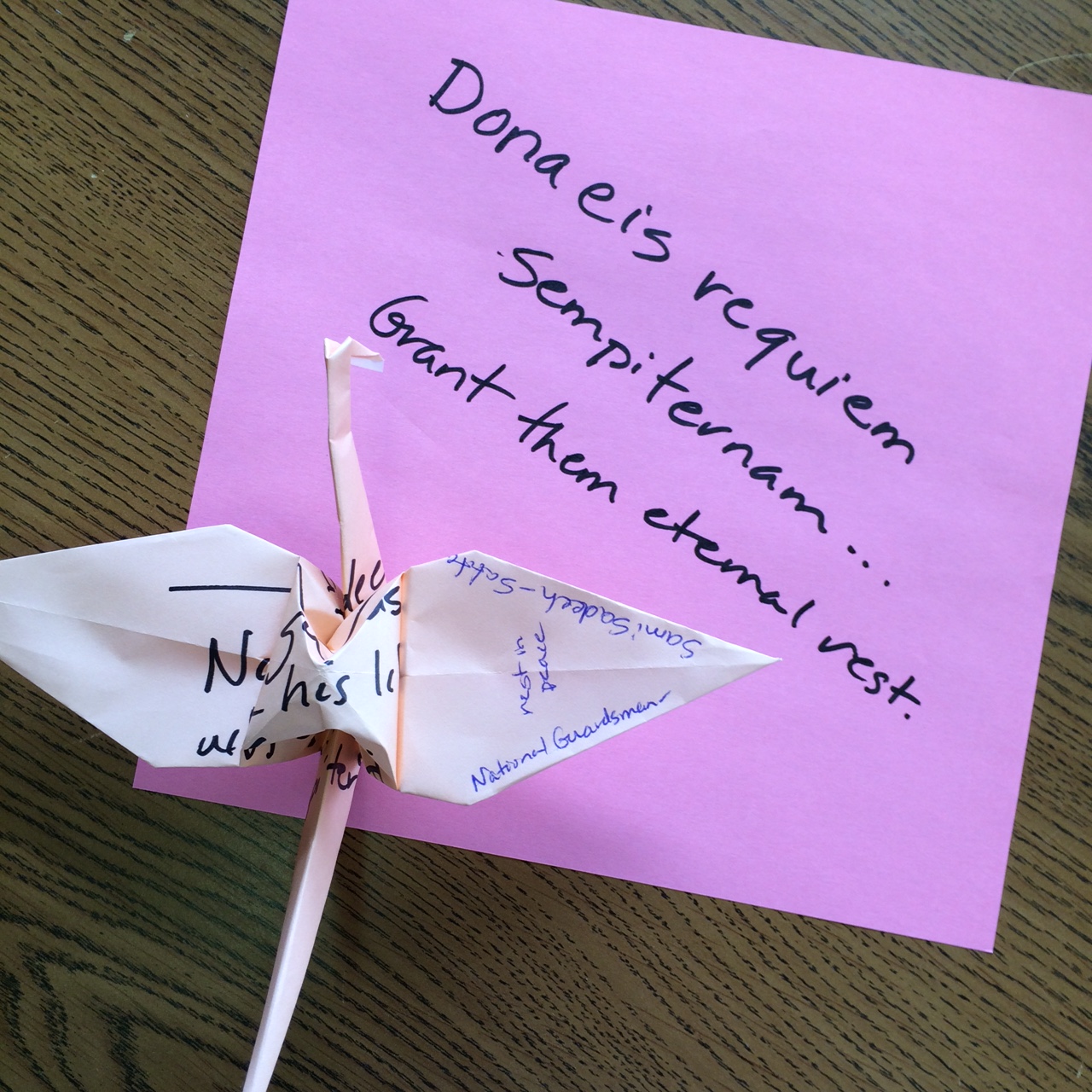
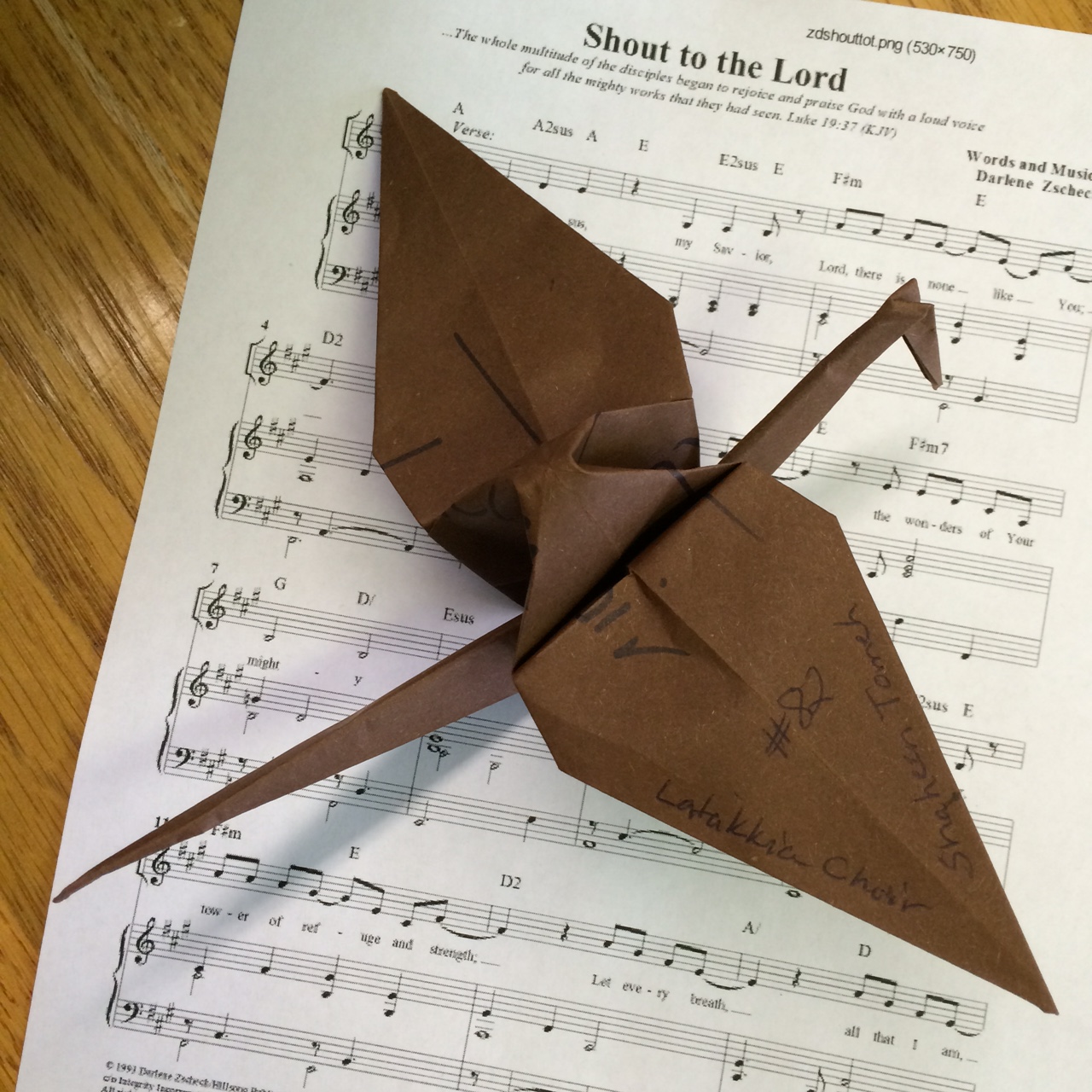
Paper crane Sami SadeehBut my prayer for Sami is different and I wrote it on the 301st paper crane that I folded just today in his memory. It was not dona nobis pacem, for peace has been granted to him. Instead I used the words from that prayer used at a requiem mass, dona eis requiem sempiternam.

Grant him eternal rest.

And I will sing “Blessings” on Sunday in worship, and when I sing the line, protection while we sleep, I will see Sami’s face, and know how that prayer was answered by God through Sami and all the others.

209…one at a time

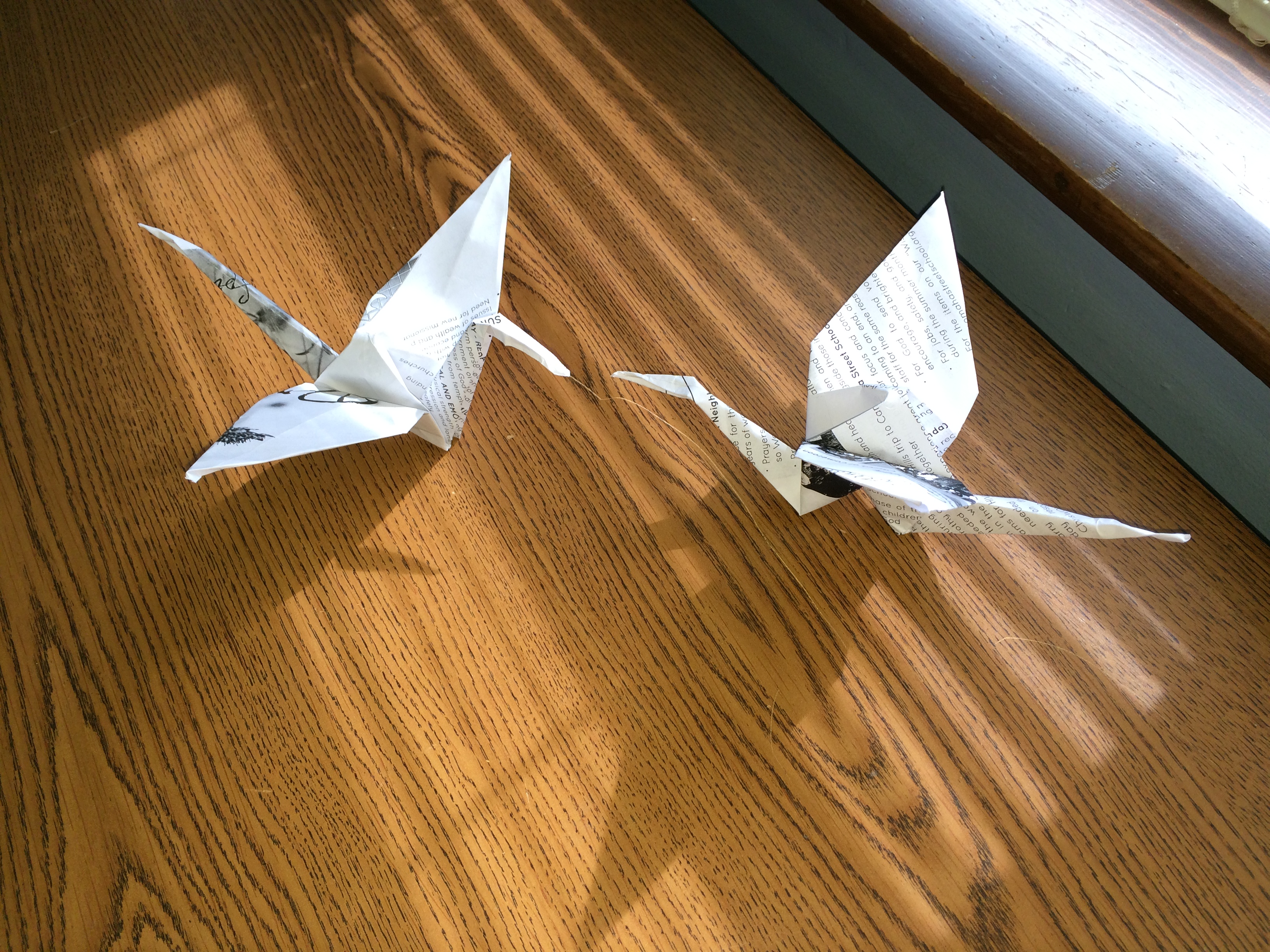
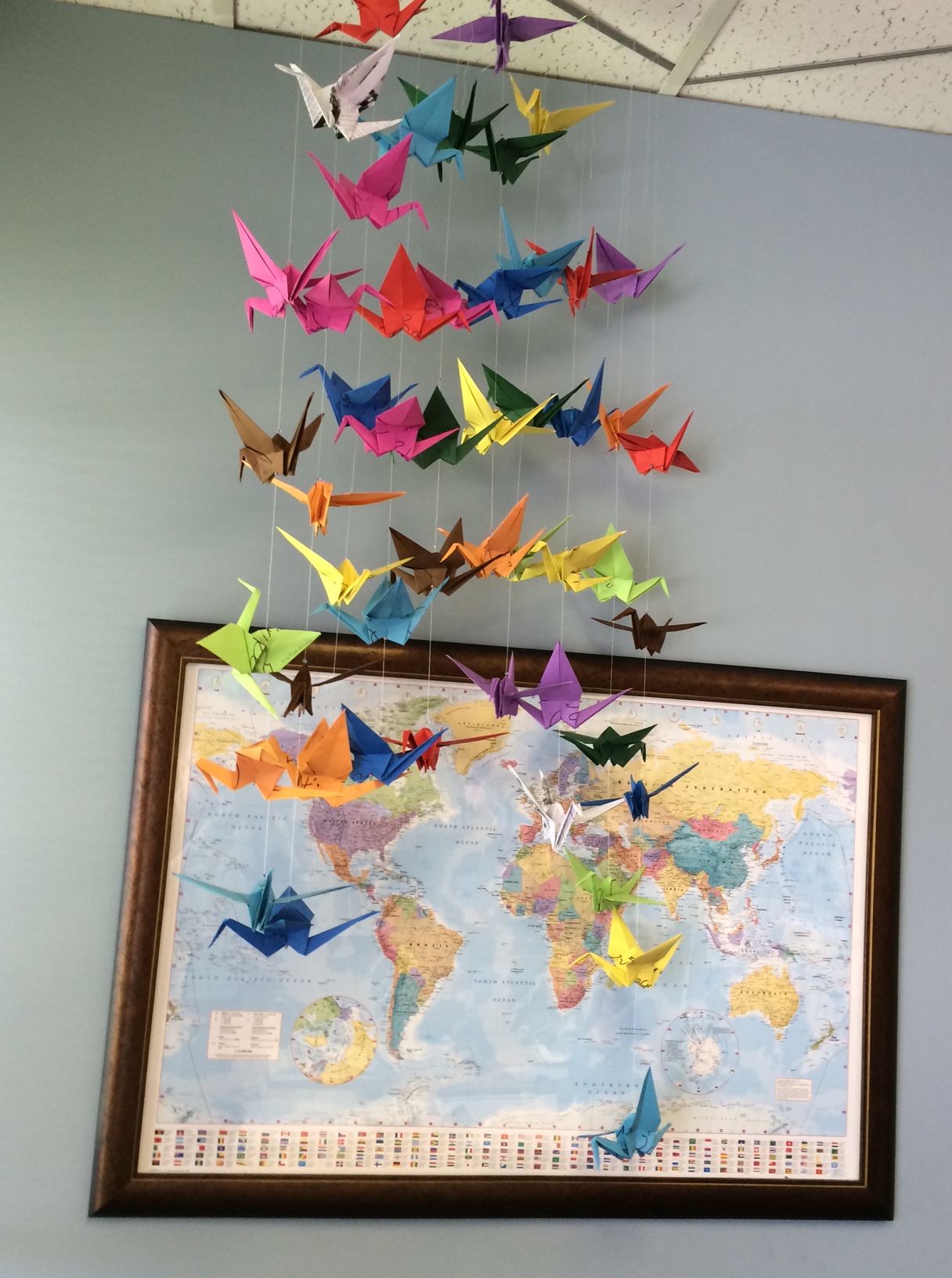
Paper cranes 209My one thousand paper cranes for peace have been a journey through this month of May. I have made 209 so far.

One at a time.

I started with two sheets of prayer-printed pages from my church, West Hills in Omaha. My friend and colleague on staff here, our Mission director Caitlin O’Hare, publishes prayers of our mission partners each quarter. When my friend Mark Borst was here visiting in March, he saw our wall of crosses in the reception area and told me about the paper cranes that carry prayers heavenward in the sanctuary at Central Presbyterian Church in Atlanta.

Connectivity being one of my strengths as measured by the Clifton Strength Finder assessment, I connected the two. All those prayer booklets…what do we do with them every quarter when the new come?

Paper cranes, of course!

After folding three of them with that paper, I decided to order 500 sheets of 8″x8″ origami paper from Amazon. Beautiful colors. Lighter weight. Easier to fold and to be held by a delicate nylon string.

I am now a master folder of paper cranes. Stop by my office and see the 209 flying here and I will fold one for you with the prayer of my heart for this project:

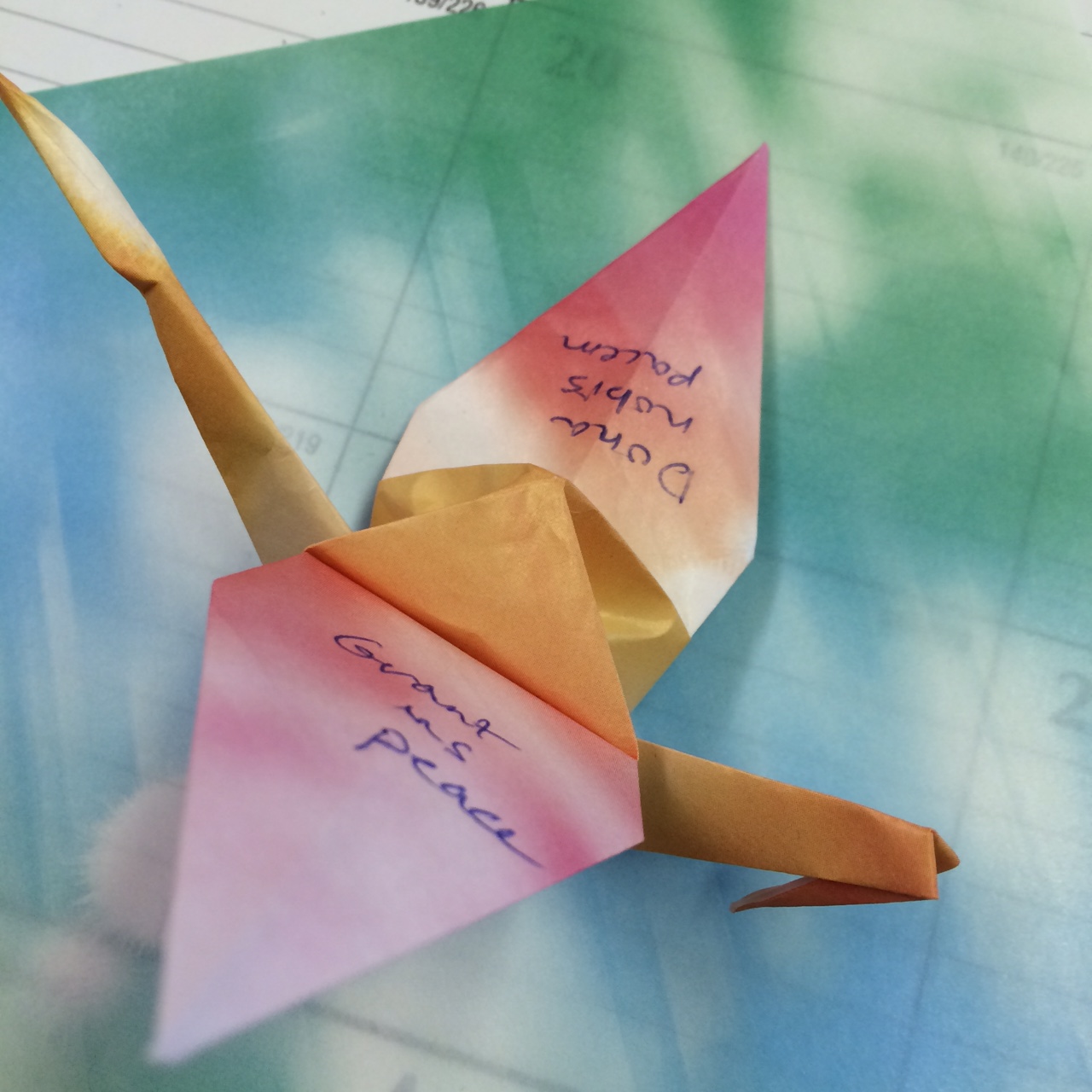
Paper cranes dona nobis pacemDona nobis pacem. Grant us peace.

These first 209 are a reflection of the places I have traveled in the last five years with The Outreach Foundation. They are photographic memories developed onto the pages of my heart of the people who live there, the people who love there, the people who are loved there by an amazing God who made us all. Each one. In his image.

And all these God-imaged people are suffering now, as they have suffered in the past. War is a journey no one should have to take.

But at the end of it should come peace. In the midst of it, they seek peace.

And that is what I pray for.

As I have folded these cranes and prayed over them in the process of folding and stringing and hanging, it has renewed my spirit to know that God hears every one of them.

And as I have continued to watch the news, I have found more to pray for, as if I didn’t have enough already. And some of those stories just emphasize that God hears those prayers. They seem to me to be answers for the peace I pray for.

You can read about Karim Wasfi, a cello player in the orchestra in Baghdad, who plays in the aftermath of a car bombing in his city.

A prayer crane for Karim. Dona nobis pacem.

You can read about Zahed Haftlang and Najad Aboud, two former combatants in the Iraq-Iran war who are now friends as they live in Canada. And on the battlefield one said of the other, “He became a human being, not an enemy.”

A prayer crane for these brothers. Dona nobis pacem.

And there is a prayer crane for Hope Came Down, in the prayer and the hope that people will watch it and be moved to send their monetary gifts to a place that is bringing hope and encouragement to those who are suffering.

A prayer crane for Hope Came Down, and others for the scriptures that inspired it, John 1:14 and Hebrews 11:1.

Dona nobis pacem…prayer by prayer…crane by crane.

One at a time.


Dona nobis pacem

Paper cranes in vitroI have very faint memories of the Roman Catholic mass being said in Latin from when I was very young. I remember mouthing what I thought were actual words, although they meant nothing to me, and thinking that I was an active participant in the mass like my sisters and brothers and parents, next to me in the pew. When I investigate now when the change from Latin to English happened, it began in 1964, right before I turned six. Mostly I just remember mass in English.

So my Latin was non-existent through most of my life, if I had ever even known any!

At Girl Scout camp in 1970, I learned this beautiful song sung as a round. It went like this:

Dona…nobis…pacem, pacem. Dona…nobis…pacem.

I didn’t know it was Latin; I only knew when four groups of girls’ voices sang it in offsetting phrases to make the round, it sounded like angels.

Years later when Jana and I attended one of our annual Lobby Day gatherings with Bread for the World, a wonderful singer named Beth Nielsen Chapman sang the blessing at a large banquet. Fascinated with the song she sang, There’s a Light, when I returned home I bought her CD called simply Hymns. There were great songs from my RC childhood that we sang in church. And there was this:

Dona…nobis…pacem, pacem.

She laid down all the tracks, so the round was recreated with her beautiful voice filling out the angel chorus. As it went straight to my heart and triggered that memory of camp and singing and angel choirs, it made me want to know more.

So all those years later, I finally looked up what those Latin words mean.

Dona nobis pacem…grant us peace.

Grant us peace.

Paper cranesAnd that has been my prayer ever since in the midst of family upheavals and tragedies, in the midst of transitions at church, and of course, in my journeys into the deep waters of a relationship with God in the Middle East.

Dona nobis pacem. Grant us peace.

And as I have delved into this old Latin phrase from my childhood, I have reconnected it to the beginning of that part of the mass:

Agnus Dei, qui tollis peccata mundi, miserere nobis.
Agnus Dei, qui tollis peccata mundi, dona nobis pacem.

Lamb of God, who takes away the sins of the world, have mercy on us.
Lamb of God, who takes away the sins of the world, grant us peace.

Not only does this prayer in an ancient language remind me of the generations of people who prayed it in community before I was conceived and born, but it reminds me to whom I am asking this request. It is a prayer to the Jesus who knows suffering because he experienced it. Because of his great mercy, he redeems us and wipes our slates clean. And we know this, and I know this. And so we come to his feet and ask him: have mercy on us. Grant us peace.

And he can. And he will. And he does.

And I know this because I have seen it in Lebanon and in Syria and in Iraq. I have witnessed those living this suffering even now as they are put upon by forces and evil that would wipe them out.

And they stay. And they pray in ancient languages: in Syriac, in Latin, in Arabic.

Grant us peace.

Dona nobis pacem.

Their prayers take flight and arise heavenward to the Lamb of God who takes away the sins of the world.

And mine join with theirs in this upward trajectory.

Prayers, like birds on the wing, flying to the throne room of the Lamb of God.

Paper cranes Shaheen TomehAnd because the Clifton Strength Finders tells me that one of my top five strengths is connectivity, I have connected my journeys with the faithful of the Middle East to my prayers of peace for them to this visible expression of those prayers in origami cranes.

The legend of the one thousand paper cranes comes from Japan, and is especially poignant when you read of a young girl who was poisoned with radiation from the bombing of Hiroshima. Folding one thousand paper cranes is supposed to bring you luck or a wish granted. She was hoping for healing of her cancer, which didn’t come to her. She was not healed, but maybe one day her wish will be granted in another way: maybe nuclear weapons will be eliminated so the threat of cancers and destruction caused by them will be wiped out. Maybe. Maybe there will be peace.

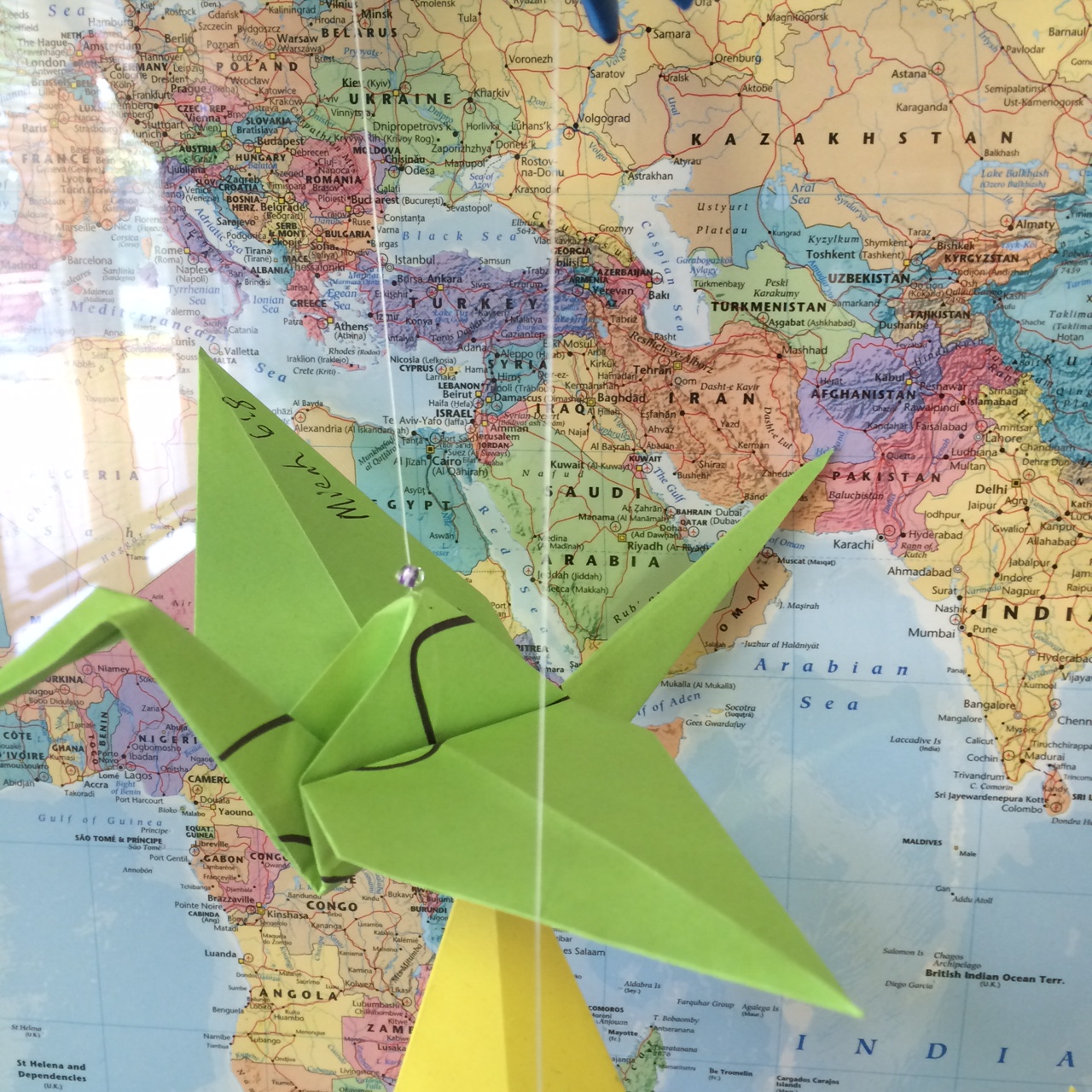
Paper cranes prayers ascendingI have folded 96 so far on my journey to one thousand. On each one is written the name of a person, or a place, or a piece of scripture, or the words of a hymn, or simply the word peace in any language I can find. As I fold each one my simple prayer of peace is attached to each one in the motions of making the crane.

The prayers are repeated and joined as I string them on nylon thread, separated by beads. It reminds me of the act of praying the rosary.

The prayers are repeated again as I hang the strings of cranes in my office near my map of the world – God’s creation – where this peace is so needed.

Every day as I enter my office, I have this visual reminder and expression of those silent prayers. And it gets larger every day with another crane, ten more cranes; another string; five more strings. And one day it will reach one thousand.

My wish – my prayer! – in folding these cranes is simply this:

Dona nobis pacem…grant us peace.

Grant peace to the people of Syria, whose war has dragged on for over four years.

Dona nobis pacem.

Paper cranes Micah 6 8Grant peace to the people of Iraq, whose troubles and war run on unabated since our country’s terrible decision to invade in 2003.

Dona nobis pacem.

Grant peace to the people of Lebanon, a country that becomes a proxy and pawn for the evil ideas of others; a small country that has borne a heavy burden from these other two wars as they are overrun with refugees.

Dona nobis pacem.

Grant peace to the pastors and churches and their congregations who stay and serve and minister in the midst of extremist attacks and destruction and death.

Dona nobis pacem.

Grant peace to those who have lost everything and are searching for new homes.

Dona nobis pacem.

Grant peace to your world, Lamb of God. Let us know your peace which surpasses all understanding.

Agnus Dei, qui tollis peccata mundi, miserere nobis.
Agnus Dei, qui tollis peccata mundi, dona nobis pacem.

Dona nobis pacem.

Amen.


Memory loss

Mark Mueller, Elmarie Parker, Rob Weingartner, Elder Zuhair, Marshall Zieman, Tom Boone and Larry Richards offer communion at the Evangelical Church of Basrah, November, 2012.

Mark Mueller, Elmarie Parker, Rob Weingartner, Elder Zuhair, Marshall Zieman, Tom Boone and Larry Richards offer communion at the Evangelical Church of Basrah, November, 2012.

Today was communion Sunday at our church and the familiar words were spoken as we began the celebration of the Lord’s supper:

And he took bread, gave thanks and broke it, and gave it to them, saying, “This is my body given for you; do this in remembrance of me.” Luke 22:19

It’s a ritual I first took part in when I received my first communion in second grade at Christ the King Catholic Church here in Omaha, fifty years ago. I wrote about it in my blog last October:

Remembering

And every time I receive the elements, the bread and the cup, I remember back to that night.

I remember the communion in Basrah, Iraq, that I witnessed in 2011 as the Presbyterian church there was able to celebrate it because our group brought four pastors with us.

I remember that communion repeated in Basrah in 2012 as we returned with six pastors.

And I remember communion in that same church in March, 2014, as we returned to celebrate communion with them as they now had their own pastor to lead it.

Memories. I collect them like others collect stamps or baseball cards. It’s what makes me Julie, or at least contributes to the essence of me.

Remembering in communion, remembering the sacrifice made for us out of great love, is the center of our Christian worship, its holy essence in the body and blood of Jesus Christ.

Jana and I just came back from seeing the movie, “Still Alice.” It stars Julianne Moore in the role of a brilliant linguist and college professor, wife and mother of three, who is diagnosed with early onset Alzheimer’s disease. Bit by bit, she loses the words she is a master of. She gets lost on the campus in her familiar daily run. She forgets where the bathroom is in her home. She forgets the names of those most familiar to her.

And even though her family grieves her loss as she disappears day by day, they love her and care for her and know that she is, after all, still Alice. But in the end, she really is not the Alice that we saw in the beginning. She has been robbed of her essence.

I have seen it happen to others I know as well, real people, not characters in a movie. It is very hard to watch and a feeling of helplessness in the situation is overwhelming.

This movie struck a bitter, minor chord in my heart today because of the recent news of what is happening in Iraq and Syria: the destruction of ancient works of art and ancient manuscripts in Mosul and other places as ISIS deems them idols of the apostate. “These things didn’t exist at the time of the Prophet. They have been invented and must be destroyed,” or something like that.

It’s a bitter chord because it is like a deliberate attack on the essence of who we are as humans and how we developed the languages to tell our story, the grand story of our creation by a loving God. The same creativity he exhibited by speaking us into being and breathing his very breath into us to give us life, has been left behind by those who wrote it down on parchment manuscripts, who sculpted it into winged creatures of bigger-than-life size, who painted it onto canvas or stone walls.

And it is systematically being destroyed, erased, even as the words that Alice knew intimately were wiped one by one from her brain.

I am reading a book right now called High Tea in Mosul by Lynne O’Donnell. She was one of the first journalists to reach this ancient city after the war ended (it never really did, did it?) after the invasion in 2003. I haven’t finished it yet, but in reading it this week I came to a part that just made me want to cry out.

Mosul is the ancient Ninevah of the Bible. The Ninevah that God sent the reluctant prophet Jonah to in order to preach his word of repentance. There is – I mean was – a temple there where Jonah was said to be buried. Lynne talks about it standing there still as testament to the power of the human spirit to hang on even in the hardest and darkest of times.

The book was written in 2007. In 2014, this temple of Jonah was destroyed.

As Alice’s family learns early on after her diagnosis, there is no cure for Alzheimer’s.

I don’t know the cure for the scourge of evil that is ISIS. And bit by bit, this disease is robbing our human family of its collective memories, the ancient artifacts that tell our story.

And so I cry out with my brothers and sisters who live there and who watch it happen and are helpless to do anything,

How long, LORD, must I call for help, but you do not listen? Or cry out to you, “Violence!” but you do not save? Habakkuk 1:2

And then I remember the bread and the cup of sacrifice. And I say thank you for the gift of memory. And I write it down and look at the pictures I have taken of men and women and children.

And I pray.


Prayer of solidarity in a string of beads

Bowl of glass stones

Sisters and brothers in Christ, today we gather around the baptismal font, remembering both God’s gracious promises to us and our sisters and brothers in Iraq, Syria and Lebanon (and Egypt). We are united by a common faith in Jesus Christ and a family bond that reaches from east to west, and north to south around this globe; one that covers all time.

This was the start of a prayer of solidarity for our brothers and sisters in the Middle East. Mission co-workers with our denomination, the PCUSA – and friends of mine – came to our pulpit to share stories of their first year living in Beirut and working with the National Evangelical Synod of Syria and Lebanon. Powerful stories. I have shared a few on this blog myself, that I have experienced personally. I recognized the places, the faces and the loss and grief as Scott and Elmarie spoke.

And since we are God’s children, we are God’s heirs. In fact, together with Christ we are heirs of God’s glory. But if we are to share Christ’s glory, we must also share his suffering.

On this day we shared by praying together in solidarity with them. And to remind ourselves to keep praying, we each came forward to the baptismal font and took a polished stone to hold in our hands.

Glass stoneMine is green glass. Polished. Smooth. Easy to hold and to admire. And when it is cupped in my hands, clasped in a gesture of prayer, it is a tactile reminder of those who are heirs to God’s glory and even now sharing in his suffering.

As I look at that picture of the collection of glass stones, I can easily assign names to them; each representing a real person, people I know and love.

There’s Lamis from Lattakia who gave me lovely earrings in 2010 in a quieter time and place.

There is Toeh, a young woman from Homs, now a refugee with her family in Amr Hasn, who doesn’t even have any photos to remind her of life before the war.

There is Huda in Yazdieh, the pastor’s wife who collects food and blankets and distributes with love and prayer to some 1700 families, like Toeh’s.

There are the eight pastors still serving fifteen Presbyterian congregations in Syria: Salam, Ibrahim, Yacoub, Ma’an, Michel, Boutrous, Firas and Mofid.

There are the synod leaders: Fadi and Josef and Adeeb and George, along with Assis Salim, the head of the organization of evangelical churches.

There are the pastors in Lebanon as well, serving their own congregations plus those who have fled there: Mikhael and Rola and Fouad and Hadi.

Educators bringing the word of God and the values of Christ to new generations: Najla and Dr. Mary and Nellie and Hala and Izdihar and Riad.

Pastors and elders and priests who are doing the same work of provision and reconciliation in Iraq: Haitham and Farook and Magdy, Patriarch Louis Sako, Fr. Aram and Fr. Turkum and Msgr. Emad and Zuhair and all the teachers in the kindergartens.

One polished stone for each of them, and I hold this green one in my hands and pray.

Saving God, hear this day the cries of those in Syria, Iraq and Lebanon (and Egypt) who have been over-run by violence. For those who are able to flee, guide them to safe havens. For those who stay, whether by choice or lack of means to leave, grant them courage, perseverance, hope and what they need to survive. May your church embody and freely share these gifts with those around them.

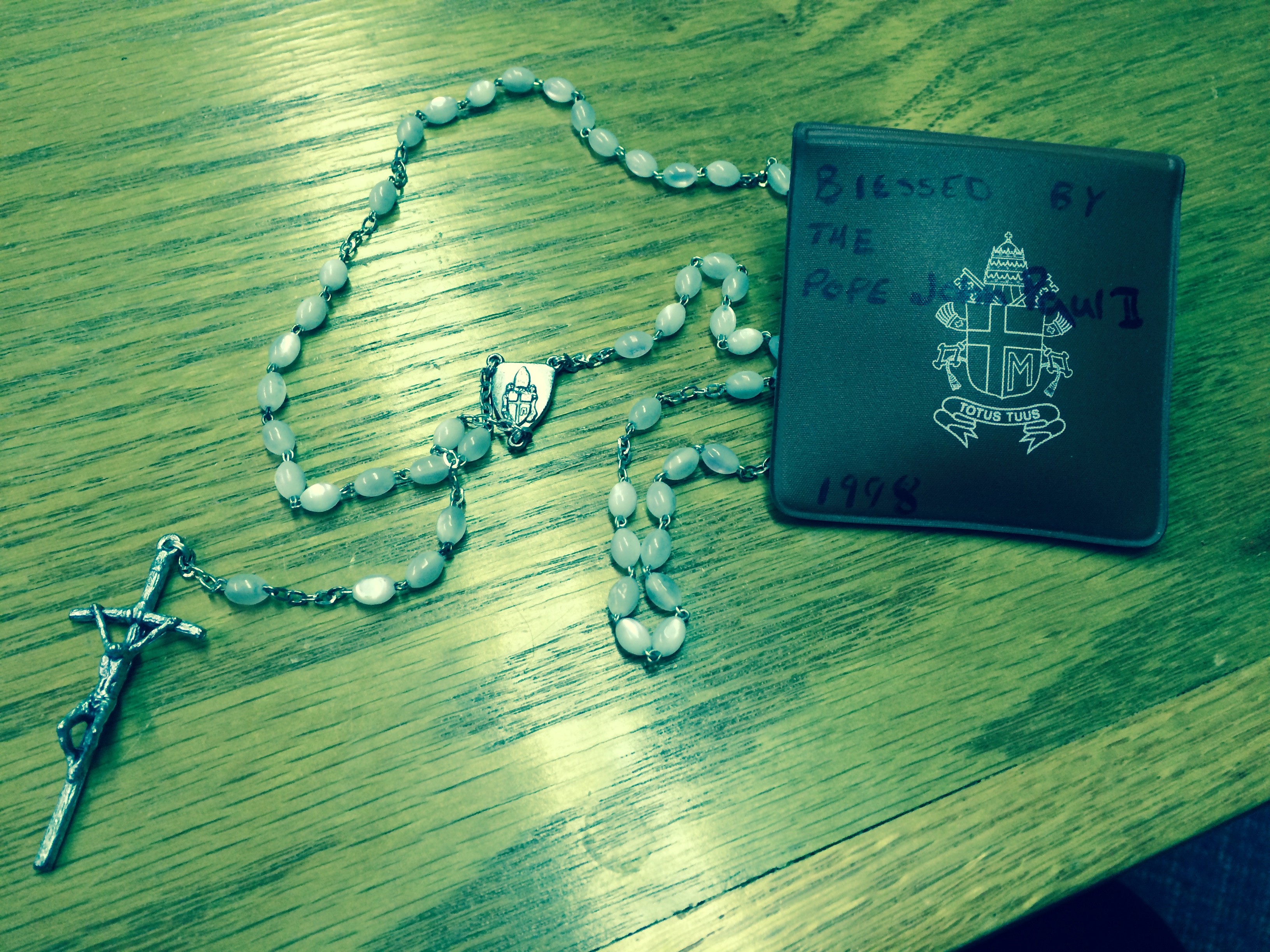
RosaryI always carry a rosary with me, a habit from my Roman Catholic upbringing. It’s a tool for prayer: 59 beads strung together with a crucifix on the end. My Aunt Carolyn, a Franciscan nun, gave this one to me on a trip earlier this year. She received it on a trip to Rome in 1998 and it has been blessed by Pope John Paul II. It’s a lovely remembrance of her trip, her vocation, and my connection to her and to the faith I was raised in.

Adeeb's prayer beadsI also have a set of beautiful amberwood prayer beads that I purchased in Lebanon this past November from a street vendor named Mohammed. Many of the pastors I know in the Middle East carry these same 33-bead strands with them everywhere, constantly moving the beads through their fingers, not out of habit, but in prayer. It was one of the first things I noticed about Assis Adeeb when I met him in 2010.

And this green polished glass stone that is now in front of me while I work, is a visual and tactile connector for me to these strings of beads used in prayer by people like me who follow Jesus. It may be a solitary stone, but it binds me in solidarity with each of those other stones as we pray together.

So let us pray.

God of peace, empower and guide those who are working to make visible your kingdom ways of justice, peace, and transforming love in Iraq, Syria and Lebanon (and Egypt). Bring your transforming peace to these lands. For Christian schools and teachers working with both Muslim and Christian students we pray – grant them wisdom, creativity, and enduring love. For Muslim and Christian students studying side-by-side – grant them the courage to live into a new kind of future together in the Middle East where there is respect and opportunity for all, regardless of religious creed, ethnicity, or gender. For those working with children orphaned and traumatized by war – grant them daily hope and joy-filled love. For children, women and men maimed in spirit, mind, or body by violence – grant them healing and a new future. For government officials – grant them the will to seek the good of their people and courage to turn away from personal or outside agendas that seek gain from war and instability. For those caught up in violent political and religious radicalism – wake them up to true life. Grant that we, disciples of Jesus from east and west, north and south, bound together by baptism and the Holy Spirit, may live each day with Christ’s kind of self-giving love: doing justice, loving kindness, walking humbly with you. Amen.

And amen.

(A special thank you to Revs. Scott and Elmarie Parker for this prayer, which is adapted from The Worship Sourcebook, pp. 286-304; Job 19:7; Habakkuk 1:2; Romans 8:17; I Thess. 5:16-18, 23-24; Micah 6-8.)

Assis Ibrahim from Aleppo

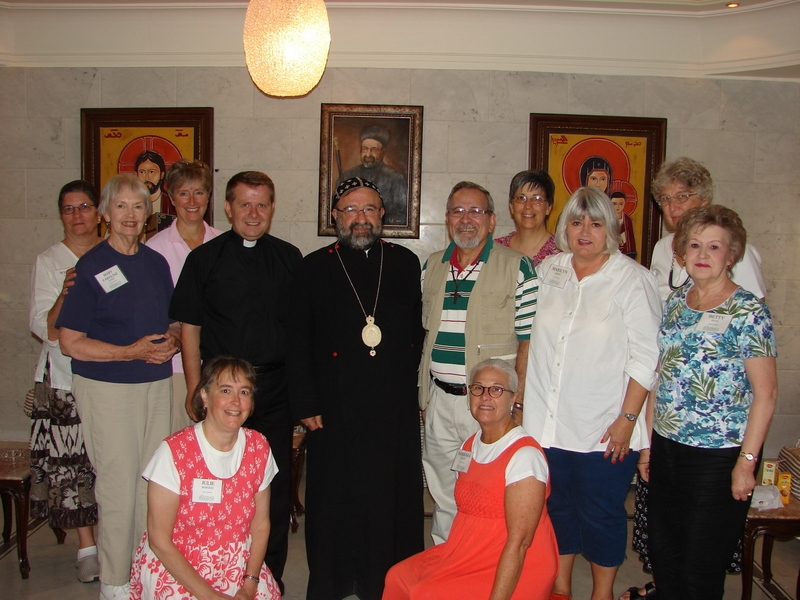
(Back) Wendy Moore, Sue Jacobsen, Kate Kotfila, Emily Brink; (standing in middle) Mary Caroline Lindsay, Assis Ibrahim Nsier, Archbishop Yohanna Ibrahim, Rev. Nuhad Tomei, Marilyn Borst, Betty Saye; (kneeling) me and Barbara Exley

(Back) Wendy Moore, Sue Jacobsen, Kate Kotfila, Emily Brink; (standing in middle) Mary Caroline Lindsay, Assis Ibrahim Nsier, Archbishop Yohanna Ibrahim, Rev. Nuhad Tomei, Marilyn Borst, Betty Saye; (kneeling) me and Barbara Exley

I first met this man of God in the summer of 2010. I remember coming home and telling my pastor George about him. His church in Aleppo was doing the kind of relational, incarnational ministry in their neighborhood that our church in Omaha was doing. Their neighborhood in Aleppo was a bit different than ours, to say the least.

But this was before the war that came to them just seven months later. We were privileged to worship with them in their lovely building, and to hear how they were caring for Iraqi refugee families in their midst. These displaced families were, of course, refugees from the war our country had brought to Iraq in 2003. Like other refugees from other wars who could not go home, they were waiting to be resettled in still other countries, unknown to them.

But this small Presbyterian congregation in Aleppo, led by this young energetic cleric was making a difference to those families, and to the kingdom of God.

I still keep a picture on Facebook as my cover photo to remind me of those precious days in August, 2010. It’s the one on the top of this post. Assis Ibrahim is in the back row standing next to another Ibrahim, Syrian Archbishop Yohanna Ibrahim, who was kidnapped in April, 2013, and still has not been heard from. I pray for them both when I see this picture, and I hope others do as well when they visit my Facebook page. I wrote about them here:

Abraham: Father of Many

Assis Ibrahim is a man I admire, to say the least, and I will never forget him.

I had the chance to hear him on phone calls twice in the last two years as I returned to Lebanon to hear about what was happening to the Syrian churches in the midst of the war. Other Syrian pastors had been able to make it to Beirut, Lebanon, to tell us firsthand of the difficulties they were facing, but Assis Ibrahim could not come from Aleppo. I listened to his voice as he told us what had happened, and what was happening. I closed my eyes and remembered the worship we had participated in back in that hot glorious August in a building that was now rubble.

And I could see the face of that young, energetic, man of God, holding onto faith and hope and love.

IMG_0936This past November, for only the second time in four years I got to spend some precious time with him as he came to Beirut to meet with our group. He may not have remembered me, but oh! how I remembered him. His face unchanged. His voice strong as ever. His vision for the future was God-sent. Who else could see a Presbyterian boys’ high school reimagined as the National Evangelical University of Aleppo, even while a war still raged?

Assis Ibrahim.

And I wanted to tell you about him so you could pray for him.

Before I could come up with my own words, I received this extraordinary email from him telling the story of the church in Aleppo. And I think in the reading you will know what I have come to know about him:

This morning I woke up early at 4:30 to the sound of a mortar exploding. I said to myself, “A new day is started.” This is something normal in Aleppo.

I went to the kitchen, hoping to get some tea or Nescafe, but I had an urgent call from one of our members who was injured by the shelling. He needed someone to take him to the hospital. I got my shoes and got to the car quickly.

Thanks to God, they dealt with his wounds very quickly, and he was in church for our service.

Today, I preached that we should use what God has given us. No one can say, “I don’t have,” because if God has given us even a tiny thing, we can do a lot with this tiny thing in this situation in this community.

The church where we worshipped before the war was bombed, so now we meet in an apartment building. It’s up five floors, almost 120 stairs. We have had mortars hit the building, but God saved us and as many as 150 of us continue to worship there.

Being a pastor in this crisis is not as much about preaching as it is being with the people in their difficult time. Even if we cannot give money or fulfill their physical needs, we can at least pray with them, at least try to comfort them.

After the service, I received another call — two older women who had not one ounce of water and had run out of money to purchase water after paying for their rent and medicine. I got my family and went looking for someone in order to get them water, which I am sorry to say costs a lot of money. We need $300 a month for a family of five for drinking and washing water.

After that I received more calls asking me to go quickly to look for a home for two people whose houses were damaged from the mortar attacks that morning. We called a family from church that was out of town. They agreed to lend their house for a week until we can make repairs.

This day I described is like every day. Even what I have said doesn’t describe fully what is going on.

I am thankful to my wife and my family who remain with me in Aleppo during this crisis. Without my wife, I could be failing. She is my supporter.

We have three children, ages 6 to 12. This situation has forced itself over their lives. My children, when they hear a lot of bombing, they come to our room to feel a little bit secure. When we send our children to school, believe me, we say goodbye to each other because we don’t know if we’ll have the opportunity to see each other once again.

Always we teach the children that although it is difficult in this time, our security is in God. We try to teach them that we suffer as Jesus suffered and that the day of resurrection will come someday.

We believe we have a lot left to do in this community. As I walk around the neighborhood, I see the despair on the faces of the people. I see children on the streets begging for money. I can see people walking in the streets without shoes.

In 2013, through the church, we distributed food baskets to 100 families for two months. Last summer we were able to help 118 families with monthly cash allowances, which helps families pay for things like medical treatment, food, tuition. From August to December 2014, 65 of the most vulnerable families got monthly allowances. (MCC supported these efforts through its partner, the Fellowship of Middle East Evangelical Churches.)

We are not only supporting Christians, we are supporting the whole community to teach them that being a human means having a responsibility to the others. Believe me, we never think in ways that this is Muslim or this is Christian. We think differently. We think we are here for a message and this message should be clear for everybody — that God loves all the people and I insist on the word “all.”

We are called to live in hope. We trust God and we do our job — praying, taking care of each other, reading the Bible and being an instrument of love and peace in this community. This is what we do, and this is the hope we live in.

Please don’t forget us in your prayers.

Please don’t forget them in your prayers. And if you can do even more than pray, please consider sending a donation for the work of the church in Syria to The Outreach Foundation, 381 Riverside Drive, Suite 110, Franklin, TN 37064.

“This is what we do, and this is the hope we live in.”

Amen.

Shoveling with St. Francis

Pine tree with bent topWinter arrived in Omaha this week. We don’t have as much snow as Buffalo or Boston or Bangor, but we have what I consider to be our share. It came on Saturday, canceling church on Sunday, and it came again today, Wednesday, causing another snow day.

It came mostly today after Steve left for work, and if I was going to get out I would have to shovel. My small snowblower is busted and Steve’s is too big for me to handle, so the shovel would have to be my tool.

I was facing another 4” in our lengthy driveway, and thought if I could just shovel the top part I could make it out to the office.

Wrong.

Two hours later I am back in the living room, boots off, jean bottoms soggy with melting snow and a pulled muscle in my left arm. No getting out today.

And the thing is, I went out to do the task in the darkest of moods. More snow? Sheesh! Can’t winter which just arrived on Saturday be over already?

When it was just Jana and me on Chicago Street, we had an equally long driveway, front stoop and stairs and miles of sidewalk to clear as we lived on a corner. And once my dad got that snowblower for me, I would head out and clear it all, even doing the whole west sidewalk to the next block! Steve and I have made a great team here on Happy Hollow Boulevard with our his-and-hers snowblowers, but mine is twenty years old and out of commission. I knew the shoveling would be hard, and it was. I am older now and don’t have the strength. My weakness makes me mad and grumbly.

So I knew it would be rough, but amazingly, there was this blessing of quiet time where all the cares of the world just rolled off my shoulders.

Without the noise of the gas engine turning the turbine of the blower, there was the sound of the wind in the pine trees, which reach to the sky. And the sky was this beautiful shade of pale grey blue as the clouds were dissipating. The sound of the wind in those tall graceful trees was like music.

And that’s when I realized there was music, too.

“All creatures of our God and king. Lift up your voice and with us sing. Alleluia! Alleluia!”

Dundee Church towerThe carillon at Dundee Presbyterian Church was playing this wonderful old hymn, written by my favorite saint, Francis.

“Let all things their Creator bless,
And worship Him in humbleness,
O praise Him! Alleluia!
Praise, praise the Father, praise the Son,
And praise the Spirit, Three in One!”

And I just sang along as I shoveled, the trees keeping a rhythm with the gentle blowing of the wind. It was a moment of worship. And I took the time to pray a prayer of gratitude and thanksgiving for turning my grumbling heart to joyful praise.

I came inside, arm hurting, soggy jeans and all, to look up the story of St. Francis’ glorious hymn. And what I discovered is that he was paraphrasing Psalm 148, which begins this way:

Praise the Lord!
 Praise the Lord from the heavens; 
praise him in the heights! Praise him, all his angels;
 praise him, all his host!

And down a bit further in verses 7 and 8, after the psalmist has exhorted sun and moon and stars and so much of the rest of creation to praise God, he says this:

Praise the Lord from the earth,
 you sea monsters and all deeps, fire and hail, snow and frost, stormy wind fulfilling his command!

Snow and frost and stormy wind: Praise the Lord!

Julie B. with pulled muscle and soggy jeans: Praise the Lord!

How could I not? And so I do!

Alleluia! Alleluia!

Amen.

Reunion in Lattakia

Julie Lamis Bitar and Marilyn at Latakkia churchTraveling to the Middle East has been a life-changing experience for me. I have gone to Lebanon, Syria and Iraq a total of seven times since August, 2010, when I traveled for the first time with The Outreach Foundation and my new friend, Marilyn Borst. I have gained more friends on those trips that I am so grateful to be connected with by email and Facebook. And, of course, reuniting with them when I return.

I will return!

Back on that first trip in August, 2010, I traveled with a group of women – faithful women – as the trip was called. They were all veterans of short-term mission trips to places all over the world. They had been to Cuba, Russia, Malawi, Pakistan, North Korea, Israel/Palestine, Iraq, Lebanon, Syria…and many many more places. I had been to Germany, the Czech Republic and Cameroon on similar trips. But this one was new for all of us, except Marilyn of course.

We were traveling to be connected with Presbyterians (like us!) in Lebanon and Syria in the National Evangelical Synod of Syria and Lebanon (NESSL). We got a great overview of the history of the Synod: how Presbyterians from the U.S. came to the Middle East to convert Muslims and Jews to Christianity. Upon arriving, they found no Jews to speak of and also there was this small thing about it being illegal to convert from Islam to something else. Illegal as in the death penalty.

Instead, they reached out to the ancient Christian community already there – Melkites and Maronites and Syrian, Orthodox and Catholic – and built schools and hospitals. The reformed church was planted alongside the ancient, and that is how it still is today.

We visited historic sites in both countries. We shopped in souks. We met with Iraqi refugee families. We visited schools. We sweltered in the 115 degree summer heat.

We bonded as a community of friends, sisters in Christ.

We ended that trip in the mountains above Beirut at the Dhour Choieur Conference Center to be part of a women’s conference, just like we would have at home, only in Arabic. (They translated for us.) We sang worship songs. We delved into a Bible study about the fruit of the spirit led by my new friend Barbara Exley from Atlanta. She had brought pounds and pounds of Jelly Belly jelly beans in flavors to represent the fruits. For instance, watermelon jelly beans represented patience. It was the most joyful and sweet-filled Bible study ever!

Part of the grace of being in the Middle East is the mindset of hospitality and gift-giving, and it played out at this conference just like every other place. We made friends with women. We traded little gifts. If you admired someone’s bracelet or earrings, she would immediately remove the item and give it to you. Amazing grace in the form of jewelry.

And that is how I met Lamis Bitar from Lattakia.

She was tall, statuesque actually, with beautiful dark hair and eyes. Her smile came slowly, but when it did it was genuine. She and I became friends on that weekend and in the generosity of these people, she bestowed upon me the earrings she was wearing.

And then the conference ended and we made plans to do it again in 2011, with even more women, perhaps from Iraq. And we went back home to the USA.

And then March, 2011, came and war erupted in Syria. There would be no women’s conference in Syria, and we would not return in 2011.

I would wear those earrings at home. Precious they were to me. Every time I put them in my ears I would think of the fun we had at that Bible study with the Jelly Bellys and I would see Lamis’ face in my mind, her beautiful face with the slow smile, and wonder about her in Lattakia. I would pray. I would tell people where those earrings came from if they admired them, and I would ask them to pray for Syria.

I wondered what had happened to Lamis Bitar.

And then just this past month, November, 2014, I had the opportunity to return to Lebanon and Syria with The Outreach Foundation. Steve was with me and Marilyn of course (our fearless leader) and Barbara. We walked through the streets of Homs in Syria, looking at the devastation from three years worth of bombs and mortars, but also seeing the churches beginning to rebuild. There was some hope there. You can read about it in my previous blogs.

And then we went to Lattakia. The third largest city in Syria before the war, had now grown even larger as people found their way there to escape danger in other places. It was relatively safe, although there were still checkpoints and military personnel to be seen. Large as it is it still suffered from the results of the war: high prices and electricity that did not work 24 hours a day. (Think about that for a moment in your own context. How do you manage when the electricity goes out? Maybe for a day, or even rarely for a week? What would you do if it was on for only four hours a day and you didn’t know which four? That is Syria now.)

Joyfully, we were set to visit our friend Rev. Salam Hanna who is the pastor of the Presbyterian Church in Lattakia. It was Marilyn’s first time in this city, although she has been in Syria many, many times. So, of course, it was our first time there as well. It is a beautiful old church, renovated in the last couple of years by its previous pastor. It is also the largest church in NESSL, and we expected a large turnout, and there was one.

I wore my earrings from Lamis, hoping against hope that she was still there and had not already departed for another country.

And in the gathering darkness of night, in the midst of a rainstorm that should have kept everyone away, there she was. My friend Lamis had come to meet the American Presbyterians and I recognized her right away.

Tall. Statuesque. Dark hair. Dark eyes. Slow smile. Amazing grace.

We hugged. We reminisced about that women’s conference with the jelly beans. We locked eyes as friends and hugged some more. It was just a moment of pure joy for us both.

And that is why I go. I go to be “with” and to come home, responsible for remembering the people and their stories and to remind the church here at home that there is a church serving in Syria in the midst of war and death and loss and lack of food and fuel and electricity. They are the hands and feet and heart of Jesus walking and loving among those who need the light. And Lamis is one of them and I want you to remember her name and her face and her life.

And I want her to remember me. In addition to the earrings which I was wearing, I now have a beautiful bracelet with a cross. And Lamis has my watch, set to the time in Omaha. When she looks at it, she will know that she has a friend and prayer partner eight time zones to the west who loves her and remembers her.

Lamis, my sister in Christ. Please pray for her and for her church and for her country.

The people I sleep with

Assis Boutrous Zaour, his wife Wafa and their three children, all amazing young people!

Assis Boutrous Zaour, his wife Wafa and their three children, all amazing young people!

Assis Joseph Kassab with me and Assis Adeeb Awad

Assis Joseph Kassab with me and Assis Adeeb Awad

Since Steve and I got married on May 18, 2002, we have slept in the same bed every night, with very few exceptions. It’s expected that a married couple would share the same bed, right? Well, I guess Lucy and Ricky on the old sitcom had separate beds, or at least that was the way early television and movies would have it!

The truth is, there have always been many people that went to bed with me before I met Steve…

Talal, a refugee from Aleppo, whom we met in the refugee camp

Talal, a refugee from Aleppo, whom we met in the refugee camp

I used to start my prayers every night with

Now I lay me down to sleep
I pray the Lord my soul to keep
Guard me safely through the night
And let me see the morning light.

That is not the way everyone said that prayer, but it was the way it was printed on the night light in the bedroom I shared with my sisters when we were very small. That’s where I learned that prayer when I could first read. Years later when I learned the version that went, “If I should die before I wake, I pray the Lord my soul to take,” it scared me that anyone could pray that way. “The morning light” vs. dying before waking, was a much brighter vision!

Either way, those prayers were always followed by the Lord’s Prayer, a Hail Mary, a Glory Be and then my list of family and friends whom I wanted God to protect and bless. It was a long list of people that came to bed with me.

Gladys Aboud of the synod in Beirut and Hala Bitar, a teacher at the Beirut Evangelical School for Girls and Boys

Gladys Aboud of the synod in Beirut and Hala Bitar, a teacher at the Beirut Evangelical School for Girls and Boys

There are many people that I pray for regularly. I think it is part of my call as a follower of Jesus to bring those I love and he loves before him; to bring to the foot of the cross all those I carry burdens for. I love them; he loves them more. He knows all their names before I speak them and what a comfort it is to walk with a God like that.

I still pray for my family. Oh! How I want their safety, their provision, their comfort. Let them see the morning light! I can’t help thinking as I sleep that I have many family already sitting with God in glory who died before I woke, their souls taken to a place where there is no worry. My mom. My dad. My baby sister Cathy. All are safe on the other side.

Rola Sleiman, the preacher at the church in Tripoli, a graduate of the Near East School of Theology

Rola Sleiman, the preacher at the church in Tripoli, a graduate of the Near East School of Theology

But here on this side of heaven, are still so many.

And this night and the next, they all go to bed with me and Steve. He is as aware of them as me. Steve has traveled to their homes with me to walk with them and learn from them what faith is. They pray for us. We pray for them. And God loves and knows us all.

Assis Boutrous  Zaour and Assis Ma'an Bitar

Assis Boutrous Zaour and Assis Ma’an Bitar

Sleep has been much harder to come by lately and I’m trying to find ways to encourage my body to get to a restful state so once I am in bed, sleep will come. Last evening I took a half hour’s walk as the sun was still up but with a shadow cast upon it by the moon as a partial eclipse was happening. And as I walked my mind had a slideshow, a veritable mental Power Point of all the people who come to bed with me: pastors and preachers and leaders of the National Evangelical Synod of Syria and Lebanon, pastors, elders and kindergarten teachers in Iraqi churches, refugees from Iraq who had been in Syria, refugees from Syria now in Lebanon. Ordinary people living ordinary lives in extraordinary times, loving God in the act of loving their neighbors.

Mary Mikhael, past president of the seminary in Beirut

Mary Mikhael, past president of the seminary in Beirut

And even as a shadow is cast over them right now, just like the moon was trying to blot out the brilliance of the sun last night, we know from the the scripture, “The light shines in the darkness and the darkness has not overcome it.

Now I lay me down to sleep, I pray the Lord my soul to keep. Guard me safely through the night…and let me see the morning light.

Amen.

#hopecamedown