Send us rain — The Outreach Foundation

Send us rain — The Outreach Foundation.

FAITHFUL WOMEN ON THE ROAD: Beirut, Lebanon July 24, 2015 — The Outreach Foundation

FAITHFUL WOMEN ON THE ROAD: Beirut, Lebanon July 24, 2015 — The Outreach Foundation.

Prayer of solidarity in a string of beads

Bowl of glass stones

Sisters and brothers in Christ, today we gather around the baptismal font, remembering both God’s gracious promises to us and our sisters and brothers in Iraq, Syria and Lebanon (and Egypt). We are united by a common faith in Jesus Christ and a family bond that reaches from east to west, and north to south around this globe; one that covers all time.

This was the start of a prayer of solidarity for our brothers and sisters in the Middle East. Mission co-workers with our denomination, the PCUSA – and friends of mine – came to our pulpit to share stories of their first year living in Beirut and working with the National Evangelical Synod of Syria and Lebanon. Powerful stories. I have shared a few on this blog myself, that I have experienced personally. I recognized the places, the faces and the loss and grief as Scott and Elmarie spoke.

And since we are God’s children, we are God’s heirs. In fact, together with Christ we are heirs of God’s glory. But if we are to share Christ’s glory, we must also share his suffering.

On this day we shared by praying together in solidarity with them. And to remind ourselves to keep praying, we each came forward to the baptismal font and took a polished stone to hold in our hands.

Glass stoneMine is green glass. Polished. Smooth. Easy to hold and to admire. And when it is cupped in my hands, clasped in a gesture of prayer, it is a tactile reminder of those who are heirs to God’s glory and even now sharing in his suffering.

As I look at that picture of the collection of glass stones, I can easily assign names to them; each representing a real person, people I know and love.

There’s Lamis from Lattakia who gave me lovely earrings in 2010 in a quieter time and place.

There is Toeh, a young woman from Homs, now a refugee with her family in Amr Hasn, who doesn’t even have any photos to remind her of life before the war.

There is Huda in Yazdieh, the pastor’s wife who collects food and blankets and distributes with love and prayer to some 1700 families, like Toeh’s.

There are the eight pastors still serving fifteen Presbyterian congregations in Syria: Salam, Ibrahim, Yacoub, Ma’an, Michel, Boutrous, Firas and Mofid.

There are the synod leaders: Fadi and Josef and Adeeb and George, along with Assis Salim, the head of the organization of evangelical churches.

There are the pastors in Lebanon as well, serving their own congregations plus those who have fled there: Mikhael and Rola and Fouad and Hadi.

Educators bringing the word of God and the values of Christ to new generations: Najla and Dr. Mary and Nellie and Hala and Izdihar and Riad.

Pastors and elders and priests who are doing the same work of provision and reconciliation in Iraq: Haitham and Farook and Magdy, Patriarch Louis Sako, Fr. Aram and Fr. Turkum and Msgr. Emad and Zuhair and all the teachers in the kindergartens.

One polished stone for each of them, and I hold this green one in my hands and pray.

Saving God, hear this day the cries of those in Syria, Iraq and Lebanon (and Egypt) who have been over-run by violence. For those who are able to flee, guide them to safe havens. For those who stay, whether by choice or lack of means to leave, grant them courage, perseverance, hope and what they need to survive. May your church embody and freely share these gifts with those around them.

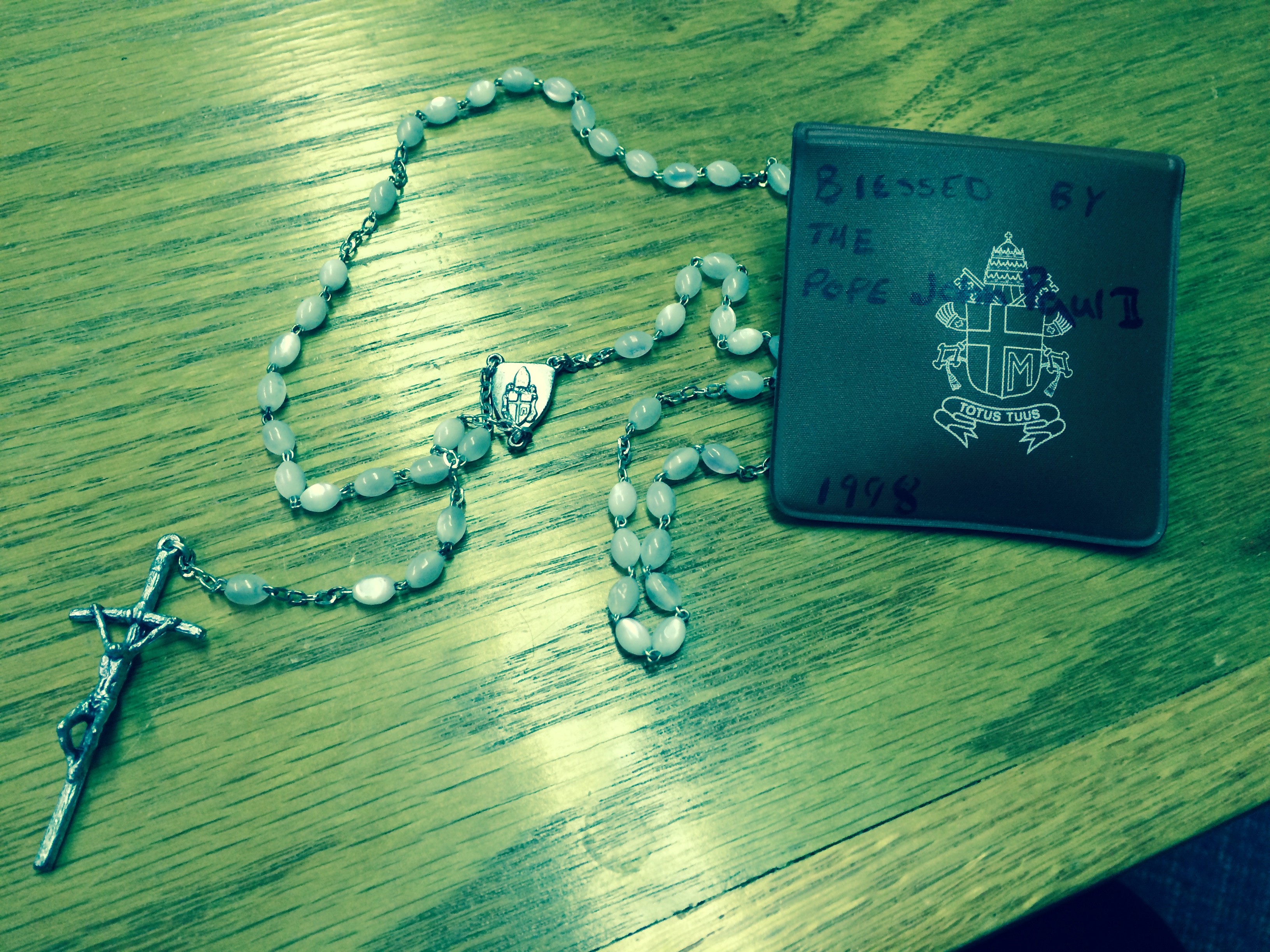
RosaryI always carry a rosary with me, a habit from my Roman Catholic upbringing. It’s a tool for prayer: 59 beads strung together with a crucifix on the end. My Aunt Carolyn, a Franciscan nun, gave this one to me on a trip earlier this year. She received it on a trip to Rome in 1998 and it has been blessed by Pope John Paul II. It’s a lovely remembrance of her trip, her vocation, and my connection to her and to the faith I was raised in.

Adeeb's prayer beadsI also have a set of beautiful amberwood prayer beads that I purchased in Lebanon this past November from a street vendor named Mohammed. Many of the pastors I know in the Middle East carry these same 33-bead strands with them everywhere, constantly moving the beads through their fingers, not out of habit, but in prayer. It was one of the first things I noticed about Assis Adeeb when I met him in 2010.

And this green polished glass stone that is now in front of me while I work, is a visual and tactile connector for me to these strings of beads used in prayer by people like me who follow Jesus. It may be a solitary stone, but it binds me in solidarity with each of those other stones as we pray together.

So let us pray.

God of peace, empower and guide those who are working to make visible your kingdom ways of justice, peace, and transforming love in Iraq, Syria and Lebanon (and Egypt). Bring your transforming peace to these lands. For Christian schools and teachers working with both Muslim and Christian students we pray – grant them wisdom, creativity, and enduring love. For Muslim and Christian students studying side-by-side – grant them the courage to live into a new kind of future together in the Middle East where there is respect and opportunity for all, regardless of religious creed, ethnicity, or gender. For those working with children orphaned and traumatized by war – grant them daily hope and joy-filled love. For children, women and men maimed in spirit, mind, or body by violence – grant them healing and a new future. For government officials – grant them the will to seek the good of their people and courage to turn away from personal or outside agendas that seek gain from war and instability. For those caught up in violent political and religious radicalism – wake them up to true life. Grant that we, disciples of Jesus from east and west, north and south, bound together by baptism and the Holy Spirit, may live each day with Christ’s kind of self-giving love: doing justice, loving kindness, walking humbly with you. Amen.

And amen.

(A special thank you to Revs. Scott and Elmarie Parker for this prayer, which is adapted from The Worship Sourcebook, pp. 286-304; Job 19:7; Habakkuk 1:2; Romans 8:17; I Thess. 5:16-18, 23-24; Micah 6-8.)

Assis Ibrahim from Aleppo

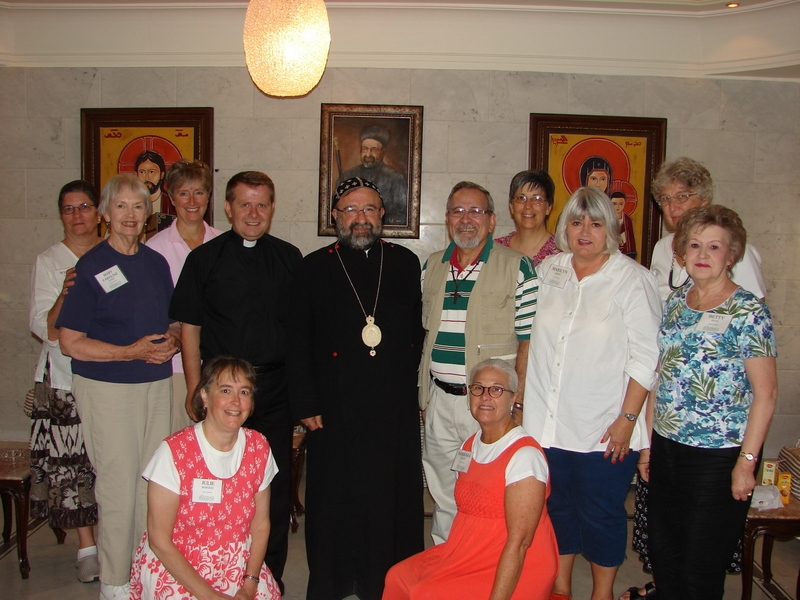
(Back) Wendy Moore, Sue Jacobsen, Kate Kotfila, Emily Brink; (standing in middle) Mary Caroline Lindsay, Assis Ibrahim Nsier, Archbishop Yohanna Ibrahim, Rev. Nuhad Tomei, Marilyn Borst, Betty Saye; (kneeling) me and Barbara Exley

(Back) Wendy Moore, Sue Jacobsen, Kate Kotfila, Emily Brink; (standing in middle) Mary Caroline Lindsay, Assis Ibrahim Nsier, Archbishop Yohanna Ibrahim, Rev. Nuhad Tomei, Marilyn Borst, Betty Saye; (kneeling) me and Barbara Exley

I first met this man of God in the summer of 2010. I remember coming home and telling my pastor George about him. His church in Aleppo was doing the kind of relational, incarnational ministry in their neighborhood that our church in Omaha was doing. Their neighborhood in Aleppo was a bit different than ours, to say the least.

But this was before the war that came to them just seven months later. We were privileged to worship with them in their lovely building, and to hear how they were caring for Iraqi refugee families in their midst. These displaced families were, of course, refugees from the war our country had brought to Iraq in 2003. Like other refugees from other wars who could not go home, they were waiting to be resettled in still other countries, unknown to them.

But this small Presbyterian congregation in Aleppo, led by this young energetic cleric was making a difference to those families, and to the kingdom of God.

I still keep a picture on Facebook as my cover photo to remind me of those precious days in August, 2010. It’s the one on the top of this post. Assis Ibrahim is in the back row standing next to another Ibrahim, Syrian Archbishop Yohanna Ibrahim, who was kidnapped in April, 2013, and still has not been heard from. I pray for them both when I see this picture, and I hope others do as well when they visit my Facebook page. I wrote about them here:

Abraham: Father of Many

Assis Ibrahim is a man I admire, to say the least, and I will never forget him.

I had the chance to hear him on phone calls twice in the last two years as I returned to Lebanon to hear about what was happening to the Syrian churches in the midst of the war. Other Syrian pastors had been able to make it to Beirut, Lebanon, to tell us firsthand of the difficulties they were facing, but Assis Ibrahim could not come from Aleppo. I listened to his voice as he told us what had happened, and what was happening. I closed my eyes and remembered the worship we had participated in back in that hot glorious August in a building that was now rubble.

And I could see the face of that young, energetic, man of God, holding onto faith and hope and love.

IMG_0936This past November, for only the second time in four years I got to spend some precious time with him as he came to Beirut to meet with our group. He may not have remembered me, but oh! how I remembered him. His face unchanged. His voice strong as ever. His vision for the future was God-sent. Who else could see a Presbyterian boys’ high school reimagined as the National Evangelical University of Aleppo, even while a war still raged?

Assis Ibrahim.

And I wanted to tell you about him so you could pray for him.

Before I could come up with my own words, I received this extraordinary email from him telling the story of the church in Aleppo. And I think in the reading you will know what I have come to know about him:

This morning I woke up early at 4:30 to the sound of a mortar exploding. I said to myself, “A new day is started.” This is something normal in Aleppo.

I went to the kitchen, hoping to get some tea or Nescafe, but I had an urgent call from one of our members who was injured by the shelling. He needed someone to take him to the hospital. I got my shoes and got to the car quickly.

Thanks to God, they dealt with his wounds very quickly, and he was in church for our service.

Today, I preached that we should use what God has given us. No one can say, “I don’t have,” because if God has given us even a tiny thing, we can do a lot with this tiny thing in this situation in this community.

The church where we worshipped before the war was bombed, so now we meet in an apartment building. It’s up five floors, almost 120 stairs. We have had mortars hit the building, but God saved us and as many as 150 of us continue to worship there.

Being a pastor in this crisis is not as much about preaching as it is being with the people in their difficult time. Even if we cannot give money or fulfill their physical needs, we can at least pray with them, at least try to comfort them.

After the service, I received another call — two older women who had not one ounce of water and had run out of money to purchase water after paying for their rent and medicine. I got my family and went looking for someone in order to get them water, which I am sorry to say costs a lot of money. We need $300 a month for a family of five for drinking and washing water.

After that I received more calls asking me to go quickly to look for a home for two people whose houses were damaged from the mortar attacks that morning. We called a family from church that was out of town. They agreed to lend their house for a week until we can make repairs.

This day I described is like every day. Even what I have said doesn’t describe fully what is going on.

I am thankful to my wife and my family who remain with me in Aleppo during this crisis. Without my wife, I could be failing. She is my supporter.

We have three children, ages 6 to 12. This situation has forced itself over their lives. My children, when they hear a lot of bombing, they come to our room to feel a little bit secure. When we send our children to school, believe me, we say goodbye to each other because we don’t know if we’ll have the opportunity to see each other once again.

Always we teach the children that although it is difficult in this time, our security is in God. We try to teach them that we suffer as Jesus suffered and that the day of resurrection will come someday.

We believe we have a lot left to do in this community. As I walk around the neighborhood, I see the despair on the faces of the people. I see children on the streets begging for money. I can see people walking in the streets without shoes.

In 2013, through the church, we distributed food baskets to 100 families for two months. Last summer we were able to help 118 families with monthly cash allowances, which helps families pay for things like medical treatment, food, tuition. From August to December 2014, 65 of the most vulnerable families got monthly allowances. (MCC supported these efforts through its partner, the Fellowship of Middle East Evangelical Churches.)

We are not only supporting Christians, we are supporting the whole community to teach them that being a human means having a responsibility to the others. Believe me, we never think in ways that this is Muslim or this is Christian. We think differently. We think we are here for a message and this message should be clear for everybody — that God loves all the people and I insist on the word “all.”

We are called to live in hope. We trust God and we do our job — praying, taking care of each other, reading the Bible and being an instrument of love and peace in this community. This is what we do, and this is the hope we live in.

Please don’t forget us in your prayers.

Please don’t forget them in your prayers. And if you can do even more than pray, please consider sending a donation for the work of the church in Syria to The Outreach Foundation, 381 Riverside Drive, Suite 110, Franklin, TN 37064.

“This is what we do, and this is the hope we live in.”

Amen.

Yazdieh

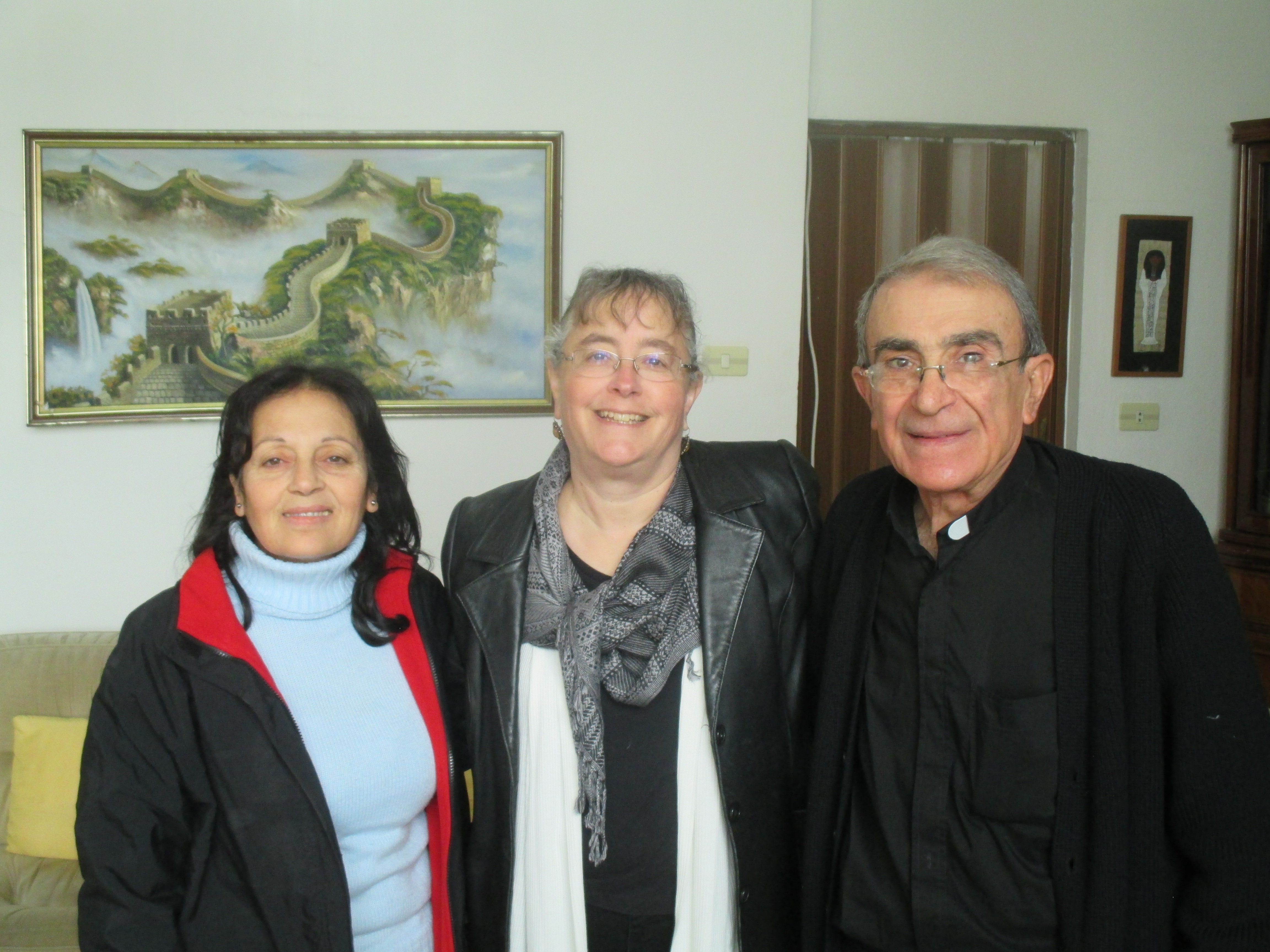
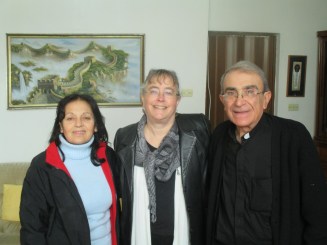
That's me, sandwiched between Huda and Rev. Michel Boughos of Yazdieh, Syria, in their home.

That’s me, sandwiched between Huda and Rev. Michel Boughos of Yazdieh, Syria, in their home.

Steve and I returned to Beirut from our six days in Syria on Thanksgiving Day, November 27. He was sick so he missed having a marvelous dinner that was prepared for us by Dr. Mary Mikhael, the former president of the Near East School of Theology (the NEST), the seminary in Beirut. He missed the meal, but he did not forgo being thankful for all we had seen and done and especially for the people we had met and shared life with for those six precious days.

Two of those nights in Syria we spent in the company of Rev. Michel Boughos and his wife Huda. Steve and I spent those nights in their home, a home they had shared for 37 years. Michel graduated from the NEST in 1977, married Huda (who was from Lattakia,) and was assigned to be the pastor of the National Evangelical Church of Yazdieh, the Presbyterian church.

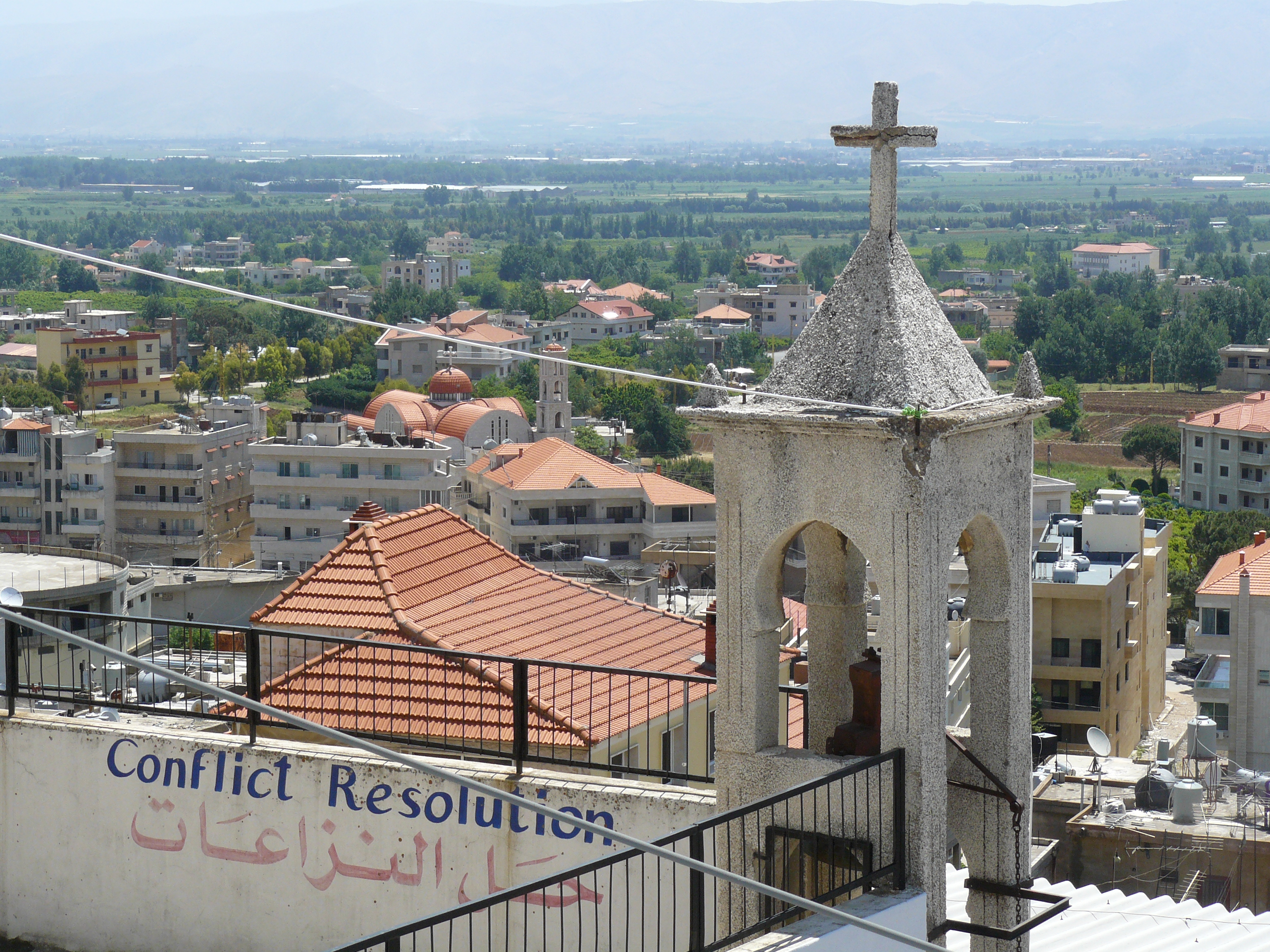
The church bell in its tower at the National Evangelical Church of Yazdieh, Syria.

The church bell in its tower at the National Evangelical Church of Yazdieh, Syria.

When they moved into this home, it was very tiny and I as understand it, the house was just a tiny appendage of the tiny church. The two are still attached, but both parts are much larger now with 37 years of ministerial work by Michel and Huda.

Our first experience of both of them was when we arrived in Amar Hosan on the day of the two-lane trip which you can read about here:

The two-lane journey

Michel reminded me of a little elf, with a quick smile and twinkle in his eye. Huda was his counterpart in smiles, and it was obvious she was a real worker bee; everyone flocked to be with her and share their needs. She listened to every person and every story. These two were just meant to be together, ministering together. Two gifted saints, who would serve amazingly as individuals, but when the two were joined, synergy was created. God sure had a plan there!

Steve preparing to read Psalm 46 as Rev. Michel introduces him.

Steve preparing to read Psalm 46 as Rev. Michel introduces him.

After the visit to Amar Hosan, we went back down the road to Yazdieh to prepare for another worship service there. We spent some time at Michel and Huda’s home having coffee and tea and planning the service. Steve was volunteered to read from the Psalms (46 actually, “God is our refuge and strength, a present help in times of trouble…”) and there would be a Power Point by Huda of the families they serve in the area and the ways they serve.

Bassam tells part of his story as Rev. Nuhad Tomeh translates for us. (Nuhad has been a part of each trip I have been on with The Outreach Foundation. Yazdieh is his home.)

Bassam tells part of his story as Rev. Nuhad Tomeh translates for us. (Nuhad has been a part of each trip I have been on with The Outreach Foundation. Yazdieh is his home.)

Here we met Bassam, a veterinarian by profession. He was a refugee from Qusayr, near the Lebanon border, a place that had experienced tremendous loss at the hands of ISIS. Bassam and his family were now an integral part of this congregation at Yazdieh, serving in many capacities. Where Huda lacked the technical know-how to get the pictures up for the presentation, Bassam stepped in to load the photos and run the computer.

I need to tell you about Bassam.

You can Google Qusayr and find lots of stories about the fighting there. When I am at home I just devour news about Syria because of my relationships there. I had read these stories about Qusayr, so when I heard that Bassam came from there I had to ask.

“Did you lose family members?”

“Twenty-two.”

Twenty-two men in his extended family had been murdered by ISIS! He told us the story of one uncle who was missing for several days. When one of the family asked where there uncle was, his thumb was returned.

His thumb.

This beloved uncle was returned over several days in 200 separate pieces. Butchered.
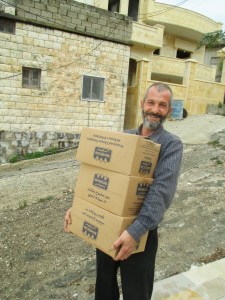
Bassam, the veterinarian from Qusayr, helps unload the truck for the food parcels.

Bassam, the veterinarian from Qusayr, helps unload the truck for the food parcels.

And here was Bassam, calmly telling us the story, bringing up pictures of his now dead relatives on his phone to share them with us.

And here was Bassam, loading the pictures up for Huda to share at the worship service. A man who heals animals for a living, now a refugee in a place not his own, but serving his neighbors in the ways that he can.

And so we went to service and saw the pictures as one by one, Bassam changed them for Huda on the screen.

Here was how they put the food baskets together.

Here was how they did crafts and games with the children at Christmastime.

Here were the blankets they could obtain and share with families for the winter.

Here were refugees needing desperate medical help and this is what we could do to help them.

On and on. Picture after picture of families in need who had left their own homes to find life in another place.

Comic relief was provided for us by a black cat who wandered into the church during this service. (Huda feeds eight cats every day at her back porch.) His name was Simony and he just kept rubbing up against her legs, Michel’s legs, the podium, my legs, Steve’s legs; anyplace he could find his comfort. Priceless!

Steve helped unload the truck as it delivered the last three parts of the food parcels.

Steve helped unload the truck as it delivered the last three parts of the food parcels.

And after the service was over, we went down to the fellowship hall to see the items gathered for the next food parcel delivery. Huda works very hard to collect it, organize it and store it until it is ready for delivery. It was enough food for 300 families, but it would be made into parcels to serve 600 families, so more would receive. (There are 1700 refugee families in their area that this small church reaches out to and tries to serve. The need is overwhelming, but they do not stop serving.) They were still waiting for three items before they started delivering: canned vegetables, zatar (a spice) and tea. (The day before we left Yazdieh, these other things arrived. Steve helped load them down in the hall and Huda began deliveries the day we left.)

Many of the families came down from the worship service with us, and we heard more stories of pain and loss and death. Picturing all this in your head is one thing, and it completely crushed my heart. I had had a meltdown earlier in the day upon arriving at Yazdieh after listening to the stories at Amar Hosan.

But then another family wanted to show us and pulled out their phone to load up a video…

I simply could not do it, but there was my Steve, offering the strength of his heart to share in their pain.

He watched the whole video on the phone and I watched his face as he watched it. There was a language barrier but he knew that one of those poor souls whose head was being cut off was the family member of that family, that was very obvious. I don’t know how he keeps that image out of his head when he sleeps, but this was the gift of being with people that he had come to give.

And so I tell you the story. When you see the news and hear stories of what is happening in Syria I want you to pause and think of this. These are real people – veterinarians, engineers, teachers, pastors, students – who look and live lives just like we do. They laugh, they cry, they learn, they love, they worship, they work. And an unspeakable evil is in their midst pushing them out of their homes and cities and countries and committing crimes against humanity that are unfathomable.

Think of them. Pray for them. And if you can, please help them. You can give to the Syrian Relief effort of The Outreach Foundation by donating at their website:

http://www.theoutreachfoundation.org

Thank you.

Reunion in Lattakia

Julie Lamis Bitar and Marilyn at Latakkia churchTraveling to the Middle East has been a life-changing experience for me. I have gone to Lebanon, Syria and Iraq a total of seven times since August, 2010, when I traveled for the first time with The Outreach Foundation and my new friend, Marilyn Borst. I have gained more friends on those trips that I am so grateful to be connected with by email and Facebook. And, of course, reuniting with them when I return.

I will return!

Back on that first trip in August, 2010, I traveled with a group of women – faithful women – as the trip was called. They were all veterans of short-term mission trips to places all over the world. They had been to Cuba, Russia, Malawi, Pakistan, North Korea, Israel/Palestine, Iraq, Lebanon, Syria…and many many more places. I had been to Germany, the Czech Republic and Cameroon on similar trips. But this one was new for all of us, except Marilyn of course.

We were traveling to be connected with Presbyterians (like us!) in Lebanon and Syria in the National Evangelical Synod of Syria and Lebanon (NESSL). We got a great overview of the history of the Synod: how Presbyterians from the U.S. came to the Middle East to convert Muslims and Jews to Christianity. Upon arriving, they found no Jews to speak of and also there was this small thing about it being illegal to convert from Islam to something else. Illegal as in the death penalty.

Instead, they reached out to the ancient Christian community already there – Melkites and Maronites and Syrian, Orthodox and Catholic – and built schools and hospitals. The reformed church was planted alongside the ancient, and that is how it still is today.

We visited historic sites in both countries. We shopped in souks. We met with Iraqi refugee families. We visited schools. We sweltered in the 115 degree summer heat.

We bonded as a community of friends, sisters in Christ.

We ended that trip in the mountains above Beirut at the Dhour Choieur Conference Center to be part of a women’s conference, just like we would have at home, only in Arabic. (They translated for us.) We sang worship songs. We delved into a Bible study about the fruit of the spirit led by my new friend Barbara Exley from Atlanta. She had brought pounds and pounds of Jelly Belly jelly beans in flavors to represent the fruits. For instance, watermelon jelly beans represented patience. It was the most joyful and sweet-filled Bible study ever!

Part of the grace of being in the Middle East is the mindset of hospitality and gift-giving, and it played out at this conference just like every other place. We made friends with women. We traded little gifts. If you admired someone’s bracelet or earrings, she would immediately remove the item and give it to you. Amazing grace in the form of jewelry.

And that is how I met Lamis Bitar from Lattakia.

She was tall, statuesque actually, with beautiful dark hair and eyes. Her smile came slowly, but when it did it was genuine. She and I became friends on that weekend and in the generosity of these people, she bestowed upon me the earrings she was wearing.

And then the conference ended and we made plans to do it again in 2011, with even more women, perhaps from Iraq. And we went back home to the USA.

And then March, 2011, came and war erupted in Syria. There would be no women’s conference in Syria, and we would not return in 2011.

I would wear those earrings at home. Precious they were to me. Every time I put them in my ears I would think of the fun we had at that Bible study with the Jelly Bellys and I would see Lamis’ face in my mind, her beautiful face with the slow smile, and wonder about her in Lattakia. I would pray. I would tell people where those earrings came from if they admired them, and I would ask them to pray for Syria.

I wondered what had happened to Lamis Bitar.

And then just this past month, November, 2014, I had the opportunity to return to Lebanon and Syria with The Outreach Foundation. Steve was with me and Marilyn of course (our fearless leader) and Barbara. We walked through the streets of Homs in Syria, looking at the devastation from three years worth of bombs and mortars, but also seeing the churches beginning to rebuild. There was some hope there. You can read about it in my previous blogs.

And then we went to Lattakia. The third largest city in Syria before the war, had now grown even larger as people found their way there to escape danger in other places. It was relatively safe, although there were still checkpoints and military personnel to be seen. Large as it is it still suffered from the results of the war: high prices and electricity that did not work 24 hours a day. (Think about that for a moment in your own context. How do you manage when the electricity goes out? Maybe for a day, or even rarely for a week? What would you do if it was on for only four hours a day and you didn’t know which four? That is Syria now.)

Joyfully, we were set to visit our friend Rev. Salam Hanna who is the pastor of the Presbyterian Church in Lattakia. It was Marilyn’s first time in this city, although she has been in Syria many, many times. So, of course, it was our first time there as well. It is a beautiful old church, renovated in the last couple of years by its previous pastor. It is also the largest church in NESSL, and we expected a large turnout, and there was one.

I wore my earrings from Lamis, hoping against hope that she was still there and had not already departed for another country.

And in the gathering darkness of night, in the midst of a rainstorm that should have kept everyone away, there she was. My friend Lamis had come to meet the American Presbyterians and I recognized her right away.

Tall. Statuesque. Dark hair. Dark eyes. Slow smile. Amazing grace.

We hugged. We reminisced about that women’s conference with the jelly beans. We locked eyes as friends and hugged some more. It was just a moment of pure joy for us both.

And that is why I go. I go to be “with” and to come home, responsible for remembering the people and their stories and to remind the church here at home that there is a church serving in Syria in the midst of war and death and loss and lack of food and fuel and electricity. They are the hands and feet and heart of Jesus walking and loving among those who need the light. And Lamis is one of them and I want you to remember her name and her face and her life.

And I want her to remember me. In addition to the earrings which I was wearing, I now have a beautiful bracelet with a cross. And Lamis has my watch, set to the time in Omaha. When she looks at it, she will know that she has a friend and prayer partner eight time zones to the west who loves her and remembers her.

Lamis, my sister in Christ. Please pray for her and for her church and for her country.

Kab Elias, Lebanon

P1080389I am in Beirut, Lebanon, for the fourth time since 2010, when I first came and was introduced to my Presbyterian brothers and sisters in this small country by the Mediterranean Sea. We spent about four or five days here on that trip visiting various expressions of the National Evangelical Synod of Syria and Lebanon (NESSL), whether the leadership of the synod, the pastors and churches, a beautiful mountainside elder care facility or a brand new school in the Bekaa Valley. These are amazing, resilient, intelligent and educated people. The evangelical, or reformed, church took root here in the 1830s as American missionaries came in the great movement of that century.

We also spent a week in Syria, visiting the ancient cities of Damascus and Aleppo and the Syrian parts of NESSL, as well as historic places such as the Street called Straight and the Ananias House (see Acts 9), the Grand Ummayyad Mosque in Damascus, and the ancient maze-like souq and the citadel in Aleppo.

These are old places bearing the marks of an ancient church as well with names like Chaldean, Maronite and Melkite Catholic, and Greek, Armenian and Syrian Orthodox. Christians have walked here since the first Pentecost after the resurrection.

In 2010 in Lebanon we learned how the church had a prominent role in offering hope and witness during the civil war here that lasted from 1975-1990, and we also saw how the church in Syria offered that same hope and witness to refugees who had fled from the Iraq war to their east, beginning in 2003.

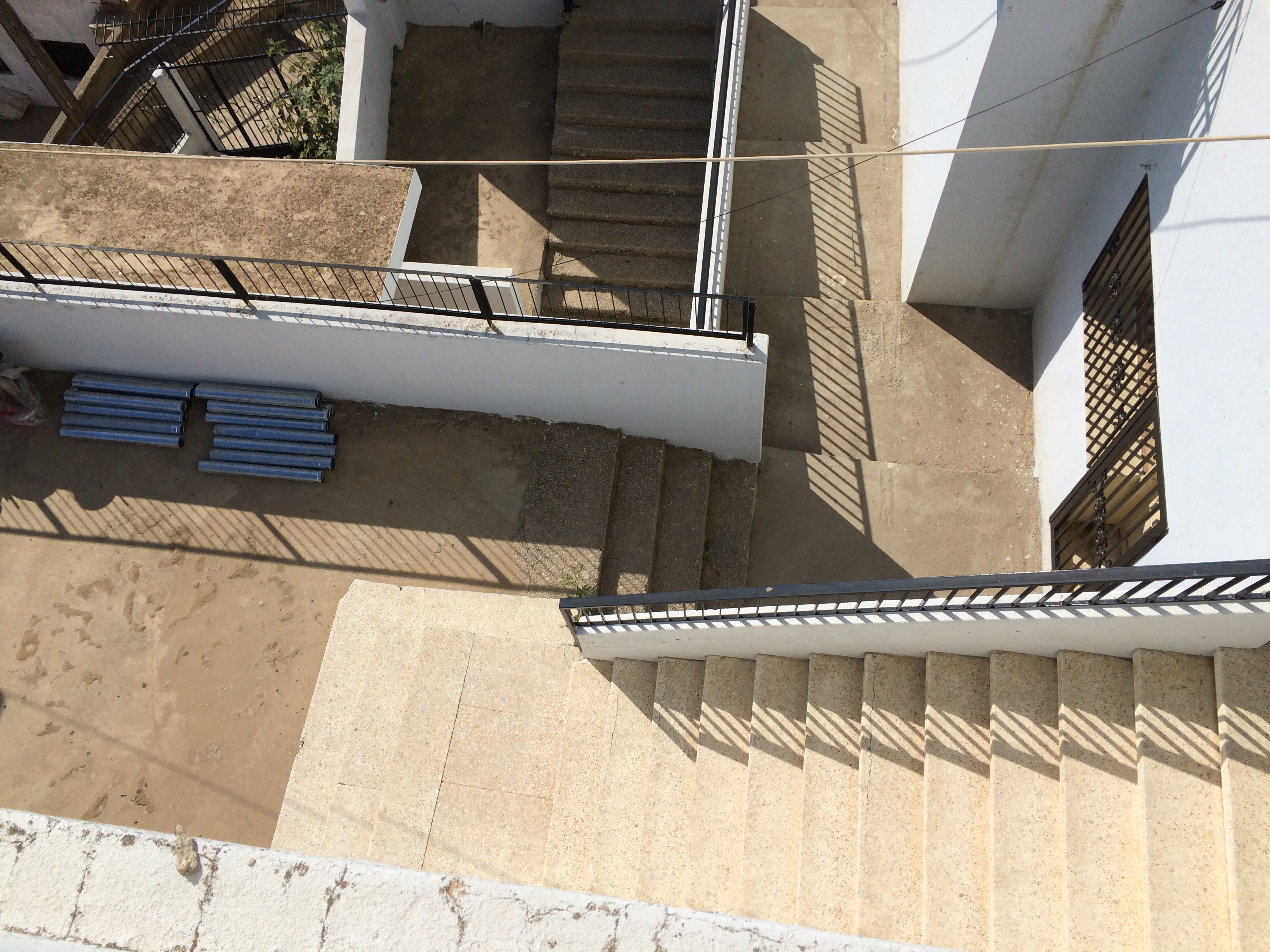
Looking down at the stairs below from top of the Kab Elias school, now apartments for refugees.

Looking down at the stairs below from top of the Kab Elias school, now apartments for refugees.

Returning to Lebanon in 2013, there was a completely different set of circumstances. The new war being fought was in Syria and had been going on for two years at the time of that trip. Refugees from that war had found their way to Lebanon as well as being internally displaced in Syria. And what we found was that same church offering hope and witness anew.

Now, in November, 2014, the crisis has increased ten and maybe a hundredfold. There seems to be no end to the streams of people being forced out their homes in one place, carrying only what their hands can hold, and setting out in a vast migration to a new place. And hopefully one where they can find at least a semblance of peace. Syrians – maybe a million or more – have come to Lebanon, a country of only four million people. They live in tents. There is really no infrastructure for their children to go to school. There are no jobs. But at least the war and the bombs and the killing machine are on the other side of the mountains.

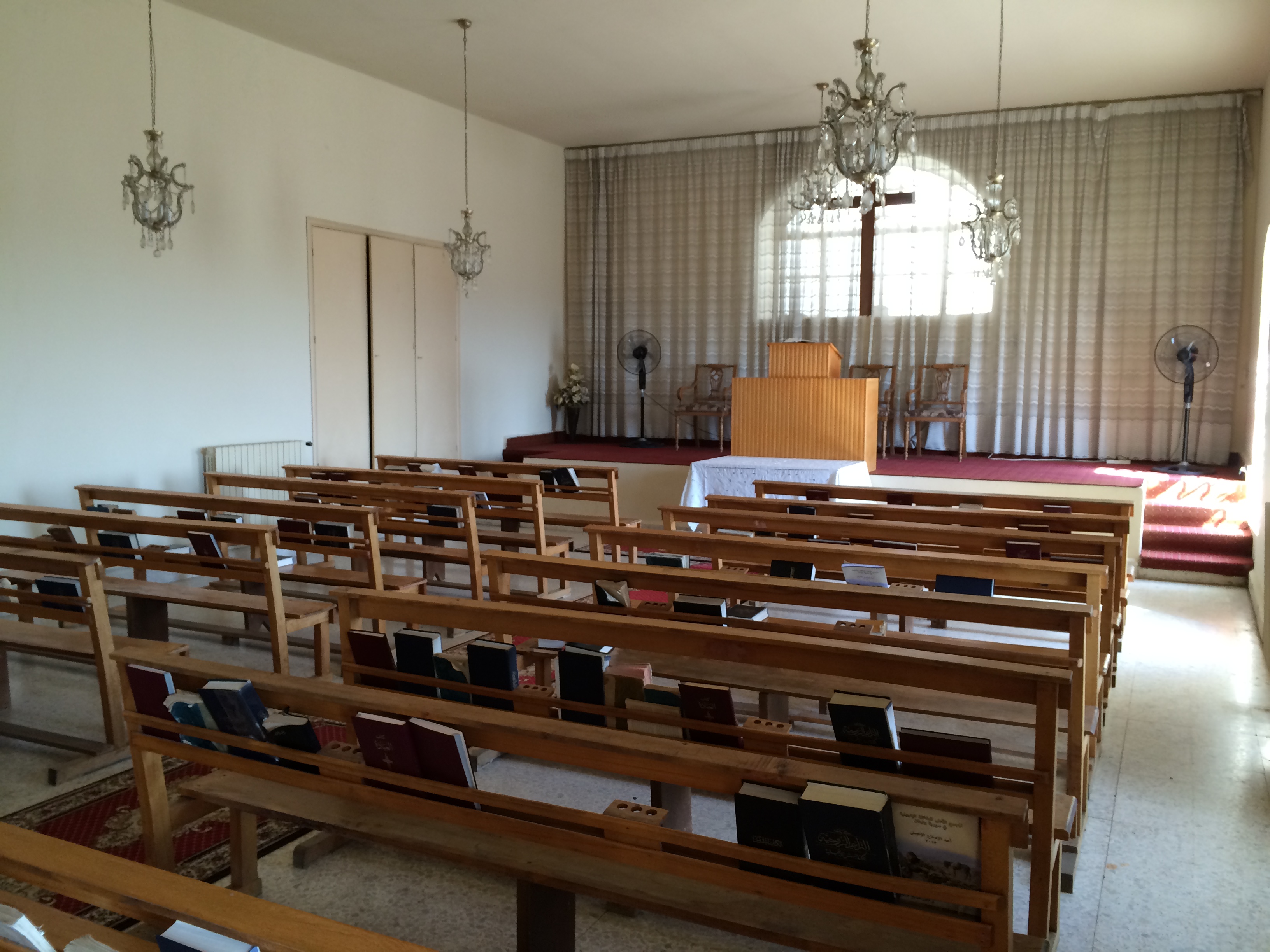
About halfway up the stairs of the former Kab Elias Evangelical School compound there is a door to your right. Inside is the small church where worship is still held on Sundays. Now part of the worshiping community are the refugees from Syria who are living here.

About halfway up the stairs of the former Kab Elias Evangelical School compound there is a door to your right. Inside is the small church where worship is still held on Sundays. Now part of the worshiping community are the refugees from Syria who are living here.

But one thing that is common on both sides of the mountain is the church. It is a common and constant presence in Syria and Lebanon. The church is here. God is here. Hope is here.

In 2013 we had the chance to visit one of those places of hope. NESSL was refitting an old, now unused school to become apartments for refugees from Syria. Rooms where once uniformed students learned reading and math and science, would be transformed into bedrooms and kitchens and bathrooms. There was even a small church here and that would remain as a weekly gathering place to come together and worship the God of peace and salvation and to study his word in the Bible.

Walking up the hundred-plus stone stairs of this multi-level compound, we saw workmen installing kitchen equipment and making bathrooms for the families who would eventually call this place home. All of those items needed for daily living – sinks, toilets, cooking stoves, refrigerators, heating stoves – had to be hauled up those stairs that had been worn by years of small feet going up and down to learn the lessons of life. Now they would be trod by families who had learned the lessons of war and fear, and would find peace in this place of God.

Yesterday upon my return here, I met three of the families who have found refuge here.

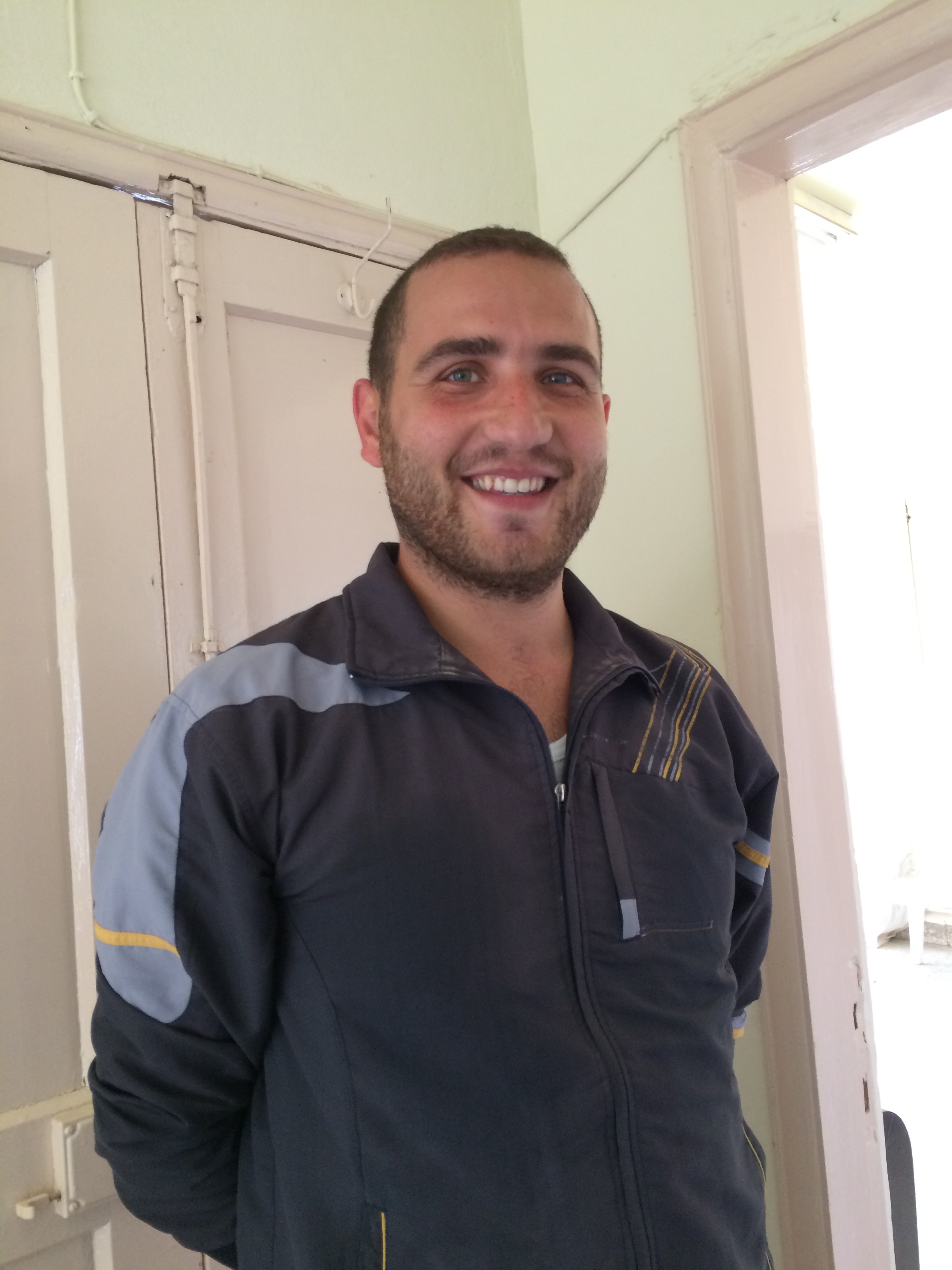
Ziad from Homs.

Ziad from Homs.

There was Ziad from Homs, who was sharing his apartment with another young, single man who was not there when we arrived. Homs is a city that had been under siege for a full three years, having been liberated just this past May. I am sure if we had more time and more ability to communicate, we could have heard some horrible stories from Ziad, but also stories of escape and survival. His simple room contained a small bed, a chest with a television on top and some meager mementos from home. It looked like a college dorm room. Young men really don’t need much, do they?

Another room was occupied by Dunia, who had come from Safita in the northwest. Her apartment was much cozier, made so by a beautiful rug on the floor, a couch and chairs in the living room and a few more reminders of her home. Her son was living there with her and he has been recruited by a local Christian leader in helping others. He has applied for admission to the Near East School of Theology in Beirut with the hope of studying to be a pastor. These are seeds of hope being planted for the future of his land.

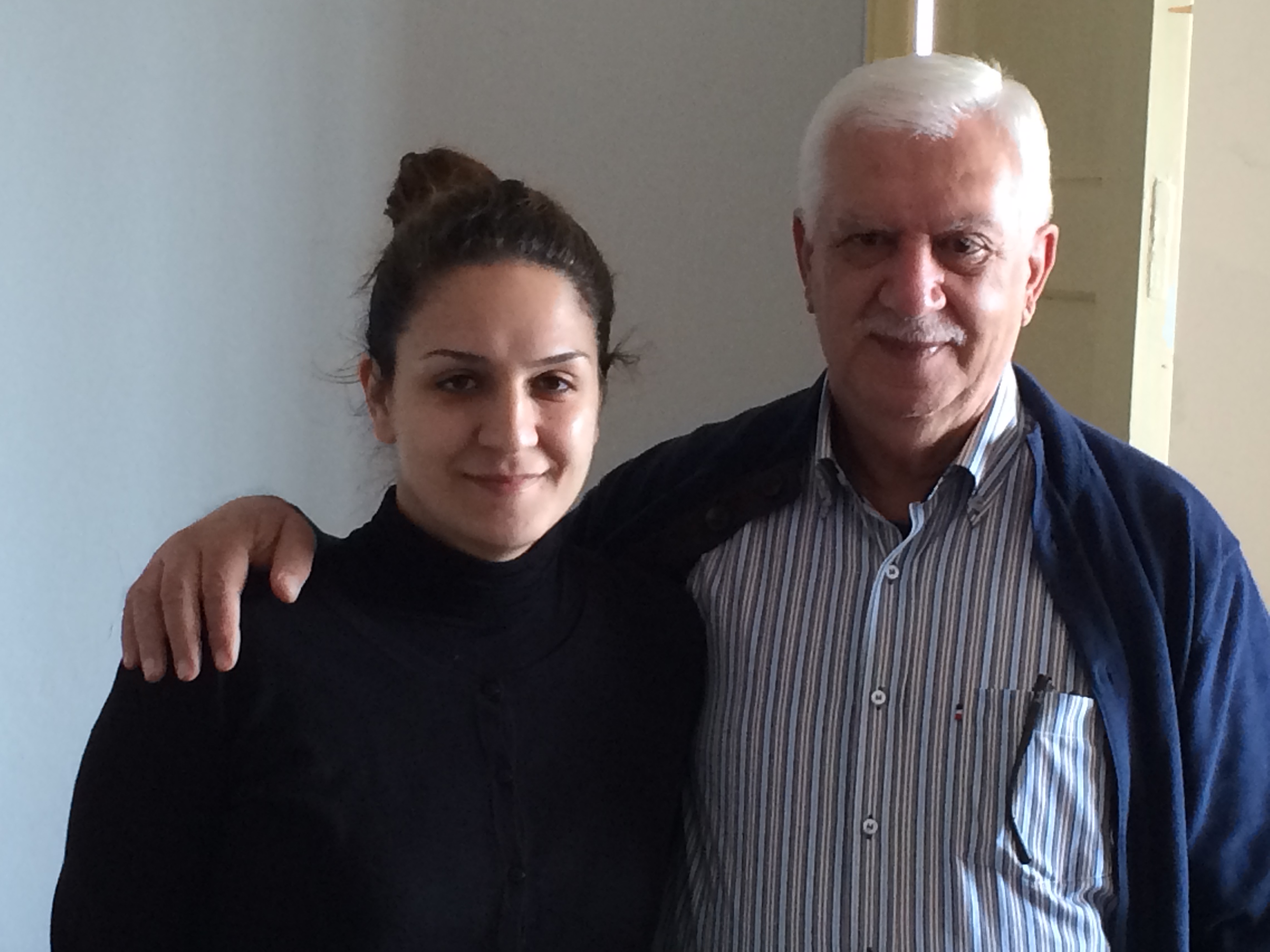
Climbing to the very top level of this vertical compound we met Elder Moussa from Aleppo and his daughter Fibi. Elder Moussa was an electrical engineer by trade and one day his skills will be needed desperately as a city of two million people will have to be rebuilt. We have heard that 55% of Aleppo has been destroyed; ISIS is active there and soon the government forces will try to surround them and deprive them of weapons and supplies to snuff them out. There is more tragedy still to be experienced in the months to come. There is still an active Presbyterian congregation there meeting in a fifth floor apartment with no electricity or water, led by a courageous pastor named Ibrahim Nsier. But that is another story.

Elder Moussa of the Aleppo Presbyterian Church and his daughter Fibi.

Elder Moussa of the Aleppo Presbyterian Church and his daughter Fibi.

Let me tell you why Moussa and his daughter Fibi and her sister Grace were in this apartment at the top of the stairs. They had not fled Aleppo in fear for their lives. Indeed, they were a part of that congregation still meeting there in an equally high place at the top of five flights of stairs. Moussa is an elder there (and I most likely met him in that church in 2010). He is a leader, seeing to the spiritual needs of that congregation. But his wife had cancer. Oh, how I curse cancer! His wife had cancer and there were no longer working hospitals or even doctors in Aleppo. (Think about that for a minute. In a city of two million people, what used to be a modern 21st-century city, there were no working hospitals.) Moussa and Fibi and Grace left with wife and mother to find treatment in Latakia to the west.

Moussa’s wife died two months ago. This man, who is probably only in his early 60s, this educated electrical engineer who owned his house and raised his family with a wife of decades, now lives with his daughters at the top of the former school. A widower, he can look out the window to the mountains, knowing she is not buried in her homeland, but that she is in the arms of a loving God.

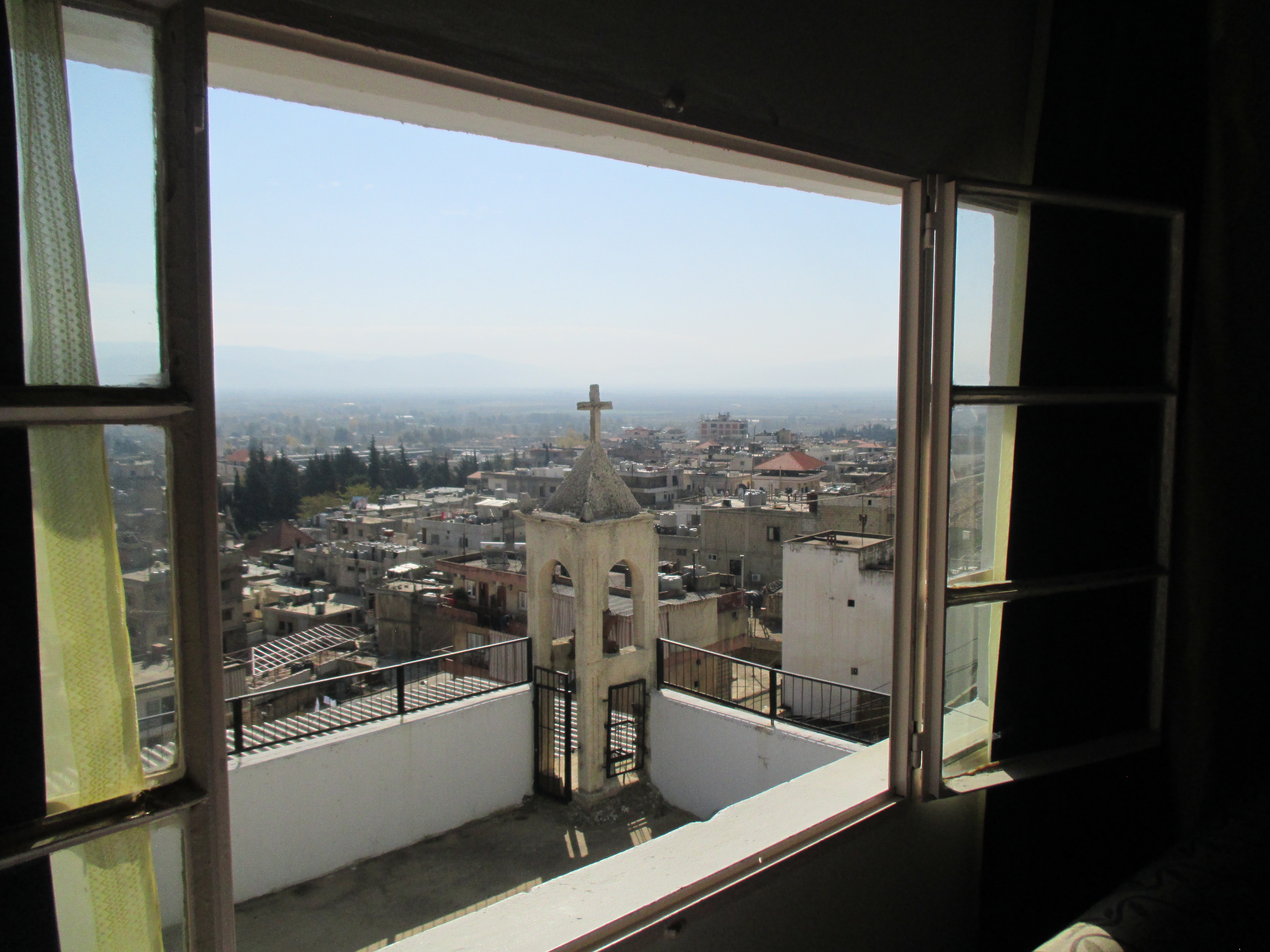
This is the view out of Dunia's window, looking to the church steeple with its bell.

This is the view out of Dunia’s window, looking to the church steeple with its bell.

A loving God, who has led him to this place for this time.

A loving God who will see him come home, either to Aleppo to help rebuild or to one of the mansions in his father’s house.

A loving God who walks up the stairs with him to the top of the school, now made home.

A loving God who walks among the thousands of tents in the valley below.

A loving God he worships in the small church a few flights below.

A loving God embodied in the churches and pastors and flocks of this place.

I pray a prayer of thanksgiving to this loving God for allowing me to enter into the lives of these people who are living in a place prepared for them by brothers and sisters of mine and yours.

And I pray to this God for peace in this land.

Praise God from whom all blessings flow, praise him all creatures here below. Praise him above ye heavenly host. Praise Father, Son and Holy Ghost.

Amen.

Persistence

julie-with-kids-at-zahle-camp.jpgWhen Steve and I started dating, we use to wrestle with each other. It was good, honest fun, I tell you. A 6’3″ gorgeous dark-haired man wrestling a 5’5″ woman, eighty pounds in weight under his. He had me in size, in weight, in strength. But the one thing I had in bigger quantity than him was persistence. I would keep coming back, even when he had both my arms pinned. I wouldn’t stop. I just wouldn’t say “uncle”!

I may not ever have won one of those awesome matches, but I never gave up!

One definition for persistence is this:

firm or obstinate continuance in a course of action in spite of difficulty or opposition

I have seen it other places besides my wrestling matches with Steve.

I have seen it in my sisters Susan and Jana. Their car hit by a train in 1983, and both severely wounded, neither gave up. Susan marched through her injuries and continued her studies at Colorado State University to become a veterinarian. Today she is a married woman of over 25 years and the vet you want your animals to have in an ER in Loveland, Colorado. She runs, she bikes, she camps and canoes, and she is an amazing nature photographer. (She is afraid of spiders, but that is another story!)

Susan never said “uncle.”

Anyone who knows Jana has seen the personification of persistence. We siblings who have known her all our lives refer to it more as stubbornness, but it is the same thing. Doctors said she would never recover and it was best just to let her go. Three weeks after the accident, although deeply in coma, her heart and brain would not quit, so they did surgery to repair all her broken bones. Doctors said she would never walk once she did come out of the coma. Six months after the surgery to repair those broken bones, she walked back into the Longmont United Hospital to embrace the doctor who did the surgery. She has traveled to Australia, Ecuador, Germany and the Czech Republic, and she has been back over and over to Washington, D.C., to advocate for poor and hungry people all over the world.

Jana has never said “uncle.”

Persistence. Stubbornness. Whatever you want to call it, we don’t say “uncle.”

There is a great parable in Luke chapter 18 that has been with me all week about another woman of stubborn persistence. And even though I am not a widow pleading my case before a judge, I am feeling some of her frustration and the need to persist:

Jesus told them a story showing that it was necessary for them to pray consistently and never quit. He said, “There was once a judge in some city who never gave God a thought and cared nothing for people. A widow in that city kept after him: ‘My rights are being violated. Protect me!’

“He never gave her the time of day. But after this went on and on he said to himself, ‘I care nothing what God thinks, even less what people think. But because this widow won’t quit badgering me, I’d better do something and see that she gets justice—otherwise I’m going to end up beaten black-and-blue by her pounding.’”

Then the Master said, “Do you hear what that judge, corrupt as he is, is saying? So what makes you think God won’t step in and work justice for his chosen people, who continue to cry out for help? Won’t he stick up for them? I assure you, he will. He will not drag his feet. But how much of that kind of persistent faith will the Son of Man find on the earth when he returns?” (Luke 18:1-8, The Message)

Maybe I am impatient, but my cause is just. I don’t have a judge to plead to. But I have a persistent prayer about helping my brothers and sisters in Christ. I have been trying to use Facebook and Twitter and email to share the story of the church in Lebanon and Syria and Iraq with as many people as I can. I am trying to create an Internet flashmob, for lack of a better term. If you are my friend on Facebook, perhaps you are sick of my posts by now, but I can’t stop. They all contain the link below and I am trying to get it to go viral, so instead of the 320 views it has now, it will have 3,200 or 32,000…or 3,200,000!

Hope came down and pitched its tent is a mash up of John 1:14 and Hebrews 11:1:

The word became flesh and dwelled among us.

Now faith is being sure of what you hope for and certain of what you do not see.

Those two verses have been with me for most of the past year as I came home from a trip to Lebanon and Syria. The children in that refugee camp had no business to be singing joyful songs and dancing with us in innocence. Didn’t they know where they were? Couldn’t they see the desolation of nothingness around them? The outhouses? The putrid drainage ditch? No parks, no trees…nothing!

And that’s when it came to me that they were seeing something else. They were seeing it with the eyes of their heart…with hope.

And they are persistent in their joy, and stubborn in their singing and dancing. They won’t say “uncle.”

And what they did see with their eyes and feel in warm embraces was the love of Christ in the person of Assis Fadi and Assis Ramsey, pastors of the National Evangelical Synod of Syria and Lebanon. They hope because someone has given them something to hope for. The church has been walking in the camps bringing food and supplies and, well, love. They have been caring for others not in camps by supplying food and rent vouchers and helping children stay in school. They have provided medical care to those who need it.

In the midst of a war, surrounded by death and chaos, they have not said “uncle.”

And on their behalf, neither will I.

The people I sleep with

Assis Boutrous Zaour, his wife Wafa and their three children, all amazing young people!

Assis Boutrous Zaour, his wife Wafa and their three children, all amazing young people!

Assis Joseph Kassab with me and Assis Adeeb Awad

Assis Joseph Kassab with me and Assis Adeeb Awad

Since Steve and I got married on May 18, 2002, we have slept in the same bed every night, with very few exceptions. It’s expected that a married couple would share the same bed, right? Well, I guess Lucy and Ricky on the old sitcom had separate beds, or at least that was the way early television and movies would have it!

The truth is, there have always been many people that went to bed with me before I met Steve…

Talal, a refugee from Aleppo, whom we met in the refugee camp

Talal, a refugee from Aleppo, whom we met in the refugee camp

I used to start my prayers every night with

Now I lay me down to sleep
I pray the Lord my soul to keep
Guard me safely through the night
And let me see the morning light.

That is not the way everyone said that prayer, but it was the way it was printed on the night light in the bedroom I shared with my sisters when we were very small. That’s where I learned that prayer when I could first read. Years later when I learned the version that went, “If I should die before I wake, I pray the Lord my soul to take,” it scared me that anyone could pray that way. “The morning light” vs. dying before waking, was a much brighter vision!

Either way, those prayers were always followed by the Lord’s Prayer, a Hail Mary, a Glory Be and then my list of family and friends whom I wanted God to protect and bless. It was a long list of people that came to bed with me.

Gladys Aboud of the synod in Beirut and Hala Bitar, a teacher at the Beirut Evangelical School for Girls and Boys

Gladys Aboud of the synod in Beirut and Hala Bitar, a teacher at the Beirut Evangelical School for Girls and Boys

There are many people that I pray for regularly. I think it is part of my call as a follower of Jesus to bring those I love and he loves before him; to bring to the foot of the cross all those I carry burdens for. I love them; he loves them more. He knows all their names before I speak them and what a comfort it is to walk with a God like that.

I still pray for my family. Oh! How I want their safety, their provision, their comfort. Let them see the morning light! I can’t help thinking as I sleep that I have many family already sitting with God in glory who died before I woke, their souls taken to a place where there is no worry. My mom. My dad. My baby sister Cathy. All are safe on the other side.

Rola Sleiman, the preacher at the church in Tripoli, a graduate of the Near East School of Theology

Rola Sleiman, the preacher at the church in Tripoli, a graduate of the Near East School of Theology

But here on this side of heaven, are still so many.

And this night and the next, they all go to bed with me and Steve. He is as aware of them as me. Steve has traveled to their homes with me to walk with them and learn from them what faith is. They pray for us. We pray for them. And God loves and knows us all.

Assis Boutrous  Zaour and Assis Ma'an Bitar

Assis Boutrous Zaour and Assis Ma’an Bitar

Sleep has been much harder to come by lately and I’m trying to find ways to encourage my body to get to a restful state so once I am in bed, sleep will come. Last evening I took a half hour’s walk as the sun was still up but with a shadow cast upon it by the moon as a partial eclipse was happening. And as I walked my mind had a slideshow, a veritable mental Power Point of all the people who come to bed with me: pastors and preachers and leaders of the National Evangelical Synod of Syria and Lebanon, pastors, elders and kindergarten teachers in Iraqi churches, refugees from Iraq who had been in Syria, refugees from Syria now in Lebanon. Ordinary people living ordinary lives in extraordinary times, loving God in the act of loving their neighbors.

Mary Mikhael, past president of the seminary in Beirut

Mary Mikhael, past president of the seminary in Beirut

And even as a shadow is cast over them right now, just like the moon was trying to blot out the brilliance of the sun last night, we know from the the scripture, “The light shines in the darkness and the darkness has not overcome it.

Now I lay me down to sleep, I pray the Lord my soul to keep. Guard me safely through the night…and let me see the morning light.

Amen.

#hopecamedown

Hand in hand

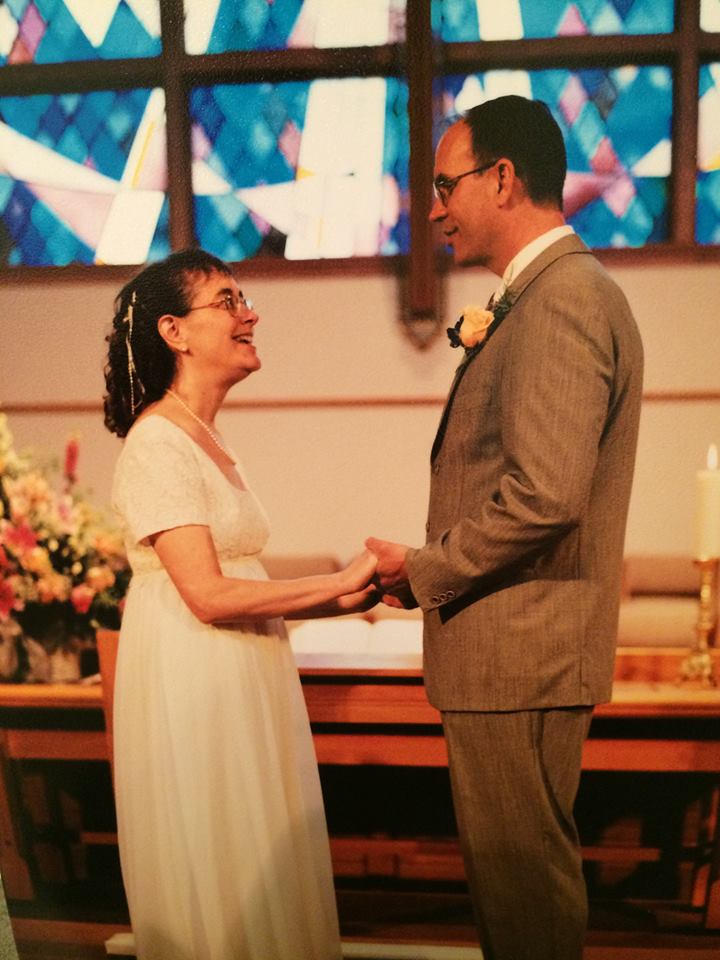
Holding hands on wedding dayThere we are on our wedding day, May 18, 2002. Gosh! We look so young you can’t even tell we are 43 and 44 years old (she said while wearing her rose-colored glasses). I remember that day like it was yesterday!

For both of us, it was our first – and we have pledged! – only marriage. First time for two folks in early middle age. Steve’s parents were married when his mom was only 19 and Chuck was 25. My mom was 23 and my dear old dad was 27. It seems so young to me!

So there we are, standing in the church for pictures on the big day, and I love this one because we are holding hands. We get teased often at church for our PDAs: public displays of affection. We often hold hands, stand arm in arm, and even exchange kisses. It’s still first love for me. It always will be.

We did meet at church, in Sunday school actually. I sat in the front row with Jana, and Steve sat in the last row. He used to tease us for being “teacher’s pets” and I accused him of flinging arrows at our heads from the back row…figurative arrows. Somehow we were friends who liked to tease each other and then we ended up on the adult education committee together. Our families joined together with other friends after church for lunch on Sundays at Arby’s. Our pastor George and his wife Pam were part of that group. After we got engaged, George shared the story of how he woke up in the middle of the night after having dreamed that Steve and I would be married someday. He woke Pam to tell her, too. Oddly enough, it was before any of the rest of our “keeping company” started. He just had a vision and I have always loved that story.

Anyway, how we eventually ended up going out that first night is another story for another day. It involves a letter from me and then a returned letter from him. It’s not fodder for an HBO mini series, but I am sure there will be a movie about it someday. Steve will be played by Kevin Costner and I will be played by…me.

The first night we went out was exactly one year before that wedding picture: May 18, 2001. We met at Delice, a bakery/bistro in Omaha’s Old Market area. He had a cup of coffee and I had a Diet Coke. We each paid for our own. I had nothing else to compare this to as I told Steve, “This is my first date. With a man. Ever in my life. Did I tell you I was 42?” That was the truth!

After our caffeine intake, we decided to walk a bit farther into the market for dinner at the Upstream Brewery. And that is when it happened: he reached out for my hand. And for the first time at the advanced spinsterly age of 42, for the very first time, (did I stress that enough?) my hand was nestled into the larger hand of a man who was not my father, not my uncle, not my grandpa. And I will never forget the wonder of that feeling. I can close my eyes and see us walking down Howard Street, hand in hand, and thirteen years have melted away. I knew then and there I would marry him someday, so it was funny when George told us of his dream.

I also experienced my first kiss that evening, but this story is not about that either. It’s about holding hands.

At dinner that evening, Steve ordered a burger and I ordered a salad. My whole self was just in shock that I was even there, and I was so enthralled that I just couldn’t eat, so Steve finished mine. But that was the end of the meal. The beginning went something like this. Steve said, “Should we say grace?” And I just nodded, knowing I couldn’t say anything. He reached his hands across the table and took both of mine in his and thanked God for our meal.

And we have never done it any other way.

After that first date (I only use that term because it’s easier. We never considered that we were dating, just keeping company.) the story got out quickly that we were a couple. We tried to keep it just to ourselves for a while because it was new and special, and frankly, I think we were both a bit scared. But once we were discovered, it was wonderful to be so easy with our PDAs, especially holding hands. We started sitting together in church and when it was time for prayer, somehow we just reached for the other’s hand and held them until the “amen.”

And we have never done it any other way.

I think of how many times we have prayed hand in hand like that in the last thirteen years. So many meals. So many church services. Weddings. Funerals. We have prayed for our family members in their joys and sorrows; we have prayed with and for our friends in theirs as well. We pray with our small group when we gather to share lives and learn more about our God. We have prayed on trips to be with the church in Germany, the Czech Republic, Iraq, Lebanon and Syria. We have prayed for peace, over and over again.

I know when we join our hands like that, God meets us right there as we pray.

praying hands in DamascusAnd so this picture means so much to me. We were in Damascus, Syria, in January with The Outreach Foundation. We had traveled to Lebanon to be with the National Evangelical Synod of Syria and Lebanon along with other global partners of NESSL. Sixteen of us made the short journey to Damascus to be with the church in a country that had been at war for almost three years. They still are, and we continue to pray for them even now with the news of the impending U.S. participation in a plan against ISIS. Oh! How we pray for peace.

While we were in the church service that day, surrounded by the members of the Damascus congregation plus the refugees who had fled other parts of Syria to be there, we bowed our heads in prayer as we have done so many times. And we reached out our hands to each other as we have done so many times. And somehow that caught the eyes of a photographer and this photo was posted on Facebook.

If there is only one picture that you can pick to describe the life you have shared with that one person you know God picked for you personally, this is the photo I would pick to tell the story of Julie and Steve. And they are not the hands of Kevin Costner.

They are Steve’s, and they are mine. Hand in hand.