Jesus Christ: Liberator

I have had a great year as a student at Creighton University. Earlier this year, as I was fulfilling some undergraduate theology credits for my master’s program, I was enrolled in an amazing class with a professor who inspired me. The class was Theology 331, Jesus Christ: Liberator, a christology class. Here is one of the answers I gave on our final exam last May. Who is Jesus?

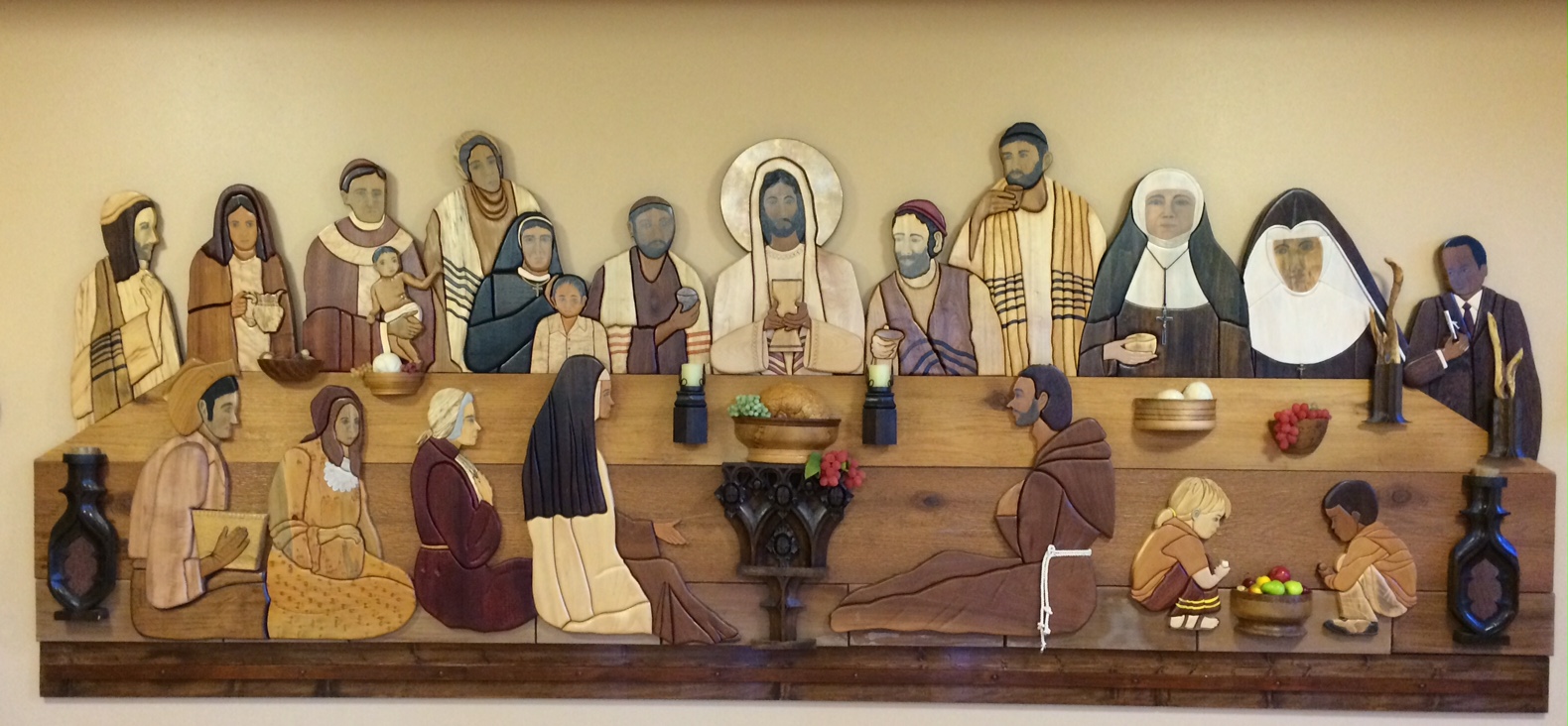
Mt St Francis last supper

“For me, in the figure of Monseñor Romero, Christ passed through El Salvador.” This one line in a documentary has stayed with me since I watched it. This is the Jesus I have come to know in my life, through my readings of scripture and story and narrative. The Jesus who reaches out to those left behind or discarded. I first met this Jesus as a seven-year old whose mother had died. That poor lost little girl was tended to by three nuns when she made her first communion in second grade. They saw her grief and worry and brought her to the table.

I have seen that Jesus who cares in a very special way for the poor all over the world as I have walked the halls of congress with my own disabled sister as we advocated for food and nutrition policy, for sustainable development, for increased funding for HIV/AIDS patients.

I have seen that Jesus in Iraq and Syria as he walks in the refugee camps and tends to newborn babies whose parents have nothing and no one to turn to. I have heard others tell his story in the form of kidnapped and murdered priests, just like Oscar Romero.

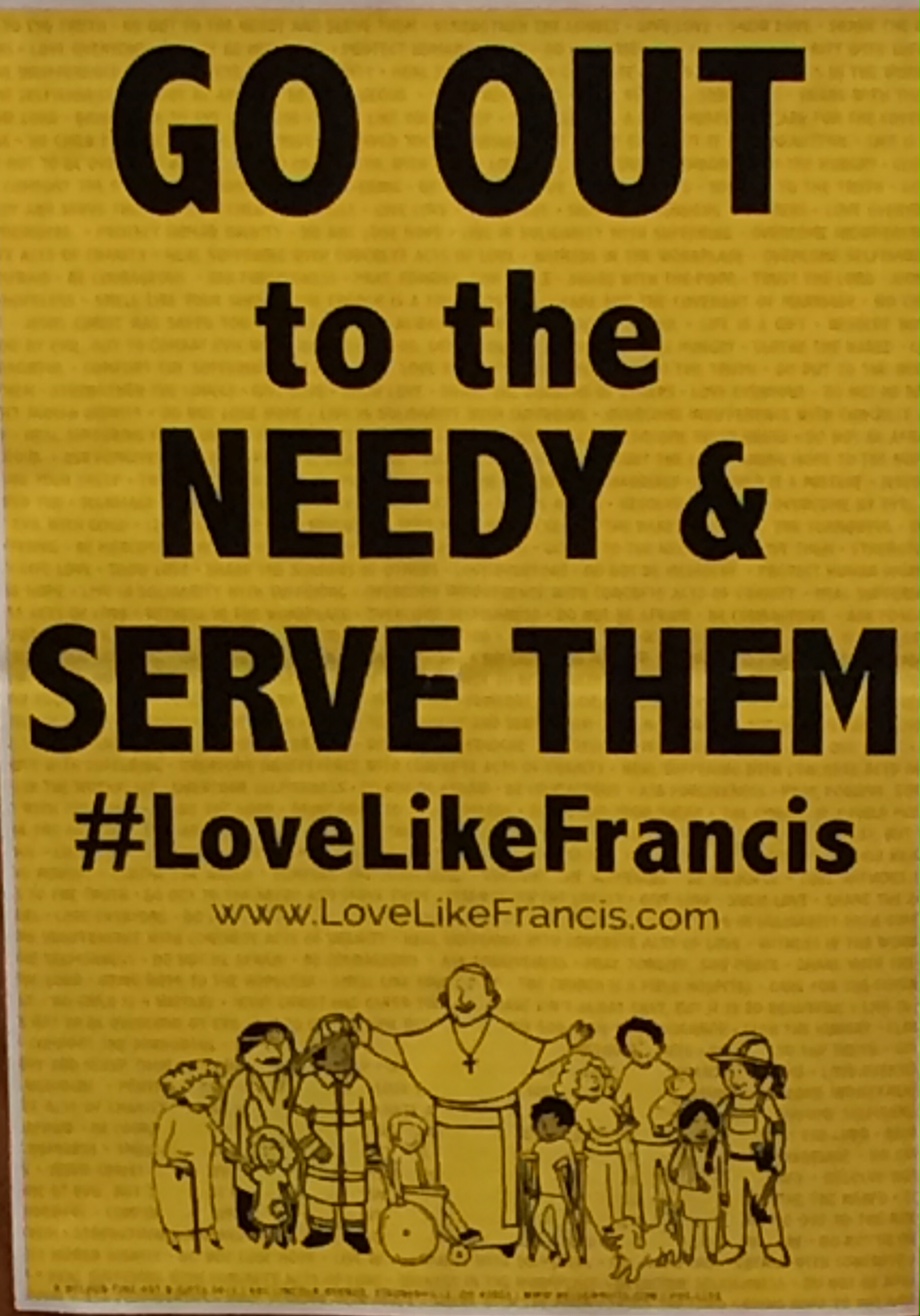
Mt St Francis Love like FrancisAs I have participated in this class and read all three authors, I have read the words out loud to my precious husband. “Look! Do you see this? This is what I keep saying over and over! You cannot profess to love God and not love your neighbor. These two are inseparable! That neighbor on the side of the road who looks scary is obviously in need of help. We can’t walk by her like the others.” What would Jesus do seems so cliché…but how do we answer that question, cliché or not?

That question and so many others rise from the depth of a heart that has not been immunized against empathy and compassion by the consumer society around me, but inflamed by the lack of justice in our laws and institutions. Sometimes it has been a lonely journey to walk. To sit in church and hear about Jesus week after week, but only in the sense that he is some kind of ideal absolute, is not what has given me cause to step out and walk with him. That Jesus is an idol, a statue on the shelf that I cannot reach.

The Jesus in this class is the Jesus that asks me to open my eyes and look around to see that others need this hands-on, give-me-a-hug, wipe-my-tears-away, human contact that reminds them that they, too, are human beings, made to love and to be loved. This is the Jesus who tells me to conscienticize myself: ask the questions of why is the world like this? What have we done to make it this way? What can we do to liberate and heal it? See. Judge. Act.

From my first reading of the entirety of scripture upon discovering Micah 6:8, my faith finally had the simplicity of six words to guide me: Act justly. Love tenderly. Walk humbly. This is the praxis of Jesus that his life demonstrated and I believe him when he tells me in Matthew 25 that our judgment will be based on this. Even when we don’t call on his name and step out in this way not expecting to see him in the moment, he is there, and we are loving him by loving our neighbor.

This is the Jesus who calls out the rich who withhold from the poor and can’t understand how serving the common good is how we all develop fully as persons, and the hypocritical church leader whose letter-following legality keeps people out and denies them hope.

This is the Jesus I have met in the community of this class. This is Rutilio Grande, Oscar Romero, Pope Francis, anyone who stands against the commodity form and sees their lonely neighbor as a person in need of human contact and comes into her life as friend. I have met this Jesus in this class and will always be grateful that I had the chance to share him with others.

Dona nobis pacem.

Holy Tears

This is my final reflection paper from my recently completed mini-class in my master’s program at Creighton University. The class was the first part of three on the history of Christian spirituality, and was appropriately titled “Martyrs and Monks.”

I first traveled to the Middle East, Syria specifically, in August, 2010. This was before the war in Syria, and the country was intact. Muslims and Christians lived together in a secular, mostly peaceful society. I visited a number of places, and one that struck me deeply was St. Simeon, the ruins of a fifth century church near Aleppo built around the pillar that St. Simeon the Stylite sat on for most of his life, praying to God. I had quiet moments of contemplation as I thought about this saint and his life and his attitude of prayer. But the highlight of my trip in 2010 was a visit to Aleppo and the Presbyterian church. This church had an amazing outreach to refugees from the American-led war in Iraq, which had begun in 2003. I met a woman named Nawal, a faithful and prayerful saint of her church, who chastised us (and rightfully so) for what our country had done to the Iraqi people. I have never forgotten Nawal, and had the chance to reconnect with her this past summer in Lebanon, but I will reflect on that later. We also had the chance to share a meal with an Iraqi refugee family in the less than modest apartment they could afford.

As a member of a group of women traveling together to learn about our sister Presbyterian church in Syria, we were each given the opportunity to lead devotion. I had chosen this passage in Acts: “All who believed were together and had all things in common; they would sell their possessions and goods and distribute the proceeds to all, as any had need. Day by day, as they spent much time together in the temple, they broke bread at home and ate their food with glad and generous hearts, praising God and having the goodwill of all the people” (2:44-47a). As I began to read, I was overwhelmed with tears and could not get through to the end. Hearing Nawal’s words to us about what we had done to the Iraqis, being welcomed into the home of an Iraqi refugee family who shared the bounty of their poverty with us in the hospitality that is the hallmark of Middle Eastern culture, I was utterly convicted of the corporate sin my people committed against the Iraqis. It was this memory that grabbed my heart as I read the readings for this class.

Over and over in the stories of the desert harlots – of Mary Magdalene and Mary of Egypt specifically – there are waterfalls of tears. Anselm’s prayer to Mary Magdalene captures it well:

St. Mary Magdalene,
You came with springing tears
To the spring of mercy, Christ…
How can I find words to tell
About the burning love with which you sought Him
Weeping at the sepulcher
And wept for Him in your seeking?…
For the sweetness of love He shows Himself
Who would not for the bitterness of tears.[1]

In his gospel, Luke tells us that a woman (possibly Mary Magdalene) who was a sinner, washed the feet of Jesus with her tears and dried them with her hair in an act of repentance (7:37-38). Mary of Egypt tells us, “Thus I understood the promise of God and realized how God receives those who repent…‘you will find rest.’ When I heard the voice say this, I believed it had come because of me, and I cried out weeping…”[2] As she tells Zossima her story of her prostitute’s life and the temptation to return to it she tells him, “When such thoughts grew in me, I would fling myself on the ground and flood the earth with weeping.”[3] When she asks Zossima to pray for her, he falls to his knees and his prayers and tears flow together.[4]

The connective tissue of tears and prayers in these stories resonated deeply with me and my experiences in the Middle East in 2010 and continuing for nine more trips through this past summer, including time in Lebanon, Iraq, and the now war-torn Syria, all places where the desert fathers and mothers actually lived. Why do the tears flow so easily, and especially in times of their prayers and mine? “Tears connect us with a part of ourselves and an expression of our deepest feelings that is far beyond our words or even our thoughts. Tears are a way that our bodies express our hearts.”[5] Said another way, “Tears are an outward manifestation of a biological release that is usually triggered by a profound emotional sensation.”[6] Being able to express emotion instead of suppressing it is a way for me to be real. On the thinking-feeling spectrum of the Myers-Briggs assessment, I register an absolute zero on thinking and am off the chart on feeling. To not express my feelings, especially to God in prayer, would violate the very meaning of prayer, according to Mother Maria. “It is only if we are rooted and grounded in reality, if we have found our own ‘heart,’ if we do not hide, that we can truly pray. All true prayer is a prayer of the heart, because it is the heart – not our physical heart but the deepest centre of our being – where we are touched by the divine, where we are fully ourselves, fully alive, fully one…present before the face of God.”[7]

As I have read through these texts, I have been thankful for what my friends have called my prayer language, which is tears of the heart. In further reading, I discovered St. Catherine of Siena and her great question to God: what is the reason and the fruit of tears?[8] Reading about the six kinds of tears God explained to her, I find that mine fall somewhere between level three and four:

Sweet tears of imperfect love: These are the sweet tears of those who have abandoned sinful ways and are beginning to serve God because they have begun to know and love him; however, their love is still imperfect, causing their tears to be imperfect as well. The person’s life is then characterized by exercising virtue, acknowledging God’s goodness, practicing self-discovery in the light of God’s goodness, and moving away from fear and toward hope in God’s mercy.

Sweet tears of perfect love: Perfect tears of mature love come from those who have developed perfect love for their neighbor and learned to love God without regard for themselves. These are the people who live the words of the Great Commandment: to love God with all your heart, mind, soul and strength; and to love your neighbor as yourself.[9]

Between those two levels is a maturing, a growth in love and in humility; a growth in the knowledge that it is only God’s love and goodness that invites us closer to him and his mercy, and away from our own sins and fears. I think those tears of mine somewhere between the imperfect and the perfect fall into the same place that St. Benedict described: “With growth in humility came ever-deeper awareness of one’s own sinfulness, as well as compassion and tears for the sins of other people. Such mindfulness meant deep feeling, and deep feeling meant tears.”[10]

As Mother Maria talks about the prayer of the heart, I discovered that my tears open my heart to the love of God. My heart moves from a heart of stone to a heart of flesh, which is what God promises in Ezekiel 36:26. Tears are a part of that process of heart softening, making real meaningful prayer possible. Abba Poemen says it this way: “The nature of water is soft, that of stone is hard; but if a bottle is hung above the stone, allowing the water to fall drop by drop, it wears away the stone.”[11]

With the Presbyterian church in Aleppo, Syria, August, 2010.

With the Presbyterian church in Aleppo, Syria, August, 2010.

So as I end this reflection, I want to return to my story of Nawal in Aleppo. Sitting on the porch of the Carslow Building at Ain Al-Kassis (which translates to “fountain of the father,” an appropriate description for how my tears flow!) in the mountains above Beirut, Lebanon, I was waiting for some of the Syrian women to arrive for the annual gathering of Presbyterian women in the Synod of Lebanon and Syria. A young woman came and sat on the porch with me, and as it turned out, we were Facebook friends although we had never met. Her name is Nisryn, and she lives in Paris, France. She had come to the conference because her mom was making the long and dangerous journey from Aleppo to be there as well. She told me it had been six years since she had seen her mother. As we sat and talked, I realized who the woman she was talking about was. “I know your mother!” I exclaimed. I jumped up to get my laptop and found this picture from my 2010 trip. I am standing behind the little boy in the front row, and Nisryn’s mom Nawal is to the right of me in the blue dress. Nisryn’s mom is the same woman who gave me pause to weep as I read the text from Acts about sharing everything, and no one was in need. She was the woman who showed me what the hands and feet of Jesus look like when serving the refugees of war. And now she was living in Aleppo still, a victim of another war and was coming to experience Sabbath at the women’s conference. Here I was, sitting with her daughter, and together we prayed at the fountain of the father for her safe travel…and our tears flowed as we came into the presence of God together and brought Nawal there with us.

Nawal, me, Nisryn, Ain al Kassis, Lebanon, July, 2016

Nawal, me, Nisryn, Ain al Kassis, Lebanon, July, 2016

It is only because we long for the presence of God, for a glimpse of his perfect beauty, for holiness, for ceaseless prayer, for union of love, for Paradise, that our hearts break with sadness when we realize how far away from it we are. It is this sadness – this “affliction” – which, I think, the Fathers called “compunction” and why they called the life of prayer – the life of trying to pray – “white martyrdom” – a way of pain. Without the longing, without repentance, without the breaking of the heart, there can be no practice of prayer and no true prayer on earth at all.[12]

These two weeks of reading the stories of the desert fathers and the harlots of the desert have touched a deep place in my heart. The message I took was so clear. My life of praying with tears is a gift I take with me in my experiences of ministry with and for the people I am privileged to journey with in Lebanon, Syria and Iraq. In repenting – in turning to God – in this way, I am my true self. I have found my heart, and it has been softened with tears of mercy and compassion. I know I have many more to shed.

Bibliography

Kangas, Billy. “The Role of Tears in the Spiritual Life: Lessons from the Desert Fathers.” The Orant. Entry posted May 2, 2011. http://www.patheos.com/blogs/billykangas/2011 /05/the-role-of-tears-in-the-spiritual-life-lessons-from-the-desert-fathers.html (accessed November 2, 2016).

Sheetz, Jenny. “The Gift of Tears: A Reflection.” stjosephinstitute.com. http://www.stjosephinstitute.com/_Assets/pdf/jennysheetz/The%20Gift%20of%20Tears.pdf (accessed November 2, 2016).

Stewart, Columba. Prayer and Community: the Benedictine Tradition. Maryknoll, NY: Orbis Books, 1998.

Ward, Benedicta. Harlots of the Desert: a Study of Repentance in Early Monastic Sources. Kalamazoo, MI: Cistercian Publications, 1987.

Zeleski, Irma. Encounter with a Desert Mother, 108-126.

Footnotes

[1] Benedicta Ward, Harlots of the Desert: a Study of Repentance in Early Monastic Sources (Kalamazoo, MI: Cistercian Publications, 1987), 20.

[2] Ibid, 48.

[3] Ibid, 50.

[4] Ibid, 51.

[5] Billy Kangas, “The Role of Tears in the Spiritual Life: Lessons from the Desert Fathers,” The Orant, entry posted May 2, 2011, http://www.patheos.com/blogs/billykangas/ 2011/05/the-role-of-tears-in-the-spiritual-life-lessons-from-the-desert-fathers.html (accessed November 2, 2016).

[6] Jenny Sheetz, “The Gift of Tears: A Reflection,” stjosephinstitute.com, http://www. stjosephinstitute.com/_Assets/pdf/jennysheetz/The%20Gift%20of%20Tears.pdf  (accessed November 2, 2016), 1.

[7] Irma Zeleski, Encounter with a Desert Mother, 110.

[8] Sheetz, 3.

[9] Ibid.

[10] Columba Stewart, Prayer and Community: the Benedictine Tradition (Maryknoll, NY: Orbis Books, 1998), 49.

[11] Sheetz, 4.

[12] Zeleski, 125.
Theology Classmates

My foray into higher education at Creighton University has kept me hopping over the last two months. But I made it through to spring break! No, I am not traveling to Myrtle Beach or South Beach or any other beach with the younger folks in my class. I am taking a few minutes to write something for this blog which has taken a back seat to writing for classes. I have written reflections on assigned movies, a letter about St. Ignatius and the Society of Jesus, mid-term essays, final essays and two research papers. It is hard to adjust my writing style to one that is more academic, but I am giving it my best shot!

THL110 class on final nightOne of my classes ended this past Monday as the seven of us in Theology 110 took our final. This group of new friends were a great reintroduction to university life. For seven Monday nights we met for four hours per class and our wonderful teacher, Mr. Mueting, fed us 2,000 plus years of theology. (That is about 300 years per week but one week we covered 800!) Every week he would bring us snacks to carry us through the dinner hour. Last Monday before we sat down to take our final exam we had a potluck dinner to celebrate. We took our picture to mark the end of this required class for all students at Creighton. There we are, Nancy and I, the two fifty-somethings; Heidi, mother of eight and studying creative writing; Manny who works for a bank and has three children; Kat the social worker who brought her perspective about adolescents searching for their identities; Brisa from Mexico whose bright purple socks made us smile; and Kit, a former EMT from Hawaii who is studying to be a nurse. Life in this class was never dull especially when Mr. Mueting, a dramaturge at heart and a former contestant on Jeopardy, stood at the front and opened the fire hydrant and poured out his extensive knowledge of theology.

It has been a marvelous two months.

Along with this class I have been taking another class in a more traditional format: 30 students (all 20 or 21, except for me!) led by a tenured professor whose doctorate in theology is on full throttle for each Monday and Wednesday class. This class has been such a gift as I have heard affirmation about what it means to love God and love your neighbor and that those two things are in tandem and should not and cannot be separated!

In both of these classes I have had good opportunities to share about the church I have been privileged to stand with in the Middle East and to bring a perspective that others might not be aware of. Even as I have been taught, I have tried to teach.

With all of these good people who share this time in history with me, I have learned about the saints who have handed down this faith to us, and it is these people I am most grateful to. Listen to their voices:

  • Disasters teach us humility. – Anselm of Canterbury
  • Man should not consider his material possession his own, but as common to all, so as to share them without hesitation when others are in need. – Thomas Aquinas
  • What does love look like? It has the hands to help others. It has the feet to hasten to the poor and needy. It has eyes to see misery and want. It has the ears to hear the sighs and sorrows of men. That is what love looks like. – Saint Augustine
  • Thou hast made us for thyself, O Lord, and our heart is restless until it finds its rest in thee. – Saint Augustine
  • Occupy yourself in beholding and bewailing your own imperfections rather than contemplating the imperfections of others. – Saint Ignatius
  • I wish not merely to be called Christian, but also to be Christian. -Saint Ignatius
  • Experience proves that in this life peace and satisfaction are had, not by the listless but by those who are fervent in God’s service. And rightly so. For in their effort to overcome themselves and to rid themselves of self-love, they rid themselves of the roots of all passion and unrest. – Saint Ignatius
  • Be who God meant you to be and you will set the world on fire. – St Catherine of Siena
  • You are rewarded not according to your work or your time, but according to the measure of your love. – St Catherine of Siena
  • Peace is not the product of terror or fear. Peace is not the silence of cemeteries. Peace is not the silent result of violent repression. Peace is the generous, tranquil contribution of all to the good of all. Peace is dynamism. Peace is generosity. It is right and it is duty. – Oscar Romero
  • If we are worth anything, it is not because we have more money or more talent, or more human qualities. Insofar as we are worth anything, it is because we are grafted onto Christ’s life, his cross and resurrection. That is a person’s measure. – Oscar Romero
  • There are not two categories of people. There are not some who were born to have everything and leave others with nothing and a majority that has nothing and can’t enjoy the happiness that God has created for all. God wants a Christian society, one in which we share the good things that God has given for all of us. – Oscar Romero
  • “he Lord God, in this plan, gave us a material world, like this material bread and this material cup which we lift up in offering to Christ the Lord. It is a material world for everyone, without borders. This what Genesis tells us. It is not something I make up. – Rutilio Grande

I think that there is song worth singing in those quotes, and a life worth living. And if we who call upon the name of the Lord could join that choir and craft our lives to the lyrics of that song, like St. Catherine said, we would set the world on fire.

Amen.

Heartburn

That's my trip journal for four trips to the Middle East. The spine is busted from stuffing it full of inserts of hymns, printed prayers, photos and bios of my teammates, devotionals I've led and other memories on paper too important to discard.

That’s my trip journal for four trips to the Middle East. The spine is busted from stuffing it full of inserts of hymns, printed prayers, photos and bios of my teammates, devotionals I’ve led and other memories on paper too important to discard.

I was looking through my dog-eared, spine-busted journal tonight for an email address. There are so many inserts into this broken-backed book! And while I found the email, I also found this. On this night, before I begin my journey into a master of arts study of ministry at Creighton University, it reminds me of one of the big reasons I am stepping out.

I wrote this article in May, 2013, shortly before my second trip to Lebanon. I am so happy to share it tonight.


Wading Into Deeper Waters

There is a difference between heartburn and a heart that burns. The former is felt usually around some poor eating habits or gastrointestinal issues. It’s very uncomfortable if you’ve ever experienced it, but you can take a pill. The latter can also be uncomfortable, but I would describe it more as comfort-afflicting. If your heart has ever burned for something or someone, your only response is action. If you don’t do something about it, it just gets worse. There is no magic pill.

My heart has burned for the situation across the Middle East since I was in high school and my step-brother Charlie worked for NBC News in Lebanon, covering their civil war which raged for fifteen years. Every night we would watch the news and see pictures of the atrocities that Charlie had stood in the midst of to get the story to us in the U.S. It was hard to watch and understand why these things went on, but more than anything, we hoped Charlie would be safe.

My heart kept burning through the years and then I met Maya in a women’s bible study here at West Hills. A native of Lebanon, she returned there to visit family in 2006 and was stuck in the middle of another war. When she came back thoroughly shaken, heartbroken and angry, reliving her childhood, she shared with us her story. This woman of faith simply asked, “Why do they hate us?”

Then I met Marilyn Borst of The Outreach Foundation and she was taking a group of faithful women to visit the churches of the Synod of Syria and Lebanon. We would travel to Beirut and visit the churches founded by missionaries in the 1800s. We would travel to Damascus and Aleppo in Syria, doing the same. We shared worship. We shared time at a women’s conference. We were welcomed into their homes. We shared coffee and tea and sweets. We met with Iraqi refugee families who were being cared for by the church. We heard stories of courage and of love and of faith, a faith lived out for over 2,000 years.

And I came home with new friends and new connections in this global gathering we call the Body of Christ. And my heart burned to return, to be back in the company of those women and those churches, to share life together again. And we would have returned the following year, 2011, but once again, war broke out.

This time the war was in Syria – first an uprising in a small town, now a two-year old war – and we couldn’t go back because it wasn’t safe…for us. It’s not safe for them either, but they live there. Or they did.

The Presbyterian Church in Aleppo, Syria, where we sang Amazing Grace and shared with the families who were caring for Iraqi refugees was completely destroyed in November, 2012. We got this news from synod officials who had traveled to be with us in a large gathering in Erbil, Iraq. Those of us in that room who had worshipped at the church in Aleppo were grieving: grieving for the ministry that would no longer be done in that neighborhood, grieving for the plans of the renovation of a Christian high school that would have served all faiths, grieving for the work that Assis Ibrahim and his congregation had done together as incarnational witnesses. Their church home was destroyed, many of their own homes were destroyed, their jobs were gone. Those who cared for refugees were now refugees themselves as they fled to safe parts of their country or to Lebanon.

In some of Paul’s epistles he refers to a collection for the church in Jerusalem. The churches created from his and other missionary journeys were collecting money for the benefit of the persecuted church there. The Outreach Foundation and other churches in our denomination are doing the same thing for the present day persecuted churches in Syria. They are collecting money to send to the Synod of Syria and Lebanon to aid these now displaced brothers and sisters in the small but important ways they can. And the people of our church have responded to that plea in the form of a $10,000 gift granted by our Mission Team. And my heart burns with gratitude at this response. We are not called to suffer as they have been. But we are called to stand with them: to show up when we can, to release the resources that God has provided us to be used in their time of need.

This burning heart of mine will return to Lebanon in May. My prayer is that these people of God will know his peace that passes all understanding. That they will be comforted by his gracious Holy Spirit. That they would have abundant life restored to them. That they would continue to shine the light of Christ wherever they are. And that they will be strengthened in this time of trial.

“I consider that our present sufferings are not worth comparing with the glory that will be revealed in us.” Romans 8:18

And now in January, 2016, I am happy to reflect back on this. The church building in Aleppo has been rebuilt in a safer place and the saints worshipped there for the first time on Christmas. The church body never stopped meeting, climbing five flights of stairs to meet in an apartment together for the last three years.

The Aleppo College for Boys, that Christian high school, has never closed its doors during the continuing conflict, now approaching its fifth anniversary. It continues to be a place where Christian and Muslim learn side by side.

My church, West Hills Presbyterian, has given other gifts to the Syria Appeal of The Outreach Foundation totaling some $25,000. (You can give too! http://www.theoutreachfoundation.org)

I have traveled back to Lebanon three times and to Syria twice. Steve and I will be returning to both again this spring.

And the inspiration of the church in persecution has put a vision of ministry in front of me, and the fulfillment of that vision begins tomorrow night when I take my first class at Creighton University.

May God continue to cause my heart to burn, and may he inflict you with that as well.

Dona nobis pacem.

Light in the dark places

And he came to Nazareth, where he had been brought up; and he went to the synagogue, as his custom was, on the sabbath day. And he stood up to read; and there was given to him the book of the prophet Isaiah. He opened the book and found the place where it was written,

“The Spirit of the Lord is upon me, because he has anointed me to preach good news to the poor. He has sent me to proclaim release to the captives and recovering of sight to the blind, to set at liberty those who are oppressed, to proclaim the acceptable year of the Lord.”

And he closed the book, and gave it back to the attendant, and sat down; and the eyes of all in the synagogue were fixed on him. And he began to say to them, “Today this scripture has been fulfilled in your hearing.” And all spoke well of him, and wondered at the gracious words which proceeded out of his mouth; and they said, “Is not this Joseph’s son?” And he said to them, “Doubtless you will quote to me this proverb, ‘Physician, heal yourself; what we have heard you did at Caper′na-um, do here also in your own country.’” And he said, “Truly, I say to you, no prophet is acceptable in his own country. But in truth, I tell you, there were many widows in Israel in the days of Eli′jah, when the heaven was shut up three years and six months, when there came a great famine over all the land; and Eli′jah was sent to none of them but only to Zar′ephath, in the land of Sidon, to a woman who was a widow. And there were many lepers in Israel in the time of the prophet Eli′sha; and none of them was cleansed, but only Na′aman the Syrian.” When they heard this, all in the synagogue were filled with wrath. And they rose up and put him out of the city… Luke 4:16-29a NRSV

P1080389This passage came back to me this week as I have been reading Kenneth E. Bailey’s Jesus Through Middle Eastern Eyes. It took me back to a staff retreat day in March, 2010, where I first met my friend and mentor Marilyn Borst of The Outreach Foundation, a day that changed my life. She used this passage of the inauguration of Jesus’ ministry to launch into her topic which was the church in dark places.

This week as I read Dr Bailey’s chapter on this passage, I was struck anew as to just how radical Jesus was with his message of loving God and loving our neighbors. Dr. Bailey writes that Jesus took a very familiar passage from the book of Isaiah, chapter 61, verses 1-7, and edited it as he read to bring a new message to these people. These folks knew this passage as a prophecy which would put them in charge and their oppressors underneath them, to be dealt with as they had done. And Jesus turned it on its head. He uses sermon examples of Gentiles being open to faith in Yahweh, the God of the Israelites, not of conquering Hebrew heroes like David or Solomon. And where they had thought his sermon started out well, in the end they just wanted to kill him.

The points that Bailey makes that strike me are these:

  • Salvation comes from beyond the community; it is not community generated.
  • Ministry involves proclamation, justice advocacy and compassion. Compassion is meant to inform both witness and advocacy.
  • And lastly, “Jesus refuses to endorse the narrow nationalism of his own community. Instead he stands in prophetic judgment over it.”

It’s not really a text for Advent, and yet that is when I am taking this all in, and recent news stories cause me to stop and think about it.

I wonder what Jesus would think coming to the U.S. as many of us light the candles of Advent leading up to Christmas?

Watching the news yesterday morning I heard a story about one of the most popular Christmas gifts this year: a new gun. The store owner interviewed even stated that “best way you can show love to your loved ones this year is “to give them a gun.” For the ladies they even had thigh holsters covered in bling.

We have had the president of a Christian university declare to the student body that if more of them had concealed-carry permits, “we could end those Muslims.”

We have presidential candidates talk about shutting doors to Muslims, carpet bombing Syria until the desert sands glow, hating the media (“But I wouldn’t kill them,” added as an afterthought), and insulting every ethnic/gender/faith group except the one that looks like them.

We have people saying, “Merry Christmas!” like it is a threat instead of an invitation or salutation.

We get up in arms because a huge chain of coffee shops has a red “holiday” cup instead of a “Christmas” cup, but pay $7 for the coffee anyway.

But where are we when the only cup that really matters is lifted humbly with a plate of bread? The cup poured out for all that we might have life. The cup of the one for whom we light those candles each week.

I am grateful for that day back in March, 2010, when Marilyn introduced me to the church in dark places, for I have been gifted to walk with them in Syria, in Lebanon, in Iraq. They remind me that Jesus is not an American, not a pandering politician, not a guy peddling $7 coffee in a red cup, not a guy carrying a gun with a concealed-carry permit, not a it’s-Merry-Christmas-not-happy-holidays! season’s greeter yelling back at the customer service rep.

He is the Christian woman declaring on a bus stopped by Syrian rebels that the young Alawite man next to her is her son, and they may not take him.

Basrah crossHe is in the Shi’ite neighbors guarding the church in Basrah, saying that rebels will not bomb this church.

He is in the evangelical school in Tripoli, in Sidon, in Kirkuk, in Baghdad, in Aleppo, in Homs, educating Christian and Muslim together in the ethics of reconciliation.

He is in the woman of the Bekaa Valley who ministers to the refugees of the war next door, knowing that her own family is in danger.

He has come from outside of every community, in judgment over our selfishness, our hatred, our greed, our twisting of the meaning of his birth.

He offers us the compassion of his lifeblood poured out for us and invites us to the table of grace.

He is the mighty God, prince of peace, wonderful counselor. He is Immanuel, God with us.

He is the light of the world.

Let us light the candles for this one.

(References from Dr. Bailey’s book, Jesus Through Middle Eastern Eyes, are found in chapter 12, The Inauguration of Jesus’ Ministry.)

Thanksgiving 2015

Every day is a day to give thanks, and I try to do that every night in my evening prayers. But in the U.S. we set aside the fourth Thursday of November as a special day.

Happy Thanksgiving!

On this fourth Thursday in 2015, I have so much to be thankful for.

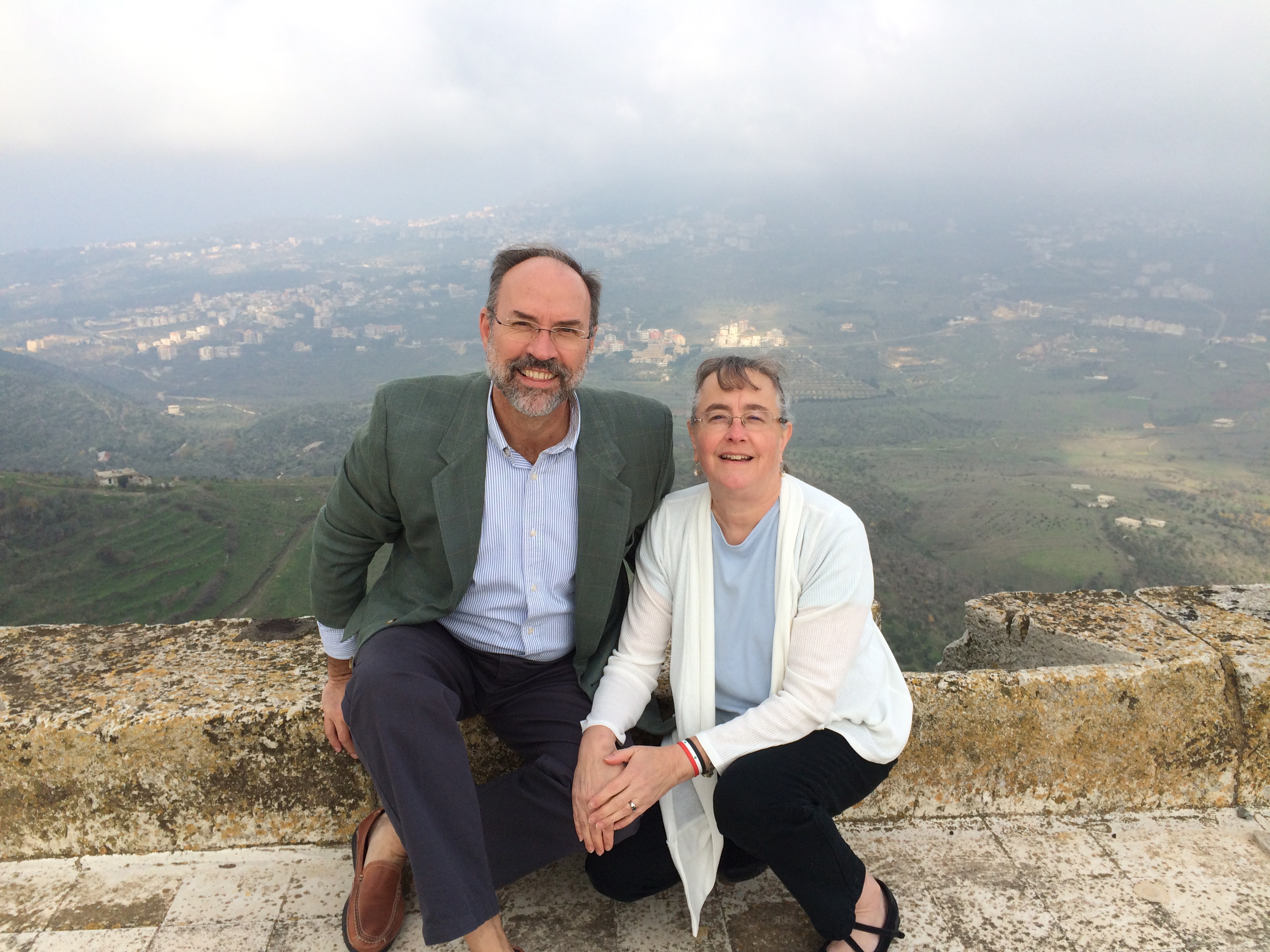
Steve and I on the top of the Krak de Chevaliers, Wadi al Nassara, Syria, November, 2014.

Steve and I on the top of the Krak de Chevaliers, Wadi al Nassara, Syria, November, 2014.

First on my list is my husband, Steve, who is standing in the kitchen chopping vegetables for a savory bread dressing, a staple of the meal that goes with this day. I am thankful for the miracle he is in my life; not looking for a life mate, our paths crossed fourteen years ago and here we are today. Sharing life. Sharing love. Sharing joy and sorrow. ‘Til death do us part.


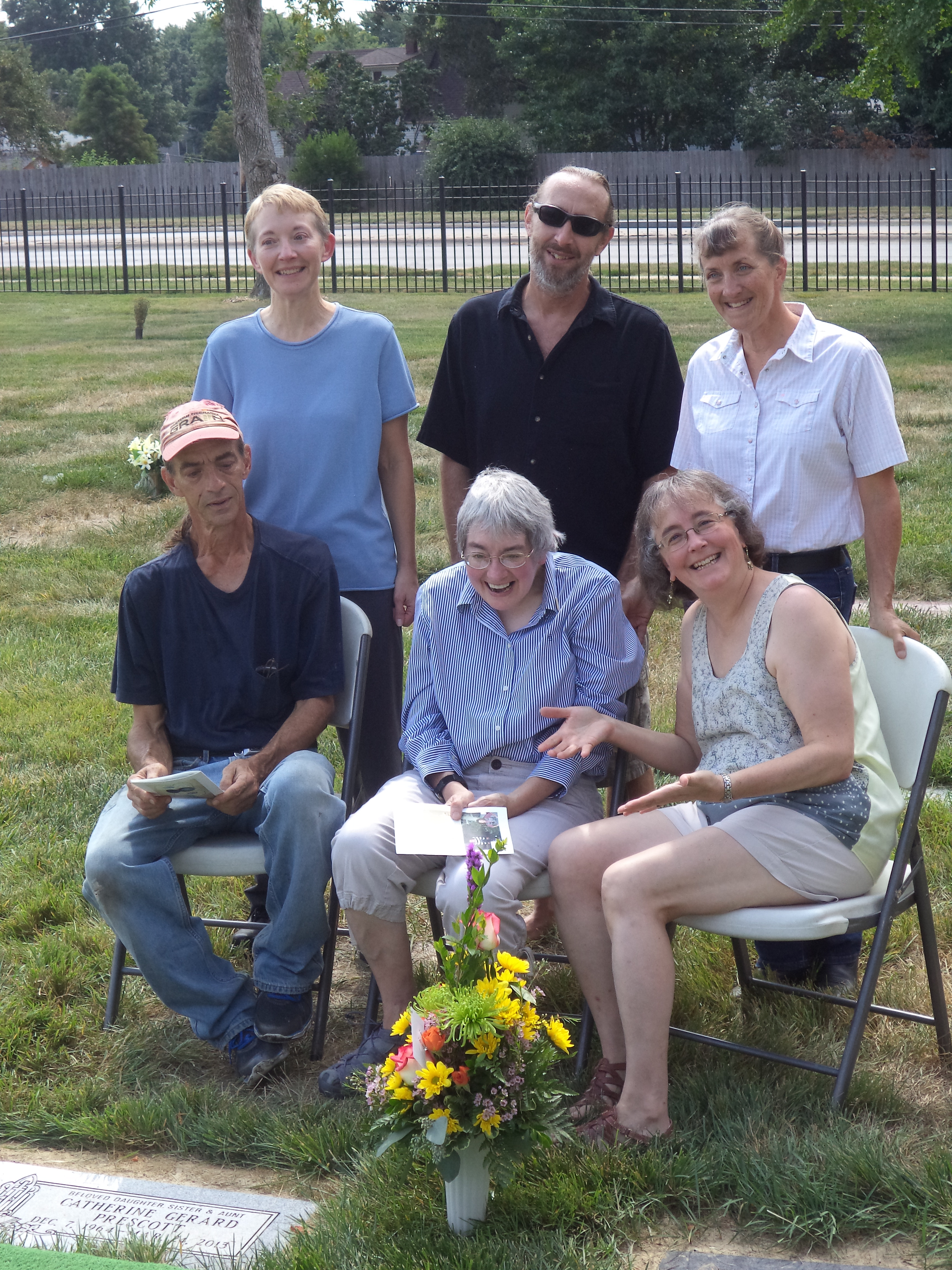
Six siblings at the memorial service for the seventh, our baby sister Cathy.

Six siblings at the memorial service for the seventh, our baby sister Cathy..

I am thankful for brothers and sisters who have walked through the hard times of head injury, of broken marriages and of new marriages, of loss through disease and grievous loss through crime. We once were seven, and now we are six, but the six remain a unit bound together through love. We are family.

I am thankful for friends who open up the world as a place to experience God’s glory and his grace. They encourage. They grieve for, mourn with, and on the other side they celebrate in joy. They are faithful women. They are lay and clergy – men and womenI am thankful for friends who open up the world as a place to experience God’s glory and his grace. They encourage. They grieve for, mourn with, and on the other side they celebrate in joy. They are faithful women. They are lay and clergy – men and women.

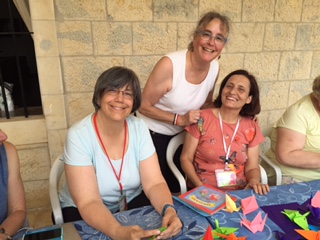
Flanked by Rev. Kate Kotfila of Cambridge, New York, and my new friend Mahsen, from Hasakeh, Syria, we fold peace cranes together.

Flanked by Rev. Kate Kotfila of Cambridge, New York, and my new friend Mahsen, from Hasakeh, Syria, we fold peace cranes together.

They sing. They dance. Their tears flow with mine. Their laughter is a symphony. They will go anywhere. They will do anything. Even when it is so hot the sweat pours off their faces; even when they are drinking their tenth cup of deep, dark, sweet Arabic coffee when they would rather have an iced tea. They will venture to places that cause people to say, “You are so brave!”, even when they know it is not their courage, but the courage of others that draws them into participation in life because they know where real courage comes from.

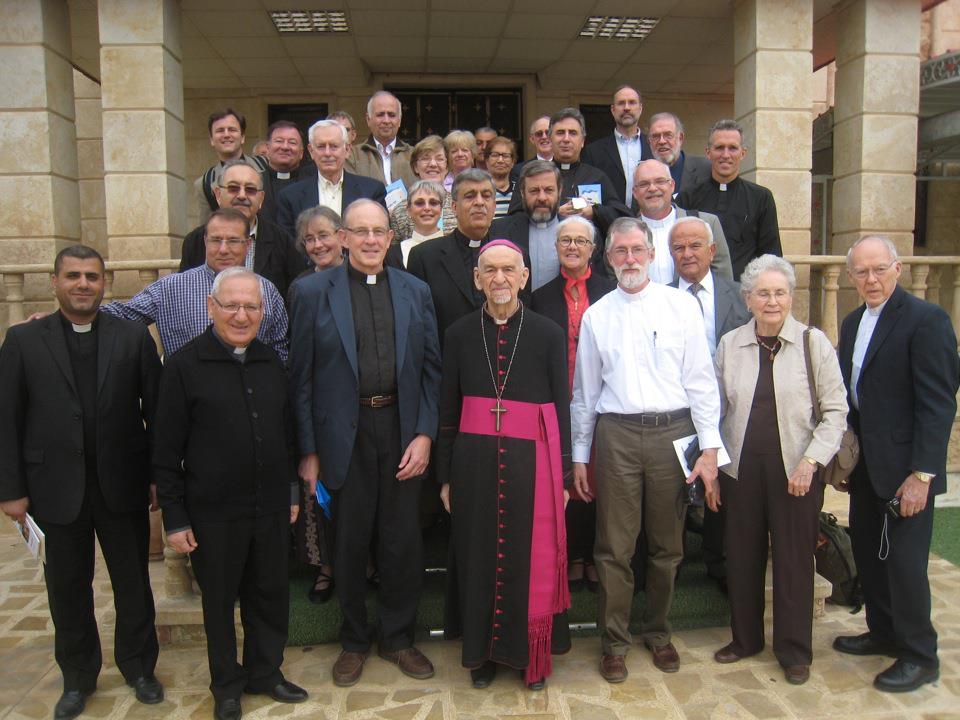
Kirkuk, Iraq, November, 2012, with The Outreach Foundation. The gentleman in the front row, second from the left, is now the patriarch of the Chaldean Catholic Church, His Grace, Louis Raphael Sako.

Kirkuk, Iraq, November, 2012, with The Outreach Foundation. The gentleman in the front row, second from the left, is now the patriarch of the Chaldean Catholic Church, His Grace, Louis Raphael Sako.

I am thankful for the church I have come to know in Lebanon and Syria and Iraq. I am thankful that when I say I believe in God the Father almighty, and in his son, my savior Jesus Christ, and in the Holy Spirit who is my guide and comfort, that I say it in community with the saints of old and the saints of now. They are embodied in Catholic, Orthodox and Reformed congregations and the faith and courage and perseverance they model every day in the midst of war and terror and death is a reminder to me of what it means to follow this triune God. He does not promise us life without loss, but he does offer us life abundant. And when I see how abundant life is in the church in these hard places, I have seen this promise lived out daily.

I am thankful for grace. For I have deserved it not, earned it not, purchased it not. But it has been freely given at great cost.

Happy Thanksgiving.

Dona nobis pacem.

Welcomed to the table

I learned a Greek word last week in Bible study: prosdechomai.

Now that I am not working but anticipating heading back to school in January, I started attending this wonderful gathering of women on Thursdays at church with my sister Jana, who has been going for over twenty years. There is always a delicious spread of food to feed our bodies even as our souls are fed on the word. This is an experienced group of Bible students and they are being led by three gifted teachers this year who are all friends of mine. Lou and Jackie and Jessica have taken us through 2 Peter, 1 and 2 John, and this past week, 3 John.

Lou took us through this short but meaty epistle where we met three men known by John and actually named: Gaius, Diotrephes and Demetrius.

The word – prosdechomai – was associated with something Diotrephes was not doing. He was not welcoming, not receiving, early missionaries into his home as they traveled with the good news. Indeed, he was even putting people out of the church who did open their homes. We had a good discussion about hospitality in the church, especially as it pertained to those who come to our church from other places to tell the stories of how God is working in this world. In a large church of 750, we have a hard time getting 25 to come to a lunch to hear what they have to say. We chewed on that a bit. And John says in verse 11: “Beloved, do not imitate what is evil but imitate what is good.” Don’t be like Diotrephes!

And then on Sunday, just three days later, we dove back into Luke 15 and the story of the prodigal son as our pastor Derek continued his two-part sermon about “the gospel within the gospel.”

Luke 15 starts out this way:

Now all the tax collectors and sinners were coming near to listen to him. And the Pharisees and the scribes were grumbling and saying, “This fellow [Jesus] welcomes sinners and eats with them.” (Luke 15:1-2 NRSV)

As I first heard from Lou, and was reiterated through Derek who was using a Ken Bailey book (The Cross & The Prodigal) to guide his sermon, the Greek word dechomai means to receive. With the prefix pros- added to it, the meaning becomes deeper: to welcome into fellowship.

So here is what causes the grumbling from the righteous: that Jesus would not only welcome the unrighteous (me and all the rest) for conversation, but that he would go even further and eat with them. He would fellowship with them.

And, of course, we know this from coming to the Lord’s table for the Lord’s supper in communion. This group of unrighteous, undeserving sinners – we the people – are invited to sup with the Lord God almighty.

It is an amazing thing. God invites to his table in fellowship those whose sins have nailed him to the tree. His enemies. Us. Grace at the table of the Lord.

This word came to me in an interesting time. There have been ISIS bombings in Baghdad, in Beirut, in the air over Egypt as a Russian airliner was taken down, and in Paris. And the big message that I have heard is that our country is now wary of Syrian refugees. Somehow the work of a very small group of radicalized terrorists has caused governors in our country (mine included) to say, “No. There is no prosdechomai for the fleeing victims of terror in our state. They might be our enemies.”

And as I walked yesterday and the day before thinking about this word – prosdechomai – a picture from 2010 came to my head and my heart.

August, 2010, Aleppo, Syria (before the war) – Nine women had traveled to Lebanon and Syria on a trip to meet and learn about our brothers and sisters in the National Evangelical Synod of Syria and Lebanon. We worshiped with Middle Eastern Christians. We laughed with them. We baked in the sun with them. We had our minds and our hearts and our world expanded by this family connection we now had experienced.

While in Aleppo for three days with the church there, we had the humbling opportunity to visit in the homes of Iraqi refugees who were being cared for by the Aleppo church as they waited for new homes in other parts of the world.

Why were there Iraqi refugees in Syria? Because the U.S. government had invaded their homeland in 2003. Faulty intelligence that said Iraq was responsible for harboring Osama bin Laden, a friend of Saddam after all, right? Faulty intelligence about weapons of mass destruction. Faulty, faulty, faulty. And Iraqi families paid a heavy price.

They were in Syria, chased out of their homes in Iraq because we had unleashed Armageddon on them. And so they sought refuge, and they found it in Syria.

And so it came to pass that nine American women were invited into the homes of three Iraqi families. Three families with nothing. Scare furnishings in their homes, donated by Aleppo church families. They were surviving on what was left of the savings they ran from Iraq with, much like what is happening today in Syria and Iraq.

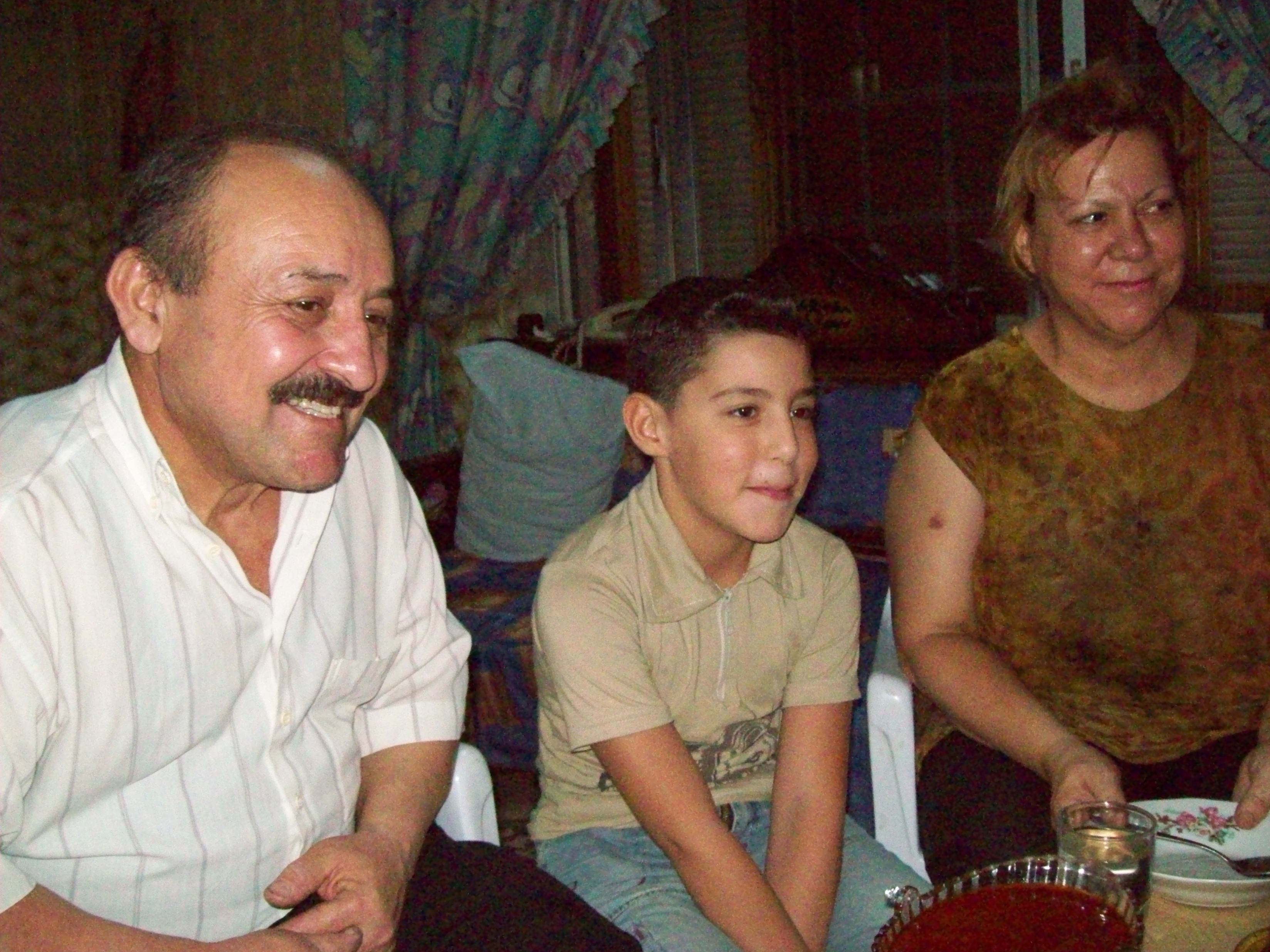
The Aziz family, refugees from Iraq living in Aleppo, Syria, August, 2010.

The Aziz family, refugees from Iraq living in Aleppo, Syria, August, 2010.

My group of Betty and Sue and me was prosdechomai-d by the Aziz family. And there we sat – sumptuous meal in front of us, tea and coffee and sweets – with people driven out of their homes by the actions of our government, the actions of we the people.

Grace at the table. Prosdechomai.

In his book The Irresistible Revolution: Living as an Ordinary Radical, Shane Claiborne says this in a footnote about a story of being in Baghdad during the U.S. invasion:

That night in Baghdad, I read Psalm 23. It’s the one folks usually read at funerals: “Though I walk through the valley of the shadow of death.” And I felt like I was. But I noticed something I have never noticed before. The psalm says that a table is prepared “in the presence of my enemies.” I remember thinking, why are our enemies there? What if after we die, God brings our enemies to the table and asks how we treated them? What if Jesus asks them, “Shane here claims to follow me. Did he love you? Did he feed you and pray for you like I taught him to?” What would our enemies say?

The story of the two sons and the loving father told in Luke 15 ends in an open manner. The father has killed the fattened calf for his younger son who earlier in the parable wished his father dead. And now he calls the older son, who in his righteousness also wishes his father dead, to come to the table. Is this not a setting of table in the presence of his enemies? Two brothers, both sinners, both wanting their father dead. But there is the father desiring to prosdechomai with both.

And so in a week of learning about prosdechomai from the word of the God I love, I believe, I humbly and haltingly try to follow, I thought of the Aziz family. I thought of how they welcomed enemies to the table and ate with us.

And I pray that we will do the same.


A prayer to open a new door


So grateful to be accepted to this program, here is my letter of application:

My name is Julie Prescott Burgess and I am applying for acceptance to the master of arts in ministry program at Creighton.

By way of introduction, I am 56 years old, married for thirteen years to my beautiful Steve, and live with and care for my head-injured older sister Jana, who is one year older than me. She was hit by a train 32 years ago in Longmont, Colorado. It was a turning point in her life and mine as well.

Baptized in the Roman Catholic church shortly after I was born before Christmas in 1958, I made my first communion in the second grade. It’s a moment that marks my life in many ways. My mom had died a few months earlier leaving seven children with my dad, ages nine to fifteen months. I was seven. On such an important occasion in the life of a young Catholic girl, I was enveloped in the love of the Servants of Mary who were teachers at Christ the King School where we attended. Being a shy, introverted young one without a mom, three wonderful sisters took me to get my hair done, took me out for lunch, and hustled me out of mass later that evening as the gravity of approaching the altar to receive the body of Christ caused me to get nauseous. Those same three women brought me back to the rail after mass was over so I could receive communion for the first time. One of those nuns was my first grade teacher, Sr. Mary Amy, whom I recently became reacquainted with through my blog. Her name is Joyce Rupp and she is quite a leader for those seeking a deeper walk of faith. The first word I remember learning from her was SURPRISE. It was a lesson that stuck with me and in our correspondence, she said she remembered it too.

I tell you that story because it was a marker in my life. Surprise. Remember. Communion. Those three things are the descriptors of my life.

Two months ago I left my position at West Hills Church here in Omaha, where I served for thirteen and half years, the last ten as the church administrator. I was called to employment there by an amazing pastor who mentored me, discipled me, pastored me and was my friend. He died in November, 2012, four days after I returned from my second trip to Iraq to be with the Presbyterian church. Because of George’s belief in me, I found the strength to step out of Omaha and travel all over the world to experience the church in many contexts.

I spent time in southwest Germany, including a short stay with a German family. As a group, we celebrated Corpus Christi Sunday. Even though we were there with the protestant church, the local Catholic priest gave us all the opportunity to receive communion. As a baptized Catholic, but now a member of a Presbyterian church, I thought this was a wonderful moment of communion and community. It was a surprise!

I had the opportunity to travel to Cameroon in west Africa twice, spending time with the Presbyterians there whose church was founded by German and Swiss missionaries. In those travels I met a Cameroonian Sunday school organizer, almost exactly one year my senior. Joe had only a fourth grade education, but he had a call to be a pastor. With the prayers of my family – husband and sister – we managed to see him through four years of seminary, and he is now ordained. As two families – one Cameroonian, one American – we walked this journey together. Surprise! Communion. And I remember.

And then the Middle East happened. I traveled first to Lebanon and Syria in the summer of 2010. Although it was to learn about Presbyterian churches started in those places in the 1850s, we had amazing meetings with Greek and Syrian Orthodox clergy. I met Syrian Archbishop Yohanna Ibrahim in Aleppo, a man who was kidnapped in April, 2013, and has still not been heard from. My nightly prayer is for his release. I met Iraqi refugee families who were being cared for by the Presbyterian church. I ate dinner in the home of the Aziz family and heard firsthand of the devastation of our 2003 invasion on their lives. But I also experienced the hospitality and faith of this Syrian Orthodox family. Surprise. Communion. I remember.

I have traveled back to Lebanon and Iraq and Syria a total of eight times. And each time I come away convicted that the most important word in the Bible is “with.” I have spent time with the church – the body of Christ – in worship, in fellowship, in communion. I stood on the Chaldean Catholic Church rooftop in Kirkuk, Iraq, with the man who is now their patriarch, Louis Raphael Sako. As we stood there and looked around, he reminded us that there were snipers in the buildings around us and we needed to be careful, but he stood there with us so we could pray for that city. When we presented him with the gift of a crystal cross, he remarked that it was fragile, like their hope. His honesty in that moment was a surprise, and he shared that candor with our community.

All these surprises, these moments of community, these memories, have weighed on my heart in the last two months. My friend Kathy Padilla called me one day a few weeks back and suggested that this program would be a good fit for this Catholic Presbyterian blogger traveler whose heart is just longing for God’s peace to reign. I said, no, I was too old. And then I went back to Lebanon…

In the waiting for a visa to return to Syria to once again be with the church there in this very difficult time, I had one of those surprising moments of community with the now retired president of the Near East School of Theology, the seminary in Beirut. Her name is Mary Mikhael and although now a Presbyterian, she grew up in the Greek Orthodox Church. As a small girl, she wasn’t allowed behind the iconostasis like the boys, so she crawled through a barred window at every opportunity to see what was back there that girls couldn’t see. Mary has had an amazing life of ministry since those days, and there was no barrier put in her way that would keep her from her call to serve. The only barrier in front of me is, well, me. In that moment, I knew I would apply.

And so I am. I hope this letter isn’t too long, but I wanted you to know some touchpoints in my journey of faith.

I have come to know and love a cloud of witnesses who have helped me put hands and feet to my faith. People like the al Saka sisters, formerly of Mosul, driven from their home last July by ISIS. Their brother was murdered by extremists in 2006, and they took as their duty the protection of their church for all those years until they had to leave. People like Rev. Ibrahim Nseir and his wife Tami of Aleppo, whose church building was destroyed in 2012, but have held it together and continue to meet in a fifth floor apartment with no water or electricity. Hope exudes from them as they are about to complete a new church building in a city that has been 60% destroyed by war. People like Elder Zuhair Fathallah in Basra, who has led his church for almost ten years since their last pastor left and leads a small but mighty band of disciples in a kindergarten ministry where 98% of the students are Muslim. People like Mazar, a man who still lives in Homs, Syria, who tried to stop the assassination of Fr. Frans vander Lugt, the Dutch Jesuit priest who was killed right before the siege of this city was lifted in the last half of 2014. I had the humble privilege of praying at his grave in the courtyard of the Jesuit monastery, where a small group of people were feeding up to 2,500 people a day who had returned after the siege ended. This cloud of witnesses inspires and encourages me to step out in this way.

I want to come to Creighton to study ministry. My mom graduated from CU in 1955, and sixty years later I think she would be so happy to know that one of her seven has chosen this path. I want to study in a Jesuit institution and serve wherever God calls me. I want to be a link between Catholic and Protestant to remind us all that we are parts of the same body and we can’t say we don’t need one another, because we do. I want to continue to learn and to travel in God’s world and bring back the surprising stories of his people. I want us to know and remember the saints who came before and the ones living now in difficult places. I want to bring those too tired or sick or disadvantaged to the communion rail.

If God opens this door for me, I want to walk through it.

Thank you for your consideration.

Peace, always peace,

Dona nobis pacem: rest stops

H.W.S. Cleveland was a landscape architect of the 19th century, and as I have been walking through my own neighborhood these past two months, I have come to appreciate how he helped my city develop some beautiful parks.

I live on Happy Hollow Boulevard, part of the system of city streets that were planned to link the Omaha parks together. Happy Hollow winds beautifully along two of the bests parks in Omaha: Elmwood and Memorial. And in my daily steps along the sidewalks and paths, I have come to find rest stops for my journey.

IMG_1980

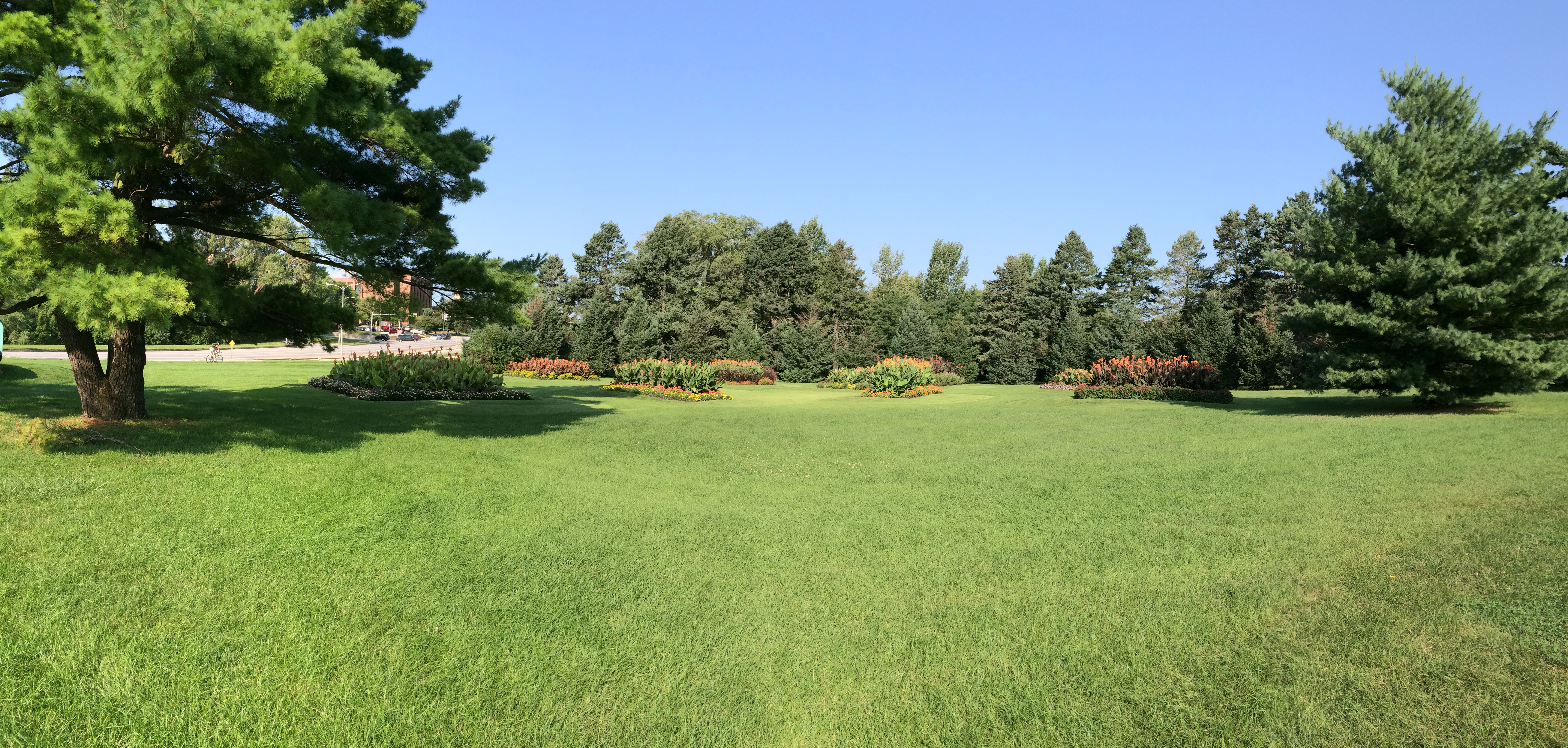
A panoramic view of Memorial Park facing west from the path.

IMG_1967

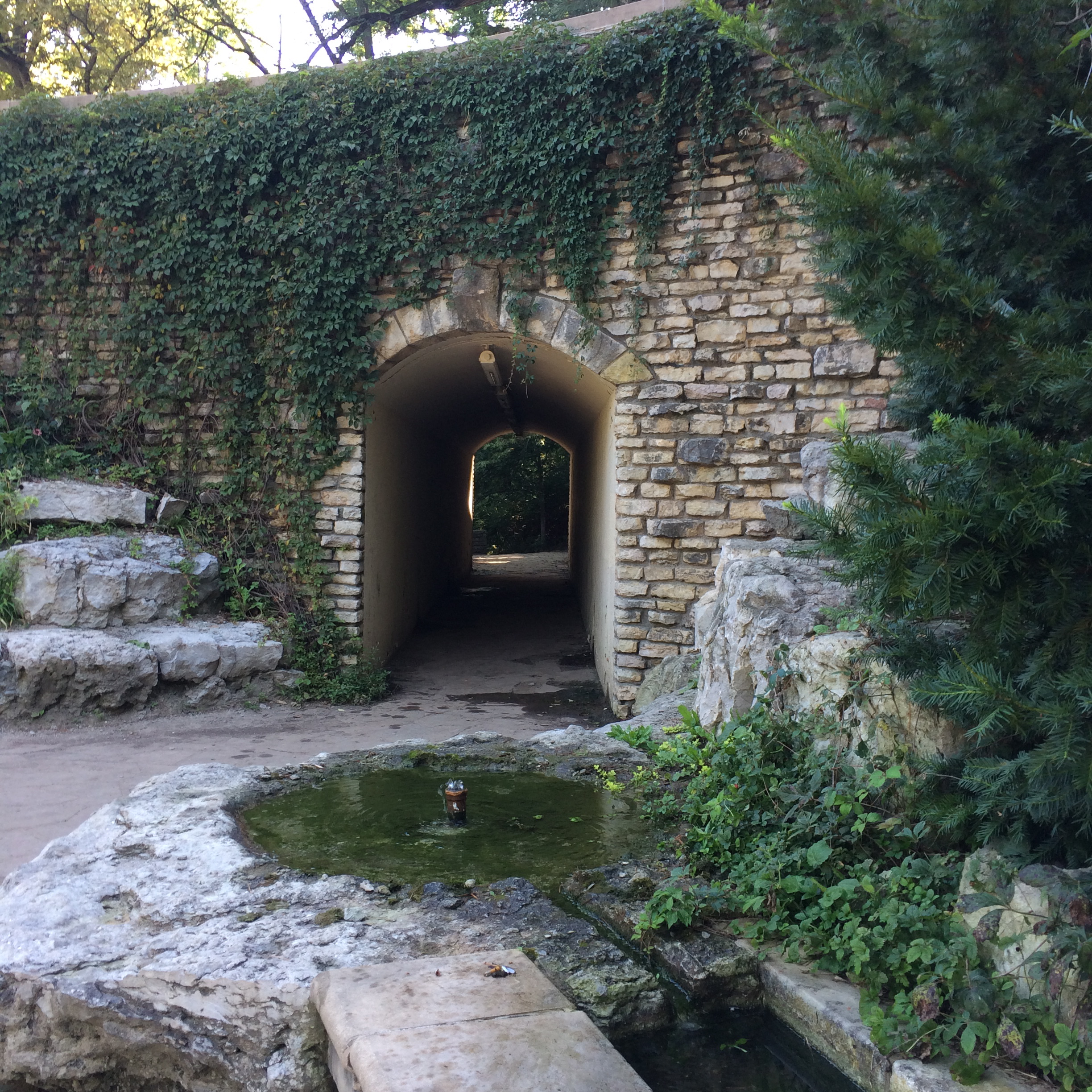
The grotto at Elmwood Park with its natural spring running through the channel.

“He leads me in paths of righteousness for his name’s sake…” goes the 23rd Psalm. Beside still waters. Green pastures. All these things are in this amazing section of Omaha that I find myself wandering through.

As I think about my friends in Syria, Lebanon and Iraq, or my family in crisis, walking has become a prayer time for me as I put one foot in front of the other, and doing it in green pastures with still waters and carefully planted trees and flower beds, is a reminder that this God who made and loves us all, is there with me at each step.

Between the two parks is my college alma mater, the University of Nebraska – Omaha. As I walk through the campus, I have found other places that also remind me of how God has unique ways of encouraging me on this daily journey as I seek his pace, his peace.

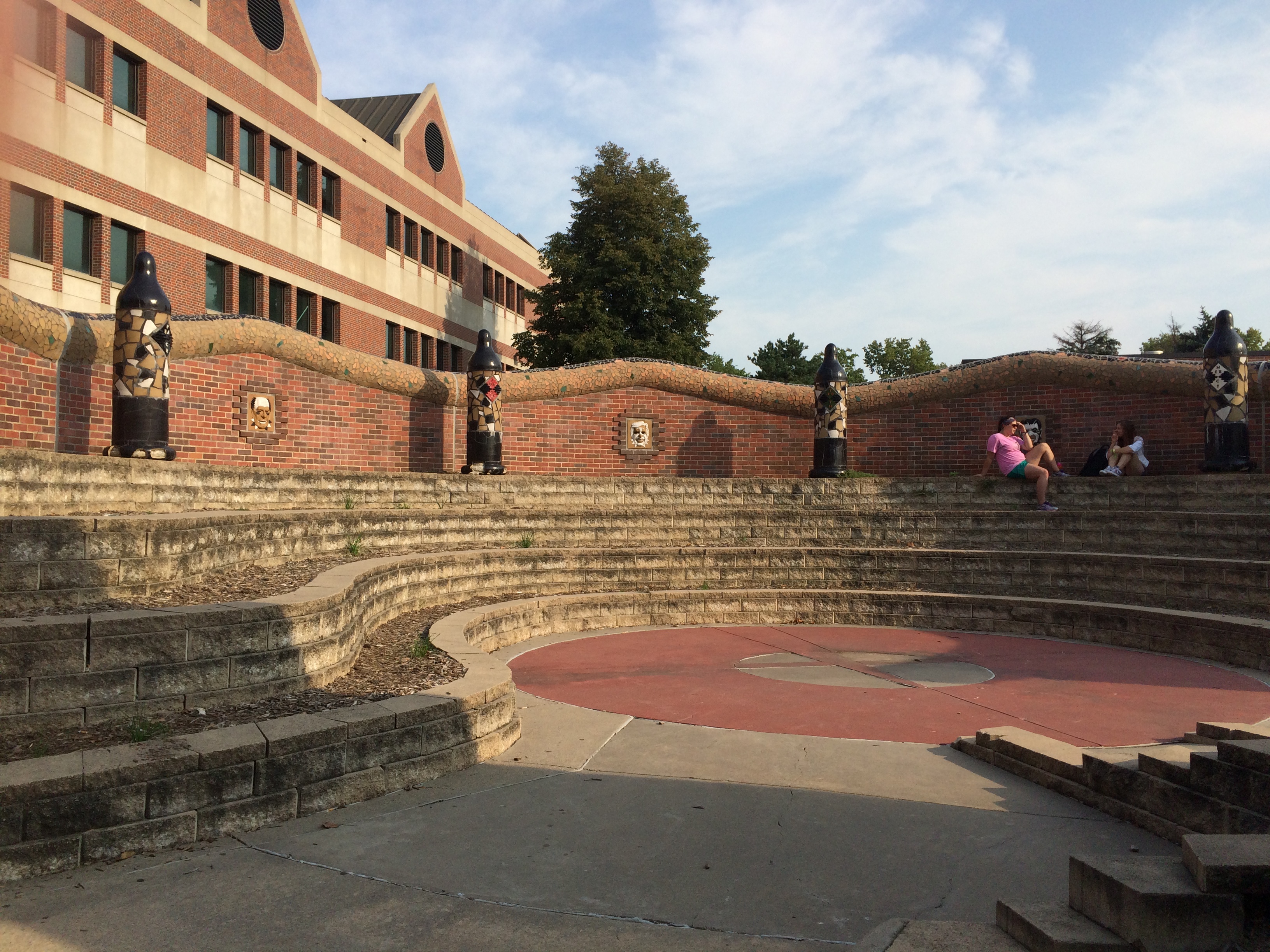
IMG_2007There is the Castle of Perseverance, an outdoor amphitheater designed by Andrew Leicester of Minneapolis. I came upon it one day several weeks back as I chugged uphill from the College of Fine Arts, and the first thing I saw was this: the word peace on a missile-shaped sculpture. I followed the semi-circle around and found justice, mercy and truth to complete the set. “Act justly. Love tenderly. Walk humbly.” My six-word reminder from Micah 6:8 was echoing through my head.

IMG_2011This place also brings Romans chapter 5 to my mind, a scripture shared at my father’s memorial service and one that speaks to my heart about the church in the Middle East that I have been humbled to walk with:

Therefore, since we have been justified through faith, we have peace with God through our Lord Jesus Christ,  through whom we have gained access by faith into this grace in which we now stand. And we boast in the hope of the glory of God.  Not only so, but we also glory in our sufferings, because we know that suffering produces perseverance;  perseverance, character; and character, hope.  And hope does not put us to shame, because God’s love has been poured out into our hearts through the Holy Spirit, who has been given to us. (Romans 5:1-5 NIV)

Song

Suffering, perseverance, character, hope. Steps on the journey of the family of God in Syria, even as I write this. Never have I seen a people who model hope in such times of suffering.

Or walking south through campus as I approach the east side of the soccer stadium I found “Song,” another art piece, many of which are sprinkled around this urban campus. With my earbuds bringing “All to Us” by Chris Tomlin into my head and heart, all I can do is sing aloud, just like the little bird:

Precious cornerstone,
Sure foundation
You are faithful to the end.
We are waiting on you, Jesus
We believe you’re all to us.

sounding stone brokenness

Walking down the hill and into Elmwood Park, past students scurrying up the hill to class, I come up the east side of the park and find the Sounding Stones, which I’ve written about before, Sounding Stones. Brokenness. Humility. Submission. Simplicity. Community. Each of those is part of our journey, my journey. And each one invites a prayer. My prayers for peace – dona nobis pacem – are so centered in that stone of brokenness these days.

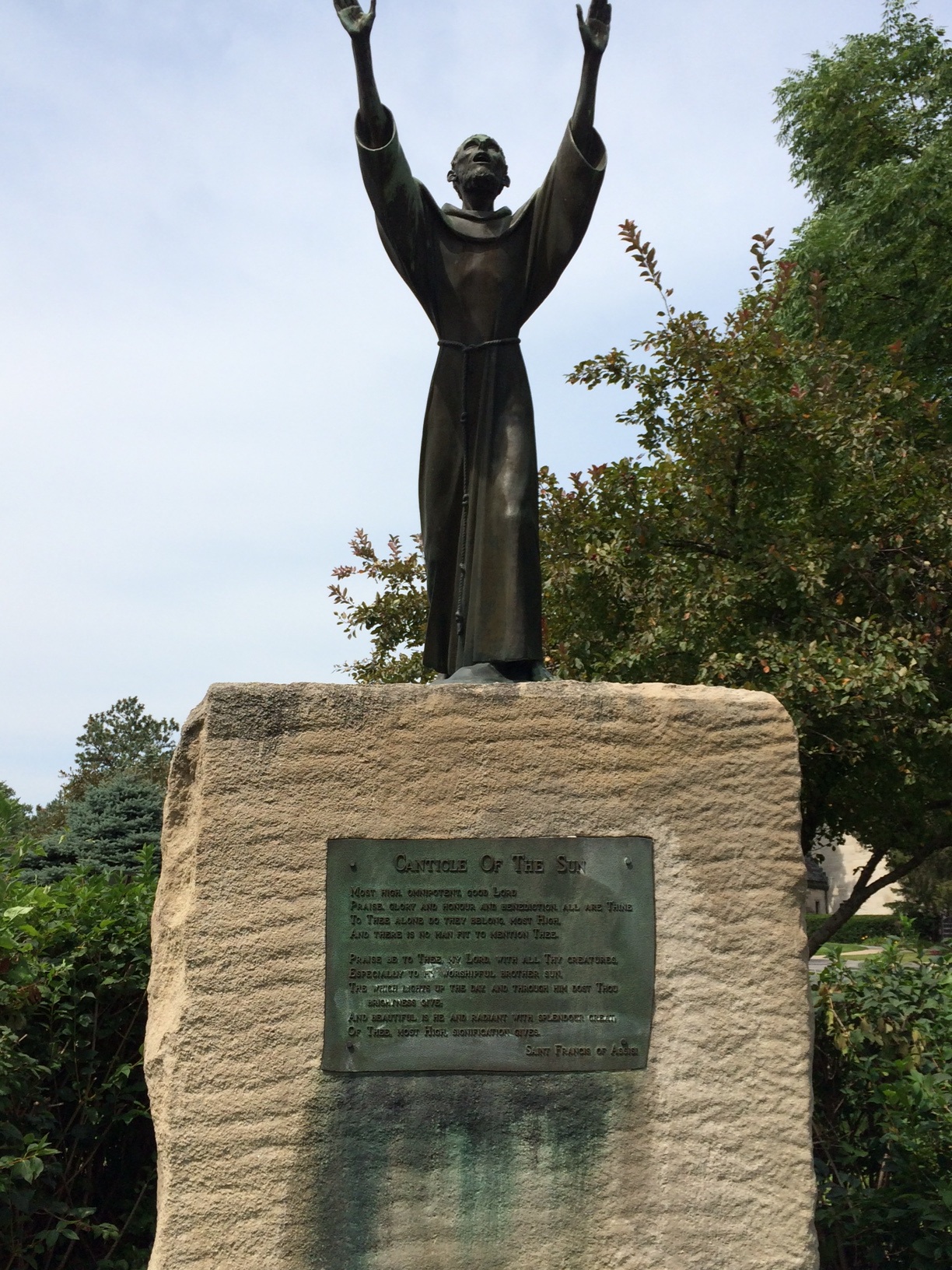
St Margaret Mary's PeaceAnd if these special rest stops on the journey don’t invite me into peaceful places (which they do), there is yet another spot I can wander between the two parks. Saint Margaret Mary’s Catholic Church stands facing the university from the north side of Dodge Street, right next to Memorial Park. If the words carved into its entryway aren’t enough to remind me of God’s peace, the sweet statue of my favorite saint, Francis of Assisi, is there, too. And though the words on his statue there are the canticle of Brother Sun, the ones he is speaking to me are, “make me a channel of your peace.”

St Margaret Mary's St FrancisShalom.

Salam.

Pace.

Paz.

Peace.

Whatever language the word is spoken in, I want to be a conduit of peace. Let my words speak it. Let my actions be its witness. And I am so grateful for these reminders in these rest stops along the way – in green valleys, in still waters, in righteous paths.

Dona nobis pacem.

Amen.


More walking memories

Walking is good! Walking is good for me! That is my mantra as I head out of the house, trying to find the cool of a warm Omaha day. It continues as heat builds up in the air and in my body as I take another step. And another. And another.

Today it was shorter because I headed out later in the day. 2.3 miles up to St. Margaret Mary’s where the kids were out for recess in their green and plaid uniforms, running and tossing a frisbee on this bright, sunny day.

I remember recess, and I even remember having it while wearing the brown plaid uniform of Christ the King school. And that is one of the things I thought about while walking this afternoon.

Of course, I can take those long-good-for-me walks because I am kind of living in a recess right now, although I prefer to think of it as a sabbatical. It’s not a permanent recess from work, because eventually I will do that again, even as I try the waters of grad school. Providing they let me in. Creighton? Anyone?

And those memories that come up as I take each of those steps in a 2.3 or 3.5 mile walk just flood in. The other day they took me back to the summer of 2001, or as I like to think of it, “The Summer of Steve,” the grand romance of intrigue and dating and love that led to our marriage. I learned so much that summer about Steve and about myself, and I continue to learn as we live out these days together.

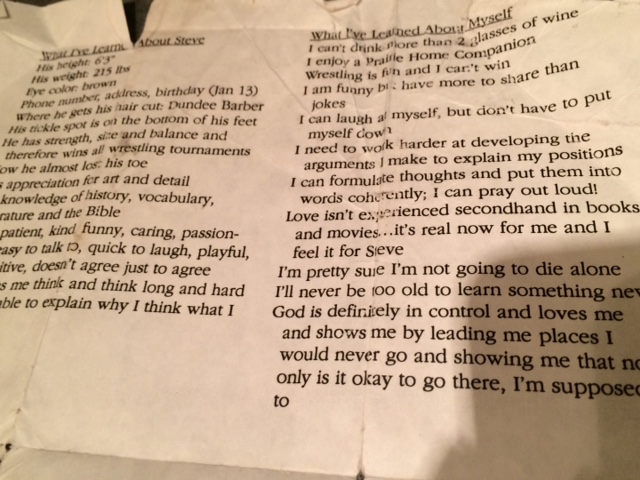
What I've learnedAnd so today I am going back into that basket of written memories to share another. I actually made a list of what I learned that summer. It is a bit shredded and worn now (I must have referred to it a lot!), but they were good lessons and it was a gift to find it and read it and to share it with Steve. He has been a great teacher.

What I’ve learned about Steve:

  • His height: 6’3″
  • His weight: 215 lbs
  • Eye color: brown
  • Phone number, address, birthday (Jan 13)
  • Where he gets his hair cut: Dundee Barber
  • His tickle spot is on the bottom of his feet
  • He has strength, size and balance and therefore wins all wrestling tournaments
  • How he almost lost his toe
  • His appreciation for art and detail
  • His knowledge of history, vocabulary, literature and the Bible
  • He is patient, kind, funny, caring, passionate, easy to talk to, quick to laugh, playful, inquisitive, doesn’t agree just to agree
  • He makes me think and think long and hard and be able to explain why I think what I think

What I’ve learned about myself

  • I can’t drink more than two glasses of wine
  • I enjoy A Prairie Home Companion
  • Wrestling is fun and I can’t win
  • I am funny but have more to share than jokes
  • I can laugh at myself, but don’t have to put myself down
  • I need to work harder at developing the arguments I make to explain my positions
  • I can formulate thoughts and put them into words coherently; I can pray out loud!
  • Love isn’t experienced secondhand in books and movies…it’s real now for me and I feel it for Steve
  • I’m pretty sure I’m not going to die alone
  • I’ll never be too old to learn something new
  • God is definitely in control and loves me and shows me by leading me places I would never go and showing me that not only is it okay to go there, I’m supposed to.

I wrote that at the ripe old age of 43. “I’ll never be too old to learn something new.” I’m 56 now and still learning.

Still learning what it means to love and be loved by someone like Steve. It’s a gift every day that I gladly receive.

Still learning to take in information and wanting to learn about complicated things like Middle East politics.

Still experiencing the joy and the power of praying, even out loud when necessary.

Still following God in the journey he has taken me on to Lebanon and Syria and Iraq and knowing it is where I am supposed to be.

Yes, I still know that I will never win a wrestling match with Steve. But I am reminded as I walk in this recess of my life, I am so glad that we still do. We wrestle with what it means to use the resources God provides to serve him. We wrestle with the news of the world and how we treat each other in such horrible ways. We wrestle with why families who look just like us in every aspect of our lives can be suffering the atrocities of extremist ideologies. We wrestle.

But we also pray, out loud, with each other every day, because in the wrestling matches of this life, we are knocked to our knees.

So, yes, walking is good for me. And today, I remember how much I love and how much I have learned. And I think about my teacher, my husband, my Steve.