Fathers loved. Fathers lost.

Easter Sunday, 2007. Daddy is on the far right of the couch in the light blue shirt.

Easter Sunday, 2007. Daddy is on the far right of the couch in the light blue shirt.

I lost my dad on April 23, 2007. As a family, we knew it was coming because he had decided to stop dialysis after one year. Three days a week he was tethered by tubes to a machine for four hours. The machine would do the work his kidneys could no longer accomplish due to the ravages of diabetes. A good man of sound mind, he made the decision for himself. As his children we were glad he could make this decision, but we knew it would mean we would no longer have him and his sense of humor and his love for high notes.

We were all by his bed in the hospice house when he took his last breath. We had been sitting with him for thirty hours, rushing there when the nurse told us to come. He wasn’t awake. His breathing was labored. The end was coming. It was the most precious time we have ever had as brothers and sisters with this man who had brought us up day by day. Since Mom died in 1966, it was his love and persistence and faith that held us together without her, and it was that same love and persistence and faith that brought us to his bedside for that very long night.

He donated his body to the medical center and a whole group of young doctors-to-be learned about the anatomy of a human body from him. I am most positive that they were even able to identify his funny bone, and were amazed by the make-up of his vocal cords, even though they never heard him nail a pun or sing “Danny Boy.”

We lost him that early Monday morning eight years ago. And as I was supposed to receive his ashes back after the anatomy department was finished with him and then never did, I thought, “Well, I guess he won’t get to lay next to Mom at Calvary Cemetery.” It was okay. I knew where he was and that Mom was there with him, rooting us all on in the lives we had left to lead.

And then Daddy came back to me.

My stepmother had apparently been the recipient of his ashes back in 2008. She recently passed away and my sister-in-law asked me what to do with Daddy’s ashes.

“You have them?” I asked, astounded at the information.

“Yes. We can put them in with Pat, or you can have them back,” was her end of the conversation.

Knowing that my sisters and brothers would, like me, want them with Mom, I asked for them back.

My lost father is now in my laundry room. I need to convince the cemetery to let us bury them with Mom and our sister Cathy, who are resting side by side. Again, I know my dad’s essence is not in those ashes. Mom and Cathy are not in the ground. They are all living in heavenly glory, free of the grief and pain and troubles on this side of life.

But there is a place we can gather as a family when we need to to remembere them together.

There was no impediment to us gathering to sit with Daddy in the moment he passed. Some had to come from miles away, but good roads and peaceful times make roads shorter.

And I think sometimes we take that for granted. It’s 2015, for Pete’s sake. There is nothing hard about traveling from one side of this big country to the other.

I pray that it would be that easy in other parts of the world.

My friend Hala lost her father this past week.

IMG_0019I pieced it together from the weirdness of Facebook’s Arabic translation and the photos Hala had posted of her dad and her on her wedding day and when she was a child. It became very clear when I saw photos of his service posted from the church in Aleppo, Syria. I knew it was Aleppo because Assis Ibrahim was in the pictures. Again the Arabic translation indicated that the coffin pictured contained the earthly remains of a person named Bitar, which is Hala’s last name. It was confirmed when I exchanged messages with this dear sister in Christ.

And so I am grieving with and for Hala and her family. Grieving for the loss of a father, something I know well.

But my grief for her is compounded by the circumstances of this death. You see, Hala lives and works in Beirut. She is an amazingly gifted and educated teacher at the Beirut Evangelical School for Girls and Boys. She teaches religion and leads chapel services for students who are Christian and Muslim. I have been the recipient of her gift of teaching as she led our summer group of women in a study of the book of Ruth.

Hala lives in Beirut, but she is from Aleppo, and that is where her parents live.

Aleppo. Syria. Where war has destroyed 60% of a city of two million. There are no safe roads in or out.

And so where me and my brothers and sisters could gather at my father’s bedside in response to a phone call in the middle of the night, Hala could only pray and grieve from a distance. It used to be only a few hours’ drive from Beirut to Aleppo. Now, it is a journey that is impossible.

I am grateful that there was a church community to celebrate the resurrected life of Edward Bitar with his family still in Aleppo. There was the family of God to grieve his loss in Hala’s absence and to comfort her mother as the man who said, “I do, in sickness and health, in good times and bad, till death do us part,” was laid to rest. These are the tender mercies of life in Christ.

But sitting in my home, eight time zones west of Hala, I grieve with her. And I share the deep feelings of loss as a beloved father is gone. I wanted Hala’s words to be in this essay and I take comfort from her description of her father. I see in her words that she loved him as the father and teacher and faithful man he was. So hear my sister’s voice:

My father’s name is Edward Bitar, and my mother is Najah. We are four in the family, Amal, Bashar, Manar and me. My father was more than a father, he was my example of faith and love. He never received a day without the Bible in his hand, and never ended a day without having his knees down to the ground praying, asking for blessings.

He was a teacher, but not like any teacher I ever met. He taught English, he dedicated his time to his students and us. He used to go around from one library to another to check out new novels and we were his first audience and listeners.

As a woman living in the Middle East I was raised by one of the most well educated and open-minded persons. His dream was to see me and my sisters happy, but happiness had to be through finishing our college degrees and continuing education. I shocked him when I decided to study theology, but knowing I will dedicate my life to serve God gave him extreme joy. He used to tell me whenever he used to see me tired and depressed, “Hala, you are serving a powerful lord, depend on Him and he will be beside you.”

His memory, his picture, his smile, his hands touching my face and head will never leave my eyes. His spirit is a source of joy, and I will never forget him. Having a father like him was so helpful to understand the meaning of the word “the fatherhood of God.” I will never forget him Julie. I will never.

Fathers loved. Fathers lost. Tender memories of times shared and lessons learned.

My prayer for Hala is that peace will return to Syria, and the road from Beirut to Aleppo will be as in the days of her childhood. That she will be able to travel that road and sit by his resting place, mark it with flowers and in the silence, hear his gentle voice and leading. She will know that she can depend on the Lord, the same one she learned of from Edward Bitar. This same Lord who was beside him, and continues to be by her side and by mine.

Fathers loved. Fathers lost.

The Father who finds us. We are sisters in him.
Dona nobis pacem: rest stops

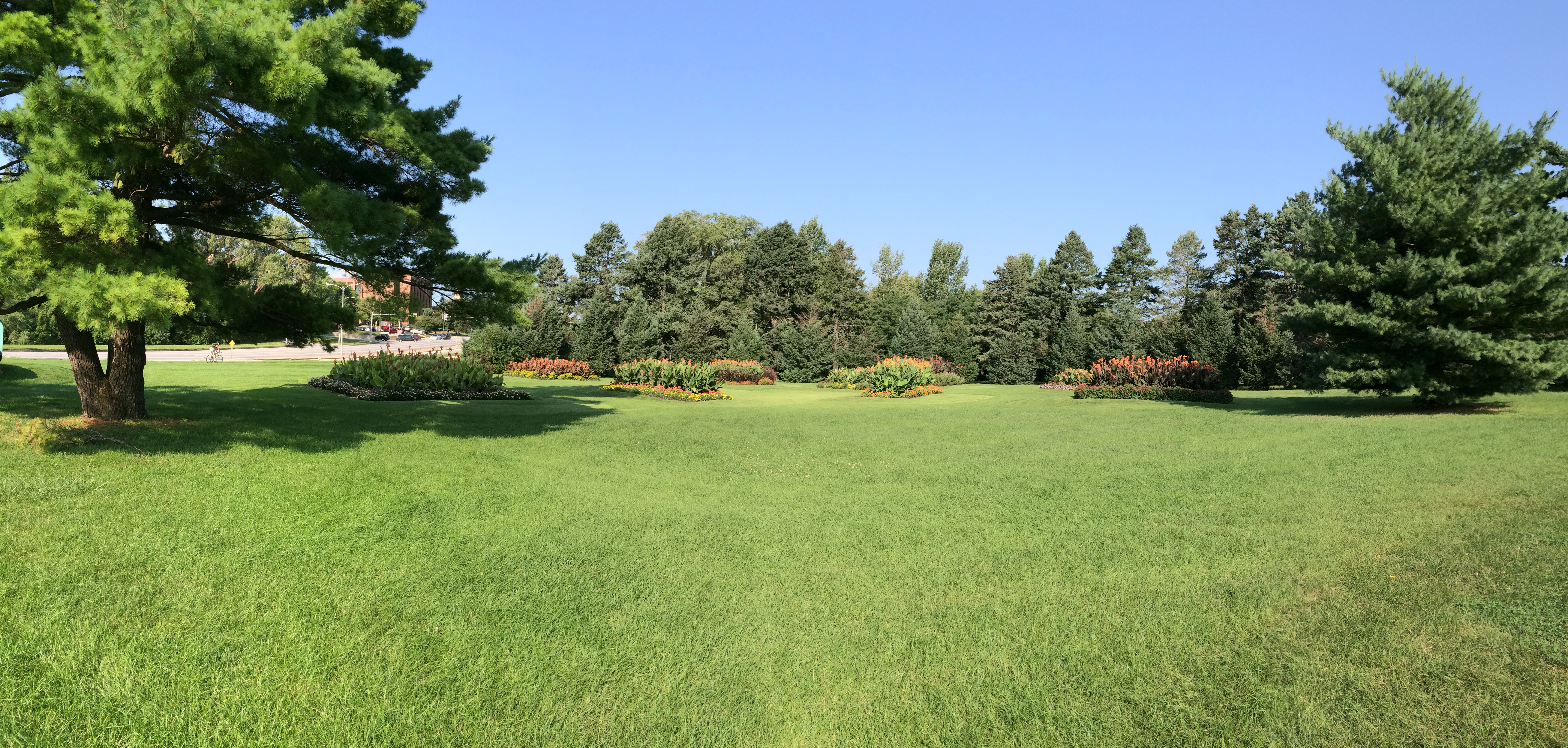
H.W.S. Cleveland was a landscape architect of the 19th century, and as I have been walking through my own neighborhood these past two months, I have come to appreciate how he helped my city develop some beautiful parks.

I live on Happy Hollow Boulevard, part of the system of city streets that were planned to link the Omaha parks together. Happy Hollow winds beautifully along two of the bests parks in Omaha: Elmwood and Memorial. And in my daily steps along the sidewalks and paths, I have come to find rest stops for my journey.

IMG_1980

A panoramic view of Memorial Park facing west from the path.

IMG_1967

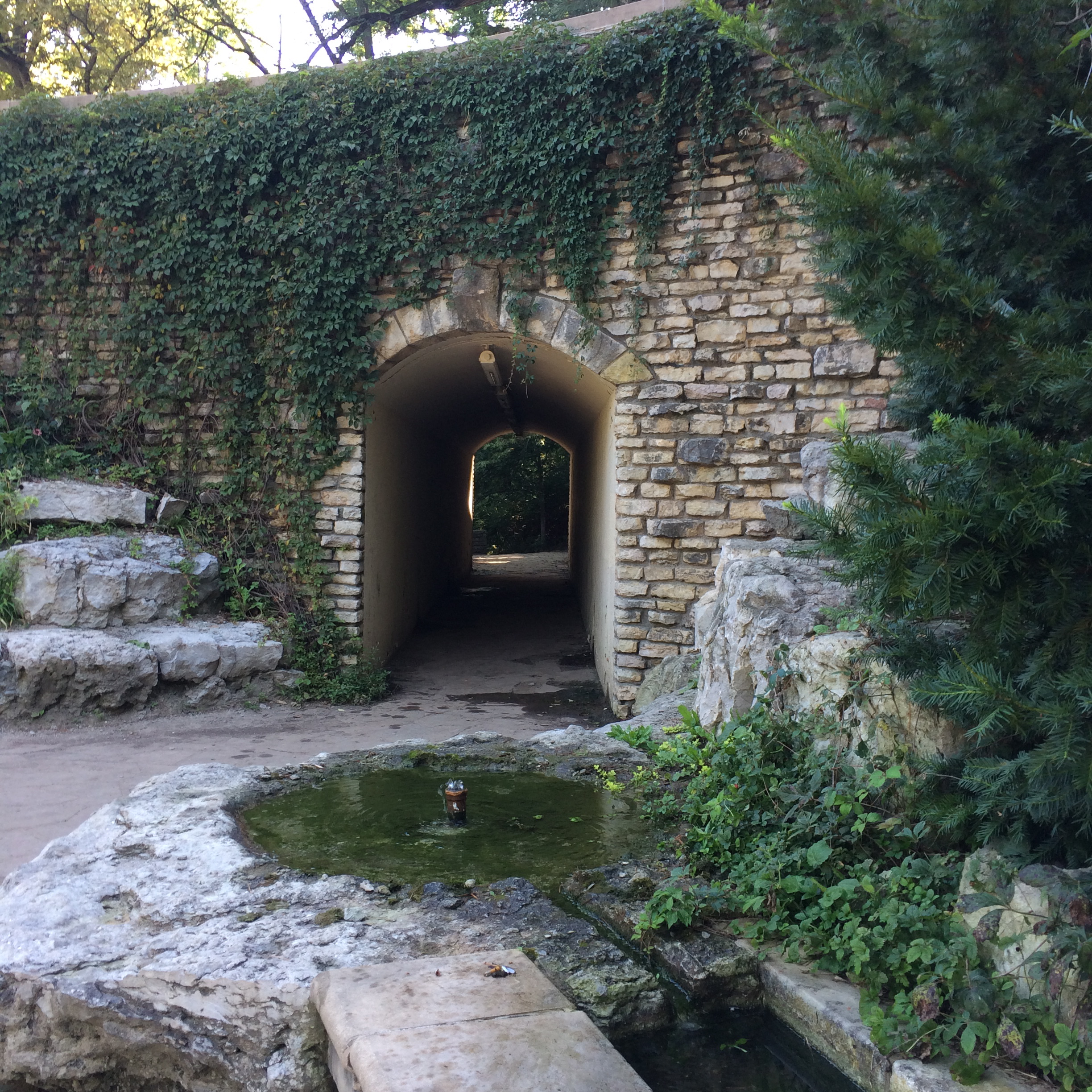
The grotto at Elmwood Park with its natural spring running through the channel.

“He leads me in paths of righteousness for his name’s sake…” goes the 23rd Psalm. Beside still waters. Green pastures. All these things are in this amazing section of Omaha that I find myself wandering through.

As I think about my friends in Syria, Lebanon and Iraq, or my family in crisis, walking has become a prayer time for me as I put one foot in front of the other, and doing it in green pastures with still waters and carefully planted trees and flower beds, is a reminder that this God who made and loves us all, is there with me at each step.

Between the two parks is my college alma mater, the University of Nebraska – Omaha. As I walk through the campus, I have found other places that also remind me of how God has unique ways of encouraging me on this daily journey as I seek his pace, his peace.

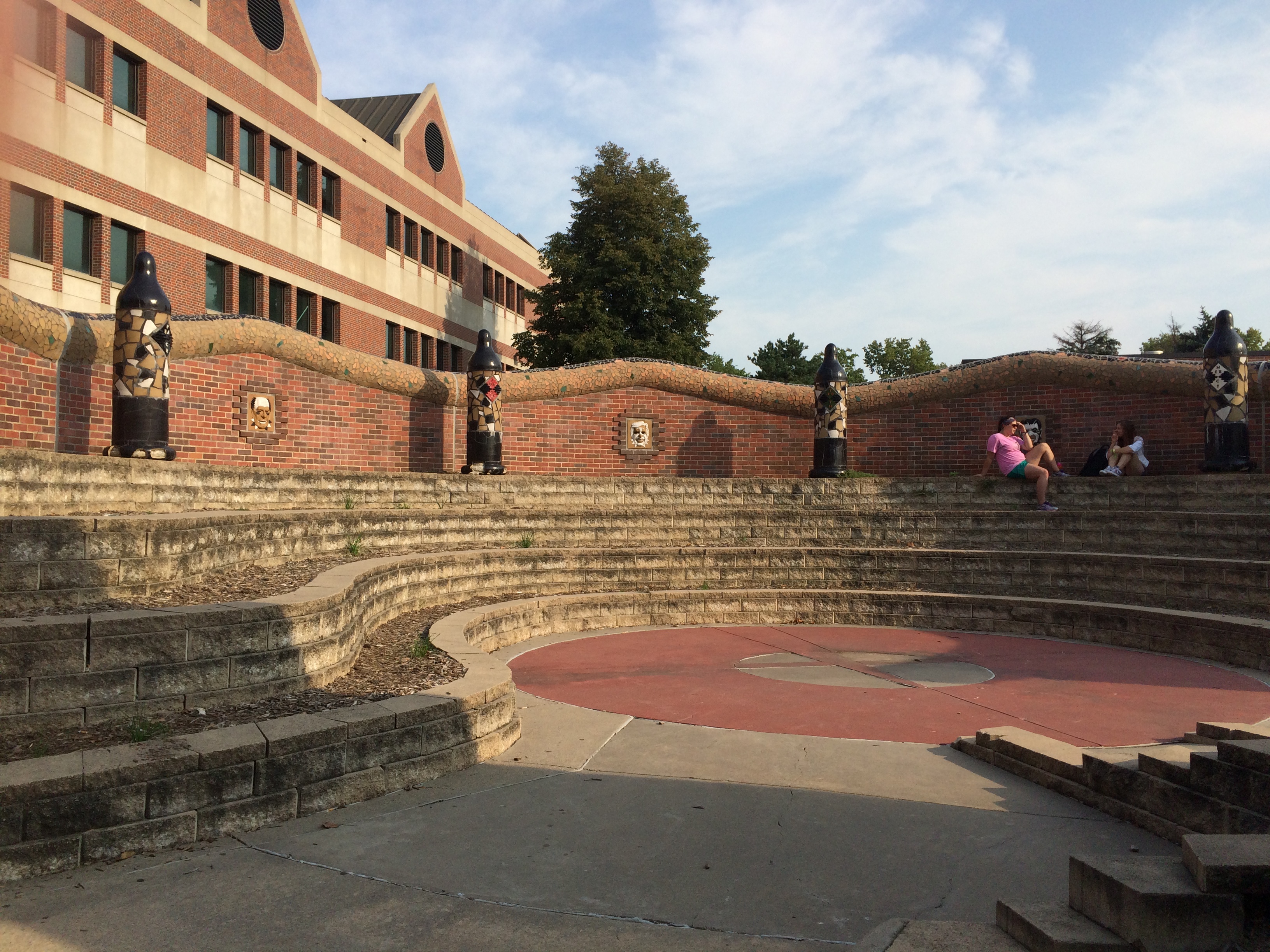
IMG_2007There is the Castle of Perseverance, an outdoor amphitheater designed by Andrew Leicester of Minneapolis. I came upon it one day several weeks back as I chugged uphill from the College of Fine Arts, and the first thing I saw was this: the word peace on a missile-shaped sculpture. I followed the semi-circle around and found justice, mercy and truth to complete the set. “Act justly. Love tenderly. Walk humbly.” My six-word reminder from Micah 6:8 was echoing through my head.

IMG_2011This place also brings Romans chapter 5 to my mind, a scripture shared at my father’s memorial service and one that speaks to my heart about the church in the Middle East that I have been humbled to walk with:

Therefore, since we have been justified through faith, we have peace with God through our Lord Jesus Christ,  through whom we have gained access by faith into this grace in which we now stand. And we boast in the hope of the glory of God.  Not only so, but we also glory in our sufferings, because we know that suffering produces perseverance;  perseverance, character; and character, hope.  And hope does not put us to shame, because God’s love has been poured out into our hearts through the Holy Spirit, who has been given to us. (Romans 5:1-5 NIV)

Song

Suffering, perseverance, character, hope. Steps on the journey of the family of God in Syria, even as I write this. Never have I seen a people who model hope in such times of suffering.

Or walking south through campus as I approach the east side of the soccer stadium I found “Song,” another art piece, many of which are sprinkled around this urban campus. With my earbuds bringing “All to Us” by Chris Tomlin into my head and heart, all I can do is sing aloud, just like the little bird:

Precious cornerstone,
Sure foundation
You are faithful to the end.
We are waiting on you, Jesus
We believe you’re all to us.

sounding stone brokenness

Walking down the hill and into Elmwood Park, past students scurrying up the hill to class, I come up the east side of the park and find the Sounding Stones, which I’ve written about before, Sounding Stones. Brokenness. Humility. Submission. Simplicity. Community. Each of those is part of our journey, my journey. And each one invites a prayer. My prayers for peace – dona nobis pacem – are so centered in that stone of brokenness these days.

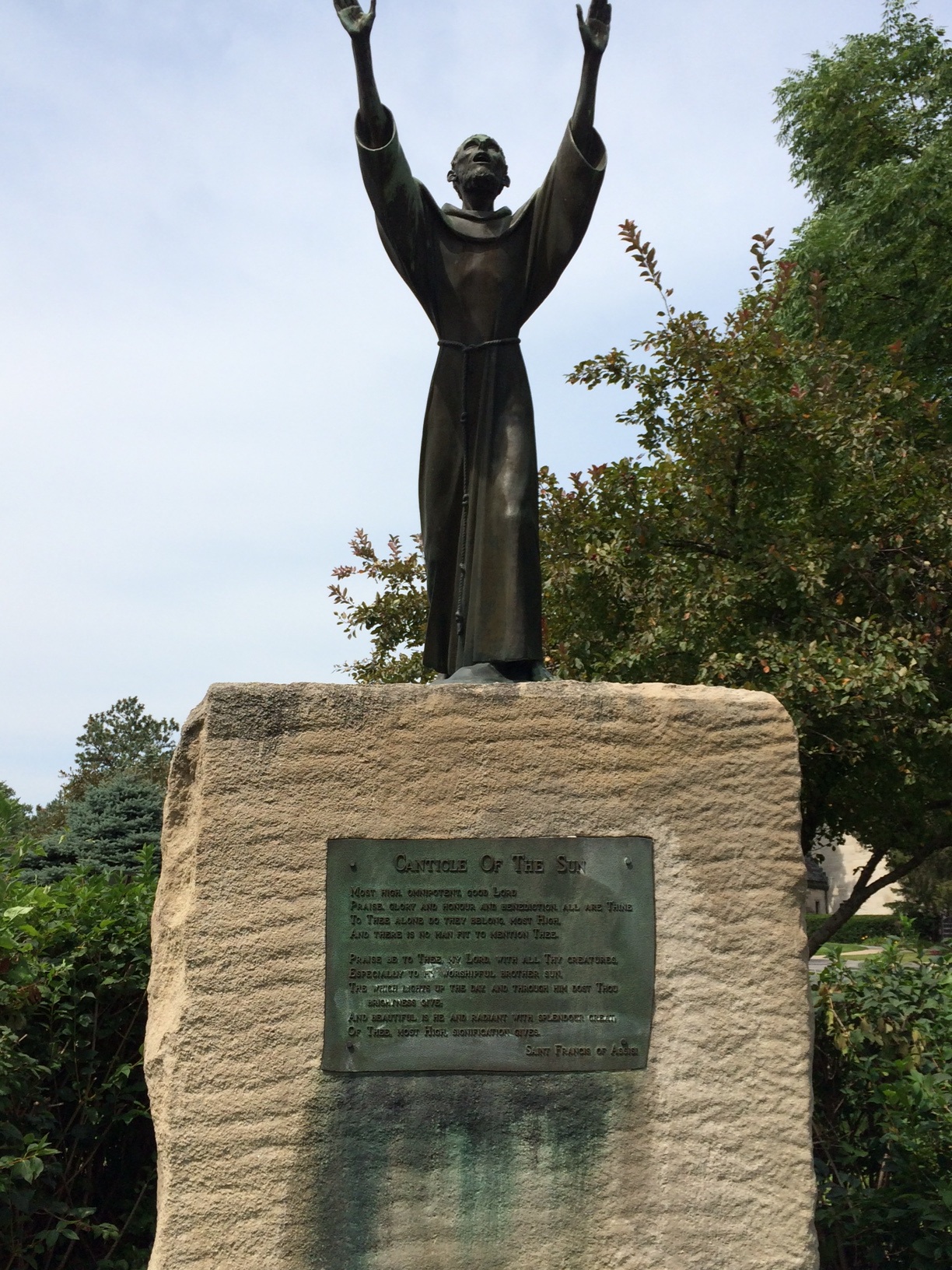
St Margaret Mary's PeaceAnd if these special rest stops on the journey don’t invite me into peaceful places (which they do), there is yet another spot I can wander between the two parks. Saint Margaret Mary’s Catholic Church stands facing the university from the north side of Dodge Street, right next to Memorial Park. If the words carved into its entryway aren’t enough to remind me of God’s peace, the sweet statue of my favorite saint, Francis of Assisi, is there, too. And though the words on his statue there are the canticle of Brother Sun, the ones he is speaking to me are, “make me a channel of your peace.”

St Margaret Mary's St FrancisShalom.

Salam.

Pace.

Paz.

Peace.

Whatever language the word is spoken in, I want to be a conduit of peace. Let my words speak it. Let my actions be its witness. And I am so grateful for these reminders in these rest stops along the way – in green valleys, in still waters, in righteous paths.

Dona nobis pacem.

Amen.


Finding peace at gate G5 in Rome

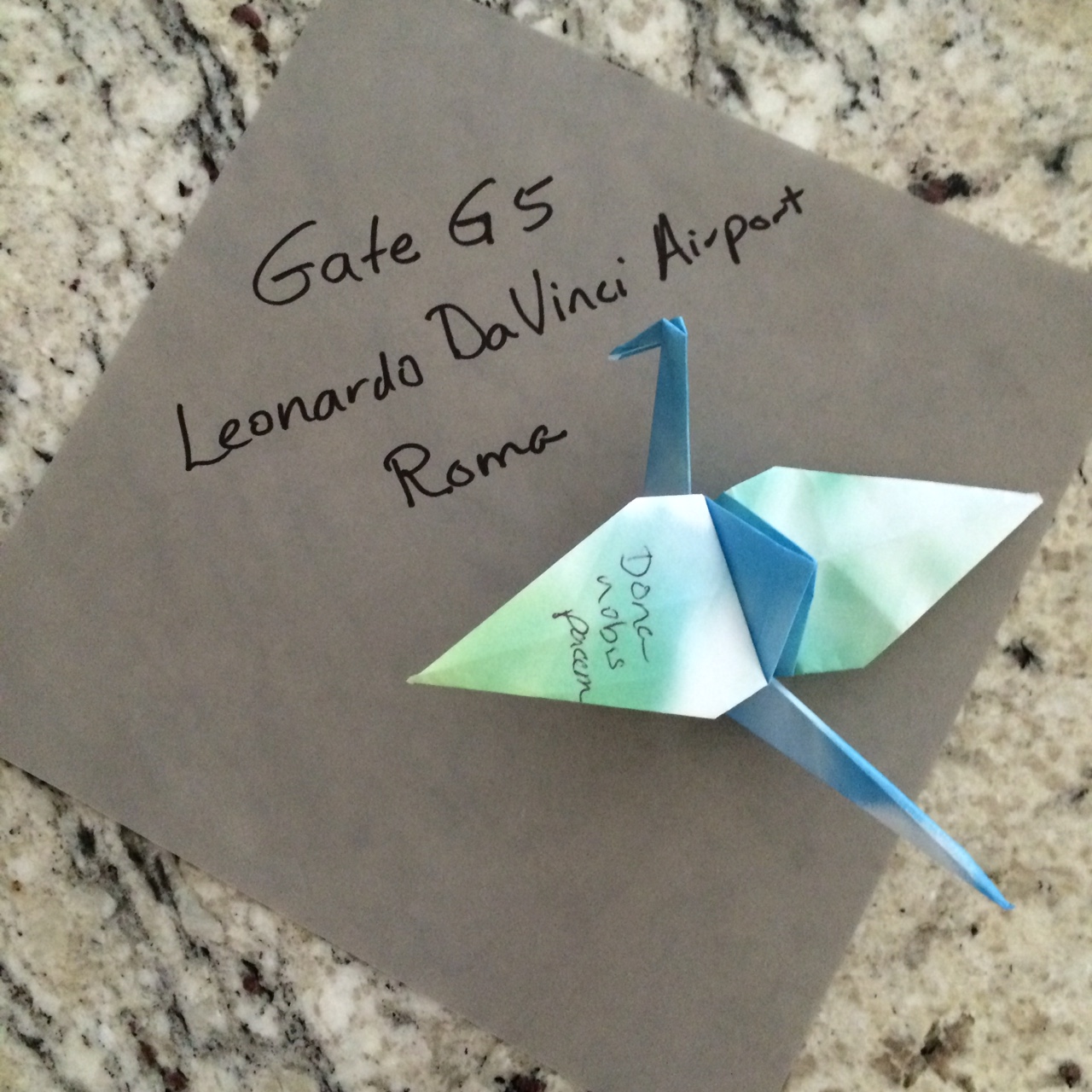
Paper crane gate G5 RomeAs a little girl I made a memorable visit to the United Nations in New York. It was the summer after third grade so I must have been all of nine, but I remember being struck by all the different flags and all the different people. It was and is a place where those of many nations come together to seek the good of all of us who share this big blue marble of a planet.

As a now much older woman, middle-aged at 56, I have seen the United Nations at work in the refugee camps in Lebanon that are filled to overflowing with those who have fled the war next door in Syria. UNHCR, the United Nations High Commission on Refugees, is stenciled on the tents and on shipments of food and supplies. Nations have come together to provide for those in need, and there are millions upon millions in need.

But I think the biggest purpose of this organization is to somehow help nations come together to talk and to prevent such wars, and maybe even to stop those already in progress. I think the bigger purpose is peace, and it is seems impossible in these days to achieve.

The stories I heard in Lebanon about what is happening in Syria are overwhelmingly horrible. Loss of work. Loss of home. Loss of life. No peace.

And so last Friday I traveled home from there, my heart left behind with some pretty amazing women. The only peace I expected to find in my 24-hour journey from Beirut to Rome to Chicago to Omaha was with a pair of noise-dampening earphones stuck to my head while I lost myself in movies. But something happened…

Gate G5, Leonardo da Vinci International Airport, Rome, Italy, happened.

My plane from Beirut landed on time and my friend Meryle and I, who had spent those amazing days in Lebanon together as part of a team of eight women, said our goodbyes to each other. I sent her off to gate G3 with a hug as she headed home to Santa Barbara. I had two hours to settle into a seat at gate G5 until my Alitalia flight headed to Chicago was scheduled to leave.

Gate G6 was next to us with a flight headed to Tel Aviv, Israel. My attention was drawn to those over there who seemed to obviously belong in Tel Aviv by their attire: long black coats with wide-brimmed black hats. Prayer shawl tassels dangling. Yarmulkas on the heads of several men, young and old.

At my gate was a collection of all sorts of people, including many Muslims, some of whom had been on my flight from Beirut, including a sweet mother of two four-year-old twins who were heading to Chicago to visit family. The hijabs and abayas were visible, as well as the longish beards on some of the men.

And I will say there were Christians, too, as I am one and I was there.

So in the airport of the eternal city of Rome, not far from Vatican City where the patriarch of the Roman Catholic Church leads a large flock in the name of Jesus, at these twin gates – G5 and G6 – the three Abrahamic faiths were sitting together in peace, waiting to go someplace else.

And then came the music. Not the swelling soundtrack of a movie scored by John Williams, that might be playing in my head because I thought I had discovered how to achieve peace, but actual music. There was a grand piano in the corner and someone sat down to play it. A woman with short, dark hair started picking out a jazz melody. A man quickly joined her to watch and listen, and she stopped, kind of embarrassed that someone would come over. They had a quick conversation about their joint love of music and the piano, and then he sat down and started to play. She stood by his side and periodically leaned over and added some notes on the high end.

Soon, many were listening and smiling and just enjoying this spontaneous concert in the airport. And I looked around at the faces and everyone had just been transported someplace else as they listened along.

Eventually these two stopped and others took their own turns at the ivory and black keys. Mary had a little lamb was plucked out, followed by row, row, row your boat. I’m a little lamb who’s lost in the wood, I hope I could, always be good to someone who’ll watch over me, had me closing my eyes thinking of my sweet Steve at home.

And then came that hymn…

For the beauty of the earth,
For the glory of the skies,
For the love which from our birth,
Over and around us lies:
Lord of all to thee we raise, this our hymn of grateful praise.

She played four verses and added an amen at the end.

I looked around again as we all stood up to have our boarding passes and passports checked before going down the escalator to get on the plane. I saw old and young. Blond and brunette and gray hair, some in dreadlocks piled high, some in the soft curls of youth, and some heads that probably claimed one of those kinds of hair but hadn’t seen it in a while. Men and women, boys and girls. Muslim and Hebrew and Christian and probably some who called on no God. Italian and Lebanese and Israeli and American and other folks from all over.

And as our boarding was delayed, there was simply no pushing or shoving or shouting. There was just this music coming from the piano in the corner. And there was this kind of peace.

And I thought, why not like this all the time everywhere? If we can cram this many people into a small area of space in a busy international airport and throw in a piano for good measure, wouldn’t this be a good way to figure it out? To look at all the others crammed in there with you and say, “Hey! They’re people just like me, trying to get to the place they call home, or maybe just taking some time to see someplace new.”

I know that sounds naive and idealistic, but that’s who I am and I offer no apology for it.

It was just a two-hour window at gate G5/6 in the Rome airport, but it reminded me of that hopeful memory of standing in the United Nations in 1968. And my prayers rose anew for peace. With the help of God, I think we can figure this out.

For the love which from our birth, over and around us lies. Lord of all to thee we raise, this our hymn of grateful praise.

Amen. And amen.

Thursday in the new normal

July 2 was a Thursday this year, just two weeks ago today. For me it was not a normal Thursday, although I did sign the checks at church for invoices and reimbursements, a normal Thursday event for the last ten years.

Ten years.

Last.

It was the last normal Thursday in an old normal, as it was my last day on staff at the church I have served since January 2, 2002, the last ten as business manager, aka signer of the checks, aka money changer in the temple. Didn’t you know? Every temple needs one!

That’s the way I used to introduce myself to people who came in the door at West Hills Church, including a couple of candidates for our interim senior pastor position.

Well, you might as well be honest. 🙂

So July 2, 2015, was my last day on staff there, and it was a Thursday.

July 6, 2015, began a new chapter in my life. No, it wasn’t a Thursday, but it was a Monday after a three-day weekend for the Fourth of July holiday. I woke up a very different person: for the first time since 1977 I was unemployed.

Let me say, it was my choice. I think that is important. I left with a sense of peace, albeit with no sense of purpose. It felt right: the decision, the timing, the reason.

So here I am, two weeks later living a very different kind of life.

I have applied for a new job.

I am preparing to return to Lebanon and Syria for the fifth time in five years.

I am cleaning up my home office so we can reattach the bookshelves which are pulling away from the walls. (Can I just digress for a moment and say that the reason they are pulling away from the walls is that they were too heavy with books? I think that counts in my family’s favor that we love to read actual printed BOOKS!)

I am spending time letting folks know that I have a different e-mail address and discovering just how many places I used my church email for a point of contact.

Note to self: don’t do that again!

I am playing Bejeweled Blitz, Yuma Blitz, Pet Rescue Saga and other assorted Facebook games in my moments of solitude. Hey! Everyone needs some down time.

But it has been two weeks now. I don’t leave for Lebanon for another week and I was feeling like I needed to produce something. Not spreadsheets for the session so they have good financial information. Not attendance figures for Sunday school and worship. Not editing and proofreading marks on the Sunday bulletin (although it was obvious from last Sunday, that somebody still needs to do that function!).

No, today I needed to produce something physical, something that made me feel like I could still create beautiful aromas and flavors and to actually feed people – not the Word – but actual food.

So I pickled onions.

Beautiful cipollini onions with thin, yellow skins would be my target. I set out on this hot, humid, sunny day in Omaha, Nebraska, to find them at the grocery store. The clerk at the store wondered what I was going to do with that bulging cellophane bag of onions, so I told her.

“I am going to pickle them in a balsamic vinegar and white wine brine. But first I have to melt dry sugar into a beautiful dark caramel. They are awesome!”

“We’ve got pickled onions at our olive bar,” she explained.

“I know. That’s where the inspiration came from,” I replied. “Oh, my! They are yummy. And I am going to make some.”

July 16 cipollini onionsSo home I went with my five pounds of aromatic layered gold. I blanched them, adding another layer of yellow coloring to the pasta strainer, dumped them in an ice water bath and then squeezed the usable part of the onion out of its skin.

A couple of hours later I had this treasure, not in clay pots, but in six one-pint Ball jars.

It wasn’t enough.

For thirteen years, my dear spouse St. Stephen has been the chief chef at our house. I like to cook. He loves to cook. He finds peace in the kitchen at the end of day of architectural drawings and meetings and trying to please clients.

He is a great chef!

But he has been so busy lately and I have been, well, unemployed.

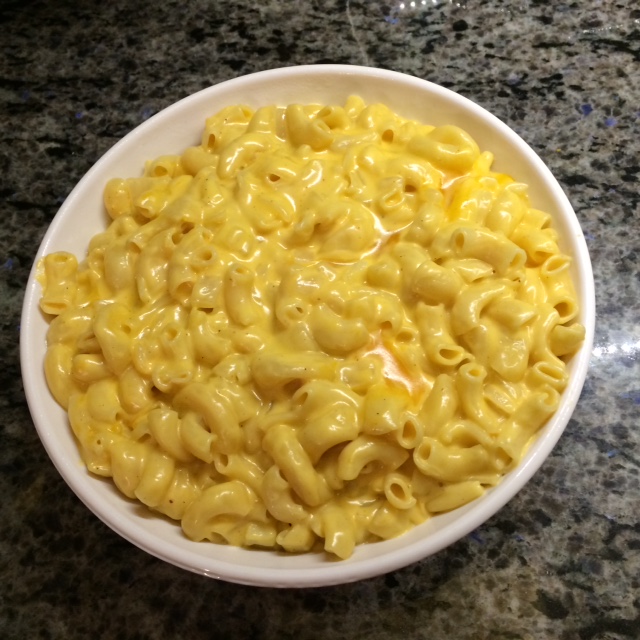
July 16 mac and cheeseSo today besides shopping for pickled balsamic cipollini onions, I shopped for macaroni and cheese. No, not the blue box my family grew up with, but the creamy, cheesy, homemade kind.

Half and half. Sharp cheddar. Colby. Large elbow macaroni. Butter. Onions.

Homemade bliss.

I love to care for people, including my family. But I also I know that Thursdays are just Thursdays.

I know that my old normal and my new normal are the perception of a well-resourced, finely educated, blessed married woman in a first world country. When I put on the glasses of my sisters – equally educated, equally blessed and formerly well-resourced – in a part of the world that had the same economic advantages of my country until years and decades of war caused their worlds to collapse, I stopped in my tracks.

Their new normal is not of their own choice or their own making like mine has been.

And so in the midst of onions and macaroni and cheese, I pray.

I pray that they, too, will come to have a Thursday like this. A Thursday of sunshine and humidity. A Thursday of pickling onions or making jelly. A Thursday of sharp cheddar cheese and creamy sauce as they wait for a hard-working spouse to come home.

I pray that their new Thursday normal will be like their old Thursday normal.

A Thursday of peace.

Mom’s Missal

Mom's missal Agnus DeiI recognized it right away, even though I hadn’t seen it in years. It was my mother’s missal.

Mike was leading a tour of our family print shop for a special dinner Steve and I were catering on the rooftop that night. Good friends of ours had purchased this sweet package at a silent auction. It included the dinner on the roof with a great view of the fireworks that 100,000 or so people had crowded downtown to see that Thursday night. It also included a ride on our 100-year old freight elevator (possibly one of the three oldest in Omaha) and a tour of the plant and building.

We were upstairs in the space over the old offices, which at one time in the early history of the building (before our family owned it) was the home of a prostitute. It has laughingly been referred to as “the whore’s nest” by more than one generation of family and friends. We always used it for storage, and a couple of years ago we emptied it out as we thought we had a buyer for the building. I hadn’t been up there since that day.

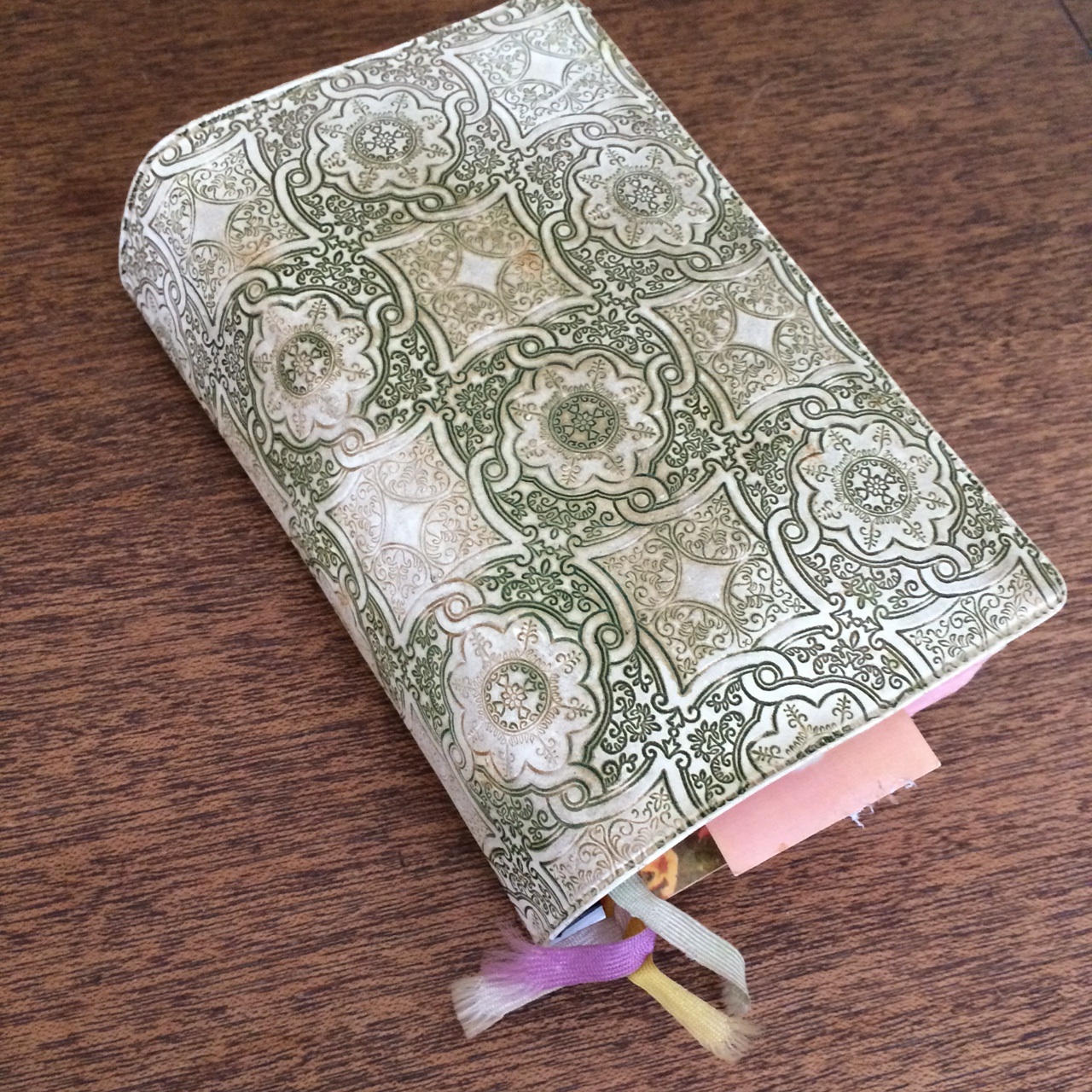
Mom's missalAnd that’s where I saw it, mom’s missal. It was on top of a small pile of family possessions that managed to survive our cleaning mission. It’s white vinyl cover now dirty and darkened by time, I knew what it was instantly.

“It’s mom’s missal,” I said aloud mostly to myself, but others heard.

“You were meant to find it today!” said my friend Chris. I had just told her that this day, July 2, 2015, had been my last day on the staff of the Presbyterian church I have served for the last thirteen and a half years.

I picked it up and carried it back downstairs for further review at home, and then we proceeded with what was a really fun night up on the roof.

This past Monday, since I am now unemployed, I took some time to just quietly thumb through the pages, remembering how it looked it my mom’s hands as she followed the mass on Sundays at Christ the King Catholic Church.

It is The New Marian Missal for Daily Mass by Sylvester P. Juergens, S.M., doctor of sacred theology (the new large type edition), published in May, 1961, by Regina Press of New York. I tried Googling it and found that you can still pick up a copy on Ebay, for about $4. There were many hits for this particular missal, so it must have been popular.

At nearly 1500 pages, it contains the masses for all the holy days, all the liturgical seasons, ordinary time as well. There is a full list of saints and their feast days, and you can also find the masses for those days.

Since it was published in 1961, it is a Latin missal with English translations on the opposite page. If you didn’t know Latin (other than the most common prayers like the Nicene Creed and the Lord’s Prayer), you could still follow along with the priest as the words were said and know what they meant. And that was and is the whole purpose of the missal: to be an active participant in the mass and not just an observer. I have tried to explain this to a number of my reformed church friends who make the most amusing but uninformed comments about the Roman Catholic mass.

I forgive them. 🙂

Its liturgical calendar at the front of the book includes dates from 1961-1980, so this was meant to be a tool for worship for the long term.

It has five now faded color ribbons to mark the sections as you moved back and forth depending on the season. I think I remember those best of all because when I could get my hands on this as little girl, I would move them back and forth among the pages to mark the colorful plates that illustrated biblical scenes like Jesus riding the donkey into Jerusalem on Palm Sunday.

Mom's missal nameplateThe back of the book has a name plate indicating that it is my mom’s. In her very neat printing in blue ink it says: Mrs. George Prescott, 7806 Ontario St, Omaha 24, Nebr, 391-9586. A later addition in pencil has this corrected to: Jana Prescott, 2526 So. 105th St. Jana must have appropriated it sometime after we moved in 1965, and Mom died in 1966.

And I stop right here and remember both those places. My dad built the house on Ontario Street in 1958. He moved the then small family of Mom and George, Jr. and Jana to that house where I joined them in December that year when I was born. In the fall of 1965, our family that now included Susan, Mike, Sally and Cathy, moved to the house on 105th Street. We had the same phone number, 391-9586, and the same ZIP code, 68124. The house was not much bigger, but Daddy had a small addition built on that gave us one more bathroom, one more bedroom, and a big dining room. I can still see my mom washing dishes at the sink or cooking at the stove, the old yellow telephone tucked under her ear as she kept up with family news while talking to Aunt Tillie or Grandma Thirtle, the phone cord stretched out to its full length, which always seemed like about fifty feet.

Such good memories.

Mom's missal Ephesians passageAs I paged through the missal I found prayer cards that Mom had tucked in there. Favorite Bible readings. The 23rd Psalm. The Beatitudes. Easy references for scriptures that spoke to her heart. There were other picture cards as well. When I turned them over to see the back, I found scriptures written in her handwriting. She must have written them out to keep them close by, handy in a book she probably used every day. And I too, love this one from Ephesians, as it uses the words that describe the dimensions of the cross to remind us just indeed how great the love of Christ is for all of us.

I turned to the section where I knew I would find the prayer that is so much on my heart these days, the Agnus Dei, a reminder of why I am folding all those paper cranes. The words are there for the ordinary mass and also for a funeral mass like the one that was offered for Mom after she left us on March 27, 1966. Dona eis requiem, dona eis requiem, dona eis requiem sempiternam. Grant them rest, grant them rest, grant them eternal rest.

There are so many days nearly fifty years since she died, that I miss my mom. I wonder what she would think of what her children have grown up to be and to do. I like to think she has smiled down at us as we have experienced love and joy, and that she has wept a mother’s tears at our failures and our sorrows. I know she has marked our lives by her love and her faith, and I am so grateful for what she passed on to me that is so important to my life and my journey.

Finding that missal in the whore’s nest on a July night in Omaha, Nebraska, with fireworks blasting and lighting up the night sky, felt like a sweet kiss blown my way from heaven. It was as if she was telling me that even though my time on the church staff has ended, my journey of faith has not. My work on earth is not done until I am called home like she was. I have good news yet to hear, and good news yet to tell. I have travels left to make with the living Christ in Lebanon, in Syria, in Iraq, places where other mothers and fathers are marking their children in the same way mine have marked me.

And so I will keep going.

Deo gratias.


Peace in the garden


garden panorama
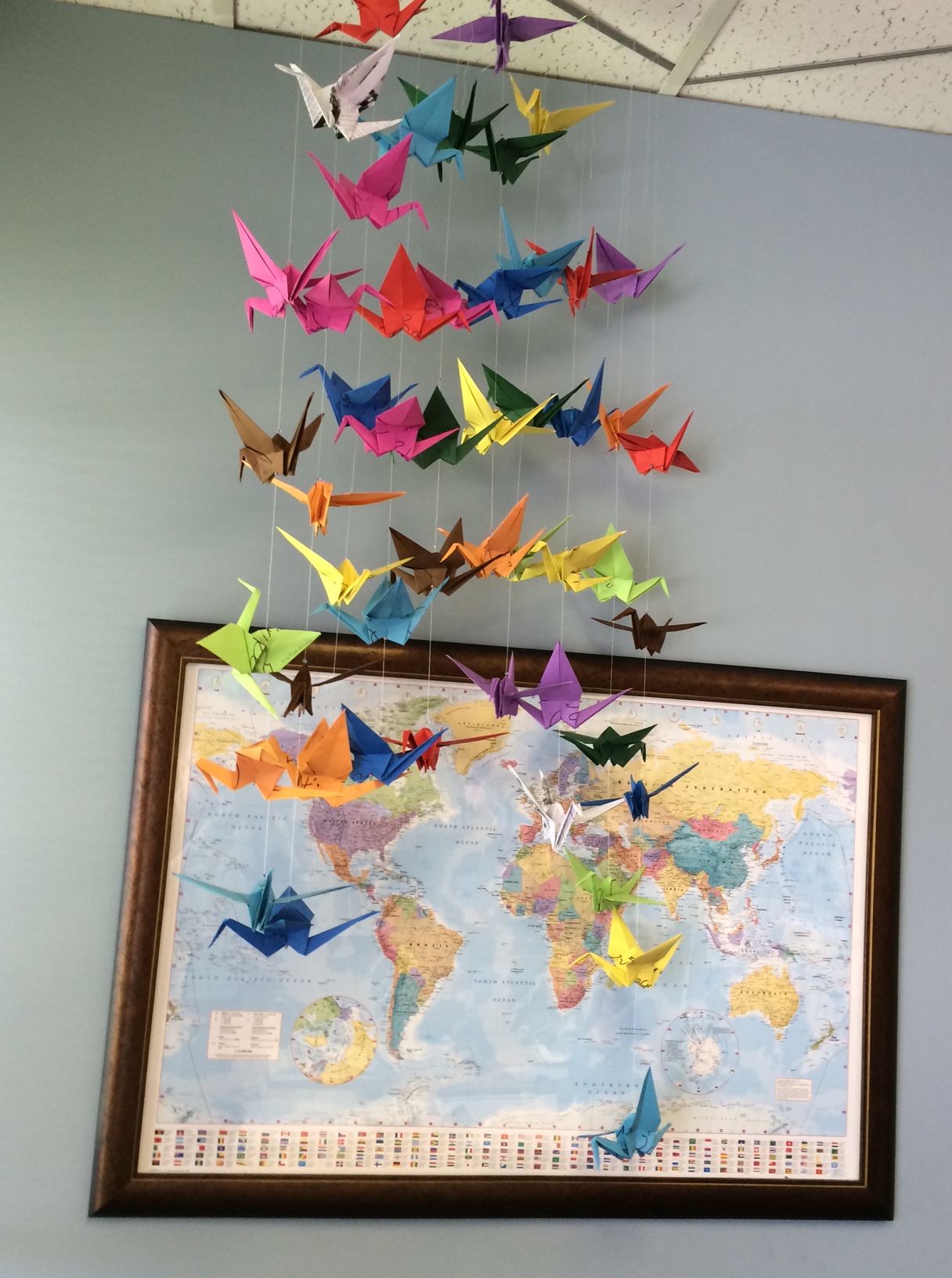
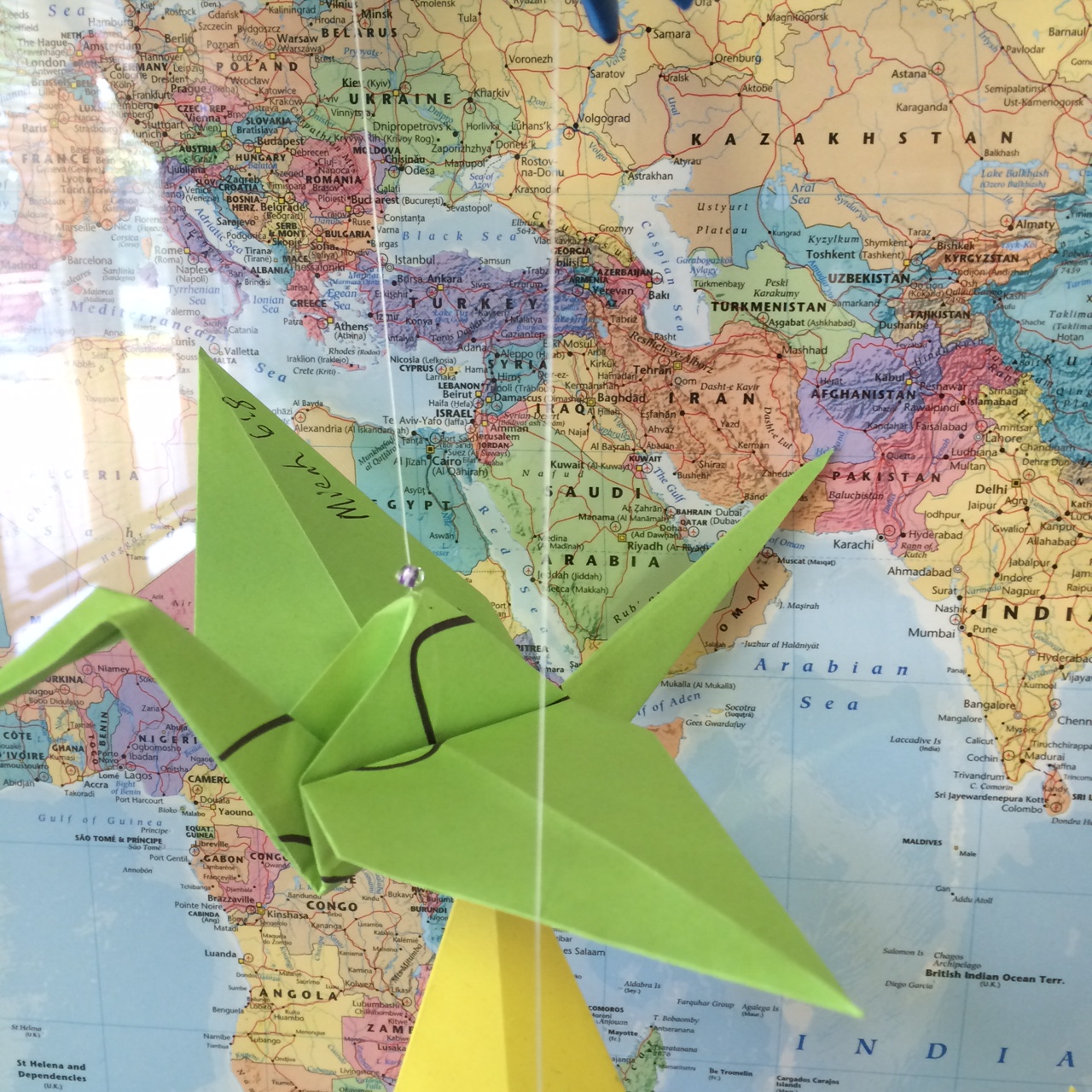
Paper cranes 323 totalI have been praying for peace for a long time, and lately I have prayed through the folding and stringing and hanging of paper cranes, 323 at last count in my office. It is a beautiful sight when I come in every morning, and catches others by surprise as well.

Dona nobis pacem. Grant us peace.

They are the colors of the rainbow, hanging on their strings, separated by glass beads and hugging my world map, a map that also reflects those same colors.

dayliliesAnd tonight I walked in my garden, which is showing many of those same colors. The oranges of day lilies, the blues and violets of cranesbill, white daisies with bright yellow centers. And so many greens! That God of ours had way more than 64 crayons in his box when he started this whole garden thing.

Daisies and cranesbillAnd so as I walked through my garden tonight, I was reminded of my peace cranes by the colors of the flowers and the greenery and the way the cranesbill and daisies tangle together, just like the strings of the cranes when I brush by them and it made me smile and it stopped me in my tracks to say it again:

Dona nobis pacem. Grant us peace.

As I came around to the steps that take me up to our little circular terrace, a place that is our secret room where we sit on Fridays and Saturdays and enjoy the peace of the garden after a long day, I passed my peace pole which contains another prayer in five languages:

May peace prevail on the earth.

Peace pole in the gardenAs I walk through this peaceful garden with prayers on my mind and on my heart and on my peace pole, I am also reminded that I am not in this alone. Just as the daisies are a gift from Susan and Lee next door and so many of the day lilies came from my cousin Kathy, the cranes in my office are a reflection of those praying with me like Cleo and Wendi and Deb and Kathy and Wilson from church; and all the faithful women like Babs and Marilyn and MC and Kate and Sue and Wendy and Betty and Emily; pastors whom I have met and those I haven’t, the Tobies and Michaels and Tripps and Chrisses; and all the people who read the papers and weep with me.

God made the garden for us as a place to walk with him in peace, and we blew it. And we continue to blow it. But even still, he makes the flowers grow and the cranes fly and invites us all to walk in places with him, inviting us into conversation. And my conversation with him most days – every day! – is for his peace to prevail.

And I believe he hears us.

And I believe he listens to us.

And I believe he will answer and redeem and make it so.

I believe his peace will prevail on this earth.

And so I will keep asking.

Dona nobis pacem. Grant us peace.

Amen.

Protection while we sleep

Sami Sadeeh Syrian national guardsman from SafitaI am on the worship team this Sunday at church and the special song we are singing is Laura Story’s “Blessings.” It is a lovely song and I am happy to be singing it with three good friends for the glory of the Lord.

There is a line that goes like this:

We pray for blessings, we pray for peace, comfort for families, protection while we sleep.

And it’s true, we pray for all of that. Peace, peace, peace, has been my prayer these last four years especially, since my traveling to the Middle East started.

But today I am centered on these words: protection while we sleep.

Protection while we sleep…

We had it in spades on our trip to Damascus in January, 2014, and I didn’t even realize it until the last day we were there. We would come up to our room in the hotel and there would be two or three normal looking men sitting in the lobby on our floor, like they were waiting on their wives or something. When we left in the mornings to accomplish our schedule and make our visits, there they would be again. Back and forth and back and forth for our three days there, those gentlemen were always in the lobby on our floor.

Walking through the Christian quarter in Damascus after having visited the church where Saul became Paul (Acts 9), we visited a craftsman shop to make some purchases of fine Syrian wood inlay boxes and lovely local fabrics and scarves. As we continued our walk back to the Presbyterian church, Steve commented about our security detail.

“There must be ten or twelve of them,” he said.

“Really?” I replied. “Where?”

In front of us, behind us, bulky automatic weapons bulging from under their jackets, they had been with us the whole time. They had also been staying in the lobby of our hotel floor. Protection while we sleep.

And now I flash forward from Damascus to our trip back to Syria in November. We had another contingent of security with us as soon as we crossed the border. I was not so naive this time and grateful for their presence. I had the opportunity to talk to them and discovered that some of them had come from the city of Raqqa in Syria. Raqqa is now the capital or main city that ISIS controls. These men had lost family members there and their homes as well to this evil that is trying to drag their country back to the seventh century.

And there they were for us: protection while we sleep.

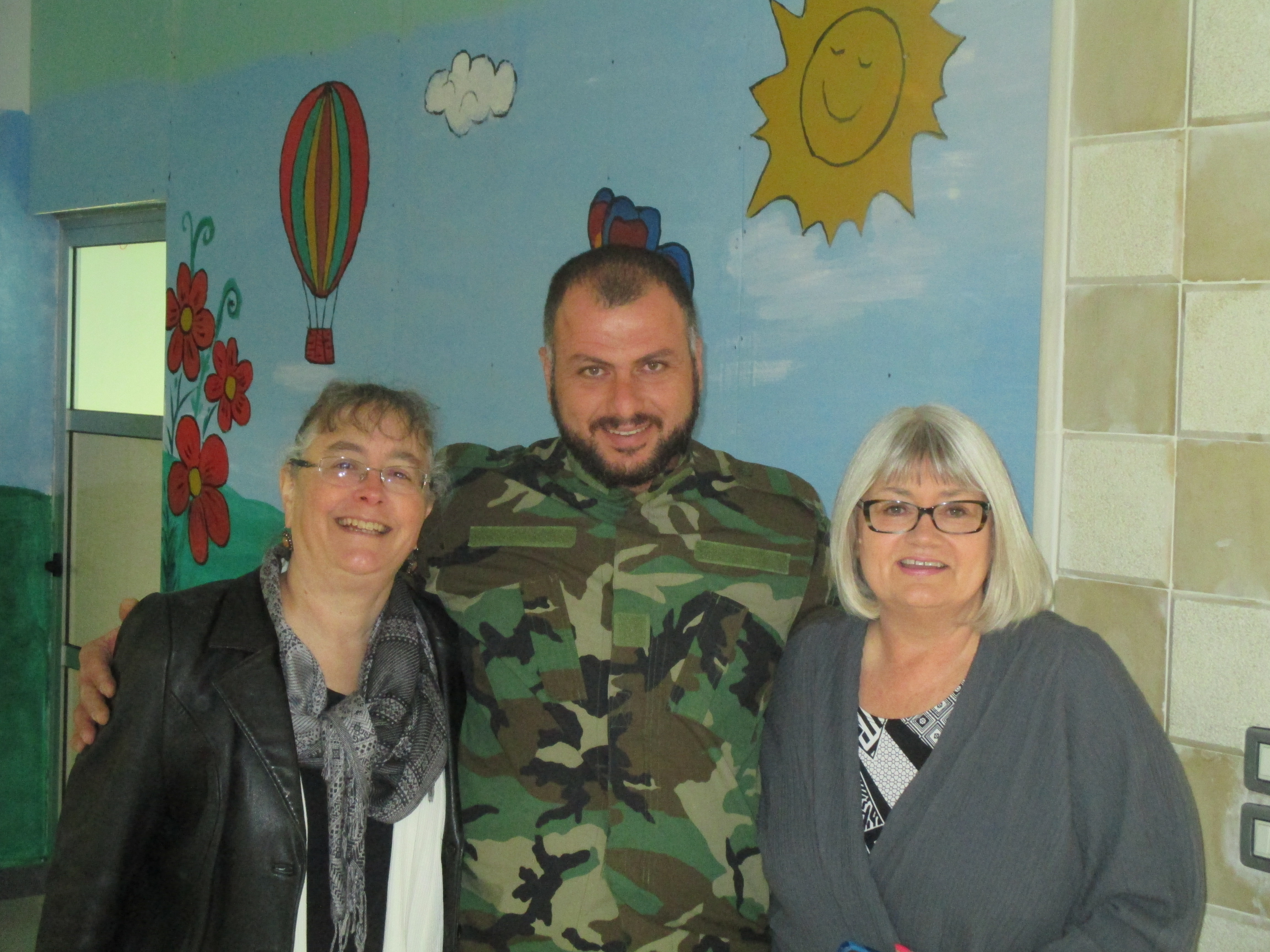
Tony in between Marilyn and I, Syria, November, 2014.

Tony in between Marilyn and I, Syria, November, 2014.

When we arrived in the Wadi al Nassara – the Christian valley of Syria – these troops handed us off to four men from Safita, all members of the national guard. They were with us for our remaining time in Yazdieh, Amar al Hasan and in Lattakia. Sweet, sweet men! The one named Tony held Marilyn’s hand through all our walking and hiking, to steady her as she was due for orthopedic surgery when we returned home.

Up and down the roads we traveled, through town after town on our way to the places on our schedule. Every town had pictures of those who had given their lives for their country, Syria, in this four-year old war. Poster after poster after poster would be at every intersection, in front of every business. And I am sure these men with us knew many of them. And I am sure that every one of those martyred soldiers had families that were missing them greatly, and who would share that same prayer: protection while we sleep.

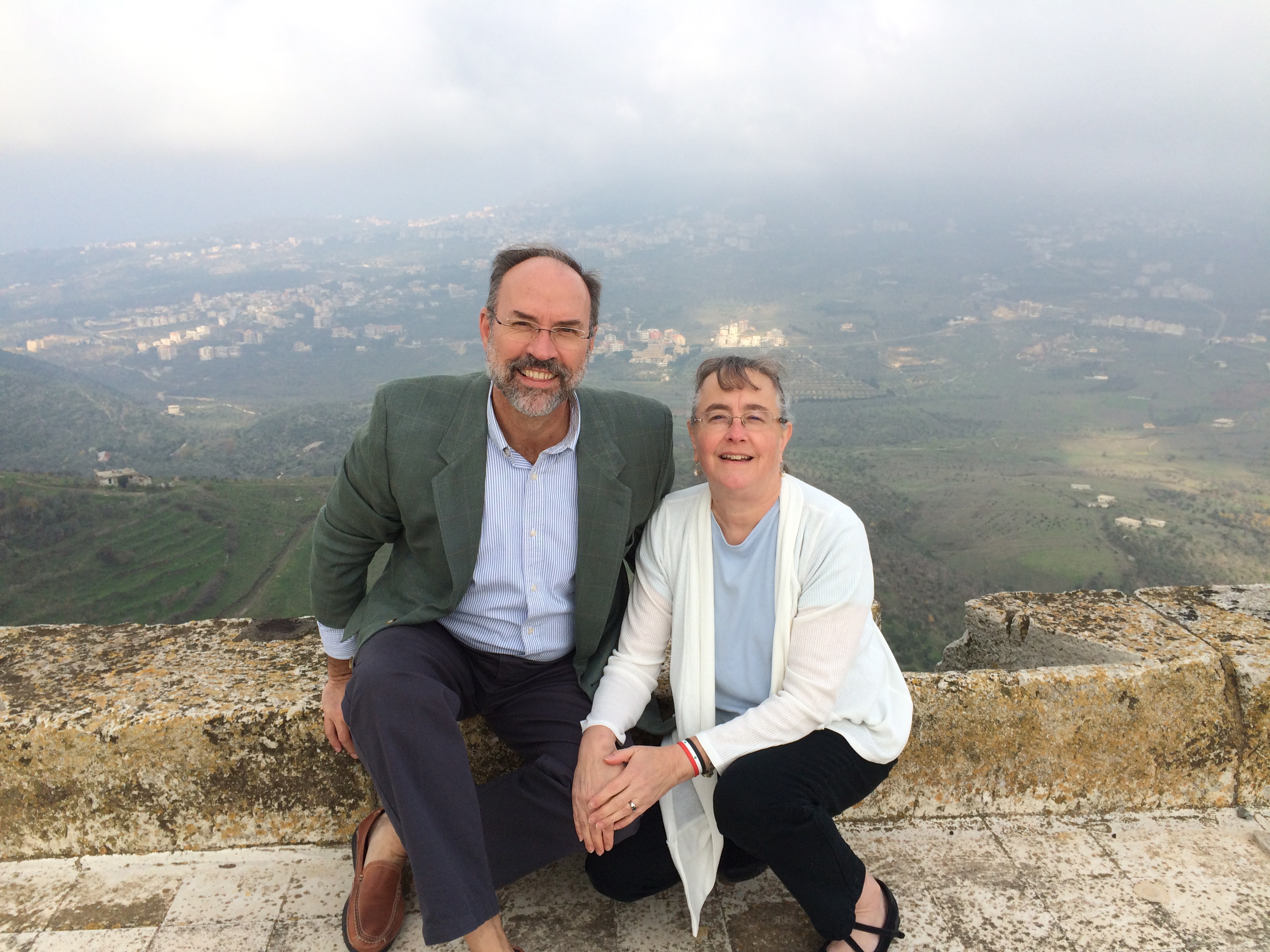
Steve and I on the top of the Krak de Chevaliers, Wadi al Nassara, Syria, November, 2014.

Steve and I on the top of the Krak de Chevaliers, Wadi al Nassara, Syria, November, 2014.

For four days and three nights, they were with us as we traveled through this beautiful place to meet with churches and refugees and families who had been driven out by ISIS from Homs and that part of the country. They went to church services with us. They ate dinner with us. They stood by while we traipsed through the world heritage site known as the Krak de Chevaliers, a former crusader castle in wars fought long ago. They told us how fanatic rebels had taken this high ground to fire on the Christians and others in the towns below. They told us how terrible things had been done to those captured, including throwing them from the high ramparts where we sat and had our photos snapped.

These four went with us everywhere for those four days, and were our protection while we slept.

On our last day there and before we left them behind, we gave them each an Arabic bible as a gift. All four are Christians, probably Greek Orthodox, and were thrilled to get the bibles and the little peace dove ornaments that we gave with them.

On the grounds of the St. George Monastery near Homs, Syria, with our national guardsmen. Sami is third from the left. God rest his soul.

On the grounds of the St. George Monastery near Homs, Syria, with our national guardsmen. Sami is third from the left. God rest his soul.

When we arrived back in the U.S. we talked about what more we could do for them. Those four gentlemen were all serving in the National Guard of Syria, but their day jobs were just like us, maybe an engineer, a teacher, or some other normal job. They weren’t doing those paying jobs while they were with us. They were volunteering their time as members of their unit to protect us while we slept and while we worshiped and while we ate and while we climbed crusader castles and had our photos taken. And we wanted to do something for them.

So Nuhad wrote to their commanding officer to find out how we could give them a small monetary honorarium for our appreciation of their great service to us, and this was the response we got back:

What he asked instead is that we make a gift in their honor to support the 100 displaced families in Safita that their unit is responsible for.

No money for them, but money for the refugees that their unit is responsible for. That is what they wanted. No greater gift…

Today on Facebook, my friend Nuhad shared this picture of one them, Sami Sadeeh. He has lost his life in this war, in protection of his family and his country. I am sure there will be a poster of him on the roads of Safita, just like the others we saw.

And so now I pray for his family: protection while they sleep.

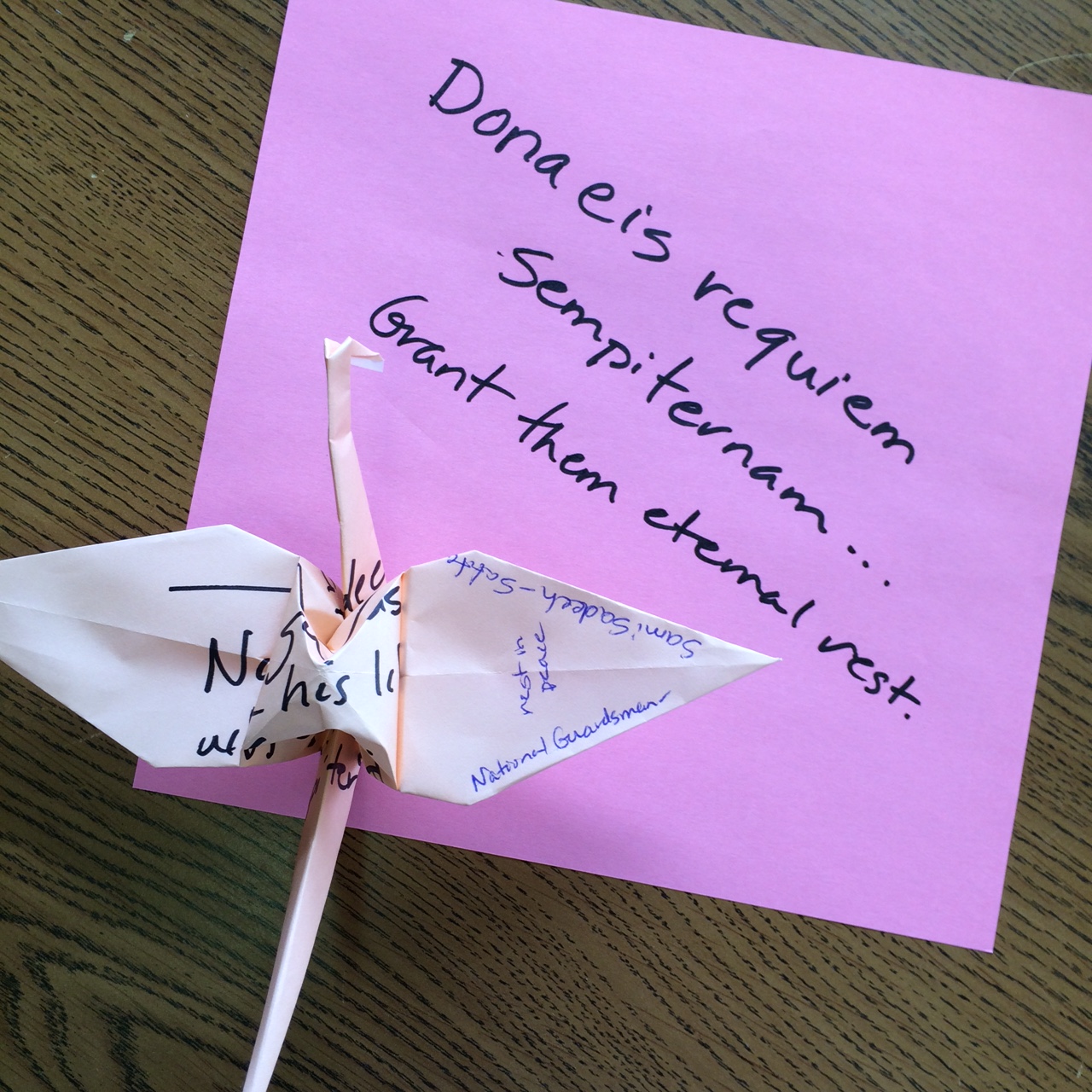
Paper crane Sami SadeehBut my prayer for Sami is different and I wrote it on the 301st paper crane that I folded just today in his memory. It was not dona nobis pacem, for peace has been granted to him. Instead I used the words from that prayer used at a requiem mass, dona eis requiem sempiternam.

Grant him eternal rest.

And I will sing “Blessings” on Sunday in worship, and when I sing the line, protection while we sleep, I will see Sami’s face, and know how that prayer was answered by God through Sami and all the others.

209…one at a time

Paper cranes 209My one thousand paper cranes for peace have been a journey through this month of May. I have made 209 so far.

One at a time.

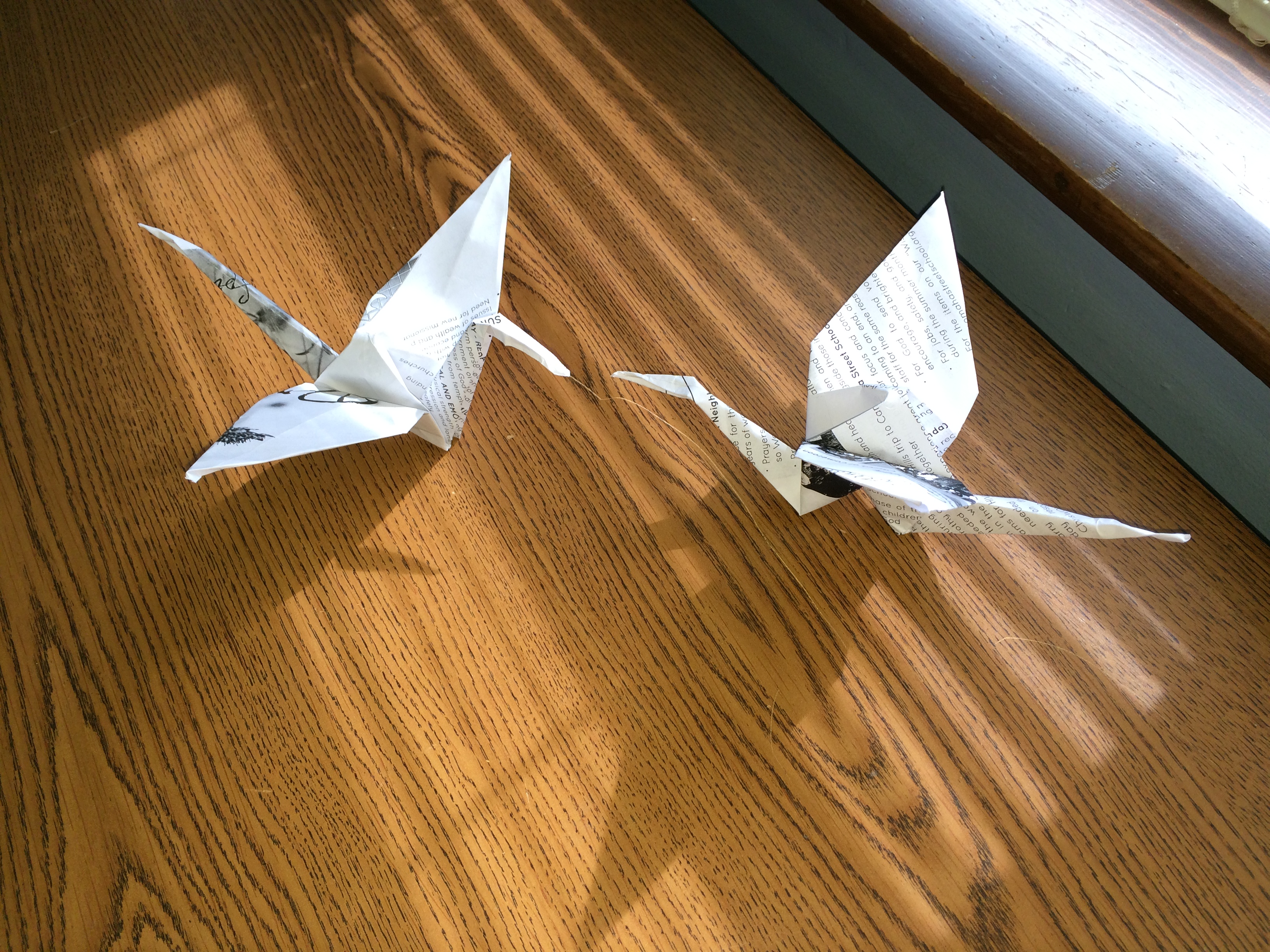
I started with two sheets of prayer-printed pages from my church, West Hills in Omaha. My friend and colleague on staff here, our Mission director Caitlin O’Hare, publishes prayers of our mission partners each quarter. When my friend Mark Borst was here visiting in March, he saw our wall of crosses in the reception area and told me about the paper cranes that carry prayers heavenward in the sanctuary at Central Presbyterian Church in Atlanta.

Connectivity being one of my strengths as measured by the Clifton Strength Finder assessment, I connected the two. All those prayer booklets…what do we do with them every quarter when the new come?

Paper cranes, of course!

After folding three of them with that paper, I decided to order 500 sheets of 8″x8″ origami paper from Amazon. Beautiful colors. Lighter weight. Easier to fold and to be held by a delicate nylon string.

I am now a master folder of paper cranes. Stop by my office and see the 209 flying here and I will fold one for you with the prayer of my heart for this project:

Paper cranes dona nobis pacemDona nobis pacem. Grant us peace.

These first 209 are a reflection of the places I have traveled in the last five years with The Outreach Foundation. They are photographic memories developed onto the pages of my heart of the people who live there, the people who love there, the people who are loved there by an amazing God who made us all. Each one. In his image.

And all these God-imaged people are suffering now, as they have suffered in the past. War is a journey no one should have to take.

But at the end of it should come peace. In the midst of it, they seek peace.

And that is what I pray for.

As I have folded these cranes and prayed over them in the process of folding and stringing and hanging, it has renewed my spirit to know that God hears every one of them.

And as I have continued to watch the news, I have found more to pray for, as if I didn’t have enough already. And some of those stories just emphasize that God hears those prayers. They seem to me to be answers for the peace I pray for.

You can read about Karim Wasfi, a cello player in the orchestra in Baghdad, who plays in the aftermath of a car bombing in his city.

A prayer crane for Karim. Dona nobis pacem.

You can read about Zahed Haftlang and Najad Aboud, two former combatants in the Iraq-Iran war who are now friends as they live in Canada. And on the battlefield one said of the other, “He became a human being, not an enemy.”

A prayer crane for these brothers. Dona nobis pacem.

And there is a prayer crane for Hope Came Down, in the prayer and the hope that people will watch it and be moved to send their monetary gifts to a place that is bringing hope and encouragement to those who are suffering.

A prayer crane for Hope Came Down, and others for the scriptures that inspired it, John 1:14 and Hebrews 11:1.

Dona nobis pacem…prayer by prayer…crane by crane.

One at a time.


Dona nobis pacem

Paper cranes in vitroI have very faint memories of the Roman Catholic mass being said in Latin from when I was very young. I remember mouthing what I thought were actual words, although they meant nothing to me, and thinking that I was an active participant in the mass like my sisters and brothers and parents, next to me in the pew. When I investigate now when the change from Latin to English happened, it began in 1964, right before I turned six. Mostly I just remember mass in English.

So my Latin was non-existent through most of my life, if I had ever even known any!

At Girl Scout camp in 1970, I learned this beautiful song sung as a round. It went like this:

Dona…nobis…pacem, pacem. Dona…nobis…pacem.

I didn’t know it was Latin; I only knew when four groups of girls’ voices sang it in offsetting phrases to make the round, it sounded like angels.

Years later when Jana and I attended one of our annual Lobby Day gatherings with Bread for the World, a wonderful singer named Beth Nielsen Chapman sang the blessing at a large banquet. Fascinated with the song she sang, There’s a Light, when I returned home I bought her CD called simply Hymns. There were great songs from my RC childhood that we sang in church. And there was this:

Dona…nobis…pacem, pacem.

She laid down all the tracks, so the round was recreated with her beautiful voice filling out the angel chorus. As it went straight to my heart and triggered that memory of camp and singing and angel choirs, it made me want to know more.

So all those years later, I finally looked up what those Latin words mean.

Dona nobis pacem…grant us peace.

Grant us peace.

Paper cranesAnd that has been my prayer ever since in the midst of family upheavals and tragedies, in the midst of transitions at church, and of course, in my journeys into the deep waters of a relationship with God in the Middle East.

Dona nobis pacem. Grant us peace.

And as I have delved into this old Latin phrase from my childhood, I have reconnected it to the beginning of that part of the mass:

Agnus Dei, qui tollis peccata mundi, miserere nobis.
Agnus Dei, qui tollis peccata mundi, dona nobis pacem.

Lamb of God, who takes away the sins of the world, have mercy on us.
Lamb of God, who takes away the sins of the world, grant us peace.

Not only does this prayer in an ancient language remind me of the generations of people who prayed it in community before I was conceived and born, but it reminds me to whom I am asking this request. It is a prayer to the Jesus who knows suffering because he experienced it. Because of his great mercy, he redeems us and wipes our slates clean. And we know this, and I know this. And so we come to his feet and ask him: have mercy on us. Grant us peace.

And he can. And he will. And he does.

And I know this because I have seen it in Lebanon and in Syria and in Iraq. I have witnessed those living this suffering even now as they are put upon by forces and evil that would wipe them out.

And they stay. And they pray in ancient languages: in Syriac, in Latin, in Arabic.

Grant us peace.

Dona nobis pacem.

Their prayers take flight and arise heavenward to the Lamb of God who takes away the sins of the world.

And mine join with theirs in this upward trajectory.

Prayers, like birds on the wing, flying to the throne room of the Lamb of God.

Paper cranes Shaheen TomehAnd because the Clifton Strength Finders tells me that one of my top five strengths is connectivity, I have connected my journeys with the faithful of the Middle East to my prayers of peace for them to this visible expression of those prayers in origami cranes.

The legend of the one thousand paper cranes comes from Japan, and is especially poignant when you read of a young girl who was poisoned with radiation from the bombing of Hiroshima. Folding one thousand paper cranes is supposed to bring you luck or a wish granted. She was hoping for healing of her cancer, which didn’t come to her. She was not healed, but maybe one day her wish will be granted in another way: maybe nuclear weapons will be eliminated so the threat of cancers and destruction caused by them will be wiped out. Maybe. Maybe there will be peace.

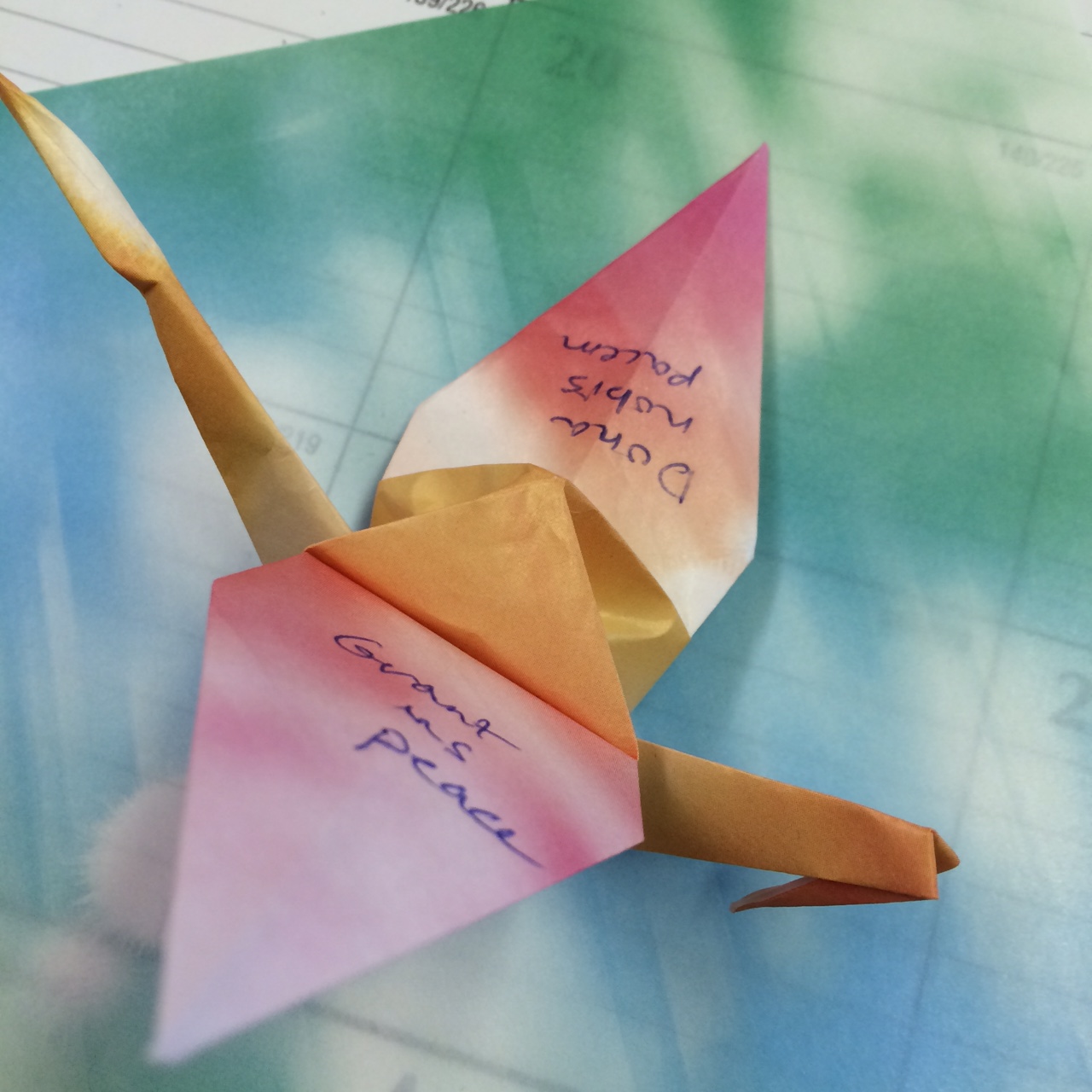
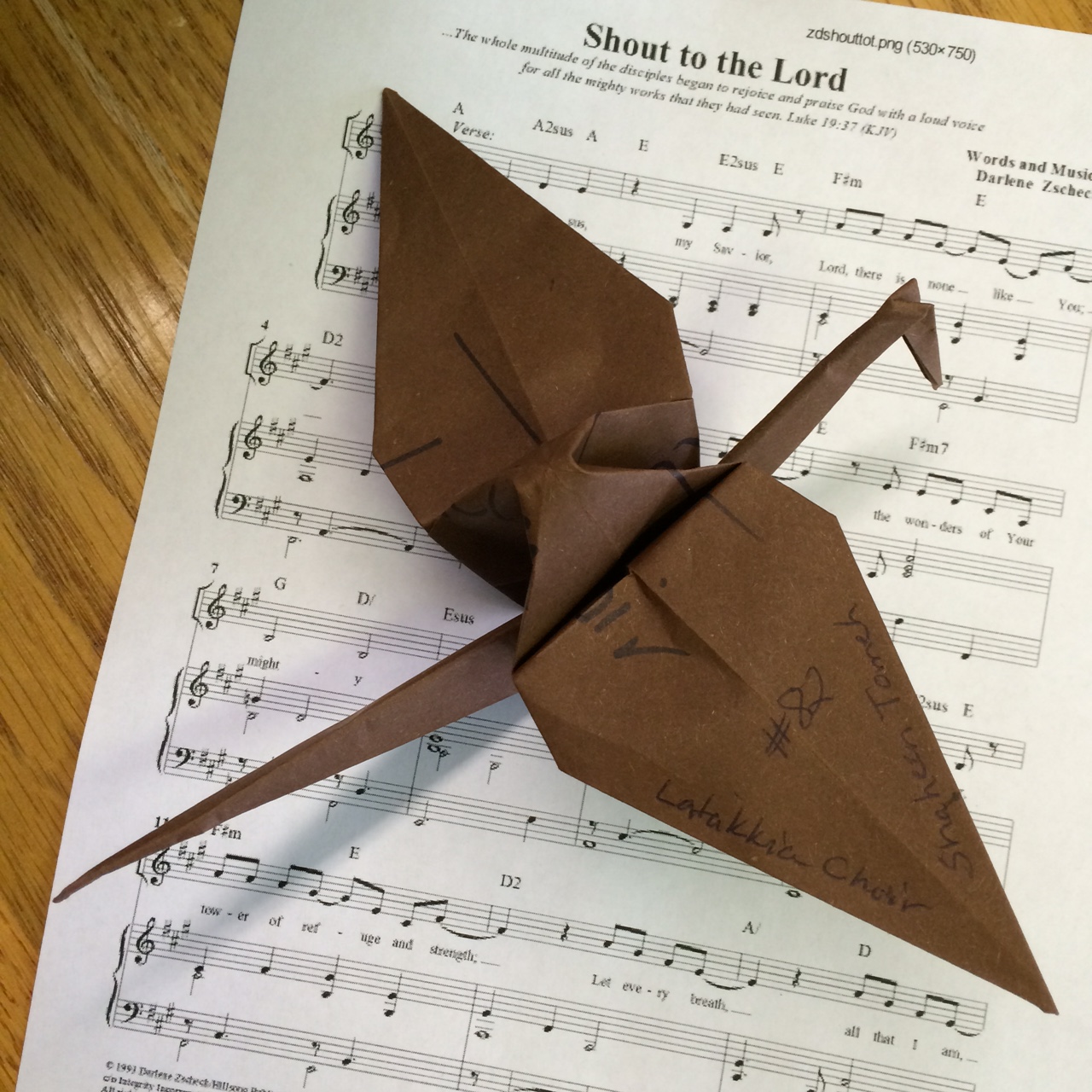
Paper cranes prayers ascendingI have folded 96 so far on my journey to one thousand. On each one is written the name of a person, or a place, or a piece of scripture, or the words of a hymn, or simply the word peace in any language I can find. As I fold each one my simple prayer of peace is attached to each one in the motions of making the crane.

The prayers are repeated and joined as I string them on nylon thread, separated by beads. It reminds me of the act of praying the rosary.

The prayers are repeated again as I hang the strings of cranes in my office near my map of the world – God’s creation – where this peace is so needed.

Every day as I enter my office, I have this visual reminder and expression of those silent prayers. And it gets larger every day with another crane, ten more cranes; another string; five more strings. And one day it will reach one thousand.

My wish – my prayer! – in folding these cranes is simply this:

Dona nobis pacem…grant us peace.

Grant peace to the people of Syria, whose war has dragged on for over four years.

Dona nobis pacem.

Paper cranes Micah 6 8Grant peace to the people of Iraq, whose troubles and war run on unabated since our country’s terrible decision to invade in 2003.

Dona nobis pacem.

Grant peace to the people of Lebanon, a country that becomes a proxy and pawn for the evil ideas of others; a small country that has borne a heavy burden from these other two wars as they are overrun with refugees.

Dona nobis pacem.

Grant peace to the pastors and churches and their congregations who stay and serve and minister in the midst of extremist attacks and destruction and death.

Dona nobis pacem.

Grant peace to those who have lost everything and are searching for new homes.

Dona nobis pacem.

Grant peace to your world, Lamb of God. Let us know your peace which surpasses all understanding.

Agnus Dei, qui tollis peccata mundi, miserere nobis.
Agnus Dei, qui tollis peccata mundi, dona nobis pacem.

Dona nobis pacem.

Amen.