St. Tekla and Elias

The icon of St. Tekla decoupaged on a wood inlaid frame.

The icon of St. Tekla decoupaged on a wood inlaid frame.

I heard the story of St. Tekla (Taqla) while having tea and coffee with my traveling companions in Damascus, Syria, this past January. We had journeyed to Lebanon as partner churches of the National Evangelical Synod of Syria and Lebanon from the U.S., Sweden and Switzerland, to hear how the church is dealing with the war in Syria, now in its fourth year. As part of this encouragement trip, sixteen of us traveled to Damascus on the highway from Beirut. As you can imagine, the journey was a lonely one with very little traffic, most of it going the other way to leave Syria.

When we arrived at the immigration station just outside of Damascus, we were met by the Minister of Protocol for President Assad. We enjoyed dark, sweet Arabic coffee and sweets with him before making our final journey to our hotel in Damascus. It is simply the Middle East hospitality which you find everywhere. Indeed, when we had a meeting with President Assad himself the next day, we were served the best tea in beautiful china cups as we had 72 minutes of question and answer with him, all in regard to the status of the church. But I digress from St. Tekla…

On a walking tour of the Christian quarter of Damascus, we visited the house of Ananias. This is the very same place mentioned in Acts chapter 9, where Saul of Tarsus is baptized and renamed Paul. This Paul would go on to be a great apostle of Jesus, starting churches all over what is now Turkey. Paul himself discipled many, and the story is that young Tekla was one of these students. She professed her faith, and as many in those first centuries were, was persecuted for it. She was marked for death by her family and by the man they wanted her to marry. She escaped, as legend tells it, through a miraculous opening in a mountain into a place now known as Maaloula in Syria. There is a monastery there bearing her name, Mar Taqla, and her remains are said to be entombed there. Considering the value of a woman in those days, it was a wonderful story for this woman of faith to hear. (Maaloula might have been a refuge for St. Tekla in the first century, but it is not a refuge anymore. Just Google Maaloula and you can find stories of what happened there.)

Just like the coffee, tea and sweets at the border and in the president’s office, this story was told over coffee and tea at a table on the street outside the house of Ananias. Some of our cohort had been shopping for local crafts in a small craft store right next to the house of Ananias. Indeed, we had shopped there more than three years earlier on another trip, that one made just months before the Arab Spring and all its aftermath, including the war in Syria.

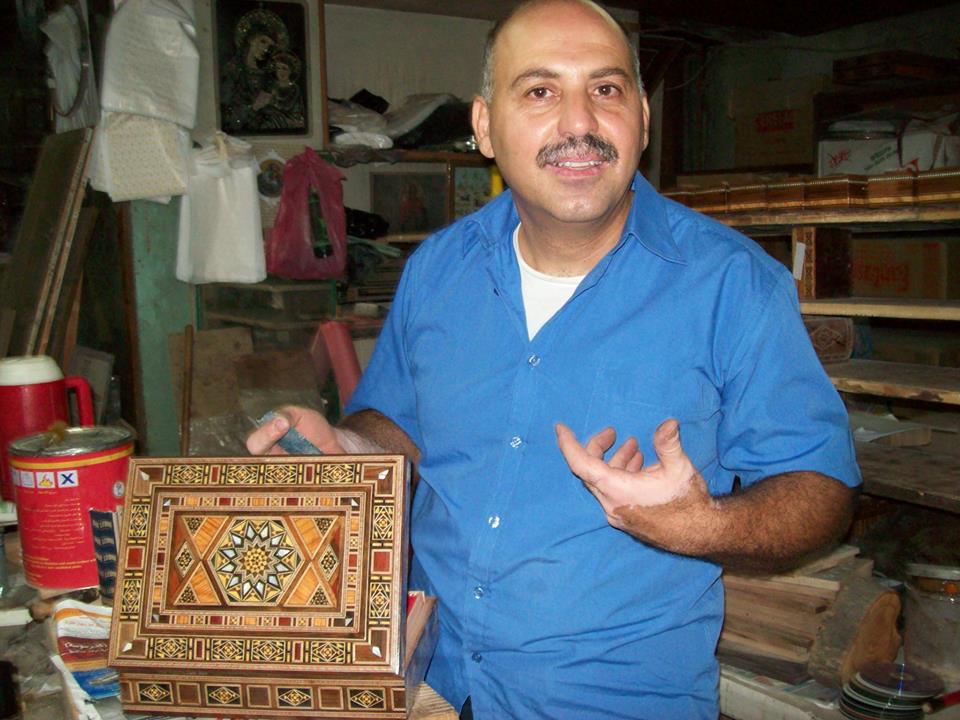
Elias in his then craft shop with the inlaid box he made and I bought for Steve, signed on the bottom by Elias.

Elias in his then craft shop with the inlaid box he made and I bought for Steve, signed on the bottom by Elias.

On that trip we had shopped in that same store, and as it was small, after making our purchases left the store to make room for others. My friend Sue and I walked just across the narrow street to another craft shop and met Elias, who showed us how they make the beautiful wood inlay on boxes and crosses and backgammon sets, souvenirs to bring home from this ancient city. I bought a box for my husband and had Elias sign the bottom. It is a treasured possession!

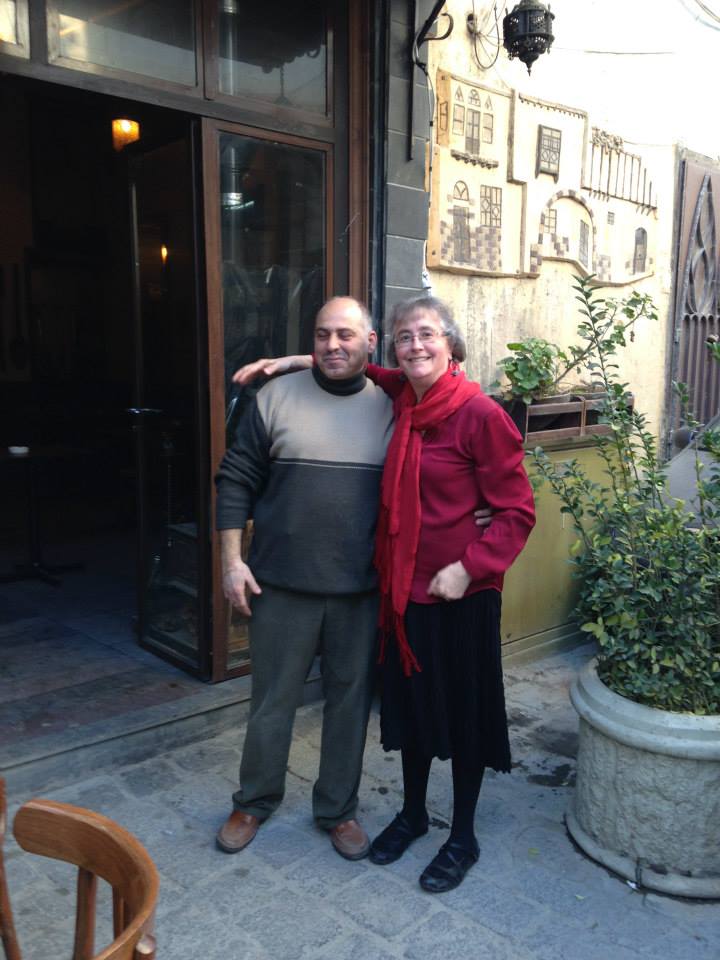
As we were sitting out on the street, enjoying the tea and coffee served by the friendly shopowner, it struck me that he and the shop looked familiar. It was the same shop! Our server was Elias, the woodworker, only now due to the war there are no tourists to buy his wares, just some random Christians from another land sitting at his table while mortars exploded in the distance. His life has been reduced to selling coffee and tea to area residents who wander by. I was so excited to see him again that I jumped up and overwhelmed him with an embrace. His smile spoke volumes and though I don’t speak Arabic and he doesn’t speak English, we both understood the other.
Elias and me on the street outside what is now his coffee shop.

Elias and me on the street outside what is now his coffee shop.

As we continued to sit and enjoy the beverages, Elias went back in the shop and brought out a dusty laminated icon. Yes. It was St. Tekla. That was how I heard her story. I wanted to pay him for it and he refused. It was a gift. Another in the party suggested I could get an authentic icon at an antique shop. But that’s not what I wanted. I had been given this gift by my brother in Christ and therein was its value.

Because of this brother, I learned St. Tekla’s story. And now you know his story. And his name…Elias.

Weeding

Yesterday I posted on Facebook that weeding isn’t for sissies. That comment was provoked by spending parts of Saturday and Sunday afternoons out pulling weeds. Did I mention that it was hot and humid? Well it was. Temps were in the upper 80s and 90s and the humidity seemed to match. They were the kind of days when you could take a shower and feel clean and refreshed and then step outside and feel like you had caught yourself in an early episode of dementia. “Wow! I think I should have showered before starting out today…”

So weeding isn’t for sissies. You have to stick with it to make some progress and you are going to get dirty and sweaty and mosquitoes will bite you. That’s the chore you just signed up for. Mosquitoes alone will keep the delicate from venturing forth. It bears repeating: it’s not for sissies.

I have a lot of flowerbeds that I joyfully look forward to working in every spring and summer. I love the parade of blossoms as each plant in turn puts on its show. “Look at me!” shout my tree peonies. “No! Over here!” tempt the columbine. Astilbe, aster, brunnera, caryopteris, cranesbill, hemerocallis, lavender, monarda, plumeria…each in its own season. And they are under constant attack from a stealthier foe: Weeds are much quieter, not wanting the attention until they have amassed such an army that total domination seems at hand. Funny thing is, many of them have lovely flowers as well, usually in shades of purple. The blossoms on the dreaded creeping charlie actually complement the orange and peach hues of the daylilies. And yet they must be pulled to advance the growth of the good flowers.

It’s not just for my good pleasure that I weed on days that keep the sissies inside. My neighbors also take care of their flowerbeds and those sweet flowers on the other side of the fence between us were being advanced upon by that same creeping charlie. Something had to be done and so I did it. Some days being a good neighbor isn’t for sissies either.

Mother

I work with some really wonderful people at the church where I am on staff. This week has been a particularly difficult one for some of them. One of them experienced the loss of her mother just yesterday after a battle with cancer that lasted over a year. The end came quietly in her home, with one of her daughters by her side.

Another one of these amazing people is sitting at the side of her mother-in-law, also soon to take her last labored breath after a bone marrow transplant of less than a year ago fails in her body. Her whole family – husband, children, grandchildren, siblings – are at her side, singing hymns, praying, sharing smiles and stories, even as she takes one breath, and then another, that will be her last on this earth.

Still one more of these co-workers of mine just became a grandmother for the seventh time, her own daughter’s giving birth having been a dramatic change from previous births. This grandmother of seven is now preparing for the death of her own mother as her aging body and mind, now clouded by dementia, slows to a stop.

Three women having lost or preparing to lose a mother, all showing me a picture of holding on and letting go in very different ways. All showing the amazing grace that defines motherhood.

My own mother died when I was seven, leaving behind seven children. My memories of her are scarce but precious: A smile, the gentle pumping of a treadle sewing machine, the long phone cord stretched across the room as she talked on the old kitchen wallmount while continuing to wash dishes or prepare meals for the army she and dad had brought into the world.

All these women experienced the joys and sorrows of being mothers and left their imprint on their children.

I, myself, am not a mother. I came to the place of marriage at 43, too old to have children and not wanting to experience that journey. Maybe just too selfish to put so much of myself into caring for or worrying about another life in need of so much.

In offering prayers for these special women yesterday I found these words of Julian of Norwich: “As truly as God is our Father, so truly is God our Mother.” And so when I pray at night, I will remember that not only do I pray to God my father, but to God my mother. And I will take comfort in that. And the faces that come to my mind as I pray will be of these amazingly grace-filled women who have shown me a new face of God.